Table of contents
By-Research Team
May 15, 2026 | 6 min read | DPDP
Impact of DPDP Act on Indian Business
The DPDP impact on business is no longer limited to privacy policies or legal documentation. The Digital Personal Data Protection framework is changing how Indian businesses collect, store, process, and manage personal data across daily operations.
From startups and e-commerce brands to hospitals, banks, HR teams, and SaaS companies, organizations now need stronger consent systems, better data governance, and clearer accountability structures.
Businesses that ignore these changes may face operational disruption, customer distrust, and regulatory scrutiny in the coming years.
What Is the DPDP Act?
The DPDP Act is India’s digital privacy law that regulates how organizations collect and process personal data. It gives individuals greater control over their data while placing compliance obligations on businesses handling digital personal information.
If your business collects customer details, employee records, payment information, or app usage data digitally, the law is likely relevant to your operations.
Which Businesses Need to Comply with the DPDP Act?
Almost every Indian business handling digital personal data may need to comply with the DPDP Act. The law applies across industries because most modern organizations process customer, employee, or user information in some form.
Many founders still assume:
“We are not a tech company, so this law may not apply to us.”
That assumption rarely survives a proper data audit.
If your business collects names, phone numbers, email addresses, payment details, employee records, KYC documents, or app usage information digitally, the DPDP framework likely affects your operations.
Some industries will face higher compliance pressure because of the volume and sensitivity of the data they process.
-
BFSI & Fintech
Banks, NBFCs, insurance companies, and fintech platforms process highly sensitive financial information daily. Stronger consent systems, breach reporting, and cybersecurity controls will become critical operational requirements.
-
Healthcare
Hospitals, clinics, diagnostics platforms, and health-tech companies handle sensitive patient information. Poor data handling in healthcare quickly becomes both a privacy issue and a trust issue.
-
E-Commerce & Retail
Online businesses collect behavioural data, addresses, payment details, and customer preferences at scale. Businesses in this sector will need better retention policies and consent management practices.
-
HR & Recruitment Platforms
Employee databases often contain salary details, identity documents, and background verification records. Companies can no longer treat employee data protection as a secondary HR formality.
-
SaaS & Technology Companies
Many SaaS businesses process customer data on behalf of other organizations. This creates layered accountability involving vendors, APIs, cloud providers, and third-party processors.
-
Education Platforms
Ed-tech companies and educational institutions often process student information, parent details, and payment records digitally. Data governance expectations in this sector are likely to increase significantly.
How the DPDP Act Will Affect Indian Businesses
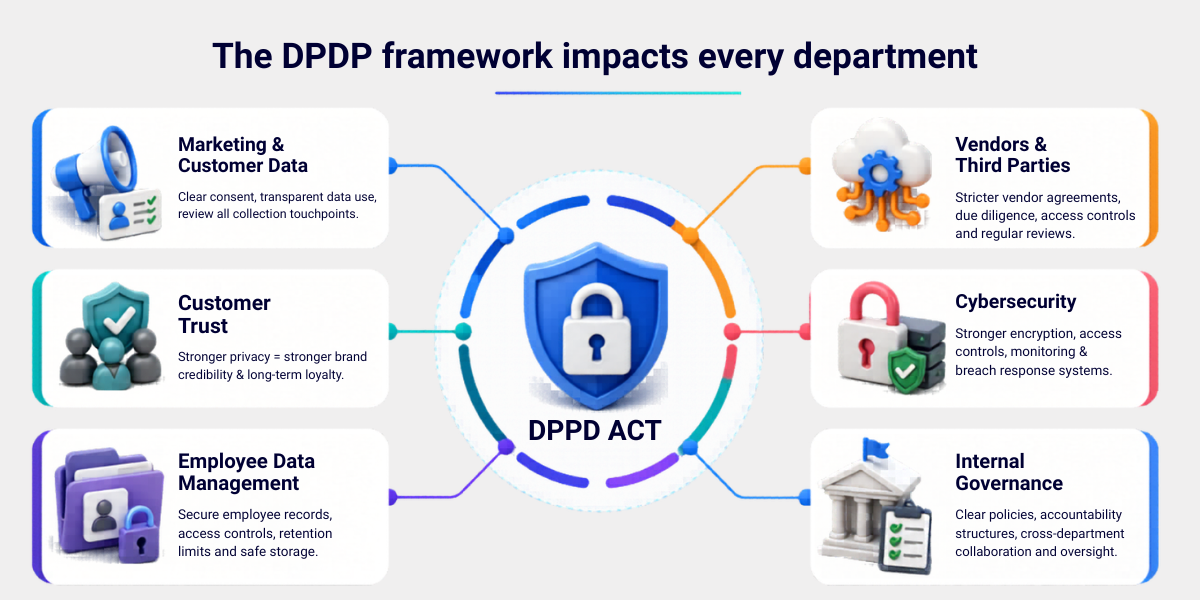
The DPDP Act affects much more than privacy policies or customer data collection. It changes how businesses manage marketing, employee information, cybersecurity, vendors, and internal operations.
Many organizations still see data privacy as only a legal or IT issue. In reality, the DPDP framework affects multiple departments and daily business processes.
Companies may now need stronger systems for accountability, transparency, and responsible data handling.
The impact is not limited to one team. It spreads across the entire business.
- Impact on Marketing & Customer Data
For years, many businesses followed a simple approach: collect as much data as possible and organize it later.
The DPDP framework is changing how businesses collect and use customer data for marketing and engagement activities. Companies can no longer rely on unclear consent processes or collect excessive user data without increasing compliance risk.
Marketing teams may now need to review website forms, lead generation campaigns, WhatsApp communication, email marketing systems, and onboarding journeys to ensure users clearly understand how their data is being used.
- Impact on Customer Trust
Customer trust is increasingly linked with data protection practices.
When businesses fail to protect personal data, the damage often goes beyond regulatory issues. Customers may start viewing weak privacy practices as a sign of poor governance and weak operational systems.
This is especially important for industries like fintech, healthcare, SaaS, and e-commerce, where businesses handle large volumes of sensitive customer information every day.
- Impact on Employee Data Management
The DPDP Act also affects how organizations manage employee information internally.
HR teams regularly handle salary records, identity documents, bank details, attendance systems, health records, and background verification data. In many companies, this information is still spread across spreadsheets, shared folders, and multiple third-party systems.
Under the DPDP framework, employee data protection is no longer just an HR responsibility. Businesses may now need stronger controls around who can access employee information, how long it is stored, and how securely it is managed.
- Impact on Vendors & Third Parties
Modern businesses depend heavily on vendors for cloud storage, payroll, analytics, outsourcing, customer support, and marketing automation.
As personal data moves through these external systems, vendor management becomes an important compliance concern. Businesses may now need stricter vendor agreements, stronger due diligence processes, tighter access controls, and regular compliance reviews.
- Impact on Cybersecurity
The DPDP framework is also increasing pressure on businesses to strengthen cybersecurity systems.
Privacy compliance now depends heavily on technical safeguards like encryption, access controls, authentication systems, endpoint monitoring, and breach detection mechanisms. Businesses that previously treated cybersecurity as only an IT expense may now need to view it as part of core business infrastructure.
- Impact on Internal Governance
The DPDP Act is gradually pushing privacy governance into leadership-level discussions.
Businesses may now need clearer internal policies, accountability systems, escalation workflows, and data handling procedures across departments. This affects legal teams, HR, operations, marketing, compliance, and senior management together.
Leadership teams increasingly need visibility into how data is collected, stored, shared, and protected across the organization.
Privacy is no longer only about avoiding penalties. It is becoming part of long-term business discipline.
Conclusion
The real DPDP impact on business is operational.
The law is changing how Indian businesses manage customer trust, employee information, vendor relationships, and digital systems. Organizations can no longer afford fragmented data practices or informal governance structures.
The DPDP framework is not asking businesses to stop using data.
It is asking them to use data responsibly.
And in the coming years, responsible data governance will increasingly become a basic expectation for doing business in India.
Key Takeaways
- The DPDP Act is changing how Indian businesses collect, manage, and protect personal data across operations.
- Almost every business handling digital customer or employee data may need to comply with the DPDP framework.
- Industries like fintech, healthcare, e-commerce, SaaS, and HR face higher compliance pressure due to sensitive data handling.
- The DPDP framework is reshaping marketing practices, customer trust, employee data management, and vendor relationships.
- Businesses may need stronger cybersecurity systems, internal policies, and accountability structures to manage privacy risks effectively.
- Responsible data governance is gradually becoming a core business expectation in India’s digital economy.
Related Blog