Table of contents
By-Research Team
March 24, 2026 | 8 min read | DPDP
Significant Data Fiduciary under the DPDP Act
Organizations today process unprecedented volumes of personal data. Banks, fintech platforms, health-tech companies, and large digital platforms manage millions of user records daily.
Yet many organizations still ask a critical compliance question: When does a Data Fiduciary become a Significant Data Fiduciary under the DPDP Act?
The answer matters.
Being classified as a Significant Data Fiduciary (SDF) fundamentally changes an organization’s compliance obligations under the DPDP Act. Additional governance layers, audit mechanisms, and accountability structures become mandatory.
Think of it this way:
A normal Data Fiduciary builds a privacy shield.
A Significant Data Fiduciary must build a regulatory fortress.
This article provides a practical blueprint to understand:
- What a Significant Data Fiduciary is
- How an organization is classified as an SDF
- The additional duties of SDFs under the DPDP Act
- Why this classification matters for DPDP compliance
Who is a Significant Data Fiduciary under the DPDP Act?
A Significant Data Fiduciary is a Data Fiduciary designated by the Central Government under the DPDP Act based on factors such as the volume and sensitivity of personal data processed, risks to Data Principals, and potential impact on national interests. Once designated, the entity must comply with enhanced governance, audit, and accountability obligations.
In simple terms, the DPDP Act recognizes that some organizations create higher privacy risks than others.
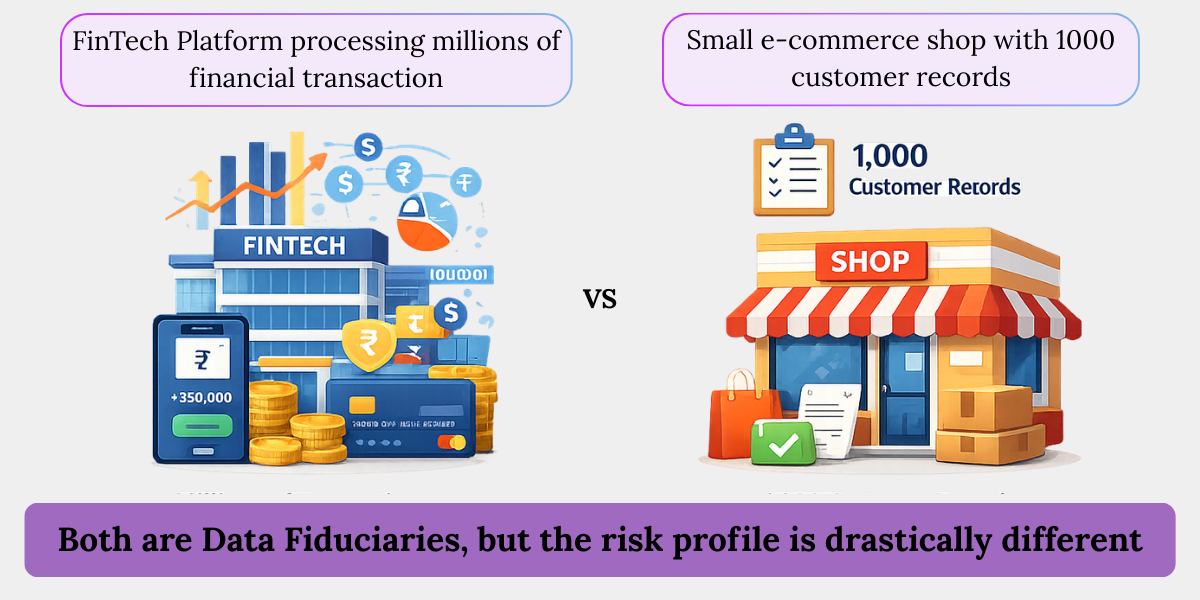
For example:
- A small e-commerce store processing a few thousand customer records
- A fintech platform processing millions of financial transactions
Both are Data Fiduciaries, but the risk profile is drastically different.
The law responds to this risk imbalance by introducing the concept of Significant Data Fiduciaries (SDFs) — organizations whose data processing activities require stricter regulatory oversight.
Key point: Every SDF is a Data Fiduciary, but not every Data Fiduciary becomes a Significant Data Fiduciary.
Who Can be Classified as a Significant Data Fiduciary?
A Data Fiduciary may be classified as a Significant Data Fiduciary when its data processing activities create substantial risk to individuals or society, particularly due to the scale, sensitivity, or strategic importance of the data being processed.
The designation is not automatic. It is made through notification by the Central Government.
In practice, organizations that are most likely to be classified as SDFs include those that:
- Process large volumes of personal data
- Handle sensitive personal information
- Operate digital platforms with millions of users
- Manage financial, health, or identity data
Why does this matter?
Because large-scale data processing amplifies privacy risks.
One data breach in a small system affects hundreds.
One breach in a large digital platform could affect millions of Data Principals.
That is precisely why the DPDP Act introduces stricter compliance requirements for Significant Data Fiduciaries.
Factors Used to Designate a Significant Data Fiduciary
Under the DPDP Act, the government considers several factors before classifying an entity as a Significant Data Fiduciary. These factors are designed to evaluate the risk posed by the organisation’s data processing activities.
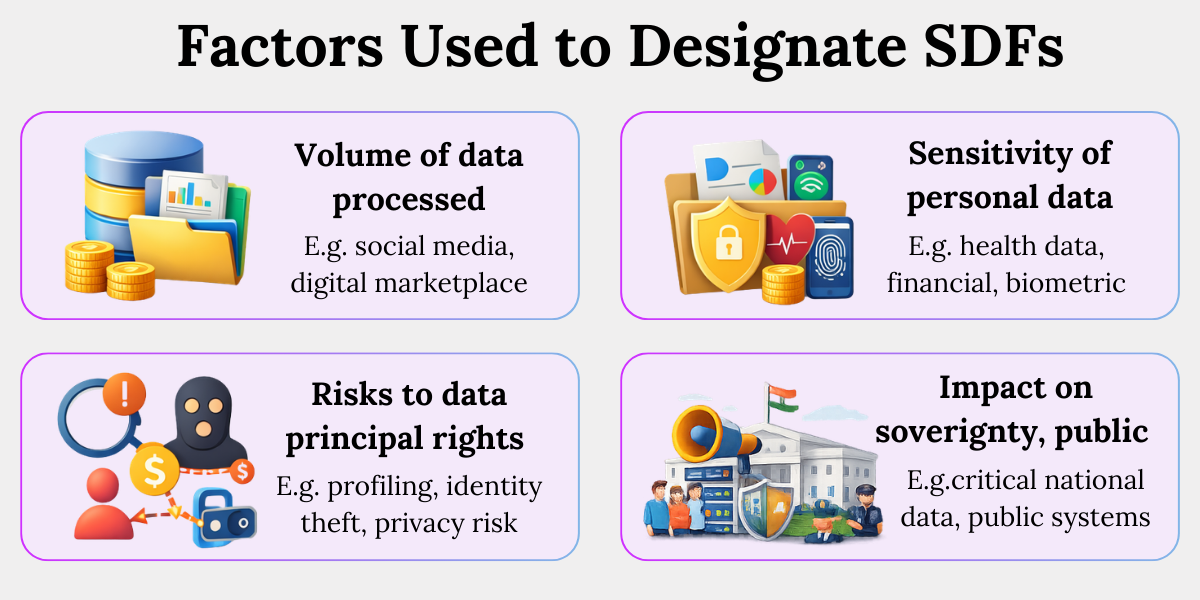
The key factors include:
1. Volume of Personal Data Processed
Organizations processing large volumes of personal data are more likely to be designated as SDFs.
Why?
Because scale increases risk. A single security failure could impact millions of Data Principals.
For example:
- Large social media platforms
- Digital marketplaces
- Telecom providers
These systems operate on massive datasets, making governance and accountability essential.
2. Sensitivity of Personal Data
The nature of the data being processed also plays a major role.
Certain categories of data create higher privacy risks, such as:
- Financial information
- Health records
- Biometric data
- Identity documents
Organizations handling such datasets may attract greater regulatory scrutiny under the DPDP Act.
3. Risk to the Rights of Data Principals
Another important consideration is the potential harm to individuals if the data is misused or breached.
For instance:
- Unauthorized profiling
- Identity theft
- Financial fraud
- Privacy violations
When an organisation’s data processing activities pose significant risks to Data Principals, the government may designate it as an SDF.
4. Impact on Sovereignty, Security, or Public Order
Certain digital platforms have systemic importance.
For example:
- Platforms influencing public discourse
- Infrastructure managing critical national data
- Systems affecting public safety
In such cases, data governance becomes a matter of national interest, not just corporate compliance.
What Additional Obligations Do Significant Data Fiduciaries Have?
Once an organisation is designated as a Significant Data Fiduciary, it must comply with additional obligations beyond standard Data Fiduciary responsibilities. These obligations aim to strengthen accountability, transparency, and risk management.
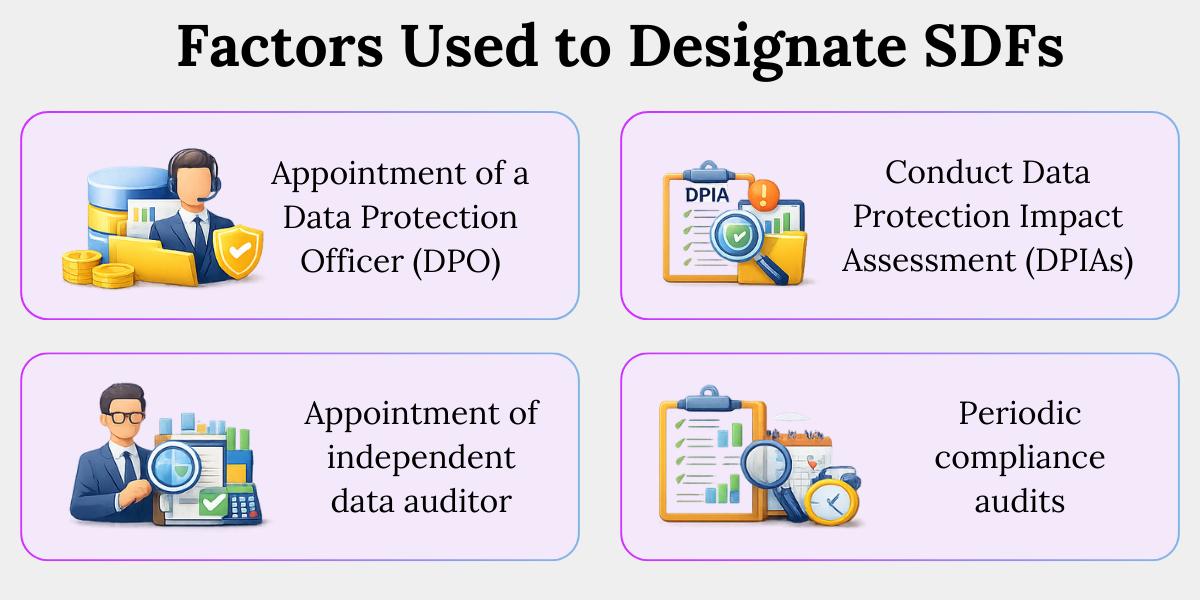
The key additional duties of SDFs include:
1. Appointment of a Data Protection Officer (DPO)
Significant Data Fiduciaries must appoint a Data Protection Officer responsible for overseeing DPDP compliance.
The DPO acts as:
- A point of contact for Data Principals
- A compliance leader within the organisation
- A liaison with regulatory authorities
In practice, the DPO helps build the internal governance architecture required for large-scale data processing.
2. Conducting Data Protection Impact Assessments
SDFs must conduct Data Protection Impact Assessments (DPIAs) to evaluate the risks associated with data processing activities.
A DPIA helps organizations:
- Identify privacy risks early
- Evaluate security safeguards
- Implement mitigation strategies
Think of it as a risk radar for privacy compliance.
3. Appointment of an Independent Data Auditor
The DPDP Act also requires Significant Data Fiduciaries to appoint an independent data auditor.
The role of the auditor is to:
- Evaluate compliance practices
- Review privacy controls
- Assess governance structures
This introduces external oversight into the organization’s privacy framework.
4. Periodic Compliance Audits
Significant Data Fiduciaries must conduct periodic audits to ensure ongoing compliance with data protection obligations.
These audits typically examine:
- Data governance policies
- Security measures
- Consent management processes
- Data lifecycle management
In our observation, organizations that embed privacy audits into operational governance are far better prepared for regulatory scrutiny.
Difference Between Data Fiduciary and Significant Data Fiduciary
A Data Fiduciary and a Significant Data Fiduciary both process personal data under the DPDP Act, but SDFs are subject to stricter compliance requirements due to the scale and risk of their processing activities.
The difference can be understood clearly:
| Aspect | Data Fiduciary | Significant Data Fiduciary |
|---|---|---|
| Regulatory classification | Default category | Designated by Government |
| Data processing scale | Small to moderate | Large-scale processing |
| Compliance obligations | Standard DPDP duties | Additional governance duties |
| Audit requirements | Limited | Mandatory audits |
| Governance requirements | Basic compliance | Enhanced privacy governance |
In other words:
All organizations handling personal data must comply with the DPDP Act. But SDFs operate under heightened regulatory scrutiny.
Which Organizations May Become Significant Data Fiduciaries?
Although the Central Government makes the final designation, certain sectors are more likely to fall under the Significant Data Fiduciary classification due to their scale and data sensitivity.
Common examples include:
- Large social media platforms managing millions of users
- Banks and fintech companies processing financial data
- Health technology platforms managing medical records
- Large e-commerce marketplaces handling extensive customer datasets
- Telecommunication companies managing communication metadata
These sectors typically process large volumes of personal data and operate digital systems critical to daily life.
Why the SDF Classification Matters for DPDP Compliance
The classification of an organisation as a Significant Data Fiduciary fundamentally changes its compliance responsibilities under the DPDP Act.
Organizations designated as SDFs must build stronger governance frameworks, conduct audits, and implement proactive risk assessments.
Why is this important?
Because data governance failures at large organisations can create systemic risks.
A breach in a small company is problematic.
A breach in a platform with 100 million users becomes a national privacy incident.
That is why the DPDP Act introduces stricter oversight for Significant Data Fiduciaries.
Conclusion
The Significant Data Fiduciary framework under the DPDP Act reflects a risk-based approach to data protection. Instead of imposing identical obligations on every organization, the law recognizes that large-scale data processing demands stronger oversight.
For organizations processing large datasets, the message is clear:
DPDP compliance is no longer just a legal requirement — it is an operational responsibility.
Building the right governance structure today can help organizations avoid regulatory risk, protect Data Principals, and build long-term trust in the digital economy.
Key Takeaways
- A Significant Data Fiduciary (SDF) is a Data Fiduciary designated by the Central Government under the DPDP Act based on the scale and risk of its data processing.
- The DPDP Act recognizes that organizations processing large or sensitive personal data create higher privacy risks and require stricter oversight.
- Not all Data Fiduciaries are SDFs; the designation is made by the government based on risk factors.
- Key designation factors include volume of data processed, sensitivity of data, risk to Data Principals, and impact on national interests.
- Once classified as an SDF, organizations must comply with additional governance and compliance obligations.
- These obligations include appointing a DPO, conducting DPIAs, appointing a data auditor, and performing periodic audits.
- Large digital platforms and data-heavy sectors are more likely to be designated as Significant Data Fiduciaries.