Table of contents
By-Research Team
March 27, 2026 | 10 min read | DPDP
How to Write a Privacy Notice in 2026: DPDP Guide
Most organizations don’t fail compliance because they ignore the law. They fail because they treat the privacy notice like a formality instead of a defence system.
Under the DPDP Act 2023, your privacy notice is the document regulators and users will examine before anything else. A vague or incomplete notice doesn’t just confuse users; it signals non-compliance risk.
So, what’s the fix?
Build your privacy notice like a blueprint—structured, precise, and legally aligned.
What Is a Privacy Notice Under the DPDP Act 2023?
A privacy notice is a legally required document under the DPDP Act 2023 that explains how a data fiduciary collects, uses, stores, and shares personal data of a data principal, along with outlining their data principal rights and consent mechanisms for DPDP compliance.
Think of it as your frontline compliance interface. It translates legal obligations into user-facing clarity.
Why Is a Privacy Notice Critical for DPDP Compliance?
A privacy notice is essential for DPDP compliance because it enables lawful data processing through informed consent, establishes accountability for the data fiduciary, and ensures enforcement of data principal rights under the DPDP Act 2023. Without a valid privacy notice, data processing may be considered non-compliant and legally invalid.
Let’s be blunt.
No valid notice = no valid consent.
No valid consent = compliance failure.
In our observation, most organizations:
- Copy generic templates
- Ignore India-specific requirements
- Miss key disclosures like grievance mechanisms
This is where enforcement begins. And it’s where penalties follow.
How to Write a Privacy Notice?
A DPDP-compliant privacy notice must clearly define the purpose of data collection, obtain valid consent, outline data principal rights, and disclose data fiduciary details and grievance mechanisms as required under the DPDP Act 2023. It should be structured, transparent, and easy to understand to ensure effective DPDP compliance.
Let’s build this like a compliance fortress.
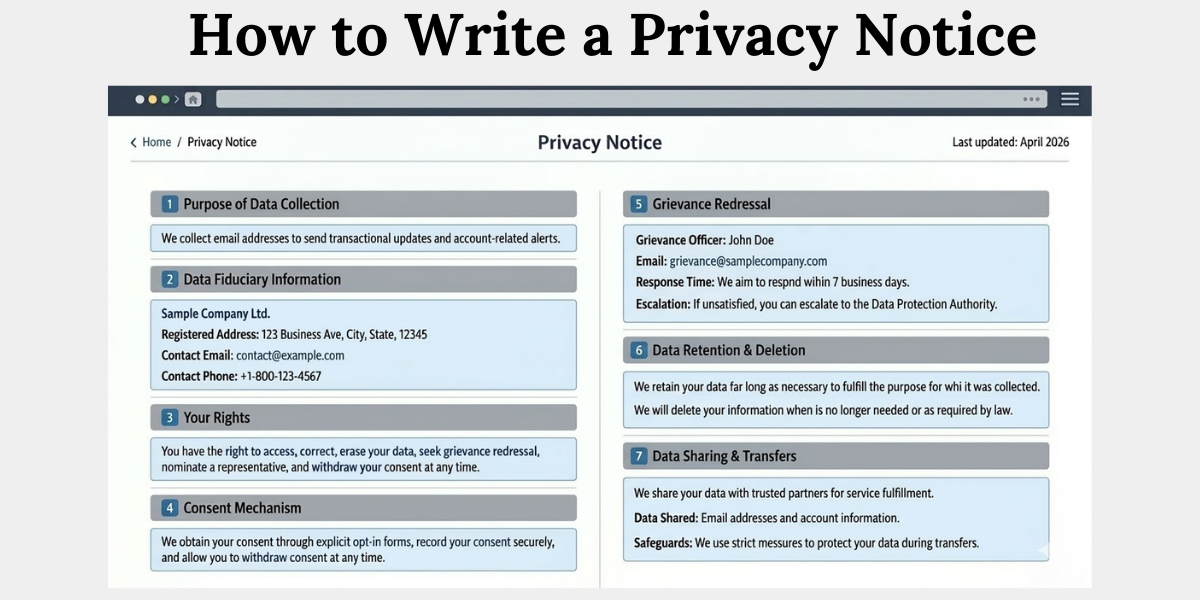
1. Define the Purpose of Data Collection
State why you are collecting data—clearly, specifically, and without ambiguity.
Don’t say: “We collect data to improve services.”
Say: “We collect email addresses to send transactional updates and account-related alerts.”
Why this matters:
The DPDP Act 2023 mandates purpose limitation, meaning a data fiduciary can only process data for the purpose stated in the privacy notice, ensuring valid consent.
This prevents misuse and function creep. If actual use differs from disclosure, it can lead to invalid consent and non-compliance.
In practice:
If your app collects location data but your notice doesn’t mention it, you’ve already breached compliance.
2. Identify the Data Fiduciary
Clearly disclose who controls the data.
This includes:
- Legal entity name
- Registered address
- Contact details
- Grievance officer details
- Contact method for rights requests
- Business identity
Think of this as putting a name on the shield.
Without identification, accountability collapses.
Why this matters:
The DPDP Act 2023 requires clear identification of the data fiduciary to ensure accountability and enable data principals to exercise their rights.
This ensures a traceable responsible entity. Without it, users cannot raise grievances, leading to compliance gaps and regulatory risk.
Regulatory insight:
Transparency around the data fiduciary is a baseline requirement under DPDP Rules.
3. Explain Data Principal Rights
List and explain all data principal rights under the DPDP Act.
These include:
1. Right to Access Information
The data principal can request details about what personal data is being processed, including purpose, categories, and sharing with third parties.
2. Right to Correction and Erasure
Users can correct inaccurate data or request deletion of personal data that is no longer necessary for the stated purpose.
3. Right to Grievance Redressal
The data principal can raise complaints with the data fiduciary and expect resolution within defined timelines under DPDP compliance practices.
4. Right to Nominate
Individuals can nominate another person to exercise their rights in case of death or incapacity.
5. Right to Withdraw Consent
The data principal can withdraw previously given consent at any time, and the process must be as easy as giving consent under the DPDP Act 2023.
Why this matters:
The DPDP Act 2023 requires clear communication of data principal rights in the privacy notice to ensure meaningful consent and user control.
This ensures transparency and accountability. If rights are unclear, it can lead to invalid consent and compliance risk.
4. Detail Consent Mechanisms
Consent refers to a data principal’s free, specific, informed, and unambiguous agreement to the processing of their personal data.
Explain how consent is obtained, recorded, and withdrawn.
Under DPDP:
- Consent must be free, specific, informed, and unambiguous
- Withdrawal must be as easy as giving consent
Why this matters:
The DPDP Act 2023 makes consent the primary basis for processing, requiring it to be informed, specific, and easy to withdraw.
This ensures user control. If consent is unclear or difficult to withdraw, it can lead to invalid consent and compliance risk.
Reality check:
If users need 5 clicks to withdraw consent, your system is broken.
5. Include Grievance Redressal Mechanism
The DPDP Act 2023 provides a grievance redressal mechanism to every data principal, and a data fiduciary must clearly communicate this in the privacy notice to ensure awareness and accessibility of rights.
Provide a clear, accessible complaint mechanism.
Include:
1. Grievance Officer Details
Clearly identify the designated Grievance Officer with name/designation, email ID, and contact channel. This ensures a traceable point of accountability for handling complaints and data principal rights requests under the DPDP Act 2023.
2. Response Timelines
Specify the timeframe within which complaints will be acknowledged and resolved. While the DPDP Act 2023 requires timely grievance resolution, it does not prescribe a strict universal timeline—however, best practice (aligned with global standards) is:
- Acknowledgement within 24–48 hours
- Resolution within 15–30 days
This demonstrates proactive DPDP compliance and reduces regulatory risk.
3. Escalation Process
Define a clear escalation path if the grievance is not resolved satisfactorily. A typical structure includes:
- Level 1: Grievance Officer
- Level 2: Senior compliance/legal team
- Level 3: Escalation to regulatory authority (e.g., Data Protection Board under DPDP)
Why this matters:
The DPDP Act 2023 requires a clear grievance redressal mechanism in the privacy notice to enable users to exercise their rights.
This ensures accountability. Without it, complaints may go unresolved, leading to regulatory risk and loss of trust.
In practice:
This ensures that a data principal is not stuck in a dead-end loop and has a structured path to enforce their rights.
6. Specify Data Retention and Deletion
Data retention refers to how long a data fiduciary stores personal data, while data deletion means permanently removing data once it is no longer required for the stated purpose.
Tell users how long their data is stored and when it will be deleted.
Under the DPDP Act 2023, data must not be retained longer than necessary for the specified purpose. However, certain data may need to be retained for mandatory legal or regulatory requirements (e.g., tax, financial, or audit laws).
In addition, organizations can define their own internal retention timelines based on business needs, provided they are reasonable, purpose-linked, and clearly disclosed in the privacy notice.
Avoid vague phrases like “as long as necessary.”
Be specific: “We retain account data for 24 months post account closure.”
Why this matters:
The DPDP Act 2023 enforces storage limitation, requiring data to be retained only as long as necessary and then deleted.
This reduces risks like breaches and misuse. If data is retained unnecessarily, it can lead to non-compliance and increased liability.
7. Disclose Data Sharing and Transfers
Clearly explain if and, how, and where personal data is shared or transferred, including with third parties and across borders, as part of the privacy notice under the DPDP Act 2023.
If personal data is shared with third-party processors, vendors, or partners, you must disclose:
- The purpose of sharing
- The type of data shared
- The categories of recipients
If data is transferred outside India, clearly state:
- That cross-border transfer occurs
- The purpose and safeguards in place (if applicable under DPDP Rules)
Why this matters:
The DPDP Act 2023 requires transparency in data sharing and transfers to ensure informed consent through the privacy notice.
This prevents undisclosed data flows. If not disclosed, it can lead to invalid consent and compliance risk.
In practice:
Even if data sharing is limited (e.g., payment gateways, cloud providers), it must be disclosed to ensure transparency and maintain valid consent.
What Should a DPDP-Compliant Privacy Policy Include?
A DPDP-compliant privacy policy must include purpose limitation, consent framework, data principal rights, fiduciary details, grievance mechanisms, and data lifecycle disclosures to meet statutory transparency obligations.
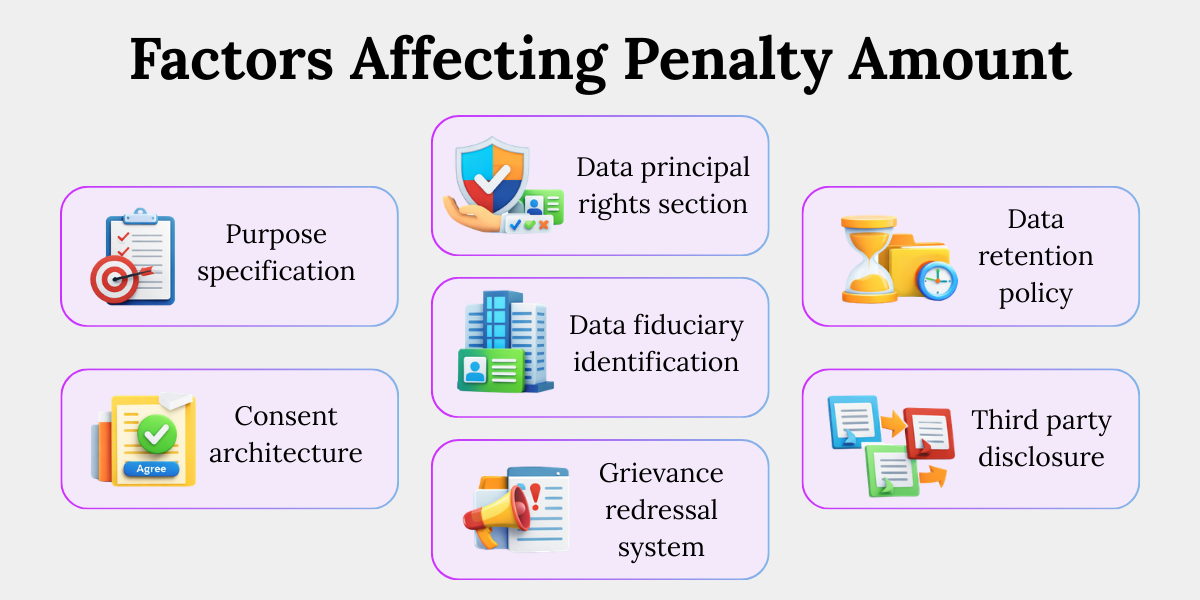
Core Elements of a Privacy Notice
1. Purpose Specification
Clearly define each specific use of personal data, so users understand exactly why their information is being collected. Avoid vague intent and ensure every purpose is tied to a clear business function.
2. Consent Architecture
Outline how users provide consent and how they can withdraw it without friction. The process should be transparent, user-friendly, and built into your product or platform journey.
3. Data Principal Rights Section
Explain what rights users have and provide clear instructions on how they can exercise them. Make it actionable by linking rights to actual request methods or contact points.
4. Data Fiduciary Identification
Provide complete and accurate details of the organization responsible for data handling. This helps users know who is accountable and where to direct queries or concerns.
5. Grievance Redressal System
Clearly describe how users can raise complaints and what they can expect after submission. Include response expectations and ensure the process is easy to follow.
6. Data Retention Policy
Specify how long different types of data are stored and what triggers deletion. This helps users understand the lifecycle of their data within your systems.
7. Third-Party Disclosures
Identify categories of external partners who may process or access data. This builds transparency around your data ecosystem without overwhelming users with unnecessary detail
Conclusion
A privacy notice in 2026 is no longer a static document. It’s a living compliance system.
Build it like a fortress. Maintain it like a roadmap. Audit it like a regulator.
Because here’s the reality:
Regulators don’t read intentions.
They read your privacy notice.
And if your notice fails, everything behind it is exposed.
Key Takeaways
- A privacy notice explains how personal data is used under the DPDP Act 2023.
- It is essential for valid consent and DPDP compliance.
- A good notice must be clear, structured, and transparent.
- Define data collection purpose to avoid misuse.
- Identify the data fiduciary for accountability.
- Explain user rights and consent clearly.
- Disclose grievance, retention, and data sharing details.
- Avoid templates, vague language, and outdated content.
Related Blog