Table of contents
By-Research Team
May 8, 2026 | 7 min read | BFSI
Impact of Data Breach in Banking Industry
A data breach in banks is not just a cybersecurity incident—it is a system-wide disruption across finance, operations, compliance, and trust.
In a sector where transactions are real-time and data is highly sensitive, even a single breach can trigger cascading consequences. The real risk is not the breach itself—it is the depth and duration of its impact.
Why Is a Data Breach in Banks More Severe Than Other Industries?
A data breach in banks is more severe because it exposes financial and personal data, disrupts real-time transactions, and triggers strict regulatory action. Unlike other industries, banking runs on constant trust and interconnected systems, so a single breach can quickly spread across customers, partners, and compliance layers.
Banks don’t just store data—they move money, identity, and trust at the same time.
One breach doesn’t stay isolated—it spreads across the entire system.
Impact of Data Breaches in the Banking Industry
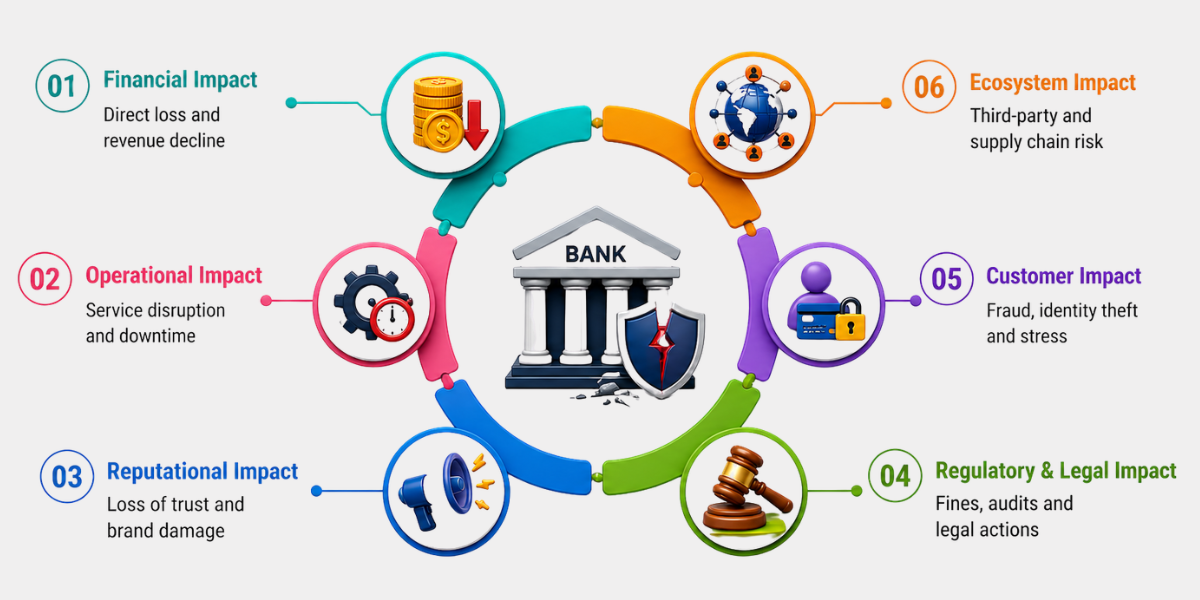
A data breach in banks leads to multi-layered consequences across financial stability, operations, reputation, regulatory exposure, customer safety, and ecosystem resilience. These impacts are not isolated—they compound over time, creating long-term business risk far beyond the initial incident.
Costs don’t stop at containment.
They expand—across quarters, audits, and customer lifecycles.
1. Financial Impact
A data breach in banks causes direct financial losses, fraud exposure, regulatory penalties, and long-term revenue decline. The cost structure is layered—immediate losses are followed by ongoing expenses related to recovery, compliance, and customer attrition.
Money is lost instantly.
But the real damage unfolds slowly.
a. Direct Monetary Loss & Fraud
Unauthorized transactions and account takeovers can happen within hours once credentials are exposed. Attackers quickly transfer funds or make payments before detection, leading to immediate financial loss.
b. Incident Response Costs
After a breach, banks must spend heavily on forensic investigations, fixing systems, and strengthening security. These costs involve multiple teams, external experts, and technology upgrades, making recovery expensive and time-consuming.
c. Long-Term Revenue Loss (Customer Churn)
When trust is broken, customers quietly shift to other banks over time. This reduces deposits, transactions, and long-term revenue, as replacing customers is far more expensive than retaining them.
Financial impact is cumulative—it compounds over time, not just at the moment of breach.
2. Operational Impact
A data breach disrupts banking operations by causing system downtime, transaction failures, investigation delays, and business continuity breakdowns. Since banking relies on uninterrupted services, even short disruptions can halt critical financial activities.
Operations don’t degrade gracefully.
They collapse under pressure.
a. System Downtime
Banks may need to shut down systems temporarily to contain the breach and prevent further damage. During this time, customers cannot access services, causing major disruption.
b. Disrupted Banking Services
Everyday services like payments, fund transfers, and ATM withdrawals may slow down or fail. Even short disruptions can impact thousands of customers and business transactions.
c. Internal Investigation Burden
Employees shift focus from regular operations to handling the breach, including audits and reporting. This reduces productivity and delays normal banking activities.
d. Business Continuity Stress
Backup systems and recovery plans are tested during a breach, often exposing gaps. If these systems fail, banks struggle to maintain operations smoothly.
In practice: banking services slow, fail, or stop.
3. Reputational Impact
A banking industry breach damages reputation by eroding customer trust, attracting media scrutiny, and weakening customer retention and acquisition. Since trust is the foundation of banking, reputational damage often has longer-lasting effects than financial loss.
Trust takes years to build. Minutes to break.
a. Loss of Customer Confidence
Customers begin to doubt whether their money and data are safe with the bank. Even a single breach can reduce trust built over years.
b. Brand Damage
The bank’s image takes a hit as the breach becomes public knowledge. This affects how customers, investors, and partners perceive the institution.
c. Media Amplification
News coverage and social media spread information about the breach quickly. This increases public scrutiny and puts pressure on the bank to respond.
d. Market Position Weakening
Competitors may gain advantage as customers look for safer alternatives. The bank may lose its position in the market due to reduced trust.
Example:The JPMorgan Chase breach exposed data of millions, affecting public perception and highlighting trust-related risks in large banks.
4. Regulatory & Legal Impact
A data breach in banks triggers mandatory reporting, regulatory penalties, increased audits, and legal liability under frameworks like DPDP and RBI guidelines. Regulatory impact is continuous—extending beyond the breach into long-term compliance obligations.
The breach is the trigger.
Regulation is the aftermath.
a. Mandatory Breach Notifications
Banks are required to inform regulators and affected users within a specific time after a breach. Delays or failure to report can lead to penalties.
b. Penalties Under DPDP Act
If personal data is not properly protected, banks can face significant fines under data protection laws. This directly impacts financial stability.
c. RBI & Sectoral Compliance Pressure
Regulators may impose stricter rules and require additional controls after a breach. Banks must invest more effort into compliance and reporting.
d. Audits and Investigations
Post-breach, regulators conduct detailed audits to assess failures. This increases scrutiny and requires extensive documentation from banks.
e. Legal Actions & Lawsuits
Customers or affected parties may take legal action against the bank for negligence. This leads to legal costs, settlements, and reputational damage.
Regulatory impact is not a one-time penalty—it is sustained pressure.
5. Customer Impact
A data breach impacts customers by exposing them to identity theft, financial fraud, loss of data control, and psychological stress. In banking, the consequences extend beyond inconvenience into real financial and personal risk.
The breach hits systems. The damage hits people.**
a. Identity Theft
Stolen personal data can be used to create fake identities or access financial services. This exposes customers to long-term fraud risks.
b. Loss of Data Control
Customers lose visibility over how their personal information is used or shared. This creates uncertainty and lack of control over their own data.
c. Emotional Distress
Financial insecurity and fear of fraud can cause stress and anxiety. Customers may constantly worry about misuse of their information.
6. Ecosystem Impact
A BFSI breach impacts the broader ecosystem by exposing third-party vendors, disrupting fintech integrations, and creating systemic risks across interconnected financial networks. Because banks operate within a shared infrastructure, breaches propagate beyond the originating institution.
Banks are not isolated entities. They are nodes in a network.
a. Third-Party & Vendor Exposure
If a vendor connected to the bank is compromised, it can expose the bank’s data as well. This makes third-party relationships a major risk factor.
b. Fintech Integration Vulnerabilities
Banks rely on APIs and fintech platforms to offer services, but these connections increase the attack surface. A weak integration can become an entry point for attackers.
c. Supply Chain Impact
A breach in one system can spread across multiple institutions connected through shared infrastructure. This creates a chain reaction of risk.
This is not a contained incident.
It’s a chain reaction across the financial ecosystem.
Conclusion
Breaches are inevitable.
But uncontrolled impact is not.
In banking, resilience is not defined by prevention alone—it is defined by how well the institution absorbs, responds, and recovers. A strong compliance framework, supported by operational readiness, acts as your blueprint for survival.
Because when a breach happens—your preparedness determines your outcome.
Key Takeaways
- A data breach in banks is not just a tech issue—it affects finance, operations, trust, and compliance at the same time.
- Banking breaches are more severe because of sensitive data, real-time transactions, and interconnected systems.
- Financial impact goes beyond immediate loss—it includes fraud, recovery costs, and long-term revenue decline.
- Operational impact can disrupt services completely, where banking systems slow down, fail, or stop.
- Reputational damage leads to loss of trust, negative publicity, and weakened market position.
- Regulatory impact is ongoing, involving fines, audits, legal action, and strict compliance pressure.
- Customers face real risks like identity theft, loss of data control, and emotional stress.
- Breaches don’t stay isolated—they spread across vendors, fintech systems, and the entire financial ecosystem.
Related Blog