Table of contents
By-Research Team
May 5, 2026 | 7 min read | BFSI
DPDP for Banks: Hidden Data Risks in Banking and Financial Services
Banks don't lose data by accident. They expose it through everyday systems.
Data risk in banking is no longer just a technical issue—it is directly linked to data protection and legal compliance under India's Digital Personal Data Protection Act, 2023. When personal data is exposed, even unintentionally, it can qualify as a personal data breach, bringing regulatory scrutiny and penalties.
Most banks focus on security tools.
But the real problem lies deeper—in how data is stored, shared, and processed across systems.
This blog highlights the hidden data risks in banking that often go unnoticed but have serious implications under DPDP and BFSI regulations.
What are Data Risks?
Data risks refer to the possibility of personal or sensitive data being exposed, misused, or accessed without authorization due to weak systems, processes, or controls.
In simple terms, data risk means: Your data is visible where it shouldn't be.
This could happen through:
-
Poor system design
-
Excess data sharing
-
Weak access controls
Under the DPDP Act, any such exposure of digital personal data can be treated as a data breach, even if there is no malicious hacking involved.
What are Data Risks in Banking and Financial Services?
Data risks in banking involve the exposure or misuse of highly sensitive financial and personal data such as account details, KYC records, and transaction histories. These risks are more severe because banks handle large volumes of regulated personal data.
Think about what banks store:
-
Identity proofs
-
Financial transactions
-
Contact details
In banking, data risk is not just about security—it is about trust and legal responsibility.
Under DPDP, banks act as data fiduciaries, meaning they are responsible for protecting customer data across all systems and processes.
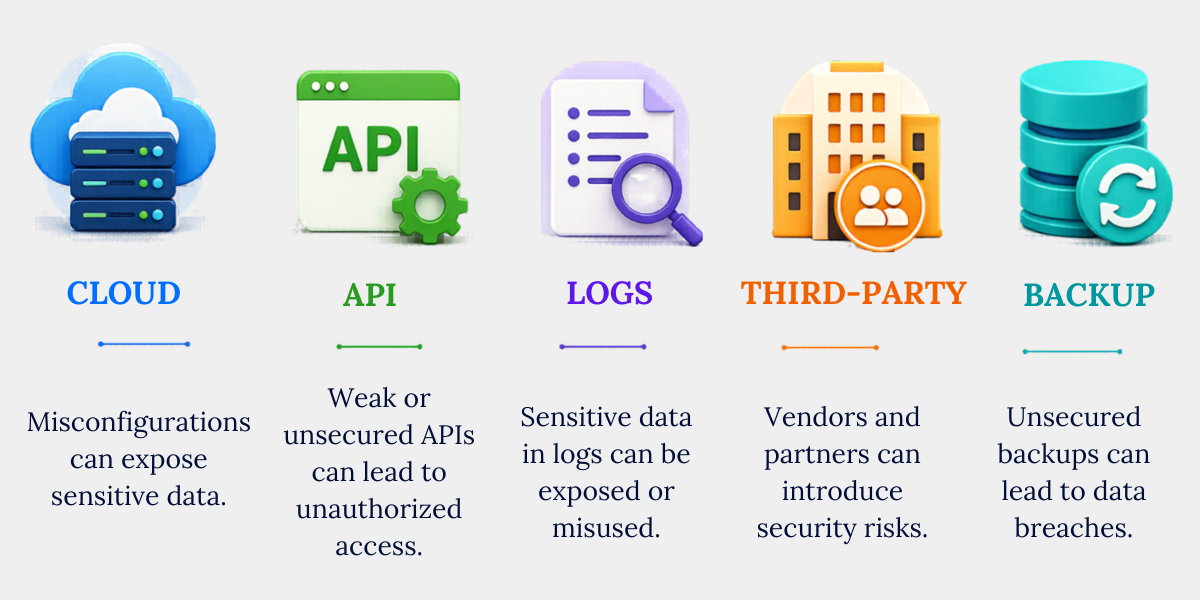
What are the Most Common Data Risks in Banking?
Here are the five most critical and commonly overlooked data risks in banking systems:
-
Misconfigured cloud storage
-
API data exposure
-
Logs and error message data leaks
-
Third-party data risks
-
Backup and test data exposure
Each of these risks may not be visible on the surface—but they can expose large volumes of personal data.
- Misconfigured Cloud Storage in Banks
Misconfigured cloud storage can expose sensitive banking data like KYC documents and account details due to incorrect access settings. This is one of the most common causes of large-scale data exposure.
Cloud systems are designed to store massive amounts of data.
But a small mistake—like enabling public access—can make that data visible to anyone with a link.
This is not hacking.
This is exposure due to weak configuration.
Under DPDP, this directly impacts the requirement of maintaining reasonable security safeguards for personal data.
- API Data Exposure in Banking Apps
API data exposure happens when banking systems share more data than required during digital transactions or app interactions.
APIs are used in:
-
Mobile banking apps
-
Payment gateways
-
Account services
But many APIs return excessive data in the background.
Even if users don't see it, the data is still being shared and can be accessed.
This goes against the principle of data minimisation, where only necessary data should be processed.
- Logs and Error Messages Exposing Bank Data
System logs and error messages can store sensitive information like account numbers, tokens, and transaction details, making them hidden sources of data exposure.
Logs are created for troubleshooting.
But they often contain real customer data.
These logs are rarely secured with the same level of protection as core systems.
As a result, they become an easy target for unauthorized access.
From a DPDP perspective, data exposure in logs is still considered a breach of personal data protection.
- Third-party Data Risks in Banking
Third-party data risks arise when banks share customer data with external vendors, increasing the chances of exposure due to varying security practices.
Banks work with:
-
Payment processors
-
Fintech partners
-
Analytics providers
Each partner processes customer data.
But here's the key issue:
The bank remains responsible for that data.
Under DPDP, banks acts as a data fiduciary, meaning it is accountable even if the exposure happens through a third party.
- Backup And Test Data Exposure in Banks
Backup files and test environments often contain real customer data but lack strong security controls, making them highly vulnerable to data exposure.
In many cases:
-
Real data is used for testing
-
Old backups are stored without encryption
-
Test environments are not monitored
This creates multiple copies of sensitive data.
And each copy increases the risk.
Under DPDP, this conflicts with purpose limitation, where data should only be used for its intended purpose—not for convenience.
How Does DPDP Affect Banks?
The Digital Personal Data Protection Act (DPDP) makes banks legally responsible for protecting personal data, ensuring secure processing, and preventing unauthorized exposure across all systems and partners.
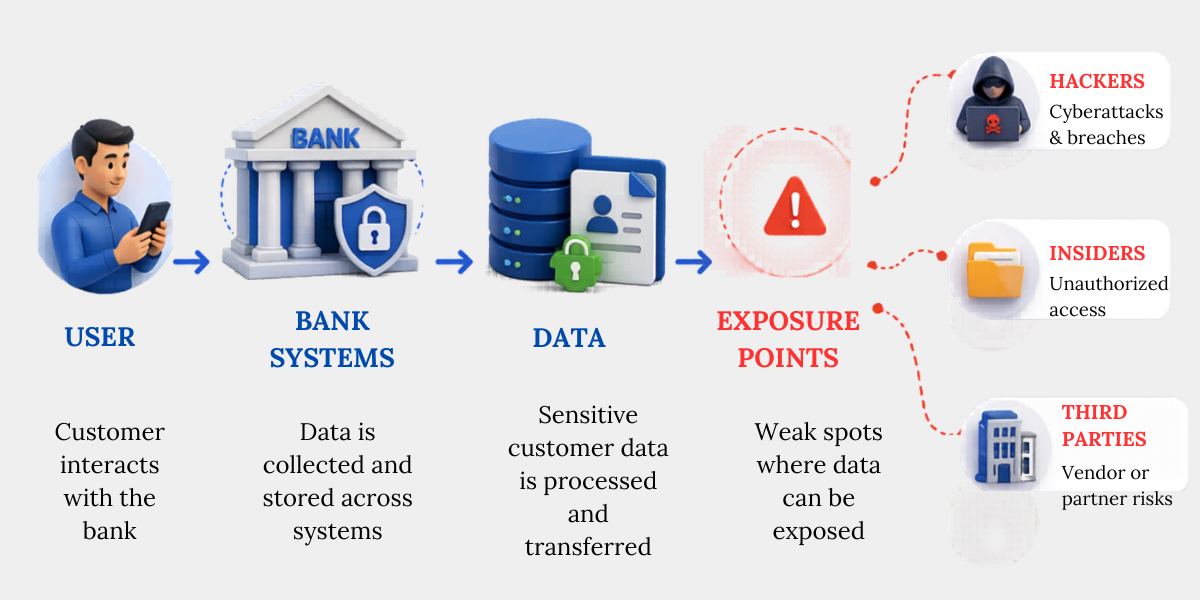
This changes the way data risks are viewed.
-
Data exposure = personal data breach
-
System gaps = compliance failure
-
Vendor risks = bank liability
Banks are classified as data fiduciaries, meaning they must ensure:
-
Data is protected
-
Data is used correctly
-
Data is not exposed
With DPDP in place, hidden data risks in banking are no longer technical issues—they are regulatory risks.
Conclusion
Banks operate on trust—and trust depends on data protection.
Many data risks in banking are hidden inside everyday systems like cloud storage, APIs, logs, vendors, and backups. These can expose sensitive data without any obvious breach.
With the Digital Personal Data Protection Act, 2023 in force, data exposure is now a legal risk, not just a technical issue.
Failure to protect data can lead to penalties, investigations, and loss of customer trust. At the same time, customers expect stronger data protection than ever before.
For banks, data protection is no longer optional—it is essential for compliance and trust.
Key Takeaways
-
Data risk in banking means customer data can be exposed due to weak systems or processes.
-
Data risks are higher in banking because banks handle sensitive personal and financial data.
-
Common risks include cloud issues, APIs, logs, third parties, and backups.
-
Cloud misconfigurations can make customer data publicly visible.
-
APIs can share more data than needed, increasing exposure risk.
-
Logs and error messages can store and leak sensitive data.
-
Third-party vendors increase risk, but banks remain responsible under DPDP.
-
Under the Digital Personal Data Protection Act, 2023, even unintentional data exposure is treated as a compliance failure and legal risk.
How Privacy Global Can Help?
At Privacy Global, we help banks and financial institutions:
-
Identify hidden data risks
-
Align systems with DPDP requirements
-
Strengthen data protection across operations
If your systems handle personal data, DPDP compliance is not a future goal—it is a current responsibility.
Related Blog