Table of contents
By-Research Team
October 6, 2026 | 14 min read | Product Guide
Top 10 DPDP Compliance Solutions for Banks
The top DPDP compliance solutions for banks are those that can address privacy across real banking processes—not just offer a long list of privacy features. Banks handle personal data across KYC, onboarding, core banking, lending, CRM, credit bureaus, cloud platforms and other processors, making privacy a complex operational challenge.
For banks, the practical question is therefore not, “Does this platform have consent management?”
It is more useful to ask: Can this platform connect the privacy requirement to the banking process, system, customer data and third party involved?
This guide examines 10 DPDP compliance solutions for banks based on their documented banking relevance, privacy capabilities and fit across key banking processes. The list is a market-focused selection, not a ranking, and vendor-specific claims are identified as such.
Why Do Banks Need a DPDP Compliance Solution?
Banks need a DPDP compliance solution because personal data is distributed across customer-facing channels, banking systems and third parties, while privacy obligations must operate alongside existing financial-sector requirements. A practical solution should therefore help connect data collection, consent, rights, retention, sharing, risk and evidence to the bank's actual operating processes.
Think about opening a bank account.
A customer's data may move from a branch or digital channel to KYC systems, core banking, CRM and communication platforms.
Add a loan application, credit bureau, video-KYC provider, cloud service or lending partner, and the data flow becomes even more complex.
RBI also recognises banks' use of IT service providers and requires controls over customer data, service providers, subcontractors, audits and incidents.
The challenge is not just knowing where personal data is stored. It is knowing where it goes, who uses it and what happens to it.
Top 10 DPDP Compliance Solutions for Banks
The right DPDP compliance solution for a bank depends on its banking processes, technology environment, data flows and privacy requirements. Based on publicly available product information, the solutions below differ in their focus—from broad privacy lifecycle management and banking-specific data governance to consent management and DPDP-focused compliance workflows.
- Privacy Global
- Perfios DPDP Suite
- PrivaTrust by eMudhra
- Digital Anumati
- ConsentOS
- Consentin by Leegality
- OneConsent
- ComplyDP
- GoTrust
- Privy by IDfy
1. Privacy Global
Privacy Global provides a broad privacy compliance and governance platform covering data mapping, consent, Data Principal Rights, vendor management, risk, breach management, audit and ongoing privacy operations. Its solutions page also explicitly positions the platform for BFSI.
Banking Relevance
- Customer data mapping across internal systems and external providers
- Consent and Data Principal Rights
- Vendor and processor governance
- Privacy risk and audit management
- Breach management
Key Capabilities for Banks
- Data discovery and mapping
- Consent management
- Data Principal/Subject Rights
- Vendor management
- Risk management
- Breach management
- Audit management
Source: Privacy Global Compliance Solutions
Its main banking relevance is the breadth of the privacy lifecycle. Instead of treating consent, customer rights, vendor oversight and breach response as separate activities, the platform connects them within a broader privacy governance framework.
What Banks Should Verify
- Core banking, CRM, KYC and lending integrations
- Connectors available for their existing technology environment
- Cross-system automation for consent and rights workflows
Best Suited For
Banks looking for a broader privacy governance platform covering multiple stages of the privacy lifecycle.
Ready to simplify DPDP compliance across your banking operations?
Check out Privacy Global DPDP Compliance Solutions
2. Perfios DPDP Suite
Perfios DPDP Suite brings data discovery, classification, RoPA, consent governance, Data Principal Rights Management and database activity monitoring into a unified platform. Its financial-services focus also makes it relevant to banking environments.
Banking Relevance
- Customer onboarding
- Lending and financial processing
- Marketing and analytics
- Financial-services data platforms
- Existing technology stacks through APIs
Key Capabilities for Banks
- Data discovery and classification
- RoPA
- Consent governance
- Data Principal Rights Management
- Database activity monitoring
- Compliance reporting
Its financial-services ecosystem provides context for banking workflows, particularly where consent connects onboarding, lending, downstream systems and withdrawal.
What Banks Should Verify
- Core banking integrations
- KYC and LOS/LMS connectivity
- CRM and data warehouse integration
- Capabilities included in the deployed configuration
Best Suited For
Banks looking to combine DPDP compliance capabilities with financial-services technology and lending workflows.
3. PrivaTrust by eMudhra
PrivaTrust provides a banking-focused privacy architecture covering data discovery, consent management, customer rights and remediation across banking systems and third-party processors.
Banking Relevance
- KYC and onboarding
- Core banking systems
- CRM and data warehouses
- Mobile and internet banking
- Branch operations
- Third-party processors
Key Capabilities for Banks
- Data discovery
- Data mapping
- Consent management
- DSAR management
- Data governance
- Remediation
The platform explicitly maps privacy requirements to the banking data landscape, including core banking, CRM, mobile applications, branch records and KYC data.
What Banks Should Verify
- Legacy core banking connectors
- Document repository integrations
- Third-party processor workflows
Best Suited For
Banks that need privacy controls mapped closely to their banking systems and customer data environment.
4. Digital Anumati
Digital Anumati takes a consent-centric BFSI approach, with documented use cases covering digital lending, co-lending, credit bureaus, recovery agents, Account Aggregator flows and multi-party consent.
Banking Relevance
- Digital lending
- Co-lending
- Credit bureau sharing
- Account Aggregator flows
- Recovery-agent workflows
- Multi-party financial data sharing
Key Capabilities for Banks
- Consent capture
- Purpose and scope-based consent
- Consent propagation
- Consent ledger
- Consent revocation
- Retention and erasure conflict handling
Its strongest documented focus is on carrying consent across complex financial relationships, such as Bank → NBFC → Credit Bureau → Recovery Agent.
What Banks Should Verify
- Actual behaviour of advertised integrations
- Consent-revocation performance in production
- Handling of processing that does not rely on consent
Best Suited For
Banks with complex lending, co-lending and multi-party consent workflows.
5. ConsentOS
ConsentOS focuses on privacy compliance for regulated BFSI organisations, with particular attention to DPDP erasure requests that conflict with RBI and PMLA retention requirements.
Banking Relevance
- Regulated BFSI operations
- Customer erasure requests
- RBI retention requirements
- PMLA-related retention
- Compliance evidence
Key Capabilities for Banks
- Consent management
- Data Principal Rights
- Conflict-of-law register
- Legal-obligation override
- Retention-versus-erasure workflows
- Evidence management
Its distinctive focus is the conflict between privacy rights and mandatory financial-sector record retention—for example, when a bank receives an erasure request for information that must legally be retained.
What Banks Should Verify
- Which capabilities are currently live
- Implementation scope
- Support for the bank's RBI, PMLA and internal retention requirements
Best Suited For
Regulated financial institutions where retention and erasure requirements need to be managed together.
6. ConsentIn by Leegality
ConsentIn focuses primarily on managing consent across digital and physical customer journeys, including consent capture, withdrawal, consent records and synchronisation with business and third-party databases.
Banking Relevance
- Branch journeys
- Website and mobile applications
- Assisted customer channels
- BFSI customer journeys
- Third-party data sharing
Key Capabilities for Banks
- Consent capture
- Consent artefacts
- Consent withdrawal
- Consent synchronisation
- Data Request workflows
- API and webhook connectivity
Its focus is on keeping consent consistent when customers interact with banks through multiple touchpoints rather than a single onboarding journey.
What Banks Should Verify
- Core banking integration
- Lending-system connectivity
- How consent interacts with non-consent processing grounds
Best Suited For
Banks that need to operationalise consent across multiple customer touchpoints and downstream systems.
7. OneConsent
OneConsent combines consent management with broader privacy governance, including Data Principal rights, data governance and third-party oversight. Its BFSI materials address KYC, loans, transaction data, marketing consent and partner sharing.
Banking Relevance
- KYC processing
- Loan applications
- Transaction histories
- Marketing consent
- Partner data sharing
- Legacy customer data
Key Capabilities for Banks
- Consent capture
- Preference management
- Purpose-based tracking
- Consent withdrawal
- Data Principal Rights
- Third-party oversight
A key focus is maintaining the connection between customer data, its original purpose and the processing basis, particularly when KYC data may later be considered for other uses.
What Banks Should Verify
- Data discovery depth
- Rights orchestration
- Integration with the bank's existing architecture
Best Suited For
Banks seeking consent and privacy governance across varied customer-data use cases.
8. ComplyDP
ComplyDP approaches DPDP compliance through data intelligence, processing records, data-flow mapping, purpose and basis mapping, and compliance-gap identification.
Banking Relevance
- Loan application data
- Credit assessment
- Credit bureau sharing
- Underwriting
- Data retention
- Fintech operations
Key Capabilities for Banks
- Data inventory
- Processing activity records
- Purpose and basis mapping
- Data-flow visualisation
- Gap identification
- Compliance tracking
Its focus is on establishing visibility into what data enters each system, how it is processed, where it goes and how long it remains—an important foundation for banking privacy controls.
What Banks Should Verify
- KYC repository support
- Lending-platform integrations
- Legacy-system connectivity
- Automated rights workflows
Best Suited For
Banks that need stronger data intelligence and visibility into processing activities and data flows.
9. GoTrust
GoTrust provides a broad privacy, security and governance platform covering data discovery, data mapping, consent, DSRs, vendor risk, assessments, compliance automation and risk management.
Banking Relevance
- KYC documents
- Loan applications
- Payment records
- Banking software
- Cloud services
- Third-party vendors
Key Capabilities for Banks
- Data discovery
- Data mapping
- Consent and preference management
- DSR response
- Vendor risk management
- Compliance automation
Its broader privacy-and-security architecture and data-discovery capabilities can support complex banking environments with structured and unstructured data sources.
What Banks Should Verify
- Banking-specific implementation experience
- Connectors for their technology stack
- Automation for banking rights and consent workflows
Best Suited For
Banks looking for a broader privacy and security governance platform with strong data discovery capabilities.
10. Privy by IDfy
Privy provides a DPDP compliance solution specifically positioned for banks and NBFCs, addressing fragmented customer data across core banking, LOS/LMS, CRM, collections, credit bureaus and verification systems.
Banking Relevance
- KYC and verification
- Core banking
- Lending and LOS/LMS
- CRM and collections
- Credit bureaus
- Branches, mobile and net banking
- Digital lending
Key Capabilities for Banks
- Personal-data discovery
- Consent lifecycle management
- Data Principal Rights Management
- Third-party risk management
- Incident response
Its banking-specific documentation maps privacy challenges to the fragmented data landscape found across KYC, lending, CRM, collections, credit bureaus and multiple customer channels.
What Banks Should Verify
- Integration depth
- Deployment architecture
- System-level orchestration
- Production automation for rights, consent and incident workflows
Best Suited For
Banks and NBFCs dealing with fragmented customer data across multiple banking systems and customer channels.
How We Evaluate DPDP Compliance Solutions for Banks
We evaluate DPDP compliance platforms by asking how they fit into real banking processes rather than counting how many privacy modules they advertise. The assessment considers documented banking workflows, systems, data movements, consent requirements, customer rights, regulatory retention constraints, third parties and audit evidence. Capabilities that are not publicly documented are not treated as confirmed capabilities.
-
Customer Onboarding and KYC
KYC and onboarding were considered because this is where banks collect critical customer information. The assessment covered privacy notices, processing purposes, KYC data mapping and the ability to trace Data Principal requests across onboarding and KYC systems.
-
Digital Banking and Customer Channels
Mobile banking, internet banking, branches, call centres and digital applications form multiple entry points for customer data. The focus was therefore on whether privacy controls remain consistent across these channels and connected systems such as CRM.
-
Lending and Credit Processes
Lending can involve application data, income information, credit assessment, underwriting, credit bureaus, lending partners and LOS/LMS platforms. Particular attention was given to how each solution addresses privacy across this connected lending ecosystem.
-
Consent Across Banking Relationships
Consent becomes more complex when customer information moves between banks, credit bureaus, lending partners and service providers. The assessment covered purpose-based consent, withdrawal and the propagation of consent changes across relevant downstream systems.
-
Data Principal Rights
Customer information is rarely held in a single banking system. The analysis therefore considered how solutions handle requests across CRM, KYC, core banking, lending platforms, document repositories and external processors.
-
Data Retention and Deletion
Deletion cannot always be separated from banking and regulatory retention requirements. This area focused on how solutions address applicable exceptions, restrictions and evidence when privacy rights intersect with mandatory record retention.
-
Third-Party and Processor Data Sharing
Banks routinely share or process data through KYC providers, credit bureaus, cloud providers, BPOs, collection agencies, lending partners and communication vendors. The assessment considered the visibility and governance provided across these external data flows.
-
Marketing and Customer Communications
Marketing provides a practical test of how privacy preferences move through operational systems. The analysis looked at workflows connecting CRM, email, SMS, WhatsApp and other communication channels, while distinguishing marketing preferences from processing required for core banking services.
-
Data Breach and Privacy Incident Response
A privacy incident can involve multiple banking systems, customers and third parties. This area focused on how solutions connect affected systems and data with risk assessment, response actions, third-party involvement and supporting evidence.
-
Audit, Governance and Evidence
Finally, auditability was considered because banks need to demonstrate how privacy controls operate across their technology and operational environment. The assessment looked at the connection between banking processes, customer data, systems, vendors, risks, actions and evidence.
How to Choose a DPDP Compliance Solution for Your Bank
The right DPDP compliance solution should be evaluated against the bank’s actual processes, systems and data flows—not just a vendor’s feature list.
Start with key workflows such as KYC, onboarding, lending, digital banking, marketing and customer rights. Then check how the platform handles consent, data discovery, third-party sharing, retention, Data Principal requests, integrations and audit evidence across these processes.
Banks should also test how the platform works with their existing technology, including core banking, CRM, KYC, LOS/LMS, mobile banking and vendor systems. Test real scenarios such as consent withdrawal, customer rights requests and deletion where regulatory retention applies.
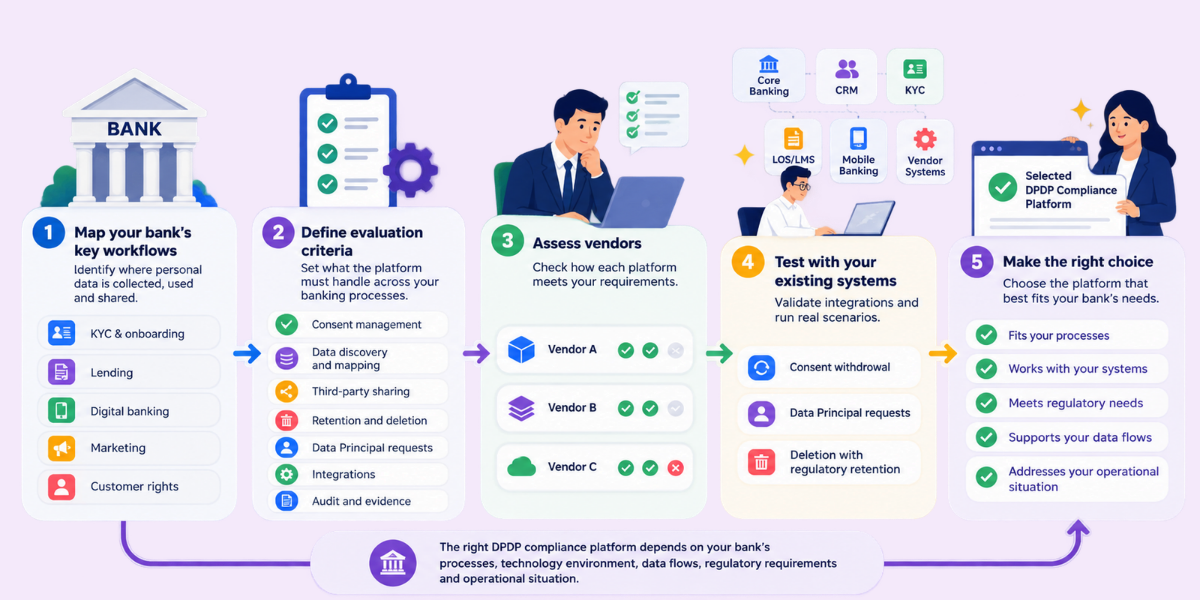
The right choice of platform ultimately depends on the bank’s specific processes, technology environment, data flows, regulatory requirements and operational situation.
Conclusion
The right DPDP compliance solution is not necessarily the one with the longest feature list. It is the one that fits the bank’s actual processes, systems and data flows.
A practical evaluation follows this path:
Banking process → Personal data → Purpose → Processing basis → System → Third party → Privacy action → Evidence
The ten solutions covered here approach DPDP compliance differently, with varying strengths across banking workflows, consent, data intelligence, discovery, governance and privacy automation. The right choice ultimately depends on the bank’s data landscape, technology environment and specific compliance needs—not just the product brochure.
Key Takeaways
- Banks need DPDP compliance solutions that connect privacy requirements with real banking processes and data flows.
- Privacy Global covers a broad privacy lifecycle, including data mapping, consent, rights, vendor management, risk and breach management.
- The solutions reviewed differ in their focus across banking workflows, consent, data intelligence, governance and privacy automation.
- Banking-specific areas such as KYC, digital banking, lending and customer communications are important when assessing platform fit.
- Consent must work across banks, credit bureaus, lending partners and other service providers.
- Data Principal requests and deletion need to work alongside banking systems and regulatory retention requirements.
- Third-party data sharing, incident response and audit evidence are important parts of a bank’s privacy architecture.
- The right platform depends on the bank’s processes, technology environment, data flows and specific compliance needs.
Related Blog