Table of contents
By-Research Team
September 25, 2026 | 16 min read | Industry Cases
DPDP Compliance Checklist for Banks
A DPDP compliance checklist for banks is a structured way to review whether the right privacy controls are in place across these activities. It helps banks move beyond policies and identify what needs to be checked, documented, assigned, monitored and improved.
This checklist covers 14 key areas of DPDP compliance, including governance, data inventory, data mapping, consent, Data Principal rights, retention, security, third-party processing, breach management, cross-border data, DPIA and audit readiness.
What Does DPDP Compliance Mean for Banks?
Banks operate one of the most interconnected personal-data environments in the financial sector.
A customer's information can begin with an application form or digital onboarding journey and then move through KYC, core banking, credit assessment, payment processing, customer service, fraud monitoring and external service providers.
The DPDP Act applies to the processing of digital personal data, while banks must also continue managing their existing regulatory and operational obligations. That means privacy controls need to fit into the bank's existing architecture rather than sit beside it as another disconnected compliance programme.
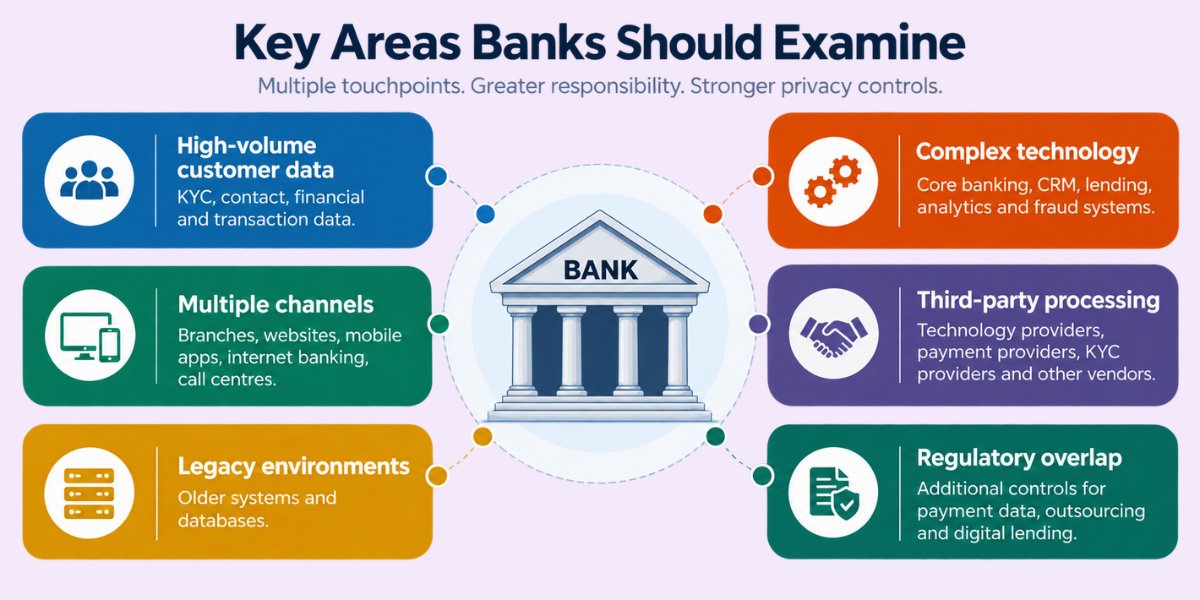
Banks should therefore examine:
- High-volume customer data: KYC information, contact details, financial information and transaction-related information can be processed across multiple functions.
- Multiple channels: Branches, websites, mobile applications, internet banking, call centres and relationship managers can all become data collection or access points.
- Complex technology: Core banking, CRM, loan origination, loan management, analytics and fraud systems can create interconnected data flows.
- Third-party processing: Banks frequently rely on technology providers, payment providers, KYC providers, lending service providers, cloud providers and other vendors.
- Legacy environments: Older applications and databases can make it difficult to establish where personal data resides and when it should be deleted.
- Regulatory overlap: Banking-specific requirements may impose additional controls around areas such as payment data, outsourcing, digital lending and customer information.
Which Banking Operations Involve Personal Data?
A bank should not begin its DPDP assessment by asking only, "What data do we collect?"
Ask the harder question: "Where does personal data enter, move, get transformed, get shared and eventually leave our environment?"
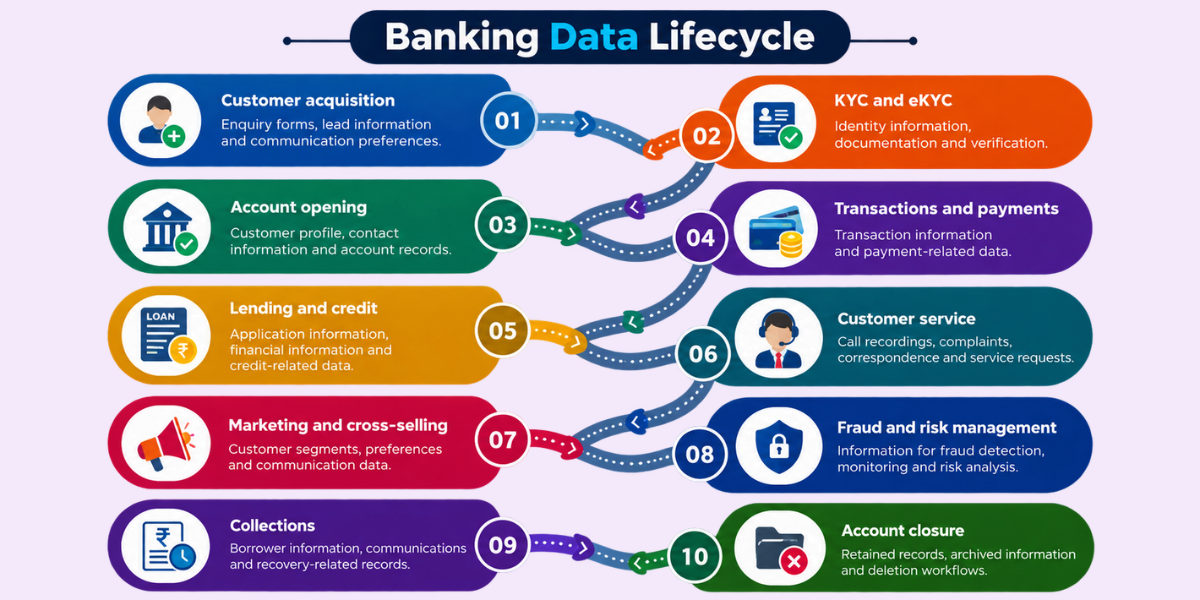
A practical banking data lifecycle can include:
- Customer acquisition — enquiry forms, lead information and communication preferences.
- KYC and eKYC — identity information, documentation and verification information.
- Account opening — customer profile, contact information and account-related records.
- Transactions and payments — transaction information and payment-related data.
- Lending and credit — application information, financial information, credit-related information and supporting documents.
- Customer service — call recordings, complaints, correspondence and service requests.
- Marketing and cross-selling — customer segments, preferences and communication data.
- Fraud and risk management — information used for fraud detection, monitoring and risk analysis.
- Collections — borrower information, communications and recovery-related records.
- Account closure — retained records, archived information and deletion workflows.
What Should Banks Check for DPDP Compliance?
A bank's DPDP compliance checklist should cover governance, data discovery, mapping, notice and consent, processing purpose, Data Principal rights, retention, security, third parties, breaches, cross-border data, DPIA and audit readiness, employee awareness, and continuous evidence. Each control should be tested against the bank's actual systems, processes, vendors and supporting documentation rather than treated as a policy-only exercise.
Governance & Accountability
Check whether privacy responsibility has an owner. The DPDP Act places general obligations on Data Fiduciaries, while Significant Data Fiduciaries have additional statutory obligations, including requirements relating to a Data Protection Officer, DPIAs and audits.
A bank should check:
- Privacy ownership: Is responsibility for personal-data governance clearly assigned?
- Roles and responsibilities: Are Privacy, Compliance, Legal, IT, Information Security, Risk and business teams clear about their respective responsibilities?
- Policies: Are privacy policies and procedures documented and periodically reviewed?
- Management oversight: Is privacy risk reported to appropriate senior management or governance forums?
- Accountability: Can the bank demonstrate who is responsible for a specific processing activity or privacy control?
Practical test: Pick one customer-data process and ask, "Who owns the privacy risk here?"
If the answer requires a five-person conference call, the governance model probably needs work.
Personal Data Inventory & Discovery
You cannot protect what you cannot find. A bank should maintain visibility into the personal data it collects, processes and stores across customer-facing applications, internal systems, databases, documents and third parties.
The checklist should test whether the bank has identified:
- KYC data: Identity and verification information collected during onboarding.
- Account data: Customer profile and account-related information.
- Credit data: Information processed for loan applications and credit decisions.
- Transaction data: Personal information associated with banking and payment activity.
- Communication data: Emails, call records, complaints and customer-service interactions.
- Employee data: Personal data processed as part of employment and internal operations.
- Third-party data: Personal data held or processed by vendors and partners.
- Legacy data: Personal data sitting in older applications, databases, archives or uncontrolled repositories.
Data Mapping & Data Lineage
Data mapping turns an inventory into an operating picture. It shows where personal data comes from, where it travels, which systems process it, who accesses it, which third parties receive it and where it is stored.
A bank should map:
- Collection points: Branches, websites, apps, forms, call centres and digital onboarding.
- Internal flows: Movement between KYC, CRM, core banking, lending, analytics and other systems.
- Access points: Internal teams, applications, administrators and service providers.
- External transfers: Data shared with processors, fintechs, payment providers and other partners.
- Storage locations: Databases, cloud environments, backups, archives and other repositories.
- Lifecycle events: Collection, use, sharing, retention, archival and deletion.
Practical scenario: A customer submits KYC information through a mobile application. The data may then move to a verification provider, core banking platform, CRM and analytics environment.
A privacy team that sees only the mobile application does not see the whole data flow.
Privacy Notices & Consent Management
Privacy notices should tell customers what data is being processed, why it is needed and how they can exercise their rights. The DPDP Act contains notice and consent requirements, while Rule 3 of the 2025 Rules specifies additional notice characteristics, including clear and plain language and information needed for specific and informed consent.
Banks should check:
- Notice coverage: Are notices presented at relevant customer touchpoints?
- Data description: Does the notice identify the personal data being processed?
- Purpose: Is the purpose of processing clearly explained?
- Consent records: Where consent is the basis for processing, can the bank demonstrate when and how it was obtained?
- Withdrawal: Can customers withdraw consent through an accessible mechanism?
- Propagation: Does withdrawal reach relevant systems and third parties where applicable?
- Version control: Can the bank identify which notice was presented at a particular point in time?
The practical challenge is rarely writing a privacy notice.
It is making sure the notice shown on the app, website, branch process, partner channel and subsequent customer journey actually corresponds to the processing taking place behind the screen.
Purpose & Processing Governance
Every major personal-data processing activity should have a clearly understood purpose and an accountable owner. The DPDP Act establishes grounds for processing and general obligations for Data Fiduciaries, making purpose governance an important part of the bank's privacy architecture.
A bank should check:
- Purpose definition: Is the reason for processing documented?
- Data necessity: Is the data actually required for that purpose?
- Purpose changes: Are new uses of existing data assessed before implementation?
- Secondary uses: Are analytics, marketing and cross-selling activities separately evaluated?
- Process ownership: Is an accountable business owner associated with the processing activity?
- Documentation: Can the bank demonstrate why specific data is being processed?
Consider a simple scenario.
A customer gives information during a loan application. Later, another team wants to use the same information for a new marketing initiative.
The existence of the data does not automatically answer whether the new use is appropriate.
Data Principal Rights Management
Banks need an operational mechanism for receiving, verifying, routing, fulfilling and documenting Data Principal requests. The DPDP Act provides rights relating to access to information about personal data, correction and erasure, grievance redressal and nomination.
The checklist should test:
- Access: Can the bank identify and retrieve relevant personal data?
- Correction: Can inaccurate information be corrected across appropriate systems?
- Erasure: Can applicable deletion requests reach relevant systems and processors?
- Grievances: Is there a documented process for handling privacy grievances?
- Nomination: Is the bank prepared to support the statutory nomination mechanism?
- Identity verification: Can the bank verify the requester without creating unnecessary friction?
- Request tracking: Can every request be tracked from submission to closure?
Data Retention, Archiving & Deletion
Retention should be deliberate, not accidental. Banks need to distinguish between personal data that must be retained for applicable legal or regulatory reasons and information that no longer needs to remain in active systems.
The checklist should examine:
- Retention rules: Are retention requirements defined for major data categories?
- Regulatory obligations: Are other applicable legal and regulatory retention requirements considered?
- Archiving: Is archived data governed rather than simply forgotten?
- Deletion triggers: Are there defined conditions for deletion or erasure?
- System deletion: Can deletion be executed across relevant applications?
- Third-party deletion: Can applicable deletion requirements be communicated to processors?
- Evidence: Can the bank demonstrate what was deleted, when and through which process?
Security Safeguards for Personal Data
Security safeguards form the defensive layer of a bank's privacy architecture. Rule 6 of the 2025 Rules specifies minimum measures such as encryption or masking, access controls, logging and monitoring, backups, contractual safeguards with Data Processors, and technical and organisational measures; its commencement is phased under the Rules.
Banks should check:
- Encryption and protection: Are appropriate protection mechanisms applied to personal data?
- Access control: Is access restricted according to business need?
- Monitoring: Can the bank detect and investigate unauthorised access?
- Logging: Are relevant access and security events recorded?
- Backups: Can critical processing continue following compromise or loss of access?
- Processor controls: Do processor contracts address appropriate security safeguards?
- Technical and organisational measures: Are safeguards supported by governance, procedures and operational controls?
Third-Party & Processor Management
A bank's privacy boundary does not stop at its firewall. Personal data may be processed by technology vendors, fintechs, lending service providers, KYC providers, payment providers, cloud platforms, call centres and other service providers.
A bank should maintain controls for:
- Vendor inventory: Which third parties process personal data?
- Data shared: What information does each vendor receive?
- Purpose: Why is the vendor processing it?
- Contractual safeguards: Do contracts address applicable privacy and security requirements?
- Access controls: Does the vendor receive only appropriate access?
- Sub-processors: Can the bank identify relevant downstream processors?
- Deletion: Can applicable deletion requirements be operationalised?
- Monitoring: Are vendors periodically reviewed based on risk?
Digital lending provides an especially clear example: RBI states that outsourcing to a Lending Service Provider or Digital Lending App does not diminish the regulated entity's obligations, and regulated entities must ensure relevant service providers comply with applicable requirements.
Your vendor's system is still part of your risk map.
Personal Data Breach Management
A bank needs a privacy breach response process that connects detection, investigation, decision-making, notification and remediation. Rule 7 of the 2025 Rules addresses intimation to affected Data Principals and the Data Protection Board following awareness of a personal data breach, including a detailed Board intimation within 72 hours, subject to the rule's provisions.
The checklist should test:
- Detection: Can the bank identify a personal-data breach?
- Escalation: Are privacy incidents connected to the wider incident-response process?
- Assessment: Can the bank determine affected data and individuals?
- Notification: Are processes prepared for applicable notifications?
- Documentation: Are decisions, timelines and actions recorded?
- Third parties: Can incidents involving processors be escalated quickly?
- Remediation: Are corrective actions tracked through closure?
A bank should be able to reconstruct what happened, when it became aware, what information was affected, what action was taken and why.
Cross-Border Data & Localisation
Cross-border data management requires a map of where personal data and relevant processing activities actually travel. The DPDP Act addresses processing of personal data outside India, while Rule 15 provides that transfers outside India are subject to requirements that the Central Government may specify regarding making personal data available to a foreign State or entities under its control or agencies of such a State.
Banks should check:
- Offshore systems: Are overseas applications and infrastructure identified?
- International vendors: Which processors operate or store data outside India?
- Data flows: Does the bank know what information crosses borders?
- Cloud architecture: Are relevant storage and processing locations documented?
- Backups: Are disaster-recovery or backup environments included in the assessment?
- Regulatory requirements: Are sector-specific localisation requirements separately assessed?
DPIA, SDF & Audit Readiness
Banks should identify whether their processing activities trigger enhanced assessment or governance requirements and maintain evidence accordingly. Under the DPDP Act, Significant Data Fiduciaries have additional obligations, and Rule 13 requires an SDF to undertake a DPIA and audit once every twelve months from notification or inclusion as an SDF.
The checklist should examine:
- SDF status: Has the bank assessed whether it has been notified or falls within a notified class?
- DPIA: Are relevant high-impact processing activities assessed?
- Audit: Is the required audit process established where applicable?
- Board reporting: Can significant DPIA and audit observations be documented and reported as required?
- Algorithmic systems: Are relevant technical and algorithmic measures subject to appropriate due diligence?
- Evidence: Are assessments, decisions and remediation records maintained?
Employee & Frontline Privacy Readiness
Privacy controls fail when employees cannot apply them in daily operations. A bank's privacy programme therefore needs to reach branches, customer-service teams, relationship managers, marketing teams, operations, IT and other employees who collect, access or handle personal data.
Check whether:
- Training: Employees receive relevant privacy training.
- Frontline teams: Branch employees understand customer-data handling requirements.
- Customer service: Teams know how to route privacy and rights requests.
- Marketing: Teams understand consent and communication controls.
- Operations: Staff understand data handling, sharing and retention procedures.
- Escalation: Employees know where to report privacy incidents or questions.
Continuous Monitoring & Compliance Evidence
DPDP compliance should be treated as a monitored control environment rather than a one-time project. Banks need evidence showing what controls exist, who owns them, whether they operate effectively, what gaps remain and what remediation is underway.
The checklist should test whether the bank can:
- Maintain evidence: Store policies, inventories, records, logs, assessments and other supporting documentation.
- Track gaps: Record incomplete or ineffective controls.
- Assign ownership: Give every remediation item an accountable owner.
- Set priorities: Identify high-risk gaps requiring faster action.
- Review periodically: Reassess controls as systems, vendors, products and regulations change.
- Demonstrate progress: Maintain an audit-ready trail of actions and decisions.
Need help implementing these controls?
Explore our DPDP Compliance Services to strengthen your bank’s privacy programme.
DPDP Compliance Checklist for Banks: Quick Reference
The following quick-reference DPDP Act checklist condenses the 14 control areas into questions a bank can use for an initial review. A "yes" answer should ideally be supported by evidence; a policy sitting in a folder is not the same thing as an operational control.
| # | Compliance Area | Key Question |
|---|---|---|
| 1 | Governance & Accountability | Are privacy responsibilities, ownership and oversight clearly assigned? |
| 2 | Personal Data Inventory | Has the bank identified personal data across its banking operations and systems? |
| 3 | Data Mapping & Lineage | Are personal-data flows, storage locations, access points and third-party transfers documented? |
| 4 | Privacy Notices & Consent | Are notices, consent records and applicable withdrawal mechanisms properly implemented? |
| 5 | Purpose & Processing | Is every major processing activity linked to a clearly understood purpose? |
| 6 | Data Principal Rights | Can the bank receive, verify, fulfil and document applicable rights requests? |
| 7 | Retention & Deletion | Are retention, archiving and deletion requirements defined and operationalised? |
| 8 | Security Safeguards | Are appropriate technical and organisational safeguards protecting personal data? |
| 9 | Third-Party Management | Are processors and other data-sharing partners identified, assessed and governed? |
| 10 | Breach Management | Can the bank detect, escalate, investigate, document and respond to personal-data breaches? |
| 11 | Cross-Border Data | Are offshore systems, vendors, processing locations and applicable localisation requirements identified? |
| 12 | DPIA & Audit Readiness | Are applicable SDF, DPIA and audit requirements identified and supported by evidence? |
| 13 | Employee Readiness | Are employees and frontline teams equipped to handle personal data appropriately? |
| 14 | Monitoring & Evidence | Are privacy controls, gaps, remediation actions and supporting evidence continuously monitored? |
How to Use This Checklist
Do not treat the table as a ceremonial compliance exercise.
For every question, ask three follow-ups:
1. Is the control implemented?
2. What evidence proves it?
3. Who owns it?
For a more detailed internal assessment, each control can then be expanded into status, evidence, responsible role, priority, risk, remediation action and review frequency.
That creates a much stronger assessment model than a simple tick-box exercise.
Conclusion
DPDP compliance for banks is not about building another document repository or adding another annual checklist to the compliance calendar.
It is about building a defensible privacy architecture around the way a bank actually operates.
Start with the data. Map where it moves. Identify why it is processed. Test how consent and rights work. Govern retention, security and third parties. Then build the evidence needed to demonstrate that those controls operate in practice.
The strongest DPDP compliance checklist for banks is the one that connects every requirement to a real banking process, system, owner and piece of evidence.
Key Takeaways
- Banks need a bank-specific DPDP checklist because customer data moves through many systems and services.
- Data inventory and mapping help banks know what personal data they have, where it is stored and how it moves.
- Governance, notices and consent ensure there is clear responsibility and customers know how their data is used.
- Purpose, rights and retention controls help banks use data properly, handle customer requests and delete data when required.
- Security and breach controls help protect personal data and respond quickly when something goes wrong.
- Third-party and cross-border controls help banks manage data shared with vendors, fintechs and other service providers.
- DPIAs, audits and employee training help banks manage privacy risks and apply the right controls across teams.
- Regular monitoring and evidence help banks keep DPDP compliance up to date instead of treating it as a one-time exercise.
Related Blog