Table of contents
By-Research Team
March 31, 2026 | 9 min read | DPDP
What is Data Protection Board of India (DPBI)?
Think your company is "DPDP compliant"? Most businesses do---until they receive a notice.
The reality is simple: if you collect or process personal data in India, your practices can be questioned at any time.
When that happens, it is the Data Protection Board of India (DPBI) that steps in to investigate, evaluate, and decide the outcome.
The Data Protection Board of India (DPBI) is the authority responsible for enforcing the DPDP Act, 2023. It examines violations, reviews how organizations handle personal data, and has the power to impose significant penalties for non-compliance.
So, what does this mean for your business in practice?
In this blog, we explain:
-
What the DPBI is
-
What powers it has
-
How to build DPDP compliance that can withstand scrutiny
What is the Data Protection Board of India (DPBI)?
The Data Protection Board of India (DPBI) is a government-appointed adjudicatory body under the DPDP Act that investigates data protection violations and imposes penalties. It does not make laws but ensures that organizations comply with the DPDP Act.
In simple terms:
-
The government makes the rules
-
The DPBI checks if you follow them
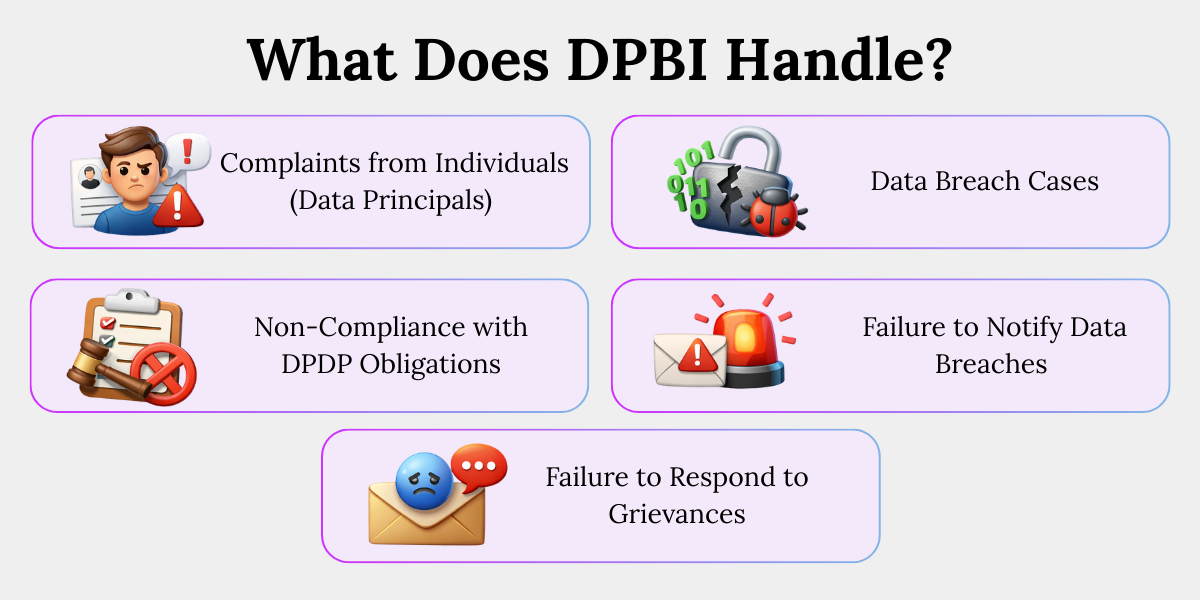
The DPBI operates digitally and handles:
1. Complaints from Individuals (Data Principals)
The DPBI can take up complaints filed by individuals when their rights under the DPDP Act are not respected.
This includes situations where:
-
A company does not respond to a request to access, correct, or delete personal data
-
Consent is taken in a misleading or unclear way
-
Users are unable to withdraw consent easily
Example: A user requests an e-commerce platform to delete their account and personal data. The company ignores the request or delays it without valid reason. The user can file a complaint, which may be reviewed by the DPBI.
2. Data Breach Cases
Organizations are required to report personal data breaches. The DPBI examines whether:
-
The breach was preventable
-
Proper security safeguards were in place
-
The organization responded in a timely manner
Example: A fintech company experiences a data breach exposing customer KYC details. If the company delays reporting the breach or lacks proper security controls, the DPBI may investigate and impose penalties.
3. Non-Compliance with DPDP Obligations
The DPBI reviews whether organizations are meeting their legal obligations under the DPDP Act.
This includes failures such as:
-
Not taking valid consent before processing data
-
Using data beyond the stated purpose
-
Not implementing reasonable security safeguards
Example: A mobile app collects user data for onboarding but later uses it for marketing without consent. This can be treated as a violation and may be examined by the DPBI.
4. Failure to Notify Data Breaches
Apart from handling breaches, the DPBI specifically checks whether organizations properly notified authorities and affected individuals.
Failure to notify is treated as a separate and serious violation.
Example: A company internally fixes a breach but does not inform users or authorities. Even if the breach is contained, non-reporting can lead to penalties.
5. Failure to Respond to Grievances
Before approaching the DPBI, individuals are expected to raise complaints with the organization. If the organization:
-
Does not respond
-
Provides incomplete responses
-
Fails to resolve the issue
The matter can escalate to the DPBI.
Example: A user repeatedly emails a company asking how their data is being used but receives no clear response. This can lead to a formal complaint.
It acts like a legal authority for data protection disputes.
What are the Powers of the Data Protection Board of India?
The Data Protection Board of India has the power to investigate complaints, demand information, conduct inquiries, and impose penalties of up to ₹250 crore under the DPDP Act based on the severity of the violation.
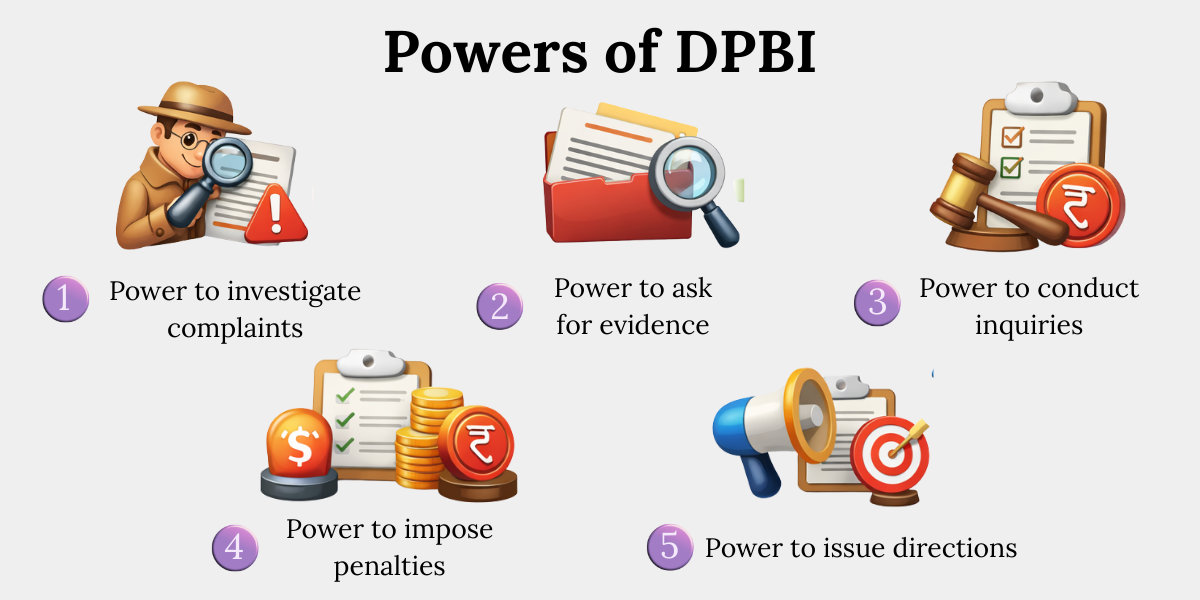
Here are its key powers explained simply:
1. Power to Investigate Complaints (Starting Point)
The DPBI can take up a case when:
-
A user files a complaint
-
A company reports a data breach
-
The government refers a matter
This is the entry point of enforcement. The DPBI decides whether an issue is serious enough to proceed further.
Example: A user asks a platform to delete their personal data but receives no response. The user files a complaint. The DPBI reviews whether the complaint is valid and whether the company needs to respond.
What DPBI does here:
-
Reviews the complaint
-
Checks if it falls under the DPDP Act
-
Decides whether to move to the next stage
2. Power to Ask for Information (Evidence Collection Stage)
Once a case is taken up, the DPBI can require organizations to:
-
Submit records and documents
-
Share details of data processing
-
Explain how personal data is handled
The DPBI collects evidence to understand what actually happened. Companies must support their claims with proper records.
Example: If a company is accused of sharing user data without consent, the DPBI may ask for:
-
Consent records
-
Data sharing agreements
-
Internal policies
If these are missing or unclear, it weakens the company's case.
What DPBI does here:
-
Issues a notice requesting information
-
Sets a deadline for response
-
Reviews documents as evidence
3. Power to Conduct Inquiries (Evaluation Stage)
After collecting information, the DPBI conducts a detailed inquiry to determine:
-
Whether the law was violated
-
Whether proper safeguards were in place
-
Whether the organization acted responsibly
This is the decision-making stage, where the DPBI evaluates both the incident and the organization's response.
Example: A company suffers a data breach. The DPBI examines:
-
Was the data properly secured?
-
Could the breach have been prevented?
-
How quickly did the company act?
Even if the breach was accidental, poor safeguards can lead to liability.
What DPBI does here:
-
Analyzes evidence submitted
-
May conduct digital hearings
-
Determines whether non-compliance occurred
4. Power to Impose Penalties (Enforcement Stage)
The DPBI can impose financial penalties of up to ₹250 crore per violation, depending on:
-
Nature and seriousness of the breach
-
Impact on individuals
-
Steps taken to prevent or mitigate harm
Penalties are based on how serious the failure was, not just whether a violation occurred.
Example: If a company uses personal data for marketing without consent and affects a large number of users, the penalty can be significant---especially if no safeguards were in place.
What DPBI does here:
-
Assesses the level of harm
-
Considers mitigating factors
-
Decides the penalty amount
5. Power to Issue Directions (Corrective Action Stage)
The DPBI can direct organizations to:
-
Fix compliance gaps
-
Update internal processes
-
Improve data protection practices
These directions are legally binding.
The DPBI ensures that organizations not only pay penalties but also correct their systems to prevent future violations.
Example: If a company does not have a proper consent mechanism, the DPBI may require it to:
-
Redesign consent notices
-
Make withdrawal of consent easier
-
Implement better user controls
What DPBI does here:
-
Issues formal orders
-
Specifies required changes
-
Monitors compliance with directions
How to Build DPDP Compliance that Survives DPBI Scrutiny
To meet DPDP compliance requirements and avoid penalties from the Data Protection Board of India, organizations must implement clear systems for data handling, consent management, breach response, and documentation.
Here's a practical approach:
1. Understand What Personal Data You Collect
Start by identifying:
-
What data you collect
-
Why you collect it
-
Where it is stored and shared
Without this, compliance is not possible.
2. Implement Proper Consent Mechanisms
You must:
-
Take clear and informed consent
-
Explain the purpose of data use
-
Keep records of consent
Consent should be easy to give and easy to withdraw.
3. Set Up a Data Breach Response System
You should be able to:
-
Detect breaches quickly
-
Report them on time
-
Inform affected users
Delayed response increases the risk of penalties.
4. Enable Data Principal Rights
Users must be able to:
-
Access their data
-
Correct it
-
Request deletion
These rights should be supported by actual systems, not just policies.
5. Maintain Proper Documentation
Keep records of:
-
Data processing activities
-
Consent logs
-
Security measures
-
Incident reports
If you cannot show proof, compliance is difficult to establish.
6. Assign Responsibility Internally
Define who is responsible for:
-
Data protection
-
Handling complaints
-
Managing breaches
Clear accountability helps in faster response and better compliance.
Conclusion
The Data Protection Board of India (DPBI) plays a central role in enforcing the DPDP Act. It ensures that organizations handle personal data responsibly and takes action when violations occur.
For businesses, this means one thing:
DPDP compliance is not just about having policies---it is about having systems that actually work in practice.
Organizations must be able to:
-
Show how data is collected and used
-
Prove that consent was taken
-
Respond quickly to breaches and user requests
If these systems are not in place, the risk is not theoretical---it can lead to investigation and penalties.
Businesses that build clear, documented, and practical data protection systems will be better prepared to handle DPBI scrutiny and reduce compliance risk.
Key Takeaways
-
The Data Protection Board of India (DPBI) enforces the DPDP Act and can investigate and penalize organizations handling personal data
-
DPBI handles complaints, data breaches, and non-compliance when users' rights are not respected
-
It has powers to investigate cases, collect evidence, conduct inquiries, impose penalties, and issue corrective directions
-
Penalties under the DPDP Act can go up to ₹250 crore, depending on the severity and impact of the violation
-
DPDP compliance requires clear systems for data handling, consent, breach response, and user rights management
-
Proper documentation and internal accountability are essential to prove compliance during DPBI review
-
Strong, practical compliance systems help organizations avoid DPBI scrutiny and reduce the risk of penalties
Related Blog