Table of contents
By-Research Team
April 2, 2026 | 9 min read | DPDP
What is DPIA? Data Protection Impact Assessment Guide
Most organizations don’t ignore compliance.
They just underestimate risk—until something breaks.
A feature gets launched. Data starts flowing. Then comes the question:
“Did you check what could go wrong before using people’s data?”
That’s where DPIA (Data Protection Impact Assessment) comes in—not as theory, but as a practical way to avoid preventable mistakes.
What is a DPIA?
A Data Protection Impact Assessment (DPIA) is a structured process used to identify, assess, and reduce risks when processing personal data - especially when the processing could significantly impact individuals’ rights under GDPR and the DPDP Act India.
In simple terms:
If your system can affect people in a meaningful way, you are expected to evaluate the risks before you use their data.
-
Under GDPR, DPIA is required for high-risk processing
-
Under DPDP, similar expectations exist through data fiduciary obligations and risk-based accountability
What Does a DPIA Include?
A DPIA includes a detailed description of data processing, an assessment of necessity and proportionality, identification of risks to individuals, measures to mitigate those risks, and documentation to demonstrate compliance with GDPR and DPDP requirements.
Think of this as the final output of your DPIA, not the process.
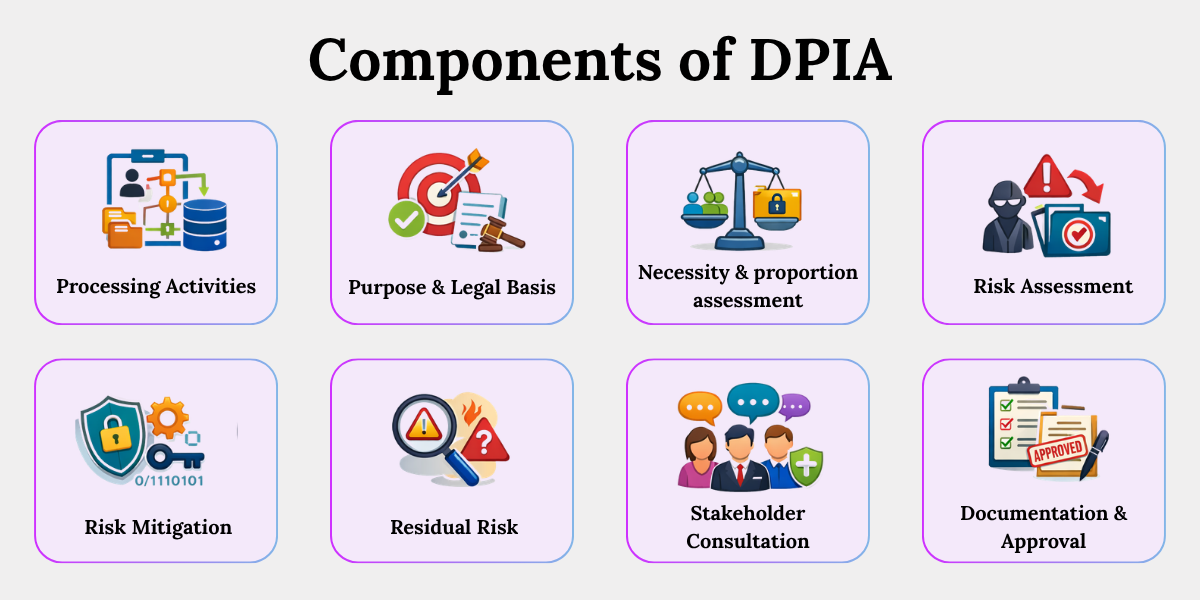
Key Components of a DPIA
1. Description of Processing Activities
A DPIA should clearly describe what personal data is being processed, the purpose of processing, and how the data flows across systems, including collection, storage, sharing, and deletion.
2. Purpose and Legal Basis
It must explain the purpose of processing and identify the legal basis, such as consent, contract, or legal obligation, ensuring alignment with data protection compliance principles.
3. Necessity and Proportionality Assessment
The DPIA should demonstrate that the data processing is necessary for the intended purpose and that only the minimum required personal data is being collected and used.
4. Risk Assessment to Individuals
It should identify and evaluate potential risks to data principals, including privacy invasion, financial harm, reputational damage, or loss of control over personal data.
5. Risk Mitigation Measures
The DPIA must outline the technical and organizational measures implemented to reduce identified risks, such as encryption, access controls, and data minimization practices.
6. Residual Risk Evaluation
It should assess any remaining risks after safeguards are applied and determine whether those risks are acceptable or require further action, including regulatory consultation.
7. Stakeholder Consultation (if applicable)
Where relevant, the DPIA should include inputs from internal teams such as legal and security, and in certain cases, feedback from external stakeholders or affected individuals.
8. Documentation and Approval
Finally, the DPIA should include proper documentation, decision records, and approval logs to demonstrate accountability and readiness for regulatory audits.
Why is DPIA Important for Data Protection Compliance?
A DPIA is important because it helps organizations identify privacy risks early, ensure compliance, and reduce the chances of data breaches by building safeguards into systems before personal data is processed.
Here’s the reality.
Most companies treat data protection compliance as documentation.
Regulators treat it as evidence of thought process and risk awareness.
Key Reasons Why DPIA is Important
1. Early Risk Identification
A DPIA helps organizations identify potential risks to personal data at the planning stage, allowing them to address issues before systems go live instead of reacting after a failure or data breach occurs.
2. Prevents Data Breaches
By evaluating vulnerabilities in advance, DPIA reduces the chances of common failures such as misconfigured systems, excessive access, or weak security controls that often lead to data breaches.
3. Ensures Regulatory Compliance
Conducting a DPIA demonstrates adherence to GDPR requirements and aligns with risk-based obligations under the DPDP Act India, helping organizations avoid penalties and regulatory scrutiny.
4. Strengthens Decision-Making
A DPIA forces organizations to justify why personal data is being collected and processed, leading to more thoughtful, necessary, and proportionate use of data.
5. Protects Data Principal Rights
It ensures that the rights of data principals are considered during system design, reducing the risk of harm such as privacy invasion, discrimination, or misuse of personal data.
6. Provides Audit-Ready Documentation
A properly conducted DPIA creates a documented record of risk assessment and mitigation, which can be used as evidence during audits or regulatory investigations.
According to GDPR enforcement insights:
- Many penalties relate to failure in implementing adequate safeguards or assessing risks beforehand
DPIA changes the approach:
-
From reacting after a data breach
-
To preventing issues during personal data processing
When is a DPIA Required Under GDPR and DPDP Act India?
A DPIA is required when processing is likely to result in high risk to individuals—such as large-scale use of sensitive personal data, continuous monitoring, or automated decision-making—under GDPR, with similar risk-based expectations under the DPDP Act India.
Let’s make this concrete.
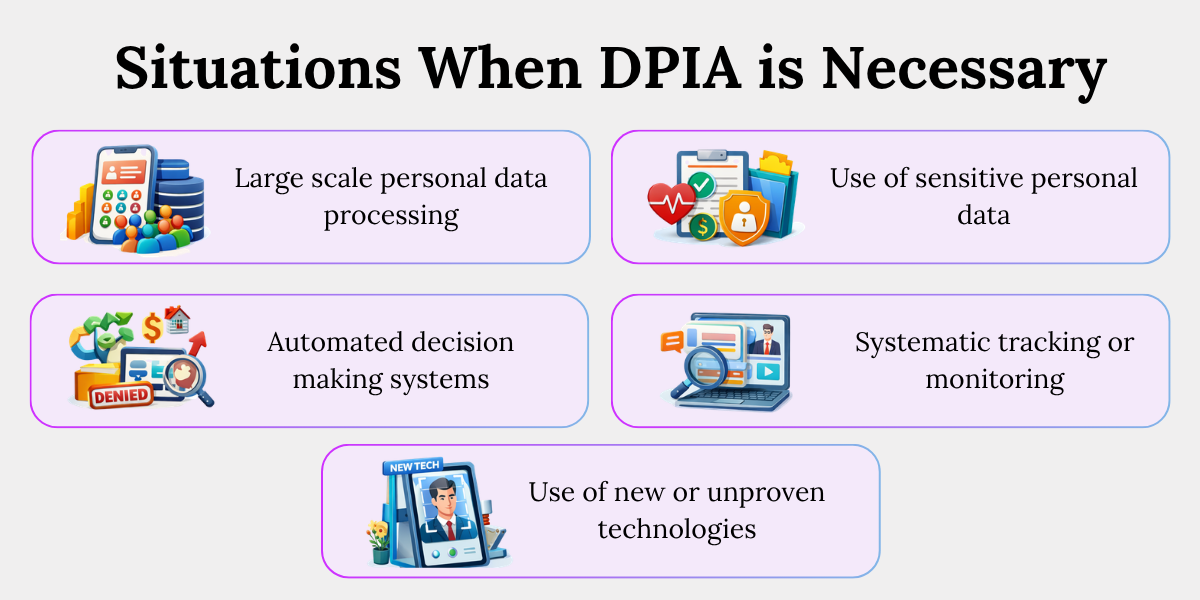
Situations Where DPIA Becomes Necessary
1. Large-Scale Personal Data Processing
When you handle data of thousands or millions of users, even a small mistake can affect a large population. For example, a social media app or edtech platform collecting student data at scale must assess risks before processing.
2. Use of Sensitive Personal Data
Processing sensitive personal data such as health records, financial details, or biometric data carries a higher risk of harm. For instance, a fitness app tracking medical conditions must evaluate how misuse or leaks could impact users.
3. Systematic Monitoring or Tracking
Continuous monitoring of individuals—such as employee tracking tools or website behaviour analytics—can significantly impact privacy. For example, tracking employee screen activity throughout the day requires a DPIA to assess fairness and proportionality.
4. Automated Decision-Making Systems
When decisions are made by algorithms that affect people—like loan approvals or insurance pricing—the risks go beyond privacy. For example, an AI model denying loans based on profiling must be assessed for bias and impact on users.
5. Use of New or Unproven Technologies
If you are deploying new technologies where risks are not fully understood, a DPIA becomes essential. For example, implementing facial recognition in a retail store without fully understanding its impact on customers would require prior assessment.
Simple rule:
If something can impact users at scale, you should do a DPIA.
What are the Steps to Conduct a DPIA?
A DPIA involves identifying data processing activities, assessing necessity, evaluating risks to individuals, implementing safeguards, and documenting outcomes to demonstrate compliance with GDPR and DPDP requirements.
Let’s break it down into actionable steps.
DPIA Process and Checklist
1. Identify what data you are processing
A DPIA begins with a clear understanding of the data being collected and processed across your systems.
-
What personal data are you collecting?
-
Who are the data principals?
-
Where does the data go?
If you can’t map it, you can’t protect it.
2. Check if the processing is necessary
Organizations must evaluate whether the data being collected is genuinely required for the intended purpose.
Ask the uncomfortable question: Do we really need this data?
-
Are you collecting extra fields “just in case”?
-
Is the purpose clearly defined?
Over-collection is one of the most common compliance gaps.
3. Assess risks to individuals
A DPIA requires a thorough assessment of the potential risks that data processing may pose to individuals.
Focus on real impact.
-
Could this lead to identity theft?
-
Financial harm?
-
Loss of privacy or control?
This is your privacy risk assessment stage.
4. Put safeguards in place
Once risks are identified, appropriate technical and organizational measures must be implemented to reduce those risks.
-
Encryption
-
Access restrictions
-
Data minimization
-
Pseudonymization
If risks remain high, GDPR requires consultation with regulators.
5. Document everything and review regularly
Maintaining proper documentation is essential to demonstrate compliance and accountability during audits.
No documentation = no compliance.
-
Maintain DPIA records
-
Update when systems or processes change
This is what regulators will actually check.
How Does DPIA Help Prevent Data Breaches and Penalties?
A DPIA helps prevent data breaches by identifying vulnerabilities early, enabling organizations to implement safeguards, and demonstrating accountability—reducing the likelihood of regulatory penalties under GDPR and DPDP.
Let’s be honest.
Most data breaches are not sophisticated attacks.
They are basic failures:
-
Misconfigured databases
-
Excessive access permissions
-
Lack of encryption
DPIA forces you to catch these issues early.
Conclusion
DPIA is not just a compliance requirement. It is a practical way to assess risks, protect personal data, and ensure accountability under GDPR and the DPDP Act India.
Organizations that evaluate risks early are better prepared to prevent data breaches and meet regulatory expectations.
If you’re looking to implement DPIA effectively, connect with Privacy Global for expert guidance.
Because in data protection, timing is everything.
Key Takeaways
-
DPIA is a process to identify and reduce risks before using personal data.
-
It includes details of processing, risk assessment, safeguards, and proper documentation.
-
DPIA helps detect risks early and prevent data breaches.
-
It is required for high-risk activities like large-scale data use, sensitive data, or AI-based decisions.
-
The process involves understanding data, checking necessity, assessing risks, and applying safeguards.
-
Common use cases include health apps, fintech systems, monitoring tools, and biometric technologies.
-
DPIA improves compliance with GDPR and DPDP requirements.
-
It helps organizations move from reactive fixes to proactive risk management.
Related Blog