Table of contents
By-Research Team
September 8, 2026 | 8 min read | Industry Cases
What is DPDP Act and How Will it Impact Indian Banks?
The Digital Personal Data Protection Act, 2023 is India’s framework for regulating the processing of digital personal data. Enacted on August 11, 2023, the Act establishes obligations for Data Fiduciaries and rights for Data Principals, covering areas such as notice, consent, security safeguards, grievance redressal, and responsible data handling.
What Does the DPDP Act Mean for Indian Banks?
- Customer Lifecycle: Banks process personal data across KYC, account opening, lending, payments, digital banking, customer service, and fraud monitoring.
- Data Management: The DPDP Act affects how banks collect, process, store, share, secure, and manage personal data while meeting existing RBI, KYC, AML, and cybersecurity obligations.
- Cross-Functional Responsibility: IT, cybersecurity, operations, risk, compliance, and vendor-management teams must understand data flows, access, processing purposes, and third-party sharing.
- Implementation Priority: Banks should use the implementation window to build privacy controls and move from policies on paper to privacy controls embedded in everyday banking operations.
Why Is DPDP Compliance Important for Banks?
DPDP compliance is particularly important for banks because banking operations depend on extensive personal data processing, including identity, contact, account, transaction, and KYC information. The Act's Schedule provides for penalties of up to ₹250 crore for failure to implement reasonable security safeguards, up to ₹200 crore for certain personal-data breach notification failures, and up to ₹150 crore for breaches of Significant Data Fiduciary obligations.
-
Financial Data Is High-Value Data
Account information, transaction records, KYC information, contact details, and other customer information require strong governance.
RBI's KYC framework requires banks to obtain information necessary to establish customer identity and understand the nature and purpose of the banking relationship. That creates a clear operational need for banks to know what data they collect, why they collect it, where it goes, and who can access it.
-
Bank Data Breaches Become a Governance Issue
The DPDP Act requires Data Fiduciaries to take reasonable security safeguards to prevent personal data breaches and contains a separate obligation relating to notification of personal data breaches. The associated penalties make breach preparedness a board-level governance concern rather than merely an incident-response exercise.
-
Customer Rights Require Operational Readiness
The Act provides Data Principals with rights including access to information about personal data, correction and erasure, grievance redressal, and nomination. Banks therefore need workflows capable of receiving, authenticating, routing, responding to, and documenting relevant customer requests.
A rights request cannot be solved by sending an email to the IT team and hoping someone finds the database.
The bank needs a repeatable process with ownership, timelines, evidence, and escalation.
What are the Key DPDP Compliance Requirements for Banks?
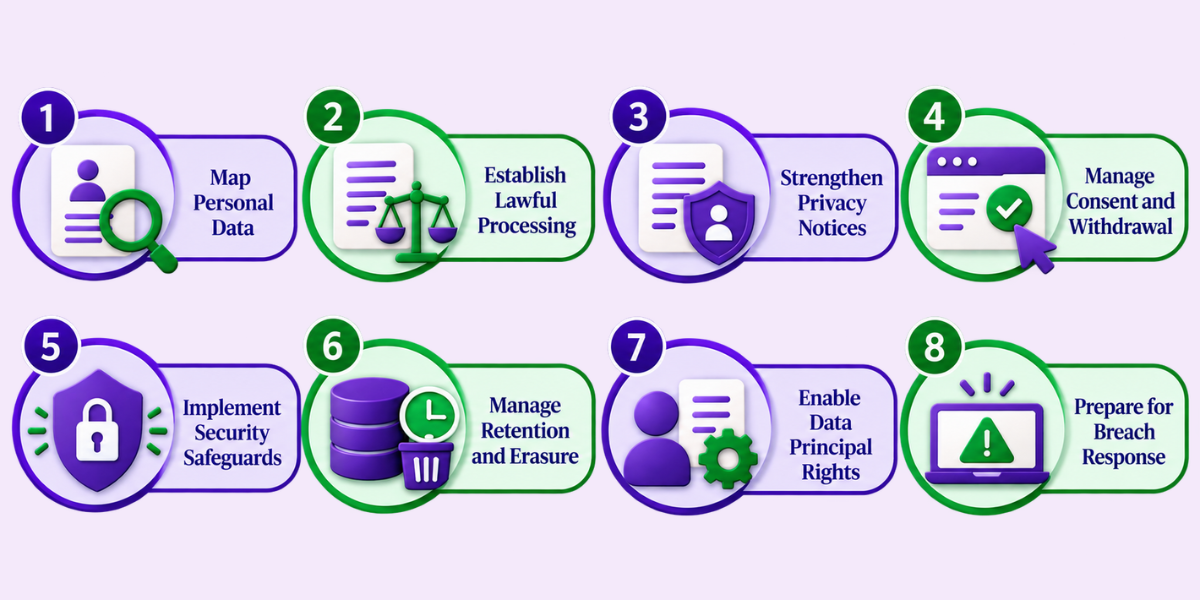
The DPDP compliance requirements for banks span the full personal-data lifecycle: identify processing purposes, provide appropriate notices, establish valid grounds for processing, manage consent where required, implement security safeguards, respond to Data Principal rights, manage processors, and maintain governance over personal-data processing. These requirements should be integrated into banking processes rather than treated as standalone legal documentation.
-
Map Personal Data
Banks should identify what personal data is collected across account opening, KYC, lending, payments, customer service, digital channels, marketing, and employee processes. Data mapping should also identify systems, recipients, processors, access points, purposes, and data flows.
-
Establish Lawful Processing
Document why each processing activity exists. The DPDP Act provides grounds for processing personal data, including consent and certain legitimate uses specified by the Act. Banks need to connect processing activities to the appropriate legal basis and ensure their operational teams understand when consent is required and when another permitted ground applies.
-
Strengthen Privacy Notices
Tell customers what matters, in languages they can actually understand. Section 5 of the Act addresses notice, while section 6 addresses consent. Banks should therefore review customer-facing notices across account opening, digital banking, lending, marketing, and other relevant touchpoints rather than assuming that one generic privacy notice covers every processing activity.
-
Manage Consent and Withdrawal
Where consent is the applicable ground, banks need mechanisms to capture and demonstrate consent and handle withdrawal appropriately. A checkbox buried inside a 30-page onboarding journey may technically exist, but that does not automatically create a well-governed consent lifecycle.
-
Implement Security Safeguards
The DPDP Act requires reasonable security safeguards to prevent personal data breaches. For banks, those safeguards should operate alongside established cybersecurity, access-control, monitoring, encryption, incident-management, and third-party security practices.
-
Manage Retention and Erasure
Banks should connect retention decisions to legal, regulatory, contractual, operational, and privacy requirements. The objective is not indiscriminate deletion; it is controlled retention with a documented reason for keeping data and an appropriate process for disposal when retention is no longer justified.
-
Enable Data Principal Rights
The DPDP Act establishes rights relating to access, correction and erasure, grievance redressal, and nomination. Banks should define responsibility across privacy, legal, operations, customer service, and technology teams so that requests can be handled consistently and evidenced.
-
Prepare for Breach Response
The DPDP Act requires notification of personal data breaches to the Board and affected Data Principals in the prescribed manner. Banks should therefore align privacy breach procedures with their existing incident-response architecture and ensure that escalation, assessment, documentation, and notification responsibilities are clearly assigned.
How Can Banks Prepare for DPDP Compliance?
Banks can prepare for DPDP compliance by treating privacy as an enterprise-wide control framework rather than a one-time legal project. Start with data discovery and mapping, assess processing activities and risks, strengthen notices and consent mechanisms, establish rights and breach workflows, review third-party processing, and create evidence that demonstrates ongoing compliance. The phased commencement of the DPDP framework provides banks with a defined preparation window.
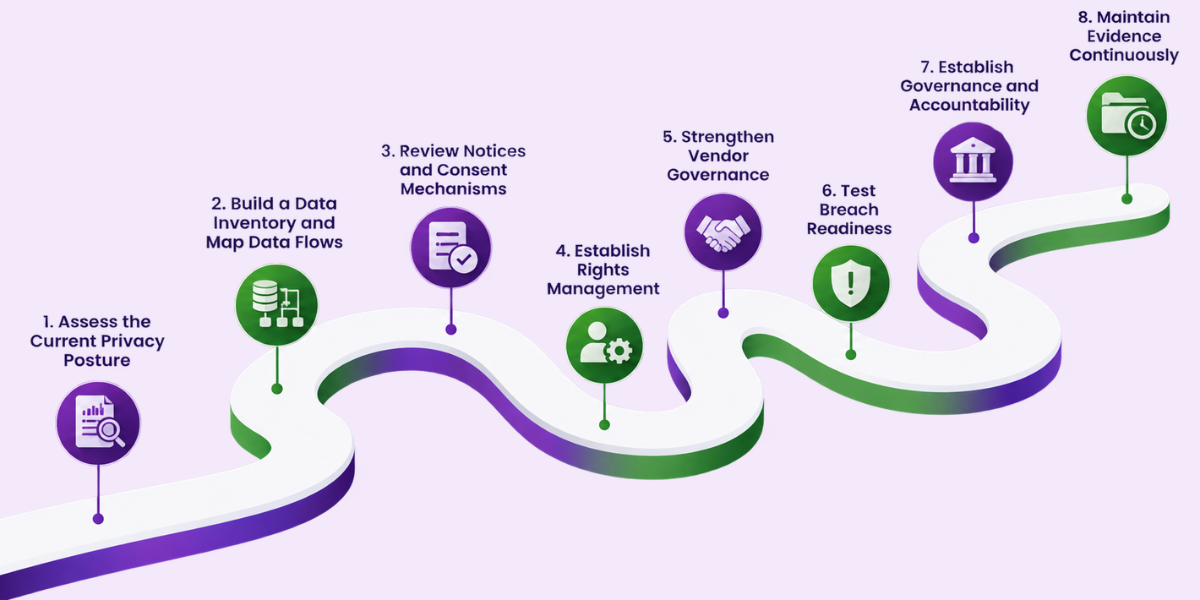
A Practical DPDP Readiness Roadmap for Banks:
-
Assess the Current Privacy Posture
Conduct a structured privacy assessment across business processes, systems, policies, vendors, customer touchpoints, and governance. Prioritize gaps according to regulatory exposure, data sensitivity, processing volume, and operational risk.
-
Build a Data Inventory and Map Data Flows
Create an inventory of personal data and map how it moves through the bank. Connect each processing activity to its purpose, systems, users, recipients, processors, retention requirements, and relevant controls.
-
Review Notices and Consent Mechanisms
Review account-opening forms, mobile applications, websites, loan journeys, marketing communications, and other customer interfaces. Ensure the relevant notices and consent mechanisms accurately reflect how personal data is processed.
-
Establish Rights Management
Define how access, correction, erasure, grievance, and nomination requests will be received, verified, routed, fulfilled, and documented. Integrate these workflows with customer-service and technology teams instead of creating another disconnected compliance mailbox.
-
Strengthen Vendor Governance
Identify vendors and processors handling personal data. Review contracts, data flows, security safeguards, access controls, retention practices, incident procedures, and oversight mechanisms.
-
Test Breach Readiness
Run tabletop exercises covering detection, assessment, escalation, legal review, regulatory notification, customer communication, remediation, and evidence preservation. The DPDP Act specifically addresses breach notification and attaches a potential penalty of up to ₹200 crore for failure to notify the Board or affected Data Principals as required.
-
Establish Governance and Accountability
Privacy compliance needs defined roles across the board, senior management, legal, compliance, information security, technology, operations, procurement, customer service, and business teams. Where a bank is notified as a Significant Data Fiduciary, additional statutory obligations apply under the Act.
-
Maintain Evidence Continuously
Maintain records of assessments, data maps, notices, consent records where applicable, rights requests, vendor reviews, risk assessments, incidents, training, policies, and remediation activities. Audit readiness should be a continuous capability—not a frantic exercise before an audit.
How Can Privacy Global Help Banks with DPDP Compliance?
Privacy Global can support banks across the privacy lifecycle—from assessment and data mapping to risk management, consent, Data Principal rights, DPIAs, breach management, governance, reporting, and continuous compliance monitoring. Its platform combines privacy workflows with expert support to help organizations establish and scale privacy programs aligned with DPDP and other privacy frameworks.
- Build the Privacy Architecture through data inventory and mapping.
- Assess and Prioritize Privacy Risk through assessments, risk management, and DPIAs.
- Operationalize Consent and Rights through structured consent and rights workflows.
- Strengthen Governance and Monitoring through compliance, breach response, reporting, and continuous monitoring.
Conclusion
The DPDP Act for banks goes beyond having a privacy policy. It requires banks to demonstrate responsible control over personal data across the entire banking ecosystem.
Banks should use the preparation window to map data, strengthen controls, govern third parties, operationalize customer rights, and test breach readiness.
With the 2025 Rules and phased commencement timeline in place, banks that act now can turn DPDP compliance from a regulatory scramble into a sustainable privacy governance capability.
Key Takeaways
- DPDP changes how banks manage personal data across KYC, lending, payments, digital banking, customer service, and third-party processing.
- Compliance requires operational controls, not just updated privacy policies or documentation.
- Data mapping, lawful processing, privacy notices, consent, security, retention, and Data Principal rights are core areas banks need to address.
- Breach readiness and vendor governance are critical, given the potential financial and regulatory consequences of non-compliance.
- Banks should use the phased implementation window to assess gaps, build data visibility, strengthen controls, and establish continuous privacy governance.
- An integrated privacy program can help banks manage DPDP requirements alongside existing RBI, KYC, AML, and cybersecurity obligations.
Related Blog