Table of contents
By-Research Team
October 13, 2026 | 15 min read | Product Guide
Best DPDP Assessment Tools in India [2026]
The Digital Personal Data Protection Act, 2023 and the Digital Personal Data Protection Rules, 2025 provide the regulatory framework. With the Rules notified in November 2025 and implementation following a phased timeline, organisations need a clear view of their current readiness.
The best DPDP assessment tools in India help organisations identify privacy gaps, assess risks, and understand what needs to be fixed before DPDP compliance requirements take effect.
These tools and services range from free self-assessment questionnaires to specialist-led DPDP gap assessments that review data flows, policies, processes, contracts, controls, and supporting evidence.
This guide compares 10 DPDP assessment tools and services in India based specifically on their assessment capabilities, including assessment scope, evidence review, gap identification, risk prioritisation, reporting, remediation planning, customisation, and automation.
Top DPDP Assessment Companies in India
The providers below are compared based on their DPDP assessment capabilities, including assessment scope, methodology, evidence review, gap identification, risk prioritisation, reporting, remediation support, customisation, and technology use.
The list is based on publicly available information and is intended as a practical comparison guide, not a guarantee of service quality. Organisations should evaluate providers against their specific assessment needs before making a decision.
- Privacy Global
- ILLUME Intelligence
- miniOrange
- DPDP Act India
- NuageSEC
- Tsaaro
- TrustArc
- DPDP Consultants
- Radiant
- KavachOne
What is a DPDP Assessment?
A DPDP assessment is a structured review of an organisation's personal-data practices against applicable requirements of the Digital Personal Data Protection Act, 2023 and the DPDP Rules, 2025. It typically examines data handling, consent, notices, rights, vendors, retention, security, governance and related controls to identify gaps and prioritise corrective actions.
A good assessment answers questions such as:
- What personal data does the organisation process?
- Where does that data reside?
- Why is it collected and processed?
- How is consent obtained and managed?
- Which vendors or processors receive it?
- How long is it retained?
- What controls protect it?
- Can Data Principal rights be operationally fulfilled?
- Where are the most important gaps?
- What should the organisation fix first?
Why Do Organisations Need a DPDP Assessment Service?
A DPDP assessment service helps organisations move from assumptions to evidence by examining how privacy requirements operate in practice. The value is not simply identifying whether a policy exists; it is determining whether the organisation's data practices, controls, responsibilities and supporting evidence are aligned with the applicable requirements.
The DPDP framework covers areas including consent and transparency, purpose limitation, data minimisation, accuracy, storage limitation, security safeguards and accountability.
That creates several practical assessment triggers.
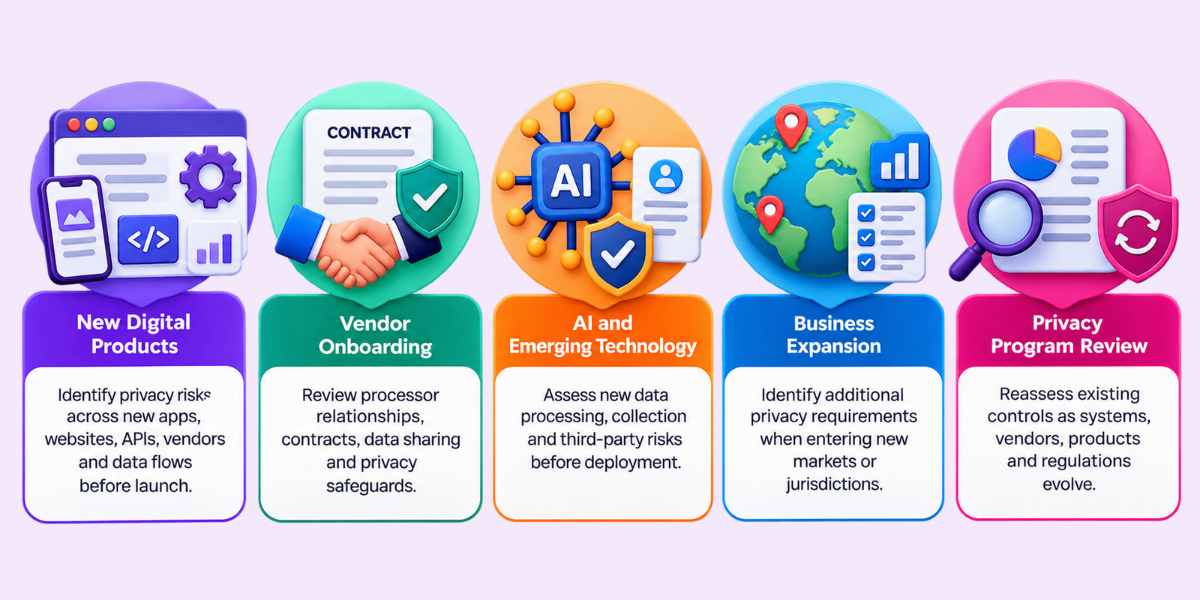
- New Digital Products: Identify privacy risks across new apps, websites, APIs, vendors and data flows before launch.
- Vendor Onboarding: Review processor relationships, contracts, data sharing and privacy safeguards.
- AI and Emerging Technology: Assess new data processing, collection and third-party risks before deployment.
- Business Expansion: Identify additional privacy requirements when entering new markets or jurisdictions.
- Privacy Program Review: Reassess existing controls as systems, vendors, products and regulations evolve.
How We Evaluated DPDP Assessment Service Providers
We evaluated the providers based on the depth and usefulness of their assessment offering, rather than the size of their overall privacy platform. The framework considers assessment scope, methodology, evidence review, risk prioritisation, reporting, remediation, regulatory coverage, customisation and technology, because these factors determine whether an assessment produces a useful roadmap or merely another compliance score.
1. Assessment Scope and Coverage
Does the service cover the core privacy lifecycle?
We looked for coverage across:
- Data discovery
- Data mapping
- Processing
- Consent
- Privacy notices
- Data Principal rights
- Vendors
- Retention
- Security
- Governance
- Breach readiness
2. Assessment Methodology and Evidence Review
This is one of the most important criteria.
Is the assessment based primarily on answers, or does the provider review evidence?
3. Gap and Risk Identification
A useful assessment should not leave the organisation with a flat list of issues.
Findings should be categorised and prioritised so management can determine what requires immediate attention.
4. Assessment Deliverables
We considered whether providers describe concrete outputs such as:
- Assessment reports
- Executive summaries
- Findings registers
- Risk ratings
- Evidence mappings
- Control mappings
- Remediation plans
- Roadmaps
5. Remediation Roadmap
An assessment is more useful when it answers “what next?”
The strongest providers connect findings to owners, timelines, priorities or implementation workstreams.
6. Regulatory Coverage
Some organisations need a DPDP-only assessment.
Others operate under GDPR, CCPA/CPRA, PDPA or other privacy regimes. A broader privacy assessment service can therefore be more valuable for multinational or rapidly expanding organisations.
7. Customisation
A bank, hospital, SaaS company and e-commerce platform do not have the same data flows or risk profile.
We therefore considered whether providers describe customisation based on industry, systems, business units, data categories or organisational maturity.
8. Technology and Automation
Automation can improve consistency and speed, particularly for recurring assessments.
However, automation should be treated as an assessment capability—not proof of assessment quality. A fast score is useful, but it does not automatically validate the underlying controls.
1. Privacy Global
Best for: Expert-led privacy and DPDP assessments across business, technology and governance
Privacy Global provides a structured privacy assessment service that evaluates how an organisation collects, processes, stores, shares, retains and protects personal data. Its assessment covers data mapping, processing, consent, privacy notices, access controls, vendors, retention, Privacy by Design and privacy-related security controls.
The major advantage is breadth.
Privacy Global's assessment methodology is designed to support organisations operating under DPDP as well as multiple other privacy frameworks, including GDPR, CCPA/CPRA, PDPA, PIPEDA, LGPD, APPI, PIPL and PDPL.
Assessment methodology
Privacy Global describes a six-stage process:
- Discovery
- Assessment & Review
- Risk Identification
- Recommendations
- Reporting
- Follow-up Support
The assessment reviews governance practices, policies, systems, workflows, vendors and privacy controls before converting identified risks into prioritised recommendations.
Key assessment strengths
- Organisation-wide privacy assessment
- Data inventory and data-flow review
- Consent and lawful-processing review
- Privacy notice assessment
- Vendor and processor assessment
- Retention and disposal review
- Privacy by Design assessment
- Privacy-related security controls
- Risk-based recommendations
- Multi-regulation privacy assessment
- Remediation roadmap
Deliverables
Depending on scope, Privacy Global describes outputs including a Privacy Assessment Report, executive summary, identified privacy risks, prioritised recommendations, data-flow observations, control assessments, third-party observations, gap analysis and a privacy maturity roadmap.
Best suited for
Organisations that need more than a DPDP questionnaire and want a broader privacy assessment that can support multiple regulatory requirements.
Source: Privacy Global Privacy Assessment Service
2. ILLUME Intelligence
Best for: Evidence-based DPDP gap assessments
ILLUME stands out because it makes evidence verification the centre of its DPDP gap assessment service. It explicitly distinguishes a specialist-led assessment from a self-reported score and says its team reviews actual contracts, consent flows, data inventories, security controls, system configurations and process documentation.
Assessment methodology
ILLUME's process includes:
- Scoping
- Evidence collection
- Specialist review
- Gap identification
- Reporting
The provider says findings are mapped to specific DPDP provisions and ranked by severity and risk.
Key assessment strengths
- Evidence-based review
- Specialist verification
- DPDP provision mapping
- Consent and notice verification
- Data Principal rights review
- Vendor contract review
- Cross-border transfer review
- Security safeguard review
- Documentation and record-keeping review
- Severity-ranked findings
Deliverables
ILLUME describes a specialist-verified gap report, severity-ranked findings, evidence references and a prioritised remediation roadmap. It also positions the output as suitable for board, investor or regulatory review.
Best suited for
Complex organisations with multiple systems, vendors or business units where a questionnaire alone may not provide enough assurance.
3. miniOrange
Best for: Technology-assisted DPDP readiness and gap assessment
miniOrange combines assessment methodology with a broader privacy technology environment. Its DPDP assessment examines data discovery, processing, governance, documentation, vendor risk, security controls and gap prioritisation.
Assessment methodology
The service reviews:
- Applications
- APIs
- Databases
- Business processes
- Vendors
- Data processors
- Privacy documentation
- Contracts
- Consent workflows
- Security controls
It also describes data-flow and data-lineage mapping as part of the assessment.
Key assessment strengths
- Data discovery
- Data-flow mapping
- Governance assessment
- Privacy policy review
- Vendor risk assessment
- Security control assessment
- Consent lifecycle review
- Data Principal rights workflow review
- Cross-border transfer review
- Risk prioritisation
Best suited for
Organisations looking for an assessment that can connect naturally to technology-supported privacy operations.
4. DPDP Act India
Best for: Structured, evidence-based DPDP readiness assessment
DPDP Act India provides both a free self-assessment and a formal specialist-led assessment. Its own methodology explicitly states that the two are not equivalent: the self-assessment provides an indicative readiness picture, while the formal service uses stakeholder interviews, documents, systems and evidence.
Assessment coverage
Its assessment framework covers:
- Scope and applicability
- Data Fiduciary and Data Processor roles
- Processing purposes
- Privacy notices
- Consent and withdrawal
- Legitimate uses
- Data Principal rights
- Security
- Vendors
- Retention
- Children's data
- SDF-related considerations
Deliverables
The provider describes:
- Executive readiness summary
- Applicability and obligation map
- Requirement/control/evidence matrix
- Risk-rated findings
- Missing-evidence register
- Prioritised remediation actions
- Immediate, 30-day and 90-day actions
- Longer-term roadmap
5. NuageSEC
Best for: Technical and security-focused DPDP assessment
NuageSEC approaches DPDP assessment heavily through the lens of cybersecurity and technical safeguards. Its published assessment scope covers 12 security domains, including data discovery, access governance and other technical security areas.
Assessment focus
The technical assessment looks at areas such as:
- Data discovery
- Data inventory
- Data-flow lineage
- Access governance
- IAM
- Security controls
- Application and API security
- Processor verification
- Breach readiness
NuageSEC also describes compliance auditing around control review, evidence review, process validation, findings and audit reporting.
Best suited for
Technology-heavy organisations, SaaS companies and businesses where cybersecurity controls are a major part of the DPDP assessment.
6. Tsaaro
Best for: Global privacy gap assessments
Tsaaro positions its GAP Assessment as a structured comparison between an organisation's existing privacy practices and applicable global privacy regulations, including GDPR and CCPA.
Assessment coverage
The service highlights:
- Privacy policies
- Privacy practices
- Privacy processes
- Non-compliance
- Vulnerabilities
- Recommendations
- Prioritisation
It also connects the assessment with Privacy by Design, risk assessments and DPO services.
Tsaaro states that it covers 50+ regulations and supports frameworks including GDPR, DPDPA, PDPL and HIPAA.
Best suited for
Companies that want a privacy gap assessment that can extend beyond India's DPDP framework.
7. TrustArc
Best for: Automated and recurring enterprise privacy assessments
TrustArc is different from most providers on this list because its Assessment Manager is primarily an assessment management platform. It supports configurable assessments, automated workflows, conditional logic, risk identification, remediation tasks and structured reporting.
Assessment capabilities
TrustArc supports assessments including:
- PIAs
- DPIAs
- TIAs
- Vendor risk assessments
- AI risk assessments
- Legitimate Interest Assessments
- Custom assessments
It also provides pre-built templates and revalidation workflows.
Automation
Its assessment workflows can:
- Surface relevant questions dynamically
- Assign follow-up tasks
- Route work to responsible teams
- Track completion
- Generate reports
- Re-run recurring assessments
TrustArc states that Assessment Manager connects with 300+ integrations and no-code workflow recipes.
Best suited for
Large privacy teams managing recurring assessments across multiple business units, vendors, projects or jurisdictions.
8. DPDP Consultants
Best for: Structured DPDP gap assessment consulting
DPDP Consultants uses a five-step assessment methodology covering grounds of processing, data mapping and inventory, privacy framework evaluation, technical and organisational measures, and gap analysis with remediation planning.
Assessment coverage
The service examines:
- Processing grounds
- Personal data inventory
- Data flows
- Classification
- Retention
- Privacy policies
- Consent
- Data Principal rights
- Breach protocols
- Access controls
- Authentication
- Encryption
- Data minimisation
- Anonymisation
Deliverables
The provider describes:
- Detailed gap analysis
- Risk prioritisation
- Remediation roadmap
- Resource allocation recommendations
- Executive-level summary
9. Radiant
Best for: DPDP assessment combined with implementation support
Radiant's DPDP assessment service combines readiness assessment, data-flow review, policy assessment, risk identification and gap analysis with broader implementation support.
Assessment coverage
Radiant describes assessment of:
- Data collection
- Consent workflows
- Storage and retention
- Governance
- Vendors and processors
- Risk areas
- Data flows
- Breach readiness
- Security controls
- Privacy governance
Radiant also provides:
- Policy drafting
- Control implementation
- Training
- Ongoing compliance support
- Periodic audits
- Third-party risk assessments
Best suited for
Organisations that want the same provider to assess gaps and support subsequent implementation.
10. KavachOne
Best for: Free, quick DPDP readiness assessment
KavachOne provides a free high-level DPDP compliance gap assessment tool. The tool is explicitly positioned as a readiness assessment against the DPDP Act, 2023 and provides a PDF report after registration, applicability assessment and completion of the assessment.
Assessment workflow
The process is presented as:
- Register
- Determine applicability
- Complete assessment
- Receive report
The tool requires organisational information and accepts organisational email addresses rather than personal email domains.
Strength
Low-friction access.
An organisation can use the tool to obtain an initial view of its DPDP readiness without immediately commissioning a full consulting engagement.
Best suited for
Startups, SMEs and organisations looking for an initial DPDP gap snapshot before deciding whether a deeper assessment is necessary.
How to Choose a DPDP Assessment Service
The right DPDP assessment service should match the organisation's risk profile, regulatory footprint and desired level of assurance. Start by deciding whether you need a quick readiness snapshot, a formal gap assessment, a technical control review, a multi-regulation privacy assessment or a technology platform for recurring assessments.
-
Choose an Expert-Led Assessment for Complex Environments
If your organisation has multiple business units, applications, vendors or data flows, a questionnaire may not reveal the full picture.
Look for providers that can review evidence, interview stakeholders and validate how controls operate in practice.
-
Choose a Technical Assessment for Security-Heavy Requirements
If the biggest concern is whether privacy requirements are reflected in applications, databases, cloud environments and access controls, a technical assessment may be more appropriate.
-
Choose a Multi-Regulation Privacy Assessment for Global Operations
If your organisation operates across India and other markets, a DPDP-only review may create another assessment later.
A broader privacy assessment service can evaluate common privacy controls against multiple regulatory frameworks.
-
Choose Evidence Review When Defensibility Matters
Ask a simple question: What evidence will the provider actually examine?
If the answer is only “your questionnaire responses,” you are buying a readiness snapshot. If the engagement includes contracts, policies, system configurations, data inventories, consent records and operational evidence, the assessment is materially deeper.
-
Choose Automation for Recurring Assessments
If your privacy team needs to assess hundreds of vendors, projects or processing activities every year, manual assessments quickly become difficult to manage.
In that case, automated workflow, conditional logic, task assignment, reporting and reassessment capabilities become important.
-
Use Free Tools for Initial Orientation
Free tools can still be useful.
They help organisations understand where potential gaps may exist before investing in a formal assessment. But a free questionnaire should be treated as the first map, not the complete architectural blueprint.
Conclusion
The best DPDP assessment tool is not necessarily the one with the most questions, the largest software platform or the fastest compliance score. The better choice is the assessment approach that gives your organisation enough visibility, evidence, risk analysis and practical direction to understand where it stands and what it should do next.
The practical rule is simple: don't choose an assessment because it gives you a score. Choose it because it gives you a defensible understanding of your privacy posture—and a roadmap for strengthening it.
Key Takeaways
- DPDP assessments help organisations identify privacy gaps, assess risks, and prioritise corrective actions.
- Assessment needs vary from quick self-assessments to specialist-led evidence reviews.
- A strong assessment should cover data, consent, rights, vendors, retention, security, governance, and breach readiness.
- Evidence review and risk prioritisation are key to turning assessment findings into meaningful actions.
- Assessment deliverables should provide clear findings, risk ratings, evidence mappings, and remediation roadmaps.
- Organisations operating across jurisdictions may benefit from a broader privacy assessment service beyond DPDP alone.
- Automation is useful for recurring assessments, but a fast compliance score does not guarantee assessment quality.
- The right assessment service should match your risk profile, regulatory needs, complexity, and required level of assurance.
Related Blog