Table of contents
By-Research Team
October 16, 2026 | 15 min read | Industry Cases
DPDP Compliance for NBFCs: A Practical Guide
In an NBFC, personal data moves through lead generation, loan applications, KYC, underwriting, credit reporting, disbursal, servicing, collections, recovery and post-loan retention, often passing through DSAs, LSPs, technology vendors and collection agencies along the way.
That makes DPDP compliance for NBFCs an operational exercise, not simply a documentation exercise.
The compliance challenge is therefore straightforward to state but harder to execute: an NBFC must know what personal data it holds, why it processes it, where it flows, who can access it, how long it should remain, and what happens when the purpose ends.
Why DPDP Compliance Is Different for NBFCs
DPDP compliance for NBFCs is different because personal data is embedded into almost every stage of lending. An NBFC must coordinate privacy controls across borrower onboarding, KYC, underwriting, credit reporting, digital lending, servicing, collections and third-party operations while also accounting for applicable RBI and other legal requirements.
-
NBFCs process personal data throughout the loan lifecycle:
A borrower’s data is collected from application and KYC to underwriting, disbursal, servicing, collections and loan closure. Privacy controls therefore need to cover the full loan journey, not just onboarding.
-
NBFCs depend heavily on third-party lending and collection ecosystems:
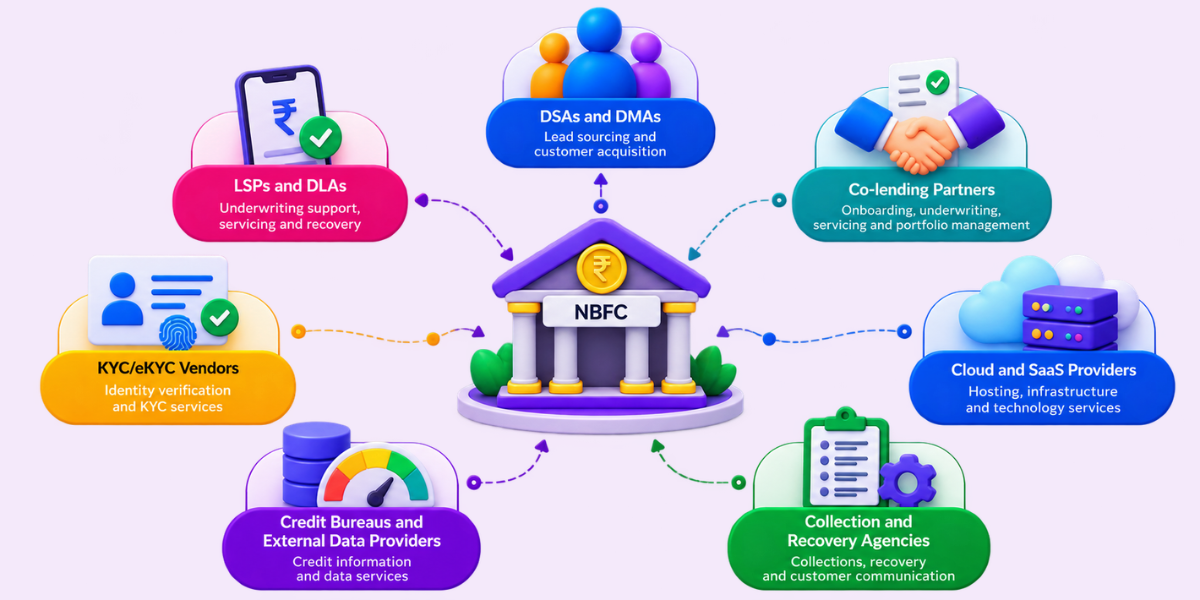
NBFCs often work with DSAs, DMAs, LSPs, KYC vendors, credit bureaus, collection agencies and technology providers. Even when these activities are outsourced, the NBFC must ensure that borrower data is handled securely and in line with applicable requirements.
-
Digital lending increases device and behavioural data risks:
Digital lending can involve device information, app activity and fraud-related signals in addition to traditional loan data. NBFCs should collect only the data they need, clearly define its purpose and maintain proper consent and access controls.
-
Regulatory retention can complicate deletion and erasure:
A borrower’s data cannot always be deleted as soon as it is no longer needed for the original purpose. Some records may need to be retained to meet legal or regulatory requirements, so NBFCs need clear rules for retention, restricted access and deletion.
-
Multiple regulatory frameworks apply to the same data:
NBFCs must manage data under the DPDP framework as well as applicable RBI, KYC, AML and other requirements. This means privacy compliance should work alongside existing compliance, risk, legal, IT and vendor-management processes—not as a separate activity.
Where Does Personal Data Flow in an NBFC?
An NBFC's personal-data lifecycle typically begins before a loan application is submitted and can continue well after the loan is closed. Mapping these stages helps identify where data is collected, transformed, shared, accessed, retained and eventually deleted. It also gives the privacy team a practical framework for assigning controls and ownership.
NBFC Personal Data Lifecycle
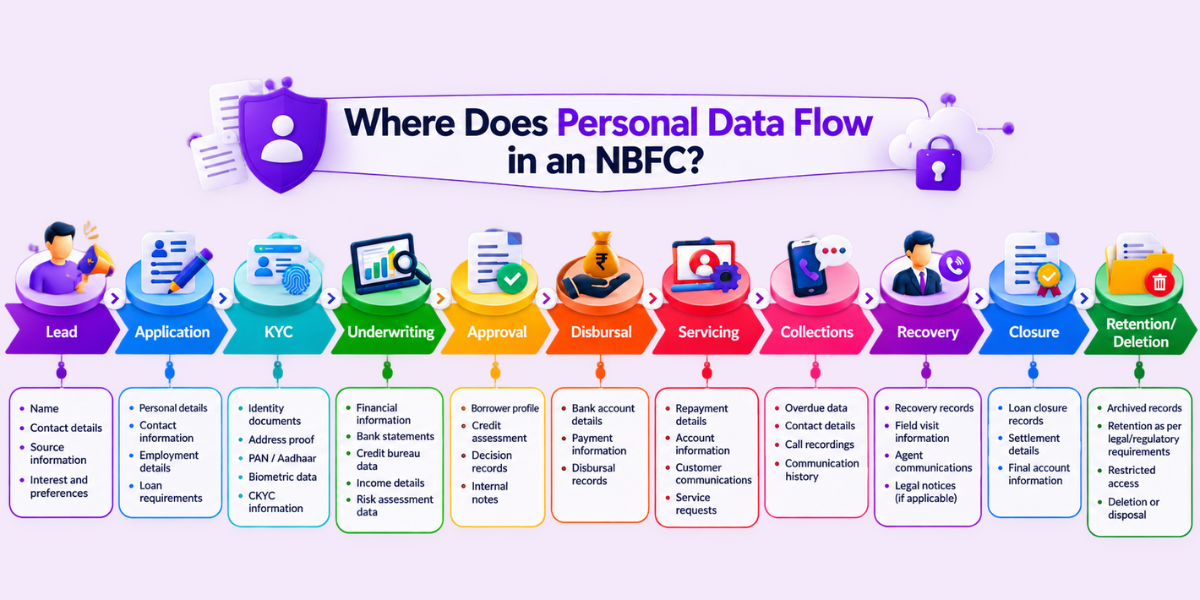
The value of this lifecycle is simple: it turns privacy from a policy document into a map of actual NBFC operations.
For example, if a borrower disputes how their information was used, the NBFC should be able to trace the relevant data from its source to the systems, teams and third parties that handled it.
That is the difference between knowing that data exists and actually governing it.
How Should NBFCs Handle Consent Under the DPDP Act?
NBFCs should not treat every instance of borrower-data processing as one large consent exercise. Consent should be clearly connected to the specific processing for which it is required, while processing that is permitted or required on another applicable legal basis should be distinguished from optional activities such as marketing or additional uses.
What should be separated from core loan consent?
An NBFC should distinguish the processing necessary for the relevant lending activity from optional purposes such as marketing, cross-selling, optional analytics or additional data uses.
For example, a borrower applying for a loan should not be presented with a confusing bundle where accepting the loan appears to require agreeing to unrelated promotional communications. The consent architecture should make each distinct purpose understandable.
How should consent records be maintained?
Consent should leave an evidence trail.
For an NBFC, that can include what notice was presented, what purpose was described, when consent was obtained, through which channel, what version of the notice applied, and how withdrawal can be exercised. The 2025 Rules require notices to be clear, independently understandable and to provide information about how consent can be withdrawn and rights can be exercised.
How should consent withdrawal affect NBFC processing?
A withdrawal should trigger an operational decision rather than simply changing a status field in a consent database.
The NBFC should determine which processing stops, which processing can continue on another applicable basis, which systems must be updated and which processors or partners need corresponding instructions. The 2025 Rules require the withdrawal mechanism to be as easy as the mechanism through which consent was given.
Data Retention and Deletion for NBFCs
NBFC data retention should be designed around purpose, applicable legal requirements and the data lifecycle—not a single organisation-wide deletion period. A practical retention framework should identify what data is held, why it remains necessary, what requirement supports continued retention, who can access it and when deletion or disposal should occur.
DPDP erasure does not mean deleting every record immediately
The DPDP framework provides for erasure when personal data is no longer necessary for the purpose for which it was processed, subject to applicable requirements that permit or require continued processing.
For an NBFC, this means a request involving a closed loan may require a record-by-record retention assessment. KYC records, loan documentation, dispute records and operational data should not automatically be treated as having identical retention requirements. [
Building an NBFC data retention schedule
A useful retention schedule should connect each data category to its business purpose and applicable requirement.
At minimum, map:
- Data category
- Processing purpose
- System or repository
- Applicable retention requirement
- Business owner
- Access restrictions
- Deletion or archival trigger
This prevents the classic compliance problem where everyone knows data must be “retained,” but nobody can explain which data, for how long, and why.
Restricted archival access
Once borrower information is no longer required for routine operations, it should not automatically remain accessible to every employee who could previously access it.
An NBFC can instead move appropriate records into restricted archival environments, with access limited to authorised teams such as legal, compliance, audit or other functions with a legitimate need.
Legal hold and litigation data
A borrower record involved in litigation, a dispute, investigation or another formal legal process may require preservation rather than routine deletion.
The practical control is a legal-hold process that identifies affected records, suspends ordinary deletion where appropriate, documents the reason and limits access to authorised personnel.
What happens to data after loan closure?
Loan closure should trigger a defined privacy workflow—not simply an account-status change in the LMS.
The NBFC should identify which records move into retention, which become restricted, which can be deleted, and which must remain available because another applicable requirement continues to apply. The 2025 Rules also prescribe specific minimum retention requirements for certain processing logs and personal data, subject to other applicable laws.
Managing DSAs, LSPs, Collection Agencies and Other Data Processors
Third-party privacy risk is one of the most important parts of NBFC DPDP compliance because borrower information routinely leaves the NBFC's immediate operational environment. The NBFC should identify what each third party receives, why it receives it, what access it has, what it can do with the data and what happens when the relationship ends. RBI specifically states that outsourcing does not diminish the regulated entity's obligations.
-
DSA and DMA data handling
DSAs and DMAs may participate in sourcing prospective borrowers and can therefore become an early point of personal-data collection.
NBFCs should establish controls around lead-source verification, permitted data fields, access, customer communication, onward sharing and evidence of the applicable notice or consent. A lead that arrives from an external source should not become an unexplained row in the CRM.
-
LSP and DLA data processing
LSPs can perform functions including customer acquisition, underwriting support, pricing support, servicing, monitoring and recovery on behalf of regulated entities. RBI's framework also places requirements on data collection through digital lending apps and LSPs.
The NBFC should therefore map the exact data flow between the DLA, LSP and NBFC, rather than relying on a generic vendor contract.
-
KYC/eKYC vendors
KYC providers can handle high-value identity documentation and verification information.
The privacy control should cover what information the vendor receives, how long it retains it, who can access it, what security measures apply and how deletion or return is handled when the service ends. RBI's KYC framework applies to RBI-regulated entities and establishes requirements around customer identification and due diligence.
-
Credit bureaus and external data providers
Credit information is not simply another marketing database. NBFCs use and report borrower information within a regulated credit-information ecosystem.
RBI's credit-information framework requires credit institutions, including NBFCs, to maintain and report credit information in accordance with applicable requirements. Since January 2025, RBI has moved credit-information reporting toward a fortnightly frequency, improving the timeliness of borrower information.
That makes data accuracy, correction and reporting governance important parts of the privacy control environment.
-
Collection and recovery agencies
Collections create a particularly sensitive access environment because agents may handle borrower contact details, overdue information, communication history and other account information.
Build controls around need-to-know access, approved communication channels, agent authentication, call records, monitoring, training and third-party oversight. Giving a recovery agent access to the entire borrower profile when only limited information is required is not a sophisticated operating model; it is simply excessive access.
-
Cloud and SaaS providers
LOS, LMS, CRM, DMS, analytics, communication and other systems may be hosted or supported by external technology providers.
The NBFC should identify where personal data is processed, define security and contractual controls, manage access and establish exit/deletion requirements. The DPDP Rules expressly require appropriate security provisions in applicable contracts between Data Fiduciaries and Data Processors.
-
Co-lending partners
Co-lending can create data flows between participating regulated entities around borrower onboarding, underwriting, servicing, repayment and portfolio management.
The NBFC should document which entity accesses which data, for what purpose, under what arrangement, and which entity is responsible for each operational privacy control. Do not leave this to an assumption that “both parties already have the data.”
DPDP Security Controls for NBFCs
Security controls for NBFCs should be mapped to the systems that actually hold borrower data: LOS, LMS, CRM, DMS, collections platforms, mobile applications, branch systems, call centres, analytics environments and cloud infrastructure. The DPDP Rules require safeguards including encryption or masking, access controls, logging and monitoring, backups, processor-contract provisions and technical and organisational measures.
-
Access control
Start with the question: who actually needs access to this borrower data?
Credit analysts, collections agents, customer-service teams, IT administrators and external partners do not need identical access. Use role-based permissions and review access when employees, agents or vendors change roles.
-
Encryption and masking
Protect borrower data while it is stored and transmitted, and reduce unnecessary visibility of sensitive fields.
The DPDP Rules expressly identify encryption, obfuscation, masking and virtual tokens as examples of security measures.
-
Audit logs
An NBFC should be able to answer who accessed borrower data, when, from where and what happened afterwards.
The DPDP Rules require visibility into access through appropriate logs, monitoring and review to help detect, investigate and remediate unauthorised access.
-
Tokenisation
Tokenisation can reduce exposure of original identifiers where a business process does not require the underlying value.
The 2025 Rules expressly recognise the use of virtual tokens mapped to personal data as one possible security measure.
-
Privileged access
Administrators can become the shortest route through the privacy fortress.
Apply stronger controls to privileged accounts, including appropriate authentication, monitoring, periodic reviews and separation of administrative duties for critical NBFC systems.
-
Agent access
DSAs, field staff, collection agents and recovery agents should not receive broad access simply because they need some borrower information.
Give agents the minimum information required for the assigned task. Then monitor that access and remove it when the assignment ends.
-
Mobile application security
For digital lending, review every category of information an application or associated technology stack collects.
RBI's digital lending framework specifically emphasises need-based data collection, prior and explicit borrower consent, borrower discretion regarding specific data and clear audit trails.
-
Document security
KYC documents, bank statements, income proofs and loan agreements often exist outside the core LOS or LMS.
Protect the document management layer, shared drives, branch repositories and archives with appropriate access controls, monitoring and retention rules. A beautifully secured database does little good if the same borrower documents are freely downloadable from an unmanaged shared folder.
Data Principal Rights in an NBFC
NBFCs should treat Data Principal rights as an operational workflow rather than a legal-policy paragraph. The rights framework includes access-related rights, correction and erasure, grievance redressal and nomination, with the organisation required to provide practical mechanisms for exercising applicable rights.
- Access requests: Provide an appropriate mechanism for Data Principals to exercise applicable access rights and understand how their personal data is being processed.
- Correction requests: Create a workflow for receiving, validating and updating inaccurate or incomplete personal data across relevant systems.
- Erasure requests: Assess erasure requests against the applicable processing purpose and any requirement that permits or requires continued retention.
- Grievances: Provide a clear grievance mechanism and ensure that the relevant customer-service, compliance and privacy teams know how to route and resolve privacy-related complaints.
- Nomination: Incorporate the nomination right into the NBFC's rights-management process and ensure the mechanism is clearly communicated to Data Principals where applicable.
Does NBFC Need SDF-Level Privacy Governance?
SDF designation is based on criteria specified under the DPDP framework, rather than simply the fact that an organisation is an NBFC.
An NBFC should assess whether its scale, nature and volume of personal-data processing could bring it within the Significant Data Fiduciary framework rather than assuming that every NBFC automatically has SDF status. Where SDF obligations apply, governance expands to areas including DPIAs, audits, DPO responsibilities, board oversight and algorithmic-processing controls.
The practical approach is to assess scale, volume and sensitivity of processing, risks to Data Principals, potential impact on sovereignty/integrity of India and other prescribed factors, and document the assessment.
Data Protection Officer
Where SDF obligations apply, the organisation needs appropriate Data Protection Officer arrangements and a clear point of accountability for privacy governance.
For an NBFC, this role should connect privacy with compliance, legal, risk, IT security, operations and business teams, rather than operating as an isolated policy function.
Data Protection Impact Assessment
A Data Protection Impact Assessment provides a structured way to identify privacy risks before or during higher-risk processing.
For an NBFC, potential focus areas could include large-scale borrower profiling, digital lending data collection, automated decisioning, extensive third-party data sharing or other processing that creates significant risks to Data Principals, where applicable.
Independent audit
The notified Rules require SDFs to undertake a comprehensive audit at least once every year, with the relevant results reported to the Board.
The audit should test whether controls work in practice—not merely whether a privacy policy exists.
Board-level governance
Privacy becomes a governance issue when personal-data processing is material to the organisation's business, regulatory exposure and customer relationships.
The Board and senior management should have visibility into material privacy risks, significant incidents, third-party exposure, remediation and compliance status rather than discovering privacy issues after an audit report lands on the table.
Algorithmic/data processing considerations
NBFCs increasingly use technology for underwriting, fraud detection, risk assessment and other decision-support activities.
The DPDP Rules require SDFs to undertake measures concerning algorithmic software used for processing personal data so that it does not pose a risk to the rights of Data Principals. RBI has also highlighted the increasing use of rule-based algorithms and machine learning models in credit decision-making and has been developing principles around model risk management.
Need Help Implementing DPDP Compliance at Your NBFC?
Connect with Privacy Global to discuss your NBFC's DPDP compliance needs.
Conclusion
DPDP compliance for NBFCs is ultimately about managing personal data throughout the lending lifecycle.
A strong privacy programme therefore cannot rely on policies alone. NBFCs need to map their data, define why it is collected, control who can access it, manage third-party sharing, apply clear retention and deletion rules, and handle Data Principal rights effectively.
The practical approach is simple: know what data you have, where it flows, who handles it, why it is needed and how long it should be kept. When these controls are built into everyday lending operations, privacy becomes part of the NBFC's compliance framework—not a separate exercise.
Key Takeaways
- NBFC privacy starts with the full lending lifecycle, covering data from lead generation and KYC through underwriting, servicing, collections, recovery and retention.
- NBFCs must manage third-party data risks across DSAs, LSPs, KYC vendors, credit bureaus, collection agencies and technology providers.
- Consent should be purpose-specific, with clear records of what was communicated, what was agreed to and how withdrawal is handled.
- Retention and deletion need clear rules, balancing DPDP requirements with applicable legal and regulatory obligations.
- Security controls should protect data across NBFC systems, including LOS, LMS, CRM, mobile apps, document repositories and collections platforms.
- Data Principal rights need operational workflows for access, correction, erasure, grievances and nomination.
- NBFCs should assess their SDF exposure and strengthen governance through DPO oversight, DPIAs, audits, Board-level governance and appropriate controls where applicable.
Related Blog