Table of contents
By-Research Team
September 22, 2026 | 8 min read | DPDP
Third-Party Vendor Contracts Under the DPDP Act: What Businesses Need to Know
A business may have strong privacy policies and secure systems, yet one weak third-party vendor contract can create a critical DPDP compliance gap. Personal data rarely stays within one organization. Cloud, payroll, SaaS, KYC, and customer support vendors may all process it. The data may leave your environment, but your compliance responsibility does not.
A third-party vendor contract under DPDP should clearly define the vendor’s processing scope, security and breach obligations, access controls, and data retention or deletion requirements.
Under the DPDP Act, a data Processor processes personal data on behalf of a Data Fiduciary. Section 8 requires Data Fiduciaries to remain responsible for processing carried out on their behalf and requires relevant Data Processor engagements to be under a valid contract.
What Is a Third-Party Vendor Under the DPDP Act?
A third-party vendor under the DPDP Act is not a separately defined statutory category. In practical compliance terms, it refers to an external organization that provides services to a business and may process personal data as part of those services. Where the vendor processes personal data on behalf of the business, it may fall within the statutory definition of a Data Processor.
The classification depends on the vendor’s role in processing personal data and whether it processes that data on behalf of the business.
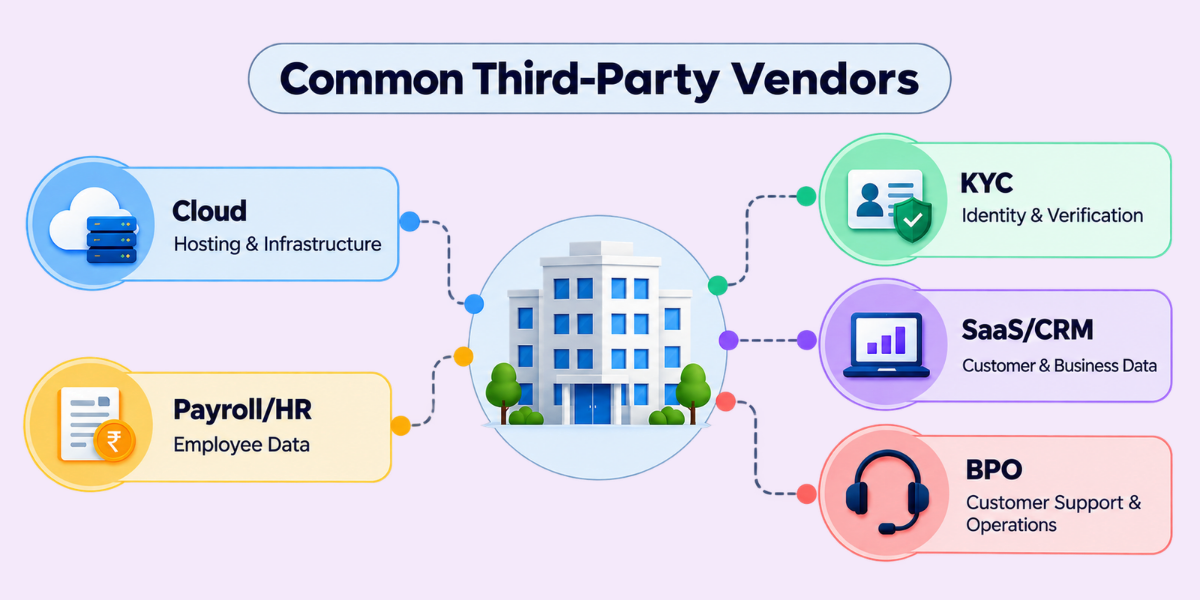
Common Third-Party Vendors
Personal data may reach vendors across everyday business operations, including:
- Cloud and Hosting Providers
- Payroll and HR Vendors
- KYC and Verification Providers
- CRM and SaaS Providers
- BPO and Customer-Support Vendors
When a vendor processes personal data on behalf of a Data Fiduciary, the contractual relationship becomes an important part of the organization’s privacy-control framework. Clear contractual controls help define how the vendor can access, use, protect, retain, and delete personal data.
What Are Third-Party Vendor Contracts?
A third-party vendor contract is an agreement between a business and an external service provider that defines the services, responsibilities, and conditions under which the vendor operates. When the vendor handles personal data, the contract should also establish clear requirements for how that data can be accessed, processed, protected, retained, and deleted.
In a privacy context, the contract turns the organization’s expectations into enforceable obligations. It can define the vendor’s permitted processing activities, security responsibilities, breach notification requirements, access controls, use of sub-processors, data retention, deletion, and support for applicable Data Principal requests.
For businesses handling personal data, a third-party vendor contract is therefore more than a procurement document. It forms part of the organization’s privacy and data-governance framework, particularly where an external party processes personal data on the organization’s behalf.
Why Do Third-Party Vendor Contracts Matter Under DPDP?
Third-party vendor contracts matter under DPDP because the Data Fiduciary remains responsible for processing carried out on its behalf by a Data Processor. Section 8 also requires relevant Data Processor engagements to be under a valid contract, while the 2025 Rules require appropriate contractual provisions for reasonable security safeguards.
Outsourcing processing does not mean outsourcing accountability.
-
Responsibility lies with the data processor as well
Section 8(1) keeps responsibility with the Data Fiduciary, even when processing is handled by a Data Processor. The business must therefore control what data is shared, why it is processed, how it is protected, and what happens when the relationship ends.
-
Contracts turn expectations into controls
A vendor contract converts privacy requirements into enforceable operational obligations covering processing, security, access, breach notification, subcontracting, retention, and deletion.
-
Security must reach the vendor
Rule 6 requires reasonable security safeguards and appropriate provisions in applicable Data Fiduciary–Data Processor contracts, including measures such as encryption, access controls, logging, monitoring, and backups.
-
Breach response needs coordination
Vendor incidents can trigger Data Fiduciary obligations. Contracts should therefore define breach notification timelines, escalation contacts, incident information, and response responsibilities. A breach clause should work in practice—not just sit in the contract.
When Is a Third-Party Vendor Contract Required Under DPDP?
A third-party vendor contract under DPDP becomes important when an external organization processes personal data on behalf of a Data Fiduciary. Section 8(2) requires relevant Data Processor engagements to be under a valid contract. The starting point is classification. Assess the vendor based on its actual processing activities and the personal data it handles.
-
Start with the processing activity
Identify whether the vendor receives, accesses, stores, analyses, transmits, or otherwise processes personal data on the organization’s behalf. This may include payroll platforms processing employee data, cloud providers hosting customer databases, or customer-support vendors accessing customer records.
-
Prioritize vendors with personal data access
Focus contractual reviews on vendors that handle customer data, employee data, hosted personal data, or data-related services such as BPO, analytics, and verification. Vendors that use sub-processors also require attention because personal data may move further along the vendor chain.
-
Review existing vendor contracts
DPDP compliance should cover existing as well as new vendor relationships. Review current agreements, identify processing-related gaps, and update contracts through amendments, DPAs, or revised agreements where required.
A simple process is Inventory → Map → Classify → Review → Remediate → Document.
What Should a Third-Party Vendor Contract Include Under DPDP?
A third-party vendor contract should define permitted processing activities and establish controls for security, confidentiality, breach handling, access, sub-processors, retention, deletion, and other relevant obligations. The DPDP framework requires relevant Data Processor engagements to be under a valid contract, with applicable contracts addressing appropriate security safeguards.
The Act and Rules do not prescribe one exhaustive vendor contract template. Businesses should tailor contractual clauses to the processing relationship, legal requirements, sector obligations, and risk.
-
Processing Scope and Purpose
Define what personal data the vendor can process, why it is processed, and which services require that processing. Avoid broad permissions that allow data to be used beyond the agreed purpose.
-
Data Types and Access
Specify the categories of personal data involved, and the level of access required. Give vendors the access they need—not unrestricted access by default.
-
Security Safeguards
Contracts should address appropriate security measures based on the processing risk, including access controls, encryption, authentication, logging, monitoring, backups, security testing, and incident management, as applicable.
-
Breach Notification
Define notification timelines, escalation contacts, required incident information, investigation support, and remediation responsibilities so the vendor can support the Data Fiduciary's breach obligations.
-
Sub-Processors
If vendors can engage other parties to process personal data, specify applicable authorization, notification, visibility, and contractual flow-down requirements.
-
Data Principal Rights
Where relevant, require vendors to support the Data Fiduciary in responding to applicable Data Principal requests, including locating, correcting, or deleting personal data.
-
Retention and Deletion
Define how personal data is retained, returned, or deleted when processing ends, including relevant production data, backups, logs, and sub-processor-held data.
-
Audit and Assurance
Establish proportionate assurance requirements, which may include certifications, audit reports, security assessments, testing summaries, or remediation evidence.
-
Termination and Exit
Define requirements for data return or deletion, access revocation, transition support, and other exit activities when the vendor relationship ends. The goal is not to create the longest contract. It is to create clear, enforceable controls that work throughout the vendor relationship.
Conclusion
The biggest mistake businesses can make with third-party vendor contracts under DPDP is treating the contract as paperwork completed after procurement.
It is not.
The contract is part of the organization's privacy architecture. It defines the boundaries within which an external party can interact with personal data and creates a foundation for security, incident response, accountability, and controlled data lifecycle management.
Start with the data flow. Identify the vendors. Classify the relationship. Then build contractual controls around the actual processing.
Because when personal data crosses your organizational boundary, your responsibility does not automatically cross with it.
Key Takeaways
- A third-party vendor contract is an important part of DPDP compliance when vendors process personal data on behalf of a Data Fiduciary.
- Engaging a Data Processor does not remove the Data Fiduciary’s responsibility for processing carried out on its behalf.
- Assess vendors based on the personal data they process and the role they perform, rather than treating every vendor relationship the same.
- Contracts should address processing scope, access, security, breach notification, sub-processors, retention, deletion, and exit requirements.
- DPDP vendor governance should cover existing vendor relationships as well as new engagements, with gaps identified and remediated where necessary.
- A strong vendor contract should support ongoing monitoring, incident response, and controlled data lifecycle management—not simply satisfy a documentation requirement.
Related Blog