
Table of contents
By-Research Team
November 21, 2025 | 8 min read | DPDP
India’s move toward a privacy-first digital economy just took a major leap. On 13th November 2025, the Government notified the Digital Personal Data Protection Rules, 2025, finally clarifying how organisations must implement the DPDP Act, 2023.
This blog breaks the New DPDP Rules down in simple, practical terms — whether you’re a business leader, compliance owner, or someone who just wants to make sure their personal data isn’t being treated like free Wi-Fi in the office.
Let’s check it out ..
Introduction
The DPDP Act tells you the law, while the DPDP Rules explain how to follow it in practice .
The Government of India released the DPDP Rules on 13th November 2025, following months of industry consultations.
This new DPDP Rules improve data protection by requiring clear deadlines, simpler consent forms, stronger child data safety, better security rules, fast breach reporting, and stricter controls for big companies (SDFs).
Data collected? Good. The next step is to manage and safeguard it properly.
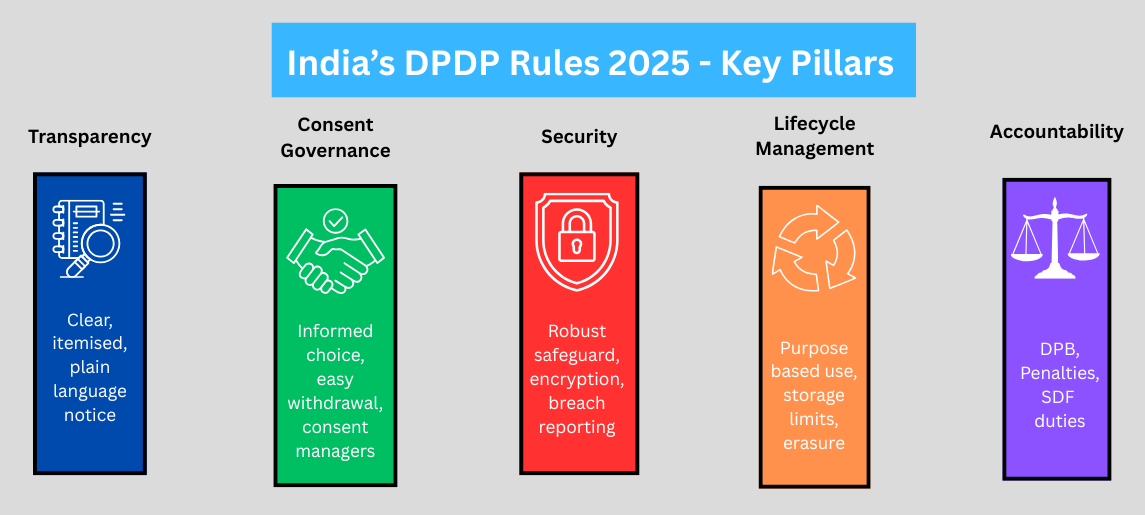
Overview of Final DPDP Rules 2025
The Final Rules revolve around five key pillars:
- Transparency — Clear, itemized, plain-language notices.
- Consent Governance — Standardised processes through registered Consent Managers.
- Security — Mandatory safeguards, access controls, logging, backup, and breach response.
- Lifecycle Management — Defined timelines and expectations for retention and erasure.
- Accountability — Stronger obligations for SDFs and reporting requirements.
These themes closely align with global privacy frameworks while keeping India’s regulatory and digital ecosystem in mind.
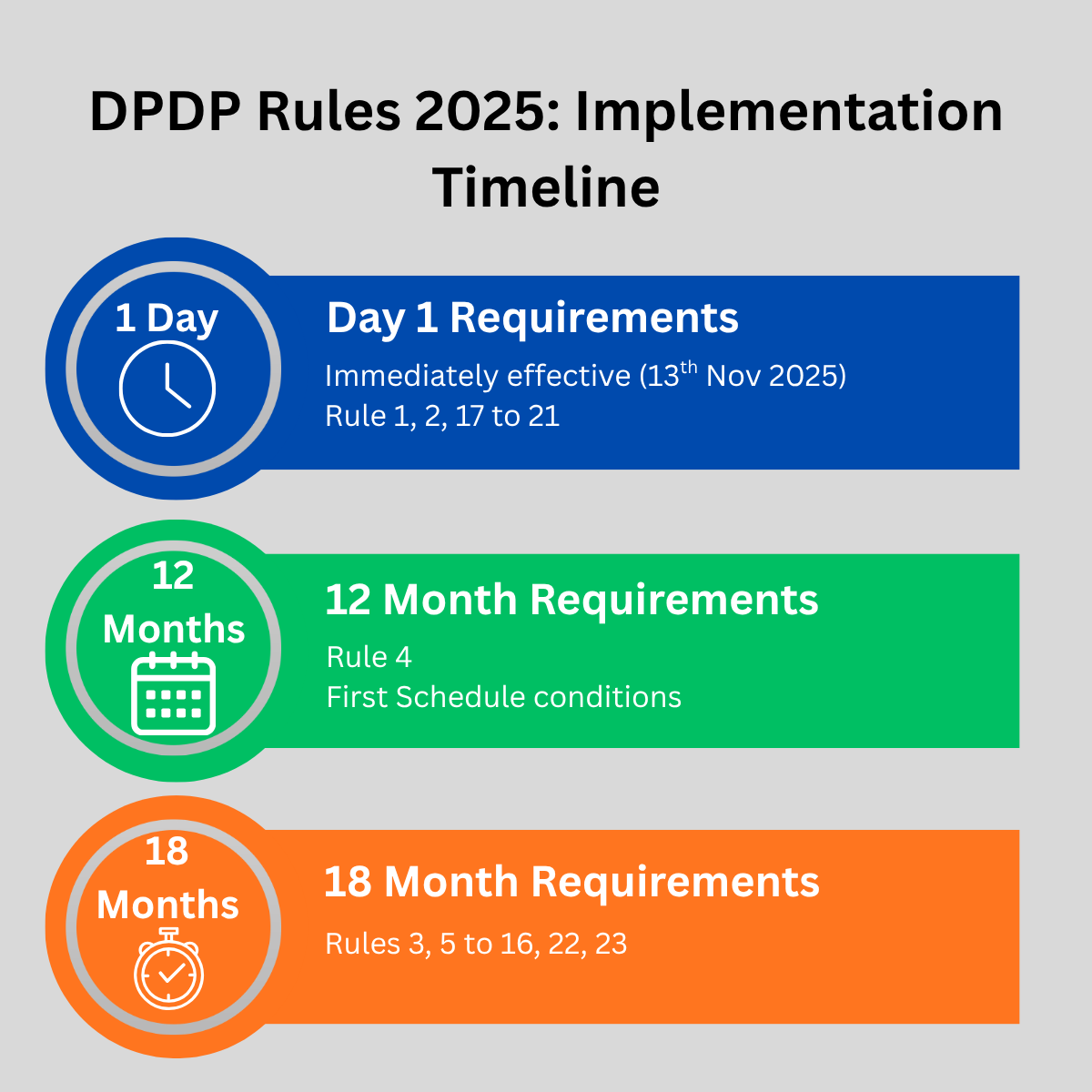
Rollout & Compliance Timelines
Day 1 Requirements
Immediately effective upon notification (13 Nov 2025):
- Rule 1 (Short title & commencement)
- Rule 2 (Definitions)
- Rules 17 to 21 (Board constitution, functioning, appointments, digital office, etc
This phase lays down the institutional foundation — the Data Protection Board must exist before compliance enforcement can begin.
12-Month Requirements
Rule 4 (Consent Manager registration) comes into force 1 year from publication.
This gives Consent Managers time to meet conditions in the First Schedule, such as:
- Minimum ₹2 crore net worth
- Proof your platform works well with others
- The tools and processes you use to ensure compliance
- Sound management with stable finances
By Month 12, Consent Managers will be fully operational.
18-Month Requirements
Rules 3, 5 to 16, 22 and 23 become effective 18 months after publication.
This includes the core operational compliance requirements:
- Notice (Rule 3)
- Consent Manager obligations (Rule 4)
- Reasonable security safeguards (Rule 6)
- Breach intimation (Rule 7)
- And many more
This 18-month buffer is essentially the government saying: “We’re giving you time. Use it wisely.”
Detailed Breakdown of DPDP Rules
Now, let’s explore the DPDP Rules in detail.
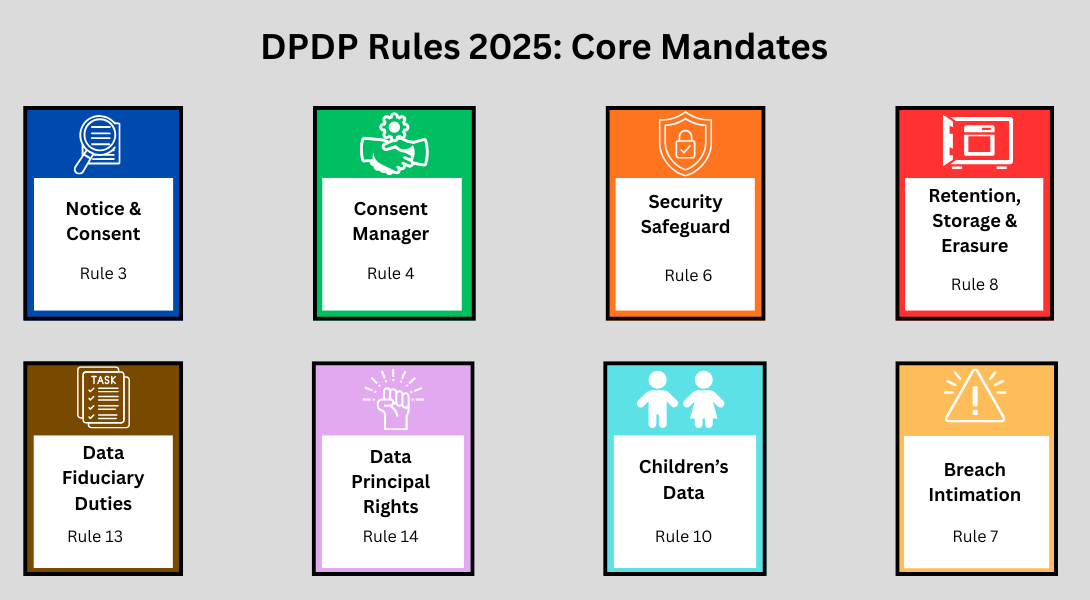
Notice & Consent Requirement (Rule 3)
A Notice must:
- Be presented independently
— You cannot bury the notice inside a 20-page Terms of Service PDF. - Use clear and plain language
— No jargon, no legalese. - Include at minimum:
(i) an itemised description of personal data being processed
(ii) the specified purpose(s) and the exact goods/services to be enabled - Provide a communication link
- to withdraw consent
- to exercise rights
- to make a complaint to the Board
Basically, no more “By clicking Sign Up, you agree to sell your soul” hidden clauses.
Registration & Obligations of Consent Manager (Rule 4)
Registration Requirement
A consent manager must be:
- A company incorporated in India
- Have minimum ₹2 crore net worth
- Have sound financials, management character, and technical capacity
- Certified to run a consent platform that works smoothly with others.
Obligations
Consent Managers must:
- Allow Data Principals to give, manage, review, withdraw consent
- Maintain records of consent given/denied/withdrawn, notice, data sharing events
- Maintain records for minimum 7 years
- Ensure unreadability of personal data
- Operate fiduciary responsibility
Reasonable Security Safeguard (Rule 6)
Every Data Fiduciary shall protect personal data via certain minimum mandatory controls, which include:
- Encryption, obfuscation, masking or virtual tokens
- Access controls on computer resources
- Logs, monitoring and review of access
- Backup measures to maintain confidentiality/integrity/availability
- Retention of logs for 1 year
Data Retention, Storage & Erasure (Rule 8)
Erasure requirements
Erasure must occur when:
- Retention is no longer necessary, OR
- The Data Principal does not interact for a defined period.
Data fiduciary must notify Data Principal 48 hours before erasure.
Mandatory Retention
- Retain personal data + traffic data + logs for at least 1 year after processing
- Unless longer retention required by law.
Intimation of Personal Data Breach (Rule 7)
Data fiduciaries must:
- Inform the data principal immediately after becoming aware of the breach, regarding nature, extent, timing of breach, consequence, mitigation measure and the recommended safety steps
- Inform the DPBI within 72 hours of the breach
The Rules don’t allow “Let’s silently pray no one notices” anymore.
Processing of Children’s Personal Data (Rule 10)
For anyone under 18:
- Verifiable parental consent is mandatory.
- No profiling.
- No behavioural monitoring.
- No targeted advertising.
- No tracking.
Basically: “Kids’ data is off-limits unless parents approve.”
Significant Data Fiduciaries (Rule 13)
These are high-impact organisations — large users, critical data processors, or high-risk sectors.
SDFs must:
- Appoint a DPO
- Undertake DPIA every 12 months
- Undergo annual data audits
- Furnish reports with significant observations
- Ensure algorithmic tools are not likely to pose risk
Rights of Data Principals (Rule 14)
Data fiduciaries and Consent managers must:
- Publish means for Data Principals to exercise rights
- Specify identifiers needed for access
- Respond within prescribed timelines
- Provide grievance redressal channels
- Allow nomination of another individual
- Adopt technical measures to ensure effectiveness
Cross-Border Transfer of Personal Data (Rule 15)
Personal digital data can be transferred to approved countries subject to government-specified conditions, including:
- Restrictions for transfers to foreign states
- Sectoral limitations
- Possible safeguards (contractual, technical)
Draft vs Final DPDP Rules: Side-by-Side Comparison
| Topic | Draft DPDP Rules (Jan 2025) | Final DPDP Rules (Nov 2025) |
|---|---|---|
| Privacy Notice | Less detailed; generic disclosure requirements. | Mandatory itemised data list, specified purpose, explicit communication link, independent presentation. |
| Consent Managers | Basic concept proposed. | Full registration conditions + obligations (₹2 crore net worth, interoperability certification, 7-year record retention). |
| Security Safeguards | High-level expectations. | Mandatory minimum controls: encryption/masking, access controls, logs, monitoring, backup, 1-year log retention. |
| Data Retention | No Third Schedule timeline structure. | Clear erasure triggers, mandatory notifications, minimum 1-year retention, DF obligation to notify 48 hours prior. |
| Breach Reporting | Report to Board; no specific timelines. | Two-step reporting: “without delay” + detailed update within 72 hours. Includes mandatory communication to Data Principals. |
| Children’s Data | Generic parental consent. | Specific technical & organisational verification steps + Digital Locker + 4 illustrations. |
| SDF Obligations | DPIA mentioned vaguely. | DPIA every 12 months, annual audits, algorithmic risk governance, retention requirements, processing restrictions. |
| Rights of Data Principals | Basic description. | Detailed procedural requirements for rights execution, identifiers, grievance timelines, nomination rules. |
| Cross-Border Transfer | Proposed restricted list. | Flexible rule: transfer allowed subject to government conditions; no positive/negative list yet. |
What These Rules Mean for Businesses ?
The DPDP Rules represent a significant shift in how organisations in India must treat personal data. This isn’t just compliance — it’s a transformation in operational discipline.
Businesses must now:
- Strengthen compliance structures,
- Maintain auditable consent trails,
- Adopt strong security safeguards,
- Prepare breach handling workflows,
- Manage data lifecycle (collect → store → delete),
- Invest in privacy governance.
The days of “Collect everything, store forever” are over.
For many organisations — especially startups and legacy enterprises — this may feel like moving from casual weekend jogs straight into a half-marathon.
But the payoff is trust, legitimacy, and stronger digital resilience.
Conclusion: The Road Ahead
The DPDP Rules, 2025 mark a major step in India’s digital governance evolution.
They are clear, practical, and aligned with global patterns — but tailored to India’s realities.
Over the next 18 months, organisations will embark on a structured compliance journey that demands discipline, accountability, and transparency.
For organisations, this is not just compliance — it’s an opportunity to build trust, credibility, and responsible digital growth.
Think of it as spring-cleaning your data practices… but with legal consequences.
How Privacy Global Can Help
Privacy Global makes DPDP compliance simpler by giving your organisation a single platform to manage consent, automate workflows, strengthen security practices, and stay audit-ready — without the complexity.
Whether you’re starting your compliance journey or scaling it, we help you meet the DPDP Rules with confidence and clarity.