
Table of contents
By-Research Team
February 6, 2026 | 10 min read | DPDP
DPDP vs GDPR: Key Differences
DPDP vs GDPR is not a question of which law is stricter. It’s a question of which compliance architecture you’re building.
We see teams copy GDPR playbooks into DPDP programs and wonder why operations break.
Different terrain. Different threat model. Different fortress design.
This guide cuts through the confusion and gives you a practical roadmap to comply with both—without duplicating effort or creating blind spots.
Why Does DPDP vs GDPR Confuse So Many Organisations?
DPDP and GDPR pursue the same outcome—protecting personal data—but they are built on different regulatory philosophies. GDPR is rights-heavy and procedure-driven. DPDP is outcome-focused and governance-led. Confusion arises when organisations assume GDPR documentation equals DPDP compliance. In practice, DPDP tests operational controls, not paperwork.
Here’s the real problem.
Most global teams treat DPDP as “GDPR-lite.” That shortcut fails audits. Organisations with perfect GDPR policies still fail DPDP checks because controls weren’t enforced at system level.
GDPR trains you to document intent. DPDP forces you to prove execution.
What Is the Core Difference Between DPDP and GDPR?
GDPR regulates how personal data rights are exercised. DPDP regulates whether data handling is demonstrably safe and purpose-bound. GDPR is a rulebook for processes. DPDP is a stress test for governance systems. One rewards completeness. The other penalises operational gaps.
Think in Fortresses, Not Checklists
- GDPR fortress: Built around consent flows, legal bases, and rights management.
- DPDP fortress: Built around access control, logging, breach readiness, and accountability.
Data Fiduciary vs Data Controller
GDPR and DPDP use different accountability terms because they assign responsibility differently. A Data Controller under GDPR is accountable for lawful decision-making around data use. A Data Fiduciary under DPDP is accountable for preventing harm through active safeguards. One governs intent. The other governs outcomes.
High-level terms hide a structural shift.
Under GDPR, a Data Controller is responsible for deciding why and how personal data is processed. Liability flows from decision-making authority, shared with processors through contracts and documented controls.
DPDP changes the centre of gravity.
A Data Fiduciary is treated less like a policy author and more like a custodian of risk. The expectation is not just lawful purpose, but continuous protection—access controls, monitoring, breach prevention, and demonstrable governance.
In practice, the difference is stark.
- GDPR asks: Did you choose a lawful basis and respect rights?
- DPDP asks: Did your systems actively prevent misuse and harm?
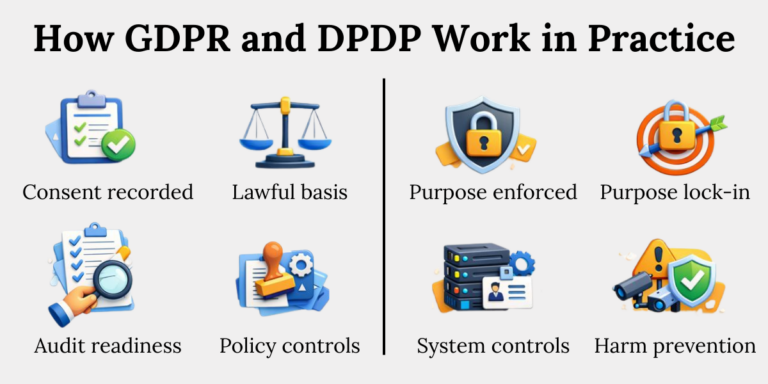
Consent Under DPDP vs GDPR
GDPR consent emphasises lawful basis and revocability. DPDP consent emphasises purpose enforcement. Under DPDP, consent without technical restriction is weak compliance. Systems must actively block data use beyond the stated purpose—not just record approval
How This Breaks in Practice
We routinely see:
1. Consent Recorded vs Purpose Enforced
Under GDPR, capturing consent and logging it is often treated as sufficient. Under DPDP, consent must be technically enforced. Systems should block data use outside the stated purpose, not just rely on policy statements.
2. Lawful Basis Flexibility vs Purpose Lock-In
GDPR allows multiple lawful bases and internal reassessment over time. DPDP expects purpose fixation at collection, making later reuse without fresh consent a direct compliance failure.
3. Policy Controls vs System Controls
GDPR operations lean heavily on policies, training, and internal approvals. DPDP operations demand system-level safeguards—role-based access, purpose tags, and automated restrictions embedded into platforms.
4. Processor Oversight vs Fiduciary Liability
GDPR distributes accountability between controllers and processors contractually. DPDP places primary liability on the Data Fiduciary, even when misuse occurs through vendors or internal teams.
5. Audit Readiness vs Harm Prevention
GDPR audits focus on documentation and decision records. DPDP scrutiny centres on whether harm was actively prevented, using logs, access histories, and breach detection timelines as proof.
That’s acceptable risk under GDPR. Under DPDP, it’s exposure.
Breach Notification: Why DPDP Changes the Clock
GDPR mandates breach notification within 72 hours of becoming aware. DPDP requires notification to the Data Protection Board of India and affected individuals without delay, with strict expectations on detection readiness. The hidden requirement is continuous monitoring, not response templates.
| Aspect | GDPR Breach Notification | DPDP Breach Notification |
|---|---|---|
| Notification Trigger | The 72-hour clock starts once the organisation becomes aware of a personal data breach. | Notification is required without delay after discovery, with expectations of early detection built into operations. |
| Regulatory Authority | Breach is reported to the Supervisory Authority in the EU member state concerned. | Breach must be reported to the Data Protection Board of India (DPBI). |
| Data Subject Communication | Individuals are notified only if the breach is likely to result in high risk to their rights and freedoms. | Affected Data Principals must be informed along with the DPBI, unless exempted by the Board. |
| Detection Expectations | GDPR focuses on response timelines after awareness; detection speed is implied but not explicitly enforced. | DPDP implicitly requires continuous monitoring and rapid detection, making delayed discovery a compliance risk. |
| Operational Evidence Tested | Emphasis on incident response plans, documentation, and decision logs. | Emphasis on system logs, monitoring alerts, escalation trails, and containment actions. |
| Penalty Exposure | Penalties depend on severity and turnover, often assessed post-investigation. | Penalties are event-specific and directly tied to failure to notify or delayed reporting. |
Penalties: Why “Lower Maximums” Are a Trap
GDPR and DPDP penalise non-compliance very differently. GDPR uses percentage-based fines tied to global turnover, making penalties scale with company size. DPDP uses fixed, contravention-specific penalties, making enforcement faster and more predictable. The real risk under DPDP is not size—it’s operational failure.
GDPR Penalties: Turnover-Based and Tiered
GDPR penalties are designed to scale with organisational size and economic power.
- Up to €10 million or 2% of global annual turnover (whichever is higher) for lower-tier violations such as record-keeping, DPO obligations, and processor contracts.
- Up to €20 million or 4% of global annual turnover (whichever is higher) for core violations like unlawful processing, invalid consent, data subject rights failures, and cross-border transfer breaches.
- Supervisory Authorities assess fines based on intent, negligence, duration, mitigation efforts, and past violations.
In practice, enforcement is procedural and investigatory, often taking months or years before final penalties are imposed.
Translation: GDPR threatens your wallet size. Bigger companies bleed more.
DPDP Penalties: Fixed, Targeted, and Operational
DPDP penalties are event-driven and failure-specific, not revenue-linked.
- Up to ₹250 crore for failure to implement reasonable security safeguards.
- Up to ₹200 crore for failure to notify personal data breaches to the Board or affected Data Principals.
- Up to ₹200 crore for violations involving children’s personal data.
- Up to ₹150 crore for failures by Significant Data Fiduciaries (DPIA, audits, governance duties).
- Up to ₹50 crore for other contraventions under the Act.
Penalties are imposed by the Board after inquiry, with a clear focus on what failed operationally.
Translation: DPDP threatens your license to be trusted. One weak control can trigger enforcement—regardless of company size.
Can One Compliance Program Cover DPDP and GDPR?
Yes—but only if built on shared controls, not shared documents. The winning approach is a dual-layer architecture: GDPR processes on top, DPDP operational safeguards underneath. One framework. Two enforcement lenses.
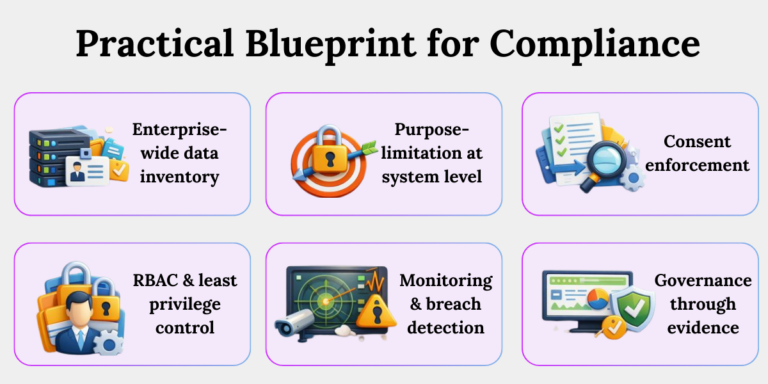
The Practical Blueprint We Recommend
1. Unify: Enterprise-Wide Data Inventory & Classification
Build a single, living data inventory covering personal, sensitive, and children’s data across systems and vendors. Classify data by purpose, risk level, storage location, and retention to support both GDPR ROPA requirements and DPDP accountability checks.
2. Anchor: Purpose Limitation at System Level
Map every data element to a defined purpose and enforce it through technical controls. Under DPDP, purpose limitation must be coded into workflows, not documented in policies, to prevent unauthorised reuse.
3. Separate: Consent Capture from Consent Enforcement
Treat consent logs and enforcement logic as distinct layers. Use consent records for auditability, but rely on access rules, flags, and automation to ensure data cannot be processed beyond approved purposes.
4. Strengthen: Role-Based Access & Least Privilege Controls
Implement granular RBAC aligned to job functions and review access periodically. DPDP expects active restriction and monitoring, while GDPR tolerates broader access if justified—this is where shared programs often fail.
5. Operationalise: Continuous Monitoring & Breach Detection
Deploy logging, alerting, and anomaly detection to identify misuse early. DPDP compliance depends on how fast you detect and contain incidents, not how well you explain them after the fact
6. Prove: Governance Through Evidence, Not Assurances
Use dashboards, audit trails, DPIAs, and management reports to demonstrate compliance in real time. Regulators under both laws test what you can show, not what your policy claims.
This is how mature teams scale compliance without duplication.
DPDP vs GDPR: Key Differences
| Dimension | GDPR | DPDP |
|---|---|---|
| Regulatory Philosophy | Rights-driven framework focused on procedures and lawful processing. | Risk-driven framework focused on safeguards and harm prevention. |
| Primary Accountability | Accountability flows from controller decisions and documented legal bases. | Accountability flows from fiduciary outcomes and operational controls. |
| Audit Focus | Emphasis on documentation, policies, and decision records. | Emphasis on system behaviour, logs, and control effectiveness. |
| Failure Mode | Non-compliance arises from legal or procedural missteps. | Non-compliance arises from operational breakdowns and control gaps. |
| Consent Enforcement | Consent is validated through records and revocability mechanisms. | Consent must be technically enforced through system-level restrictions. |
| Breach Readiness | Focuses on response timelines after breach awareness. | Focuses on continuous monitoring and rapid detection before impact escalates. |
| Penalty Design | Percentage-based fines linked to global turnover. | Fixed, contravention-specific penalties linked to control failures. |
Conclusion
DPDP vs GDPR is not about choosing a side. It’s about engineering a compliance architecture that survives both inspections and incidents. GDPR teaches discipline. DPDP tests resilience. Build your compliance like a fortress—with layered defences, clear accountability, and no decorative walls.
That’s how trust scales—legally and operationally.
Key Takeaways
- DPDP vs GDPR: Same objective, but radically different compliance architectures and enforcement logic.
- Core Difference: GDPR rewards documented intent; DPDP tests real-world execution and safeguards.
- Accountability Shift: Controllers decide under GDPR; Fiduciaries prevent harm under DPDP.
- Consent Reality: GDPR records consent; DPDP enforces purpose at system level.
- Operational Breakpoints: What passes GDPR audits often fails DPDP operational checks.
- Breach Readiness: GDPR measures response speed; DPDP measures detection maturity.
- Penalty Design: GDPR scales fines by turnover; DPDP targets specific control failures.
- Winning Model: One compliance program works—if built on shared controls, not shared paperwork.