Table of contents
By-Research Team
November 3, 2026 | 11 min read | Governance
SOC Reports and Why Businesses Need Them
Businesses rarely operate in isolation. They rely on cloud platforms, SaaS applications, payroll providers, payment processors, and other third parties to manage critical systems and sensitive information. But when these services operate outside your organisation, how do you know whether the controls protecting your business are designed and operating effectively?
SOC reports help businesses evaluate a service organisation’s controls through an independent examination. They provide information that customers, auditors, and business partners can use to assess risks associated with outsourced services. For organisations handling sensitive data or supporting critical business processes, these reports can strengthen customer assurance, support vendor risk management, and improve transparency.
The practical question is not simply whether your business needs a SOC report. It is which report addresses your risks, who expects it, and what assurance it actually provides.
What Is a SOC Report?
A System and Organization Controls (SOC) report is an independent examination report that provides information about controls at a service organisation or, depending on the SOC engagement, other organisational systems and processes. SOC reports help customers and other intended users evaluate risks associated with the services they rely on. The report’s purpose and scope depend on the type of SOC examination.
Think of a SOC report as an evidence-based view of a service provider’s control environment—not a promise that nothing can go wrong.
For example, a company using an external cloud platform may need to understand how the provider manages access, monitors systems, or protects information. A SOC report can help evaluate relevant controls, depending on the report’s scope and criteria.
What Does a SOC Report Evaluate?
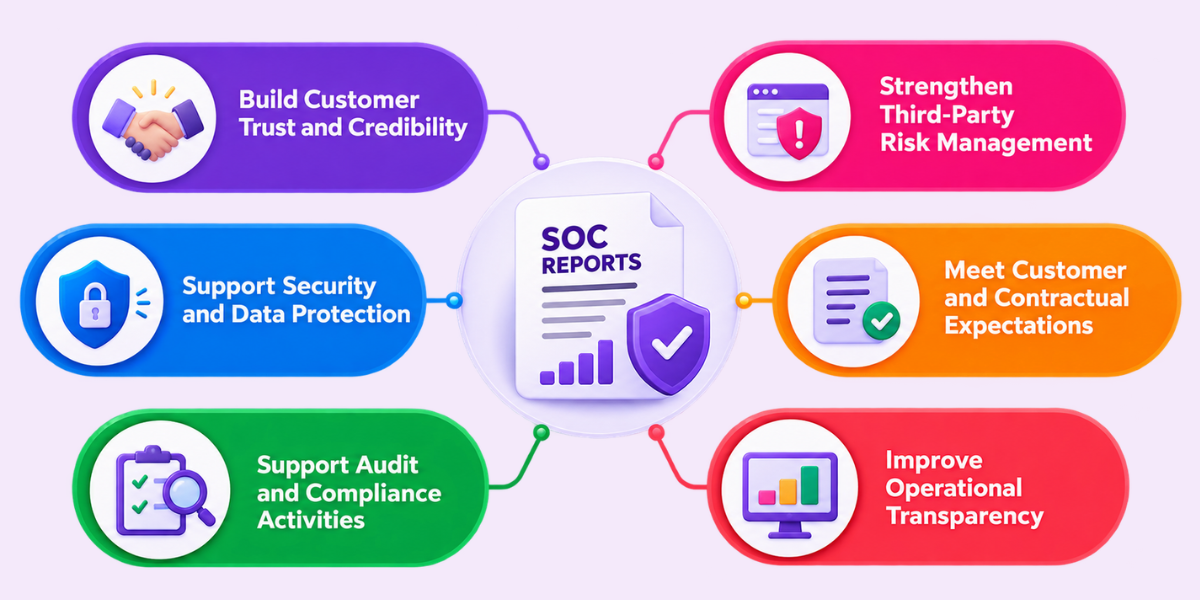
The controls examined depend on the report type and the services being assessed. They may address areas such as:
- Access controls: How access to systems and information is restricted and managed.
- Security controls: How the organisation addresses risks involving unauthorised access and system protection.
- Availability: How the service is designed to meet relevant availability commitments.
- Processing integrity: Whether system processing is complete, accurate, timely, and authorised where applicable.
- Confidentiality and privacy: How information is handled against the applicable criteria.
Not every SOC report covers every area. SOC 1 focuses on controls relevant to customers’ internal control over financial reporting, while SOC 2 examines controls against selected Trust Services Criteria.
The takeaway: Always check what the report covers before treating it as evidence of assurance for a particular risk.
Are SOC Reports Legally Mandatory?
SOC reports are not a universal legal requirement for every business. Whether an organisation needs one depends on factors such as customer contracts, procurement policies, the nature of its services, and applicable industry or regulatory expectations. A customer may make a SOC report a condition of doing business even when no law specifically requires that report.
This distinction matters. A reporting engagement may be voluntary in general, yet commercially necessary for a particular provider.
Consider a SaaS company pursuing a contract with a large financial institution. The institution may ask for a SOC 2 report as part of its third-party risk assessment. The provider might not be subject to a universal SOC 2 mandate, but without suitable assurance evidence, it could struggle to meet the customer's procurement requirements.
Before deciding whether to pursue a report, assess three separate considerations:
- Legal obligations: Determine which laws and regulatory requirements apply to your business and services.
- Contractual requirements: Review customer agreements, vendor questionnaires, and procurement conditions.
- Commercial expectations: Establish whether prospective customers commonly request independent assurance as part of their evaluation.
Why Do Businesses Need SOC Reports?
Businesses need SOC reports when customers, auditors, or other stakeholders require reliable information about relevant controls at a service organisation. These reports can support customer trust, third-party risk management, security assessments, procurement decisions, and audit activities. Their value lies in providing structured evidence for risk evaluation— not in guaranteeing that a business or service is risk-free.
Why does this matter? Because a vendor's assurances about its controls are not the same as independent examination evidence.
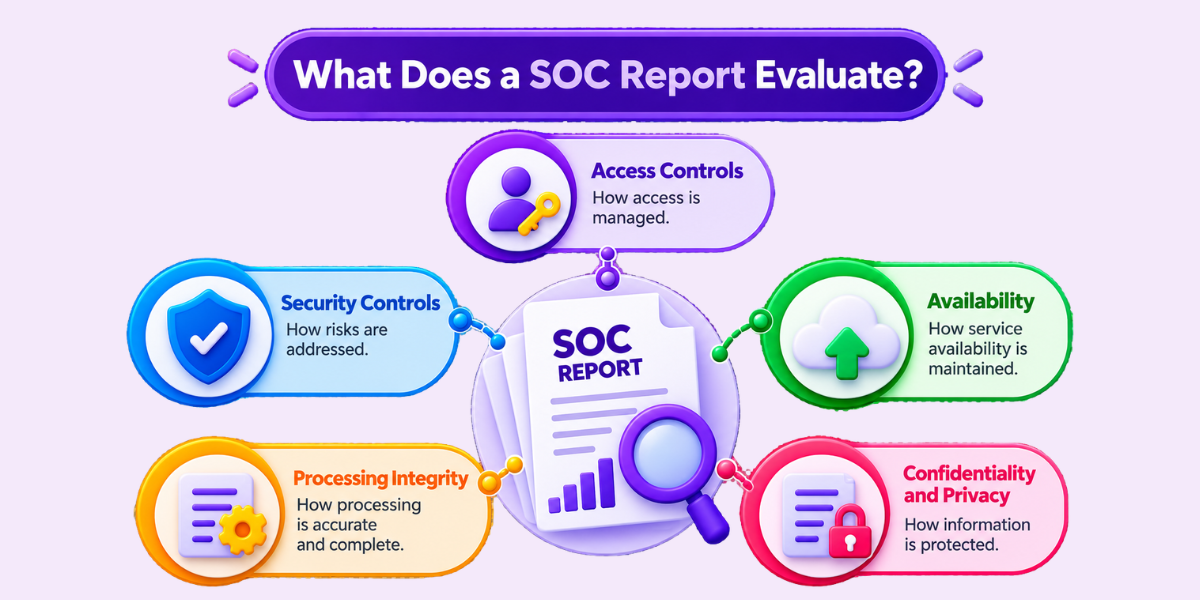
The following benefits explain the practical importance of SOC reports.
-
To Build Customer Trust and Credibility
Independent assurance can make customer due diligence more evidence-based. When customers assess a service provider, they need more than marketing claims about security or reliability.
A relevant SOC report gives intended users information about the provider's described systems, applicable controls, and the independent service auditor's opinion. This can help customers make better-informed decisions about whether the service meets their assurance needs.
For example, a business selling a cloud-based HR platform may be asked to demonstrate how it manages controls relevant to the service. A suitable SOC report can support that discussion, provided its scope covers the relevant systems and services.
However, a report should never be treated as an automatic stamp of approval. Customers still need to review its findings, limitations, and relevance to their own requirements.
-
To Strengthen Third-Party Risk Management
SOC reports help organisations assess risks that arise when critical activities are outsourced. They provide structured information that can support vendor reviews and help customers determine whether additional safeguards or follow-up questions are necessary.
Build SOC report reviews into your third-party risk management process rather than treating them as a document-collection exercise.
For example, a company outsourcing payroll processing may need assurance about the controls relevant to the provider's services. Reviewing an appropriate report can help the company identify issues that require clarification before onboarding or contract renewal.
Use the report to investigate questions such as:
- Does the examination cover the service and systems your organisation uses?
- Are relevant controls described and tested?
- Were exceptions identified, and what do they mean for your risk exposure?
- Are there complementary controls that your own organisation must implement?
- Does the report cover the period relevant to your assessment?
A report is an input to risk management, not a replacement for it. Your organisation remains responsible for deciding whether the identified risks are acceptable and what additional measures are needed.
-
To Support Security and Data Protection
SOC reports can provide information about controls relevant to security, confidentiality, privacy, and other applicable criteria, depending on the engagement. This is particularly useful when a service provider processes sensitive customer information or supports systems that are important to business operations.
Suppose your organisation stores customer information in a third-party application. You need to understand how the provider manages relevant risks—not simply whether its website says the service is secure.
A SOC 2 report may help answer some of those questions when the relevant criteria and systems are in scope. Review the actual report, however, rather than assuming every SOC 2 examination covers identical controls.
A SOC report does not eliminate security or privacy risks. It supports a more informed assessment of relevant controls and should be considered alongside your own security reviews, contractual safeguards, and privacy governance processes.
-
To Meet Customer and Contractual Expectations
Many businesses face assurance requests during vendor onboarding, enterprise procurement, contract negotiations, and periodic supplier reviews. A SOC report may help a service provider respond to these requests with structured examination evidence rather than relying entirely on custom questionnaires and separate explanations.
Consider a software company pursuing a large enterprise customer. If the customer's procurement process requires a SOC 2 report, the provider may need to plan for the engagement, establish the scope, address control gaps, and coordinate the examination.
Start early. Developing and documenting controls, collecting evidence, and completing an examination takes preparation. Waiting until a major customer requests a report can create avoidable commercial pressure.
Before committing to a reporting engagement, confirm the customer's exact expectations. Ask which report type is required, what services must be in scope, and whether the customer has specific requirements concerning the report period or examination type.
-
To Support Audit and Compliance Activities
SOC reports can help customers and their auditors understand controls at service organisations that support outsourced activities. SOC 1 reports are specifically intended to address controls likely to be relevant to user entities' internal control over financial reporting. SOC 2 reports address controls relevant to selected Trust Services Criteria.
The distinction is important. A payroll provider may need to demonstrate controls relevant to financial reporting, while a technology provider may need to provide assurance about security and other relevant system controls.
In either case, a SOC report can inform an audit or compliance assessment, but it does not automatically satisfy every audit requirement. The intended user must determine whether the report addresses the relevant risks and whether additional evidence is necessary.
-
To Improve Operational Transparency
A well-scoped SOC report provides a structured view of relevant controls and the examination performed. This can help customers understand what has been assessed, what limitations apply, and where additional review may be necessary.
For service providers, preparing for an examination can also prompt closer attention to control ownership, documentation, evidence collection, and the consistency of operational processes.
For example, a growing SaaS company may discover during readiness work that access reviews are performed but not consistently documented. Improving the process and retaining appropriate evidence can strengthen operational discipline.
The goal is not to create paperwork for its own sake. It is to make controls understandable, demonstrable, and useful for risk decisions.
Need Support With SOC Reporting?
Explore our SOC reporting services ↗ to understand how your business can prepare for reporting requirements and strengthen customer confidence.
What Are the Different Types of SOC Reports?
The main SOC report types serve different purposes. SOC 1 addresses controls relevant to user entities' internal control over financial reporting; SOC 2 addresses controls relevant to selected Trust Services Criteria; and SOC 3 provides a general-use report concerning relevant Trust Services Criteria with less detail than SOC 2. Selecting the right report starts with the assurance question being asked.
SOC 1 vs SOC 2 vs SOC 3
| Report Type | Primary Purpose | When It May Be Relevant |
|---|---|---|
| SOC 1 | Examines controls at a service organisation that are likely to be relevant to customers' internal control over financial reporting. | Payroll, accounting, or other outsourced services that may affect customer financial reporting. |
| SOC 2 | Examines controls relevant to selected Trust Services Criteria: security, availability, processing integrity, confidentiality, and/or privacy. | SaaS, cloud, and other service providers whose customers need assurance about relevant system controls. |
| SOC 3 | Provides a general-use report on relevant Trust Services Criteria, with less detail than SOC 2. | Service providers seeking a report that can be shared more broadly with prospective customers or the public. |
Conclusion
SOC reports help businesses evaluate controls, strengthen customer trust, manage third-party risks, and support audit and procurement requirements. They provide structured information that helps organisations make informed decisions about the service providers they rely on.
However, obtaining a report is only the first step. Businesses must choose the right report, understand its scope, address control gaps, and maintain appropriate evidence. This helps turn SOC reporting from a procurement requirement into a practical step towards stronger governance and business confidence.
Key Takeaways
- SOC reports provide independent examination information that helps businesses evaluate a service organisation’s controls and understand relevant risks.
- SOC reports are not universally mandatory, but customer contracts, procurement policies, and commercial expectations may make them necessary.
- SOC reports help build customer trust, strengthen third-party risk management, support data protection, meet contractual expectations, inform audits, and improve operational transparency.
- SaaS companies, cloud providers, financial service providers, healthcare technology businesses, and outsourced service providers may need SOC reports depending on their services and customer requirements.
- SOC 1 addresses controls relevant to financial reporting, SOC 2 covers selected Trust Services Criteria, and SOC 3 provides a less detailed, general-use report.
Related Blog