Table of contents
By-Research Team
October 30, 2026 | 12 min read | ISO Standards
Types of ISO Standards: A Complete Guide for Businesses
A business can have strong policies, reliable technology, and a dedicated compliance team and still struggle to manage its processes consistently. The problem is often not a lack of effort. It is a lack of structure.
Different types of ISO standards can help businesses establish consistent approaches to quality, information security, privacy, environmental management, risk, and other operational priorities. The right standard provides a framework for managing a specific area of the business, while effective implementation turns that framework into everyday practice.
The International Organization for Standardization (ISO) develops international standards covering a wide range of products, services, processes, and organizational activities.
This guide explains the different types of ISO standards, highlights important examples, and helps businesses identify which standards may be relevant to their operations.
What Are ISO Standards?
ISO standards are internationally developed guidelines or requirements that help organizations manage specific activities consistently. They establish agreed approaches to areas such as quality management, information security, environmental responsibility, privacy, and business continuity.
Think of an ISO standard as a blueprint for a business process. It helps an organization define what needs to be managed, establish appropriate procedures, assign responsibilities, and evaluate whether its processes are working effectively.
For example, ISO 9001 focuses on quality management, while ISO/IEC 27001 addresses information security management. Both support better organizational practices, but they solve different problems.
The key is to select a standard based on your organization's actual needs rather than adopting a framework simply because it is widely recognized.
What Are the Different Types of ISO Standards?
The different types of ISO standards cover distinct business functions, from product quality and workplace safety to data privacy and artificial intelligence. Understanding these categories helps organizations narrow down the standards relevant to their industry, operational risks, customer expectations, and business objectives.
Common categories include:
- Quality management: Helps organizations maintain consistent products, services, and processes.
- Environmental management: Supports the management of environmental impacts, resource use, and environmental responsibilities.
- Occupational health and safety: Provides a structured approach to identifying workplace hazards and reducing risks.
- Information security: Helps organizations manage risks to information, including unauthorized access, disclosure, alteration, or loss.
- Privacy management: Focuses on managing personal information and privacy-related responsibilities.
- Risk management and business continuity: Helps organizations identify risks, prepare for disruptions, and improve resilience.
- Artificial intelligence management: Supports the responsible management of AI-related risks and organizational processes.
- Food safety and energy management: Addresses food safety throughout relevant operations and the management of energy performance.
Not every ISO standard serves the same purpose.
Some specify requirements for a management system, while others provide guidance or recommendations. Understanding this distinction helps businesses choose an appropriate framework.
Which ISO Standards Are Most Important for Businesses?
The most relevant ISO standards depend on what a business needs to manage. ISO 9001 addresses quality, ISO 14001 covers environmental management, ISO/IEC 27001 focuses on information security, ISO/IEC 27701 supports privacy information management, and ISO/IEC 42001 addresses AI management systems. Other standards cover workplace safety, risk, compliance, and business continuity.
Here are 12 important ISO standards businesses should know.
-
ISO 9001 — Quality Management
ISO 9001 provides requirements for a quality management system. It helps organizations improve process consistency, understand customer requirements, and address problems that affect the quality of products or services.
Example: A manufacturing company can use ISO 9001 to standardize production checks, manage customer complaints, and reduce recurring errors.
-
ISO 14001 — Environmental Management
ISO 14001 helps organizations manage their environmental responsibilities systematically. It provides a framework for identifying environmental impacts, managing relevant obligations, and improving environmental performance.
Example: A manufacturing business can use this standard to monitor waste generation, manage resource consumption, and improve its approach to environmental risks.
-
ISO 45001 — Occupational Health and Safety
ISO 45001 focuses on occupational health and safety management. It helps organizations identify workplace hazards, assess health and safety risks, and establish processes to prevent work-related injuries and ill health.
Example: A construction company can use ISO 45001 to structure safety inspections, document hazards, and improve workplace safety procedures.
-
ISO/IEC 27001 — Information Security Management
ISO/IEC 27001 specifies requirements for establishing, implementing, maintaining, and continually improving an information security management system. It helps organizations manage information security risks through appropriate policies, processes, and controls.
Example: An IT services company can use ISO/IEC 27001 to manage access to business systems, protect confidential client information, and establish procedures for responding to security incidents.
Information security is not limited to technology. It also involves employees, responsibilities, documentation, and everyday business practices.
-
ISO/IEC 27701 — Privacy Information Management
ISO/IEC 27701 focuses on privacy information management. It provides a structured approach to managing privacy-related responsibilities and personal information within an organization's operations.
Example: A company that collects customer contact details, employee records, and user account information can use a privacy management framework to define responsibilities and improve how personal information is handled.
For businesses managing personal data, privacy needs to be considered throughout the information lifecycle from collection and use to retention and deletion.
-
ISO/IEC 42001 — Artificial Intelligence Management
[ISO/IEC 42001 establishes requirements for an artificial intelligence management system. It helps organizations manage AI-related responsibilities, assess relevant risks, and establish processes for the responsible development, provision, or use of AI systems.
Example: A business using AI to screen applications or support customer service can use this standard to structure oversight, document responsibilities, and address relevant risks.
AI adoption should not be treated as a technology decision alone. Organizations also need to consider how AI systems are governed, monitored, and used.
-
ISO 22301 — Business Continuity Management
ISO 22301 provides requirements for a business continuity management system. It helps organizations prepare for disruptions and maintain or restore critical operations when unexpected events occur.
Example: A financial services company can use a business continuity framework to plan for system outages, infrastructure failures, or interruptions to essential services.
The goal is to prepare before a disruption occurs rather than deciding how to respond after operations have already been affected.
-
ISO 22000 — Food Safety Management
ISO 22000 addresses food safety management across relevant parts of the food chain. It helps organizations establish processes to identify and control food safety hazards.
Example: A food processing company can use ISO 22000 to structure hazard controls, hygiene procedures, and food safety monitoring.
-
ISO 50001 — Energy Management
ISO 50001 provides a framework for managing and improving energy performance. It helps organizations monitor energy use, identify opportunities for improvement, and make energy management part of their regular operations.
Example: A factory can use an energy management system to track electricity consumption, identify inefficient equipment, and monitor the impact of energy-saving measures.
-
ISO 31000 — Risk Management
ISO 31000 provides guidance on risk management. It helps organizations integrate risk identification, assessment, and treatment into decision-making and business activities.
Unlike standards that specify management system requirements, ISO 31000 is guidance-oriented and supports a broader approach to managing risk.
Example: A company launching a new digital service can use its risk management principles to consider operational, financial, technological, and reputational risks before launch.
-
ISO 37301 — Compliance Management
ISO 37301 specifies requirements for establishing, developing, implementing, evaluating, maintaining, and improving a compliance management system. It helps organizations build structured processes for identifying and managing their compliance obligations.
Example: A growing organization can use ISO 37301 to clarify compliance responsibilities, establish reporting processes, and review whether its compliance arrangements are effective.
Compliance should not depend entirely on an employee remembering every obligation. It needs defined responsibilities and repeatable processes.
-
ISO 37001 — Anti-Bribery Management
ISO 37001 addresses anti-bribery management systems. It helps organizations establish measures to prevent, detect, and address bribery risks in their operations and business relationships.
Example: A business working with suppliers, intermediaries, or external partners can use an anti-bribery management framework to structure due diligence, reporting, and internal controls.
The standard can support an organization's anti-bribery efforts, but its use does not automatically guarantee that bribery will never occur.
How Do ISO Standards Differ From One Another?
ISO standards differ in their objectives, scope, and the business problems they address. Some focus on specific operational outcomes, such as product quality or environmental performance, while others address management of information security, privacy, compliance, or AI-related risks. Choosing between them starts with understanding the problem you need to solve.
Consider these key differences:
- ISO 9001 vs. ISO 14001: ISO 9001 focuses on quality management, while ISO 14001 focuses on environmental management.
- ISO/IEC 27001 vs. ISO/IEC 27701: ISO/IEC 27001 addresses information security management, while ISO/IEC 27701 focuses on privacy information management.
- ISO 31000 vs. ISO 37301: ISO 31000 provides risk management guidance, while ISO 37301 specifies requirements for a compliance management system.
- ISO/IEC 27001 vs. ISO/IEC 42001: ISO/IEC 27001 addresses information security risks, while ISO/IEC 42001 addresses the management of AI-related risks and processes.
These standards can complement one another, but they are not interchangeable. An organization may need more than one framework when it faces different types of risk.
For instance, a business handling sensitive customer information may need to address both information security and privacy management. A company developing AI-enabled services may also need to consider AI management alongside its existing information security practices.
The practical question is not which standard is best overall. It is which standard addresses the needs and risks that matter most to your organization.
How to Choose the Right ISO Standard for Your Business
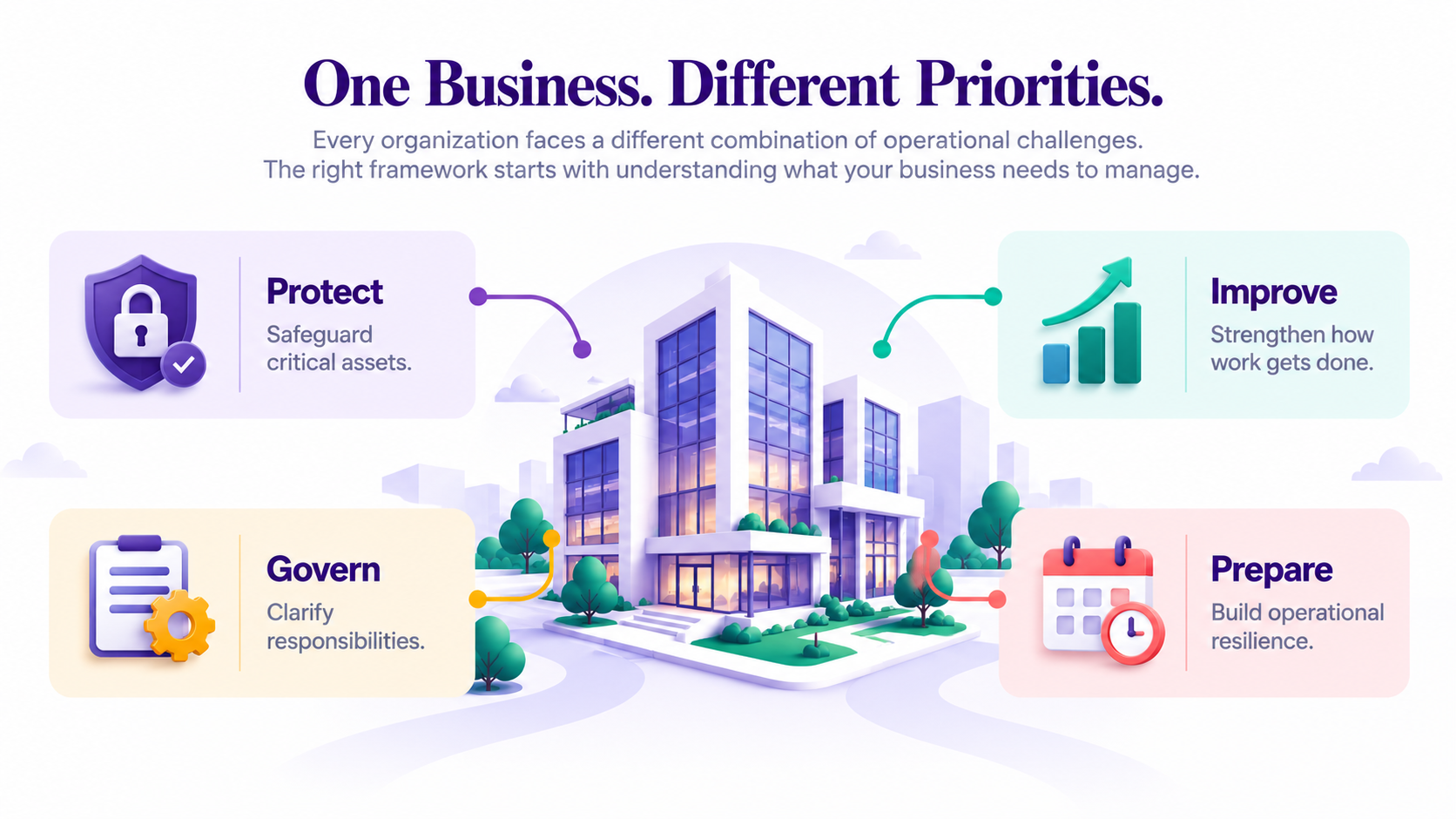
Choosing the right ISO standard begins with identifying your business objectives, understanding your risks, and determining which processes need a more structured approach. The most suitable standard is one that addresses a genuine organizational need and can be integrated into day-to-day operations.
Use this practical roadmap to narrow down your options.
Step 1: Identify Your Business Objective
Start by defining what you want to improve. Are you trying to strengthen information security, manage personal data responsibly, improve product quality, or establish better AI governance?
Your objective should guide your selection.
Step 2: Review Your Obligations
Consider the laws, regulations, contractual requirements, and customer expectations that apply to your organization. An ISO standard may support your approach to managing these responsibilities, but it does not automatically replace applicable legal requirements.
Step 3: Assess Your Existing Processes
Review your current policies, procedures, responsibilities, and controls. Identify gaps between your existing practices and the outcomes you want to achieve.
For example, a business may already restrict access to sensitive files but lack a documented process for reviewing access permissions. Identifying such gaps helps establish practical priorities.
Step 4: Prioritize Based on Risk and Business Impact
Not every standard needs to be addressed at once. Consider which issues could have the greatest impact on your operations, customers, and business objectives.
A business managing large volumes of personal information may prioritize information security and privacy management. A manufacturer may focus on quality, environmental management, and workplace safety.
Step 5: Establish a Plan for Implementation and Improvement
Once you identify the relevant standard, define responsibilities, document necessary processes, and determine how progress will be evaluated. Review the approach regularly and improve it as your organization changes.
A framework only creates value when people understand their responsibilities and consistently follow the processes established.
How Do ISO Standards Support ISO Compliance in India?
ISO standards can help Indian businesses establish structured processes for managing risks and responsibilities, but using an ISO standard does not automatically make an organization compliant with every applicable Indian law. Businesses must assess the legal requirements that apply to their activities and ensure that their processes address those obligations.
For example, an organization that collects or processes digital personal data in India may need to consider its responsibilities under the Digital Personal Data Protection Act, 2023, and the applicable rules and requirements.
ISO/IEC 27001 can support an organization's information security management, while ISO/IEC 27701 can support its privacy information management. However, neither standard should be treated as a substitute for assessing applicable legal obligations.
Businesses should distinguish between three related but different considerations:
- ISO standards: Provide requirements or guidance for managing particular organizational activities.
- Legal compliance: Requires an organization to meet the laws and regulations applicable to its operations.
- Internal policies and procedures: Translate relevant requirements into responsibilities and actions that employees can follow.
A well-structured compliance approach considers how these elements work together. It connects recognized frameworks with the organization's actual obligations, risks, and operational practices.
Conclusion
Selecting the right ISO standard is a business decision, not an exercise in collecting frameworks. Identify your priorities, assess your risks, and build a practical roadmap that connects recognized standards with the way your organization actually operates.
For businesses managing sensitive information, privacy responsibilities, or AI-related risks, ISO/IEC 27001, ISO/IEC 27701, and ISO/IEC 42001 are important standards to evaluate. The right choice depends on your organization's activities, existing processes, and objectives.
Start with the risk you need to manage. Choose the appropriate standard. Then build a system your organization can maintain and improve over time.
Key Takeaways
- Types of ISO standards: Cover quality, environmental management, workplace safety, information security, privacy, AI management, and other business functions.
- ISO standards list: Includes standards such as ISO 9001, ISO 14001, ISO 45001, ISO/IEC 27001, ISO/IEC 27701, and ISO/IEC 42001.
- ISO 27001: Focuses on information security management and the systematic management of information security risks.
- ISO 27701: Provides a framework for privacy information management.
- ISO 42001: Addresses the management of AI-related responsibilities and risks.
- ISO 31000: Provides guidance on integrating risk management into organizational activities and decisions.
- ISO compliance: ISO standards can support structured processes, but they do not automatically establish compliance with every applicable law.
- Choosing the right ISO standard: Consider your industry, business objectives, operational risks, customer expectations, and applicable legal obligations.
Related Blog