Table of contents
By-Research Team
July 17, 2026 | 12 min read | DPDP
Check Your DPDP Compliance Readiness: 12-Point Assessment for Businesses
Most organizations believe they are "working towards DPDP compliance." But readiness is more than having a privacy policy, appointing a compliance lead, or updating a few consent forms. True DPDP compliance readiness means having the people, processes, technology, and governance needed to comply with the Digital Personal Data Protection (DPDP) Act, 2023 on an ongoing basis.
Based on recent regulatory developments and industry observations, many organizations have started their DPDP journey but haven't yet assessed whether their compliance framework can withstand regulatory scrutiny.
So, how do you know if your organization is actually ready?
This practical DPDP compliance readiness assessment walks you through 12 critical indicators that every organization should evaluate.
What Is DPDP Compliance Readiness?
DPDP compliance readiness is an organization's ability to meet the operational, technical, and governance requirements of the Digital Personal Data Protection Act, 2023. It goes beyond understanding the law and focuses on whether appropriate systems, policies, controls, and processes are already in place to protect personal data and demonstrate compliance.
Many businesses assume compliance begins once the DPDP Rules are fully enforced. In reality, organizations that delay preparation often discover that privacy gaps exist across departments, vendors, applications, and business processes. Closing those gaps requires planning, coordination, and continuous governance — not last-minute documentation.
In our observation, organizations with mature privacy programmes don't ask, "Are we compliant?"
They ask, "Can we demonstrate compliance at any point in time?"
That shift — from documentation to demonstrable accountability — is what defines true readiness.
Source: Digital Personal Data Protection Act, 2023
Why Is DPDP Compliance Important?
DPDP compliance helps organizations protect personal data, reduce regulatory risk, and build trust with customers, employees, and stakeholders. Beyond meeting legal obligations, it establishes the policies, processes, and safeguards needed to manage personal data responsibly throughout its lifecycle.
Without a structured compliance programme, privacy controls often become fragmented. For example, an organization may have robust security measures but lack a process to handle Data Principal requests or retain personal data longer than necessary. These gaps can increase both operational and compliance risks.
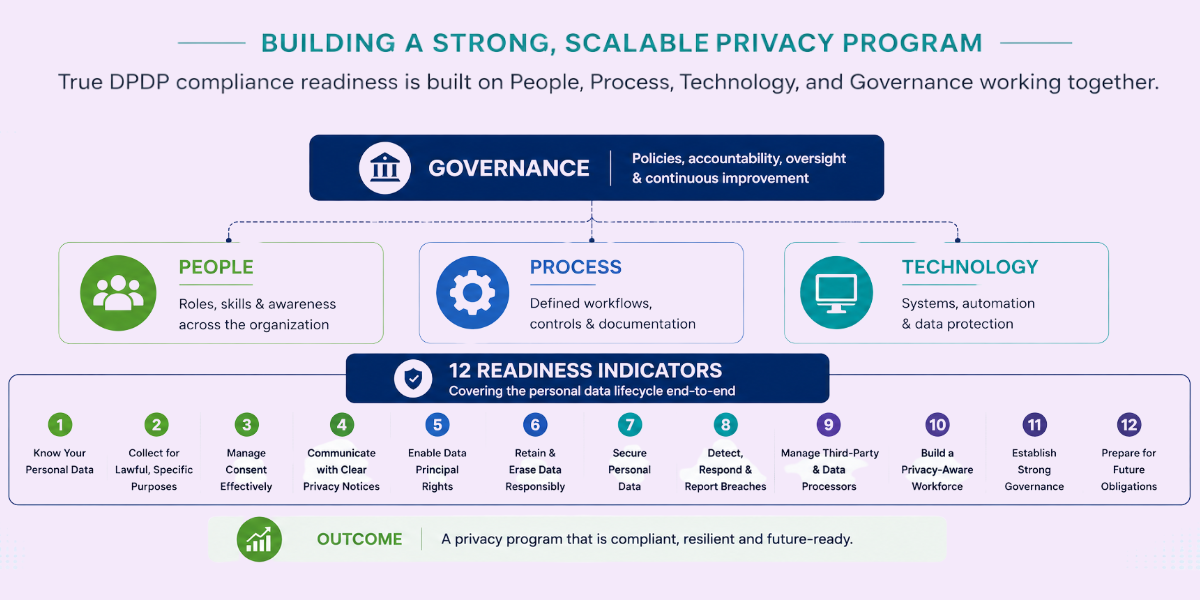
DPDP Compliance Readiness Assessment
1. You Have a Complete Inventory of the Personal Data You Collect
A comprehensive data inventory is the foundation of DPDP compliance readiness. If you don't know what personal data you collect, where it resides, why you process it, and who has access to it, every other privacy control becomes significantly harder to implement.
A robust data inventory should answer questions such as:
- What personal data do we collect?
- Why do we collect it?
- Where is it stored?
- Who can access it?
- Which third parties process it?
- How long do we retain it?
Maintaining this visibility also supports Record of Processing Activities (ROPA), privacy impact assessments, incident response, and data lifecycle management.
2. You Collect Personal Data Only for Specific, Lawful Business Purposes
DPDP compliance requires organizations to collect personal data for a clear, lawful, and defined purpose. Collecting more information than necessary increases compliance obligations, security risks, and operational complexity without adding business value.
Every additional data field expands your responsibility to protect, retain, monitor, and eventually erase that information.
Ask yourself:
- Does every data field have a documented business purpose?
- Can we explain why we collect each category of personal data?
- Have we eliminated information that is no longer required?
Organizations that practice data minimization often experience simpler governance, lower storage costs, and reduced privacy risk.
3. You Have a Secure and Integrated Consent Management System
A secure and integrated consent management system enables organizations to collect, record, manage, update, and demonstrate valid consent throughout the personal data lifecycle. It is one of the most visible indicators of DPDP compliance readiness because consent must be transparent, auditable, and easy to withdraw.
In practice, this means your consent management process should support:
- Purpose-specific consent
- Consent records and audit trails
- Consent withdrawal
- Consent updates
- Version control for notices
- Integration with customer-facing systems
4. Your Privacy Notices Clear, Transparent, and Easy to Understand
Privacy notices are one of the first interactions individuals have with your privacy programme. Clear, accessible, and transparent notices help people understand what personal data is collected, why it is processed, and how they can exercise their rights under the DPDP framework.
A privacy notice should explain your data practices in plain, understandable language before or at the time personal data is collected.
A well-designed privacy notice should clearly communicate:
- What personal data is collected
- The purpose of processing
- How long the data may be retained
- How individuals can exercise their rights
- How to contact the organization for privacy-related concerns
5. You Respond Efficiently to Data Principal Requests
An organization is DPDP compliance ready only if it can receive, verify, process, and respond to Data Principal requests through a documented and repeatable process. Rights are meaningful only when organizations can operationalize them—not just acknowledge them.
A Data Principal may request access to information, correction or erasure of personal data, withdraw consent, seek grievance redressal, or nominate another person to exercise their rights under specific circumstances. Each of these requests requires coordination across multiple systems and departments.
A mature rights management process should include:
- A dedicated channel for receiving requests.
- Identity verification before sharing or modifying data.
- Standard Operating Procedures (SOPs) for each request type.
- Cross-functional coordination between Legal, IT, HR, Customer Support, and Security.
- Documentation and audit trails for every request handled.
6. You Have Defined Data Retention and Secure Erasure Processes
DPDP compliance readiness requires organizations to retain personal data only for as long as necessary to fulfil the purpose for which it was collected and to securely erase it when it is no longer required. A documented retention and erasure process reduces both compliance and cybersecurity risks.
Ask yourself:
- Do we have documented retention schedules for different categories of personal data?
- Are retention periods aligned with business and legal requirements?
- Is data securely erased across production systems, backups, and third-party environments where applicable?
- Can we demonstrate when and how data was deleted?
Organizations should also remember that deleting data isn't simply pressing the delete key. Secure erasure involves ensuring that personal data cannot be reconstructed or recovered where deletion is required.
7. You Implemented Appropriate Security Safeguards to Protect Personal Data
Strong security safeguards are essential for DPDP compliance readiness. Organizations should implement technical and organizational measures that protect personal data from unauthorized access, disclosure, alteration, loss, or destruction throughout its lifecycle.
A strong security programme should include layered controls such as:
- Encryption for personal data at rest and in transit.
- Role-based access controls to ensure employees only access data they need.
- Multi-factor authentication (MFA) for privileged accounts.
- Security monitoring and logging to detect suspicious activities.
- Regular vulnerability assessments and penetration testing.
- Backup and disaster recovery capabilities to maintain business continuity.
8. Your Organization Detect, Manage, and Respond to Personal Data Breaches
DPDP compliance readiness depends on how effectively an organization detects, contains, investigates, and responds to personal data breaches while meeting its notification and accountability obligations.
Ask yourself:
- Is there a documented Personal Data Breach Response Plan?
- Are roles and responsibilities clearly assigned?
- Does the incident response team know when Legal, IT, HR, Communications, and senior management should be involved?
- Have breach response exercises or tabletop simulations been conducted?
A mature breach management programme should include:
- Incident identification and classification
- Containment procedures
- Root cause analysis
- Evidence preservation
- Internal escalation protocols
- Regulatory and stakeholder notification processes
- Post-incident reviews and corrective actions
The Draft DPDP Rules require organizations to notify the Data Protection Board of India and affected Data Principals in the event of a personal data breach, along with prescribed information.
Readiness Checkpoint
If you've answered "No" to multiple questions so far, don't view it as a failure. View it as your implementation roadmap.
The purpose of a DPDP compliance readiness assessment isn't to achieve a perfect score on day one. It's to identify gaps before regulators, customers, or cyber incidents do. Every gap you discover today is one less compliance challenge you'll face tomorrow.
Need help getting DPDP ready? Explore our DPDP compliance solutions to strengthen your privacy programme and close compliance gaps.
Check our DPDP Compliance Solutions ↗
9. Your Third-Party Vendors and Data Processors DPDP Ready
Your organization's DPDP compliance readiness extends beyond your internal systems. If third-party vendors, service providers, or data processors handle personal data on your behalf, their privacy and security practices can directly impact your compliance posture.
Ask yourself:
- Do we maintain an inventory of vendors processing personal data?
- Have we assessed their privacy and security controls?
- Are privacy obligations clearly documented in contracts?
- Do we periodically review vendor compliance?
A mature vendor governance programme should include:
- Vendor due diligence before onboarding
- Risk-based vendor classification
- Contractual privacy and security obligations
- Periodic compliance reviews
- Incident reporting obligations
- Exit procedures for secure data return or deletion
10. Employees Trained to Handle Personal Data Responsibly
Technology and policies alone cannot achieve DPDP compliance. Employees who collect, access, process, or share personal data should understand their responsibilities and know how to apply privacy principles in day-to-day operations.
Privacy awareness should go beyond annual compliance presentations. Organizations should provide practical, role-specific training that helps employees recognize privacy risks relevant to their responsibilities.
An effective awareness programme should cover:
- DPDP fundamentals
- Handling personal data securely
- Recognizing phishing and social engineering
- Reporting privacy incidents
- Responding to Data Principal requests
- Department-specific privacy responsibilities
11. DPDP Compliance is Embedded Into Your Governance Framework
Organizations that achieve long-term DPDP compliance treat privacy as an ongoing governance function rather than a one-time legal or IT project. Clear ownership, periodic reviews, documented policies, and executive oversight create a sustainable compliance programme.
Business processes evolve. New applications are deployed. Vendors change. Regulations develop. Without governance, even a well-designed compliance programme gradually weakens.
Ask yourself:
- Is privacy ownership clearly defined?
- Are compliance responsibilities assigned across departments?
- Are privacy risks reviewed periodically?
- Does leadership receive visibility into privacy initiatives?
A mature governance framework typically includes:
- Privacy policies and procedures
- Defined accountability
- Risk assessments
- Periodic audits
- Management reporting
- Continuous improvement initiatives
12. You are Prepared for Additional or Future DPDP Obligations
DPDP compliance readiness is not static. Organizations should continuously monitor regulatory developments and assess whether additional obligations — such as those relating to children's personal data, Significant Data Fiduciaries (where applicable), or future Rules — apply to their operations.
The DPDP Act provides the legislative framework, while implementation details continue to emerge through Rules, government notifications, and regulatory guidance. Organizations should therefore build compliance programmes that can adapt rather than relying on one-time implementation exercises.
Questions to consider include:
- Do we process children's personal data?
- Could we be designated as a Significant Data Fiduciary in the future?
- Are we monitoring new regulatory developments?
- Can our privacy programme adapt without major operational disruption?
Future-ready organizations invest in scalable privacy governance, flexible technology, and periodic compliance reviews instead of waiting for regulatory deadlines.
Is Your Organisation Ready for DPDP Compliance?
A readiness assessment is valuable only if it leads to action. Use the 12 questions above to evaluate your current maturity and identify where your organization should focus next.
Give yourself one point for every "Yes" answer.
| Your Score | Readiness Level | What It Means |
|---|---|---|
| 10–12 | High Readiness | Your organization has established a strong privacy foundation. Continue reviewing controls, monitoring regulatory developments, and improving governance. |
| 7–9 | Moderate Readiness | You have made meaningful progress, but important operational gaps still require attention before claiming comprehensive DPDP compliance readiness. |
| 4–6 | Developing Readiness | Several foundational controls are either missing or only partially implemented. Prioritize a structured gap assessment and implementation roadmap. |
| 0–3 | Early Stage | Your organization should avoid assuming compliance readiness. Begin with a comprehensive assessment before expanding privacy initiatives. |
Remember, this scorecard is a practical self-assessment — not a legal certification. A "Yes" should only be counted if the capability is implemented, documented, consistently followed, and demonstrable.
Conclusion
DPDP compliance readiness isn't measured by the number of policies your organization has drafted. It's measured by how effectively those policies operate in practice.
Think of your compliance programme as a blueprint rather than a checklist. Every capability you strengthen today reinforces the structure you'll rely on tomorrow. And as the regulatory landscape evolves, organizations with strong foundations will always adapt faster than those scrambling to build one.
Ultimately, DPDP compliance readiness is not about being prepared for an audit. It's about being prepared to handle personal data responsibly — every single day.
Key Takeaways
- DPDP compliance requires the right people, processes, technology, and governance to manage personal data responsibly.
- Knowing what personal data, you collect, where it's stored, and why it's processed is the foundation of DPDP compliance.
- Consent management, privacy notices, Data Principal rights, retention, and security safeguards should work together—not in silos.
- Vendor governance and employee awareness are essential to maintaining a strong privacy programme.
- Treat DPDP compliance as an ongoing business function, not a one-time legal or IT project.
- Periodic reviews help identify gaps, adapt to regulatory changes, and strengthen accountability.
- DPDP compliance is a continuous journey. Organizations that build scalable privacy practices today will be better prepared for tomorrow's regulatory expectations.
Related Blog