Table of contents
By-Research Team
May 19, 2026 | 9 min read | Privacy
What is User Consent?
Every click, signup, cookie banner acceptance, and app permission request revolves around one thing: user consent. Yet most businesses still treat consent like a checkbox exercise instead of a compliance defence system. That approach is becoming expensive.
Under regulations like the GDPR and India’s Digital Personal Data Protection (DPDP) Act, invalid or manipulative consent can trigger regulatory scrutiny, reputational damage, and consumer distrust.
For startups, BFSI companies, SaaS platforms, healthcare providers, and global enterprises, consent is no longer a UX detail. It is a governance framework.
User consent is the legal and ethical foundation that allows organizations to collect, process, share, or store personal data after obtaining clear permission from individuals.
Think of consent as a digital permission slip. But unlike school permission slips, regulators now inspect the fine print, timing, wording, and even button colour choices. Yes, privacy compliance has reached that level of detail.
Businesses that fail here do not just lose compliance points. They lose trust capital.
Why User Consent Matters
User consent matters because it gives individuals control over how their personal data is collected and used while helping organizations maintain legal compliance, customer trust, and operational transparency.
Without valid consent, even routine business activities—email marketing, app tracking, analytics, or personalized advertising—can become regulatory liabilities. In privacy law, intent matters. But documented proof matters even more.
-
Consent Strengthens Customer Trust
Privacy-conscious users are no longer a niche group. They are now mainstream consumers who expect businesses to handle their data responsibly. According to Cisco’s Consumer Privacy Survey, 76% of consumers said they would not buy from organizations they do not trust with their data.
-
Consent Improves User Experience
The way a business asks for consent directly affects how users perceive the brand. A fintech app requesting location access without explanation feels intrusive, while a banking app explaining that location data helps detect fraud feels responsible and transparent. Same permission. Completely different trust outcome.
-
Consent Creates Operational Clarity
Strong consent practices help businesses manage data more responsibly across departments. Without proper consent mapping, marketing teams may over-collect data, analytics teams may over-track users, and compliance teams are left fixing the confusion later. That is not governance. That is digital archaeology.
Types of User Consent
Different types of user consent determine how organizations can legally collect and process personal data across websites, apps, financial platforms, healthcare systems, and marketing channels.
Understanding these categories helps businesses build privacy systems that are both compliant and practical.
-
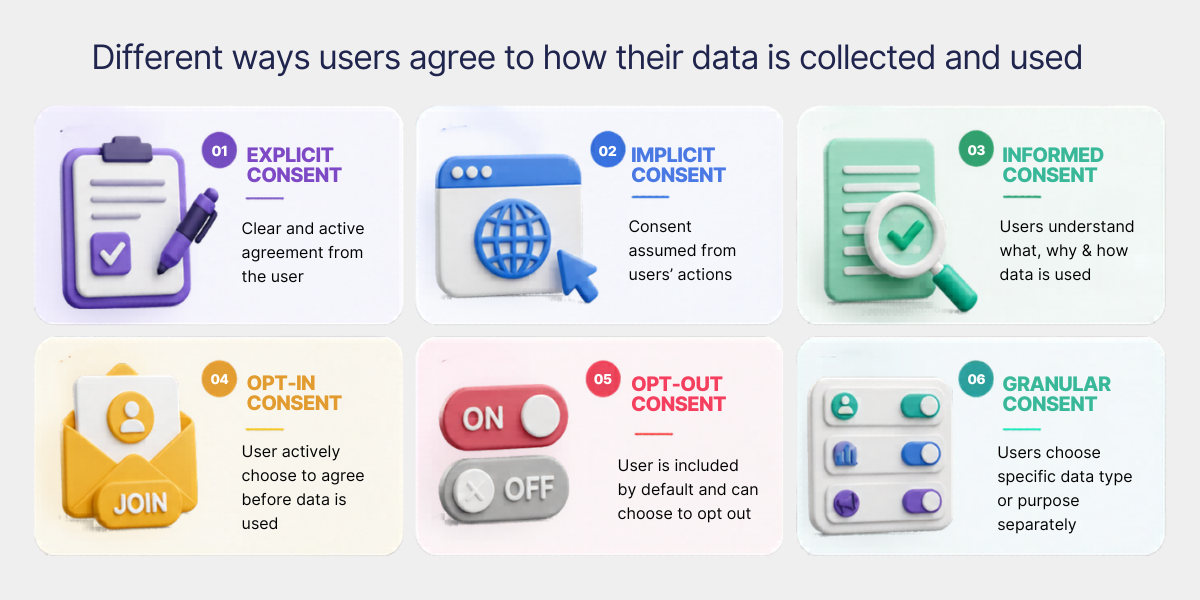
Explicit Consent
Explicit consent happens when users clearly and actively agree to data collection or processing. This usually involves actions like clicking “I Agree,” signing a consent form, or manually enabling permissions. For example, a healthcare app asking users to approve sharing medical records with insurance providers is requesting explicit consent.
-
Implicit Consent
Implicit consent is assumed from a user’s actions instead of direct confirmation. For example, some websites assume users agree to cookies simply because they continue browsing the site. This type of consent can create confusion because users may not fully understand what they are agreeing to.
-
Informed Consent
Informed consent means users clearly understand what data is being collected, why it is needed, and how it will be used before agreeing. A good consent notice explains things in simple language instead of hiding important details behind complex legal wording. Transparency is the foundation of informed consent.
-
Opt-In Consent
Opt-in consent requires users to actively choose participation before any data processing begins. Common examples include subscribing to newsletters, enabling marketing communication, or turning on app notifications. In this model, the user takes the first step instead of the business assuming permission.
-
Opt-Out Consent
Opt-out consent assumes users agree by default unless they specifically decline or unsubscribe. This model is commonly seen in email marketing and advertising platforms. However, when unsubscribe options are difficult to find or confusing to use, users may feel pressured rather than informed.
-
Granular Consent
Granular consent allows users to separately choose which types of data processing they want to allow. For example, a banking app may let users independently control marketing messages, analytics tracking, and third-party offers. This gives users more control and makes consent feel more transparent and manageable.
Examples of User Consent
User consent appears across websites, mobile apps, banking systems, healthcare platforms, e-commerce stores, and enterprise software whenever organizations collect or process personal data.
Most users interact with consent dozens of times daily without realizing it.
The real compliance challenge is not collecting consent. It is collecting valid, informed, and defensible consent.
- Cookie Consent Banners
Cookie banners are among the most visible examples of digital consent.
A compliant cookie banner should:
- Explain tracking purposes,
- Offer reject options,
- Avoid deceptive button designs,
- And allow preference management.
Many websites still use “Accept All” buttons larger than the “Reject” option. Regulators call this manipulative design. Users call it annoying.
- Mobile App Permissions
Apps routinely request access to camera, microphone, contacts, location, and storage.
But context matters.
A navigation app requesting GPS access makes sense. A flashlight app requesting contact-list access feels like a crime documentary opening scene.
Platforms like Android and iOS increasingly require:
- Contextual permission prompts,
- Granular controls,
- And revocable access.
- Email Marketing Consent
Marketing consent is one of the most mismanaged areas in digital business operations.
Valid email consent should include clear opt-in, purpose disclosure, unsubscribe mechanism, and consent logs.
Buying email lists or forcing newsletter subscriptions during account creation can violate privacy regulations.
Short-term marketing gains often create long-term compliance exposure.
Dark Patterns in User Consent
Many companies claim to give users “control” over their data, but the reality often looks very different. Some consent systems are intentionally designed to confuse, pressure, or manipulate users into clicking “Accept” quickly instead of making an informed choice. These deceptive tactics are known as dark patterns.
Dark patterns in user consent are deceptive design techniques used to manipulate users into accepting data collection, tracking, or privacy terms they may not otherwise agree to.
This is where privacy compliance intersects with behavioural psychology.
And regulators are paying attention.

-
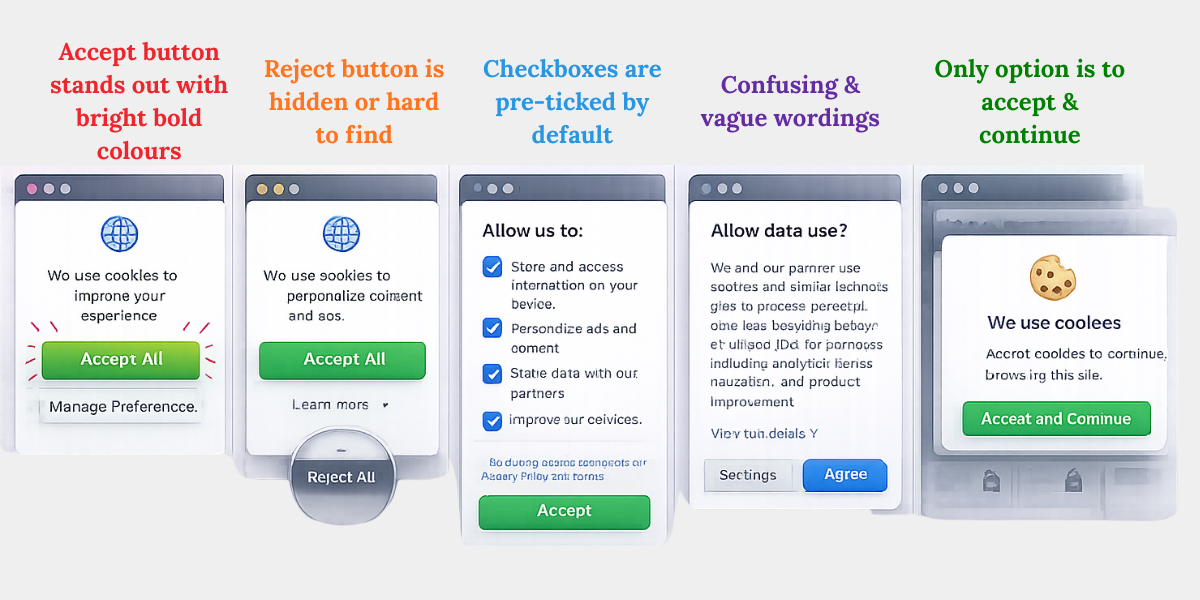
Pre-Ticked Checkboxes
Pre-ticked checkboxes automatically assume user agreement before the person has made any real choice. Many users simply continue without noticing the box was already selected. This creates the illusion of consent instead of genuine user permission.
-
Misleading Button Design
Some websites make the “Accept” button bright, large, and easy to click, while the “Reject” option is hidden, faded, or buried inside multiple settings pages. This design pushes users toward one decision instead of presenting a fair choice. That is not transparency. That is interface pressure.
-
Forced Consent Walls
Certain websites block access completely unless users accept tracking cookies or data collection practices. Users are left with two options: agree or leave the platform entirely. When people feel forced into accepting terms just to use a service, the idea of “free choice” becomes questionable.
-
Confusing Language
Many privacy notices use lengthy legal jargon, vague wording, or bundled permissions that ordinary users struggle to understand. Instead of helping users make informed decisions, these notices overwhelm them with complexity. If someone needs a legal expert to understand a cookie banner, the consent process has already failed.
Why Dark Patterns in User Consent are Dangerous
Dark patterns may increase short-term consent acceptance rates, but they often damage long-term user trust. When users feel manipulated into clicking “Accept,” they are more likely to lose confidence in the platform and question how their data is being handled.
Regulators are also paying closer attention to how consent interfaces are designed. It is no longer enough for businesses to simply include a privacy notice or cookie banner. Authorities now examine whether the overall user experience genuinely supports informed and fair decision-making.
This includes reviewing factors such as:
- Button hierarchy,
- Misleading visual design,
- Difficulty in withdrawing consent,
- And manipulative interface tactics that pressure users into agreeing quickly.
Privacy compliance is no longer limited to legal documentation alone. Interface design itself is becoming auditable.
That changes the role of privacy compliance across organizations. Product teams, marketers, and UI/UX designers are now directly involved in building consent systems that are not only functional, but also transparent and user-friendly.
Conclusion
User consent is no longer just a legal formality hidden inside privacy policies and cookie banners. It has become a critical part of how businesses build trust, manage data responsibly, and maintain transparency with users.
Organizations that rely on confusing notices, forced permissions, or manipulative design patterns may achieve short-term acceptance rates, but they risk long-term trust damage. On the other hand, businesses that focus on clear communication, meaningful choice, and user-friendly consent experiences create stronger relationships with customers.
In practice, good consent management is not about collecting more permissions. It is about creating a system where users genuinely understand what they are agreeing to and feel confident about their choices.
Key Takeaways
- User consent allows businesses to collect and process personal data transparently and responsibly.
- Clear consent practices help build customer trust and improve user experience.
- Different types of consent give users varying levels of control over how their data is used.
- Cookie banners, app permissions, and marketing emails are common examples of user consent in practice.
- Dark patterns use misleading design tactics to pressure users into accepting data collection practices.
- Transparent and user-friendly consent systems help businesses maintain trust and strengthen compliance efforts.
Related Blog