Table of contents
By-Research Team
June 9, 2026 | 10 min read | DPDP
Dark Patterns in Consent: A Hidden DPDP Compliance Risk
Most businesses do not set out to manipulate users. Yet many consent journeys unintentionally create friction, confusion, or pressure that can undermine the validity of consent. Under the DPDP Act, consent is not merely a checkbox—it is the legal foundation upon which personal data processing rests.
This is where dark patterns in consent become a compliance risk.
This article provides a practical blueprint for understanding dark patterns in consent, assessing their impact on DPDP compliance, and building consent experiences that support both user trust and regulatory expectations.
What Are Dark Patterns in Consent?
Dark patterns in consent are user interface (UI) and user experience (UX) design techniques that manipulate, pressure, confuse, or steer individuals into making privacy-related decisions they might not otherwise make. In a consent context, these patterns can influence how users provide, withhold, or withdraw consent.
The term "dark patterns" was coined by UX specialist Harry Brignull in 2010 to describe deceptive design practices that influence user behaviour. Over time, privacy regulators worldwide have increasingly scrutinized these practices because they can interfere with genuine user choice.
Common Dark Patterns in Consent
1. Pre-Selected Consent
Users are automatically opted into marketing communications, profiling activities, or additional data processing through pre-ticked boxes.
Problem: Users may unknowingly provide consent without taking affirmative action.
2. Consent Bundling
Multiple purposes are grouped into a single consent request.
Example: "I agree to receive the service and marketing communications."
A user seeking the service may feel compelled to accept unrelated marketing activities.
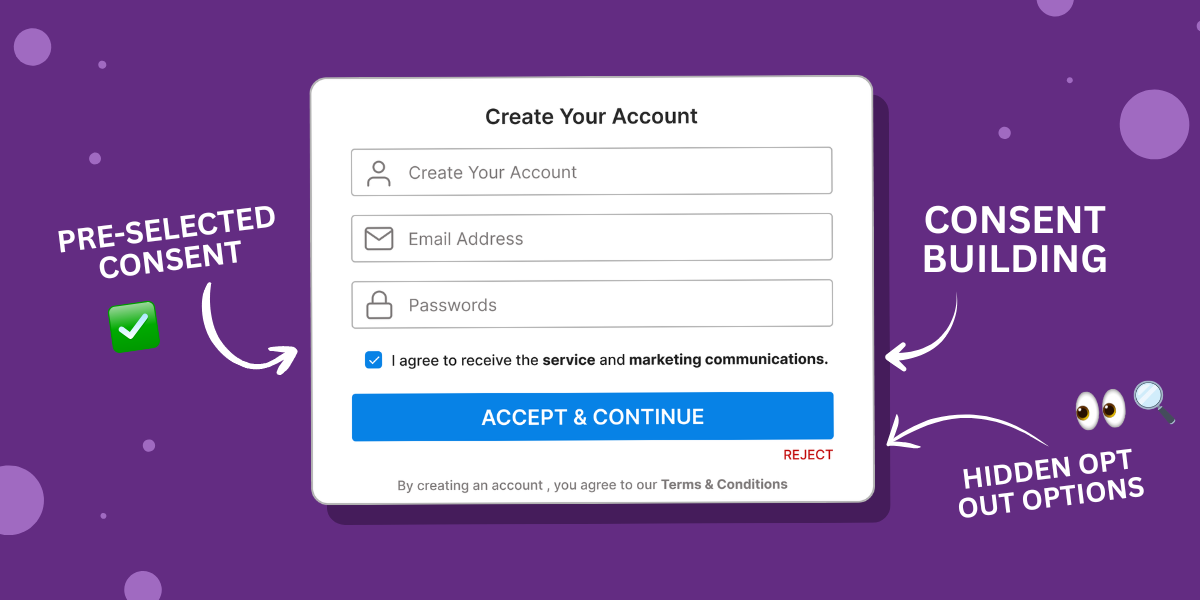
3. Hidden Opt-Out Options
The "Accept" button is prominent while the "Reject" option is difficult to locate.
Problem: Users face unequal choices.
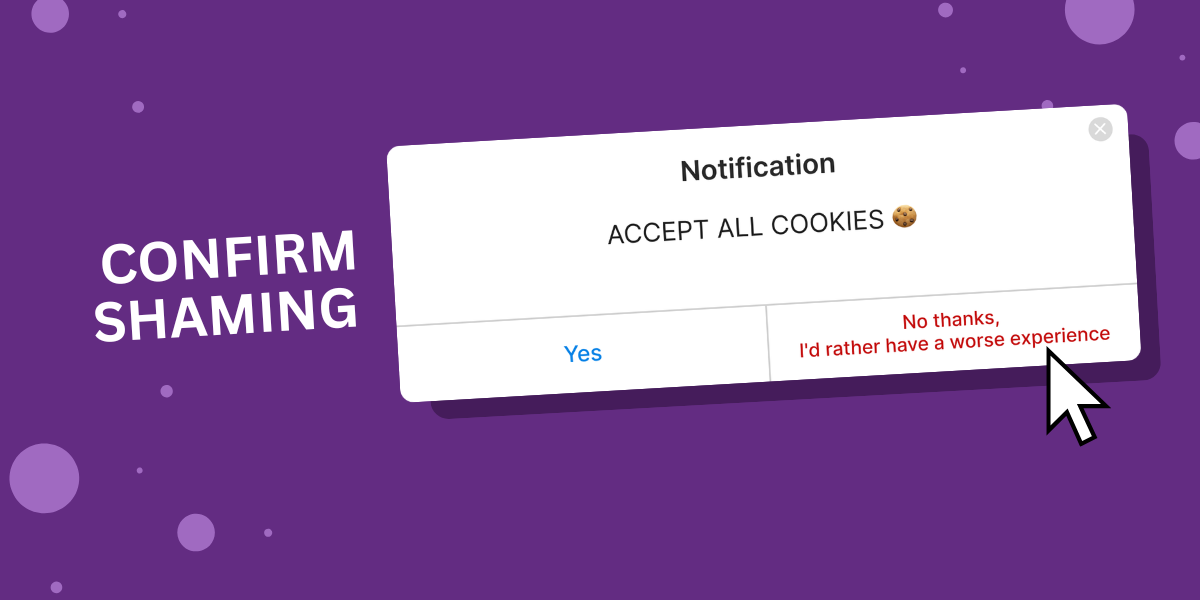
4. Confirmshaming
Declining consent is framed negatively.
Example: "No thanks, I don't care about protecting my account."
The design attempts to emotionally influence the user's decision.
5. Interface Interference
Design elements visually favour one option over another.
Examples include:
- Bright acceptance buttons
- Tiny rejection links
- Misleading placement of choices

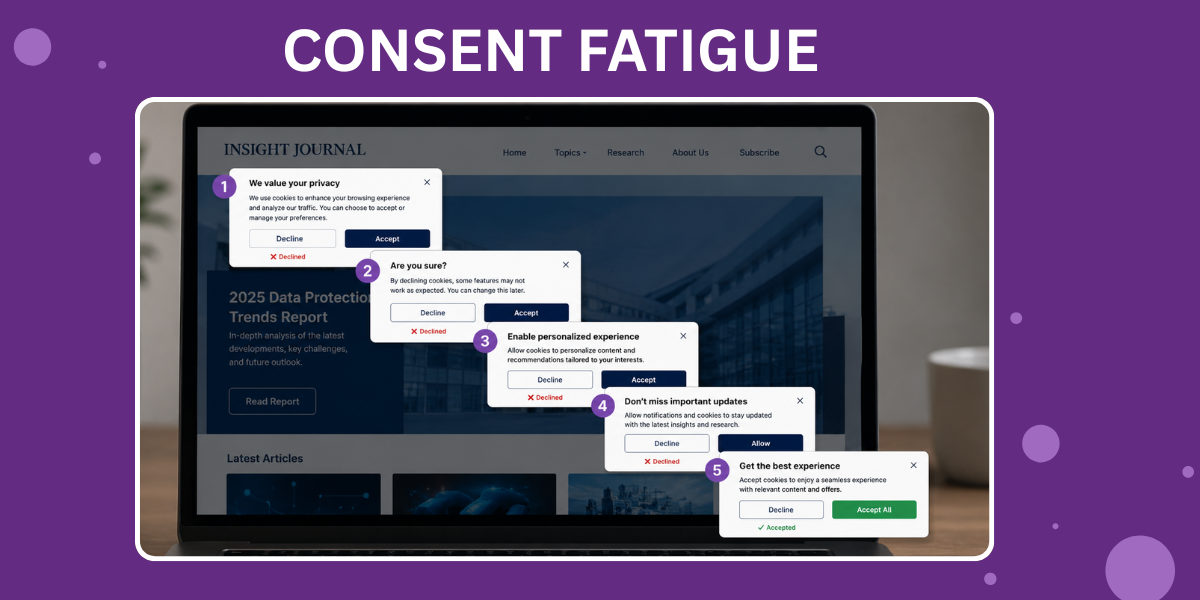
6. Consent Fatigue
Users are repeatedly prompted for consent after previously declining.
Eventually, many users accept simply to stop the interruptions.
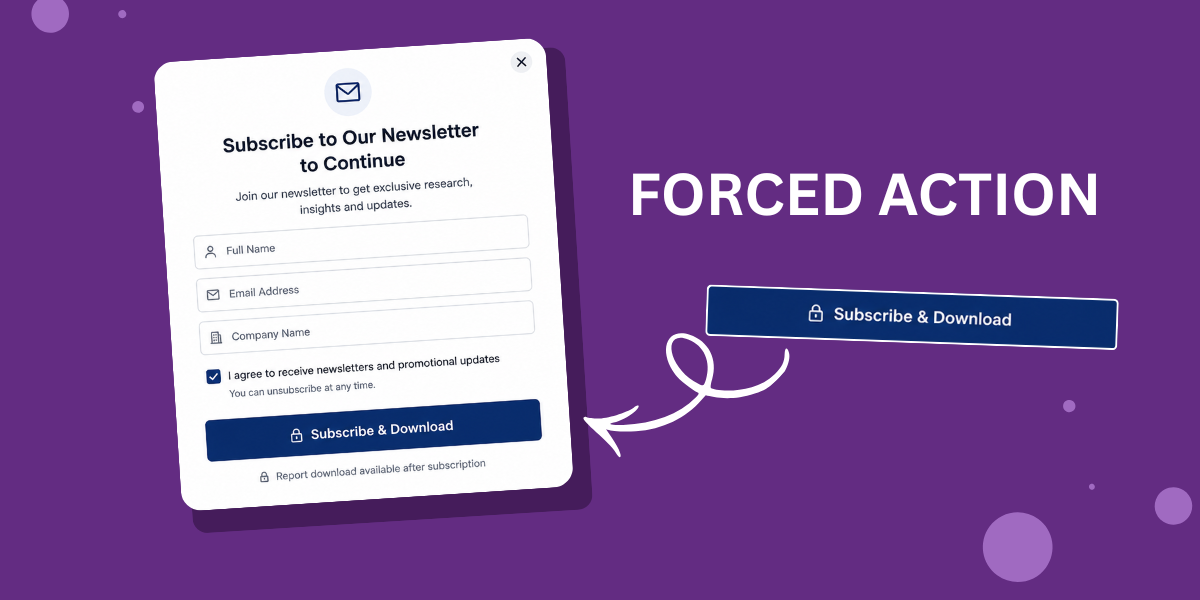
7. Forced Action
Access to a service is conditioned on consent that may not be necessary for the requested purpose.
Example: A newsletter subscription becomes mandatory to download a report.
Why Businesses Use Dark Patterns
In many cases, dark patterns are not intentional.
Based on our observation, they often emerge when:
- Marketing teams prioritize opt-in rates.
- Product teams prioritize frictionless journeys.
- Legal teams prioritize risk mitigation.
- Engineering teams prioritize speed of implementation.
The result? A consent architecture that gradually drifts away from user choice.
Why Consent Matters Under the DPDP Act
The DPDP Act treats consent as one of the primary legal grounds for processing personal data. To be valid, consent must be free, specific, informed, unconditional, and unambiguous. If a consent journey weakens any of these requirements, organizations may face compliance challenges.
The Digital Personal Data Protection Act, 2023 establishes clear expectations for obtaining consent from Data Principals.
These requirements are not merely legal wording. They function as the structural blueprint for compliant consent collection.
What Does This Mean in Practice?
Consider the difference:
- Compliant Approach
"Would you like to receive marketing emails? Yes / No"
- Potentially Problematic Approach
"By continuing, you agree to receive updates, offers, promotions, and communications."
One presents a clear choice. The other blurs the boundaries of consent.
That distinction matters.
Dark Patterns vs DPDP Consent Requirements
Dark patterns often interfere with one or more DPDP consent requirements. While the Act does not explicitly list every dark pattern, certain design choices may undermine the freedom, specificity, or clarity required for valid consent.
The easiest way to understand the issue is through a compliance mapping exercise.
| Dark Pattern | DPDP Consent Requirement Impacted | What This Means in Practice |
|---|---|---|
| Pre-ticked boxes | Unambiguous | Users should actively choose to consent. Consent should not be assumed by default. |
| Consent bundling | Specific | Users should be able to agree to each purpose separately instead of accepting everything at once. |
| Hidden privacy disclosures | Informed | Users should clearly understand what data is being collected and why before consenting. |
| Forced consent | Free, Unconditional | Users should not feel compelled to consent to unrelated activities just to access a service. |
| Interface interference | Free | Accepting and rejecting consent should be equally easy and visible. |
| Confirmshaming | Free | Users should not be pressured, guilt-tripped, or emotionally influenced into consenting. |
| Consent fatigue | Free | Users should not be repeatedly asked for consent until they eventually give in. |
| Difficult withdrawal mechanisms | Unconditional | Users should be able to withdraw consent as easily as they gave it. |
Real DPDP Implementation Mistakes Businesses Make
Many consent-related compliance issues do not arise from malicious intent. They arise from operational shortcuts, inherited website designs, or poorly coordinated implementation efforts across business functions.
Let's examine how dark patterns appear in real-world environments.
1. Lead Generation Forms
A common scenario: Download a whitepaper and automatically subscribe to marketing emails.
The problem? The user's objective is accessing content—not necessarily joining a marketing database.
DPDP concern: Specific consent.
2. Mobile App Permissions
During the initial onboarding, without clearly explaining the purpose, many applications request:
- Location access
- Camera access
- Contact access
Users often approve permissions simply to continue using the application.
DPDP concern: Informed consent.
3. Customer Onboarding Journeys
A single checkbox often covers:
- Terms and Conditions
- Privacy Notice
- Marketing Consent
- Product Updates
This approach may simplify implementation, but it weakens consent granularity.
DPDP concern: Specific consent.
4. Loyalty Program Registrations
Some organizations make marketing participation appear mandatory for joining rewards programs.
In reality, the reward program and marketing communications may be separate processing purposes.
DPDP concern: Free consent.
5. WhatsApp and SMS Marketing
Customers provide phone numbers for order updates.
Later, those numbers are used for promotional campaigns.
The original purpose and the new purpose may differ significantly.
DPDP concern: Specific and informed consent.
Why Dark Patterns Create DPDP Compliance Risks
Dark patterns increase compliance risk because they make it more difficult to demonstrate that consent was freely and knowingly provided. If challenged by a customer, regulator, or internal audit, businesses may struggle to justify the validity of the consent collected.
The risk extends beyond interface design.
It affects the entire privacy governance framework.
Risk 1: Weak Consent Evidence
Organizations must be able to demonstrate how consent was obtained.
A poorly designed consent journey creates evidentiary weaknesses.
Risk 2: Increased User Complaints
Confused users often become dissatisfied users.
When customers believe they were misled into providing consent, complaints typically follow.
Risk 3: Regulatory Scrutiny
Privacy regulators globally have increasingly examined consent interfaces, cookie banners, and user choice mechanisms.
Recent GDPR enforcement trends demonstrate growing attention toward consent design practices.
Risk 4: Erosion of Customer Trust
Trust is difficult to build and easy to lose.
A single manipulative consent experience can damage long-term customer relationships.
Risk 5: Internal Governance Gaps
Consent problems rarely exist in isolation. They often reveal broader issues involving:
- Data governance
- Privacy notices
- Consent records
- Purpose limitation controls
How to Identify Dark Patterns in Your Consent Process
Organizations should periodically audit every consent touchpoint to determine whether users are being nudged, pressured, or confused into making privacy-related decisions. A structured review can uncover compliance gaps before they become regulatory issues.
Start with a simple question:
Would a reasonable user clearly understand their choices?
Then evaluate the following areas:
Consent Design Audit Questions
1. Equal Choice
Can users reject consent as easily as they can accept it?
2. Clear Purpose
Is each consent request linked to a specific purpose?
3. Transparency
Are users informed about what data is being collected and why?
4. Granularity
Can users consent separately to different activities?
5. Withdrawal
Can consent be withdrawn without unnecessary effort?
6. Neutral Design
Are buttons, colours, and layouts designed to present balanced choices?
How to Fix Dark Patterns in Consent: A Practical DPDP Compliance Blueprint
Businesses should approach consent design as a governance exercise rather than a conversion optimization exercise. The goal is not to maximize consent rates. The goal is to maximize consent validity.
Think of this as strengthening the foundation of your consent architecture.
Step 1: Map Every Consent Collection Point
Identify all locations where consent is collected:
- Websites
- Mobile apps
- CRM systems
- Customer onboarding flows
- Marketing campaigns
You cannot fix what you cannot see.
Step 2: Review Consent Language
Remove:
- Ambiguous wording
- Legal jargon
- Multiple purposes within one statement
Use plain language instead.
Step 3: Separate Processing Purposes
Create distinct consent options for:
- Marketing
- Analytics
- Profiling
- Product updates
Specific consent requires specific choices.
Step 4: Remove Visual Manipulation
Ensure:
- Equal button prominence
- Similar font sizes
- Balanced placement
The interface should guide users, not steer them.
Step 5: Simplify Consent Withdrawal
Make withdrawal as easy as consent.
A fortress should have a clearly marked exit gate—not a hidden tunnel.
Step 6: Maintain Consent Records
Document:
- What consent was obtained
- When consent was obtained
- How consent was obtained
- Which notice was presented
Strong records strengthen accountability.
Step 7: Conduct Periodic Consent Audits
Review consent mechanisms annually or after major product changes.
Consent governance should be a continuous process, not a one-time project.
Conclusion
A consent banner, registration form, or onboarding screen may appear insignificant. Yet these interfaces form the foundation of an organization's privacy architecture. If that foundation is built on confusion, pressure, or ambiguity, the strength of the resulting consent becomes difficult to defend.
Organizations should therefore move beyond asking: "How can we increase opt-ins?"
and start asking: "How can we ensure every consent decision is genuinely free, informed, and unambiguous?"
That shift is not only good privacy practice. It is the cornerstone of sustainable DPDP compliance.
Key Takeaways
- Dark patterns can influence or manipulate how users provide consent.
- The DPDP Act requires consent to be free, specific, informed, unconditional, and unambiguous.
- Practices like pre-ticked boxes, bundled consent, and hidden opt-outs can create compliance concerns.
- Many dark patterns arise unintentionally through everyday consent collection processes.
- Poor consent design can increase compliance, governance, and trust-related risks.
- Regular consent audits help identify and fix dark patterns before they become bigger issues.
Related Blog