Table of contents
By-Research Team
June 12, 2026 | 7 min read | DPDP
Privacy Policy vs Terms and Conditions: What's the Difference?
Most businesses know they need legal documents on their website. Few know which document does what.
That confusion creates risk.
Many organizations spend time drafting Terms & Conditions and assume they have addressed their privacy obligations. Others publish a Privacy Policy copied from a template and assume they are compliant. Neither approach works.
Understanding the difference is no longer optional. With regulations such as India's DPDP Act placing greater emphasis on transparency, consent, and user rights, businesses need both documents—but for very different reasons.
Privacy Policy vs Terms and Conditions
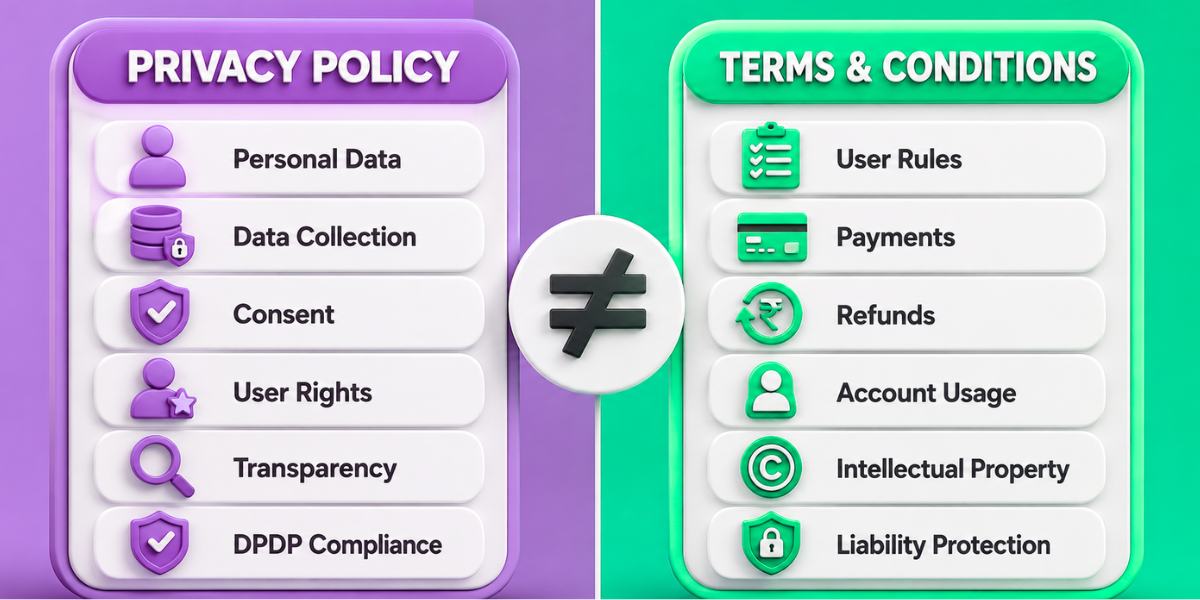
A Privacy Policy explains how an organization collects, uses, stores, shares, and protects personal data. Terms & Conditions define the rules governing the use of a website, application, or service. While both are legal documents, they serve different purposes and cannot replace one another.
A Privacy Policy focuses on data privacy. It tells users what personal information is collected, why it is collected, who it is shared with, and what rights users have over that data.
Terms & Conditions focus on business relationships. They establish acceptable use rules, payment obligations, account restrictions, intellectual property rights, and liability limitations.
Think of them as two layers of the same fortress:
Privacy Policy = Data Governance Layer
Terms & Conditions = Business Protection Layer
Is a Privacy Policy Legally Required?
In many jurisdictions, including India under the DPDP Act, organizations that collect personal data are required to provide individuals with clear information about how their data will be processed. A Privacy Policy is one of the most common ways to meet this transparency obligation.
The legal requirement is not necessarily the document title itself. The requirement is transparency.
Under the DPDP framework, organizations collecting personal data based on consent must provide notice explaining:
- What personal data is being collected
- Why it is being processed
- How individuals can exercise their rights
- How complaints can be raised
- How consent can be withdrawn
In practice, businesses satisfy these obligations through a Privacy Policy supported by consent mechanisms and operational privacy controls.
This creates an important distinction.
Having a Privacy Policy is not the same as being compliant.
Ask yourself: Can your business actually identify all personal data it collects?
If the answer is no, your Privacy Policy may already be inaccurate.
Are Terms and Conditions Legally Required?
Terms & Conditions are generally not legally required in most jurisdictions. However, they remain one of the most important documents for protecting a business from disputes, misuse, and liability exposure.
A website can often operate without Terms & Conditions.
That does not mean it should.
Without Terms & Conditions, businesses may struggle to enforce:
- Acceptable use restrictions
- Account suspension rights
- Payment obligations
- Refund conditions
- Intellectual property protections
- Liability limitations
What Information Should a Privacy Policy Include?
A Privacy Policy should clearly explain what personal data is collected, why it is collected, how it is used, who it is shared with, how long it is retained, and what rights individuals have regarding that data.
A strong Privacy Policy typically includes:
- Personal Data Collected
- Specify the categories of information collected.
Examples:
- Name
- Email address
- Phone number
- Device information
- Location data
- Payment information
- Purpose of Processing
- Explain why the data is collected.
Where applicable, explain rights related to:
- Access
- Correction
- Erasure
- Consent withdrawal
- Complaint mechanisms
- Contact and Grievance Information
- Provide channels for privacy-related inquiries and complaints.
What Information Should Terms and Conditions Include?
Terms & Conditions should define the rules governing the use of a website, application, platform, or service. Their primary purpose is to establish expectations and reduce legal uncertainty between the business and the user.
Think of Terms & Conditions as the operating manual for your digital business.
A well-drafted document usually covers:
- Account Rules
- Eligibility requirements
- Registration obligations
- Account security responsibilities
- Acceptable Use Requirements
- Specify prohibited activities such as:
- Fraud
- Unauthorized access
- Abuse of services
- Intellectual property violations
- Payment and Billing Terms
Privacy Policy vs Terms and Conditions: Side-by-Side Comparison
Privacy Policies and Terms & Conditions work together but solve different problems. One supports transparency and privacy compliance, while the other establishes contractual rules and business protections.
| Area | Privacy Policy | Terms & Conditions |
|---|---|---|
| Primary Purpose | Data transparency | User governance |
| Main Audience | Individuals whose data is collected | Users of the service |
| Focus | Personal data processing | Platform usage |
| Legal Driver | Privacy laws | Contract law |
| Covers Consent | Yes | Usually no |
| Covers User Rights | Yes | Limited |
| Covers Refunds | No | Yes |
| Covers Acceptable Use | No | Yes |
| Covers Liability Limits | Rarely | Yes |
| Supports DPDP Compliance | Yes | Indirectly |
Key takeaway: A Privacy Policy helps explain data handling. Terms & Conditions help manage business risk.
Privacy Policy and Terms and Conditions Requirements Under India's DPDP Act
The DPDP Act does not treat Privacy Policies and Terms & Conditions the same way. Privacy Policies are directly linked to the Act's transparency and consent requirements, while Terms & Conditions are not specifically required under the DPDP Act.
Privacy Policy Under the DPDP Act
The DPDP Act requires organizations to inform individuals about:
- What personal data is collected
- Why it is collected
- How it will be used
- How consent can be withdrawn
- How individuals can exercise their rights
- How grievances can be raised
Businesses typically provide this information through a Privacy Policy or privacy notice.
Terms & Conditions Under the DPDP Act
The DPDP Act does not require businesses to maintain Terms & Conditions.
Terms & Conditions primarily govern:
- User responsibilities
- Acceptable use
- Payments and refunds
- Account termination
- Liability limitations
These contractual matters generally fall outside the scope of the DPDP Act.
Conclusion
The debate around privacy policy vs terms & conditions is not really about choosing one document over the other.
It is about understanding their roles within a broader compliance framework.
A Privacy Policy acts as your organization's transparency blueprint. Terms & Conditions act as your contractual shield, defining how users interact with your business and helping reduce legal risk.
The organizations that get this right do not start with documents. They start with governance.
Build the compliance architecture first. Then let your Privacy Policy and Terms & Conditions accurately reflect it.
Key Takeaways
- A Privacy Policy explains how a business collects, uses, shares, and protects personal data.
- Terms & Conditions define the rules users must follow when using a website, app, or service.
- A Privacy Policy is often required to support transparency obligations under privacy laws like the DPDP Act.
- Terms & Conditions are usually not legally required but help protect businesses from disputes and misuse.
- A strong Privacy Policy should explain data collection, processing purposes, user rights, and grievance mechanisms.
- Common mistakes include copying templates, using outdated policies, and failing to align documents with actual practices.
- Under the DPDP Act, Privacy Policies support compliance obligations, while Terms & Conditions primarily serve as a business protection tool.
Related Blog