
Table of contents
By-Research Team
June 5, 2026 | 9 min read | Data Privacy
5 Data Privacy Issues in BFSI
Banks, NBFCs, insurance companies, and fintech organizations are handling more customer data than ever before. Every account opening, loan application, insurance policy, mobile banking transaction, and customer interaction generates personal data that must be managed responsibly.
Yet many of the most significant data privacy issues in BFSI do not originate from cyberattacks or sophisticated security breaches.
They originate from everyday operational practices.
Customer data scattered across systems, excessive data collection, fragmented consent records, uncontrolled data sharing, and indefinite retention can all create privacy and compliance risks. Under the Digital Personal Data Protection (DPDP) Act, organizations are expected to know what personal data they hold, why they hold it, how it is used, and when it should be deleted.
The challenge is not always data security.
The challenge is data visibility.
Why Are Data Privacy Issues Increasing in BFSI?
Data privacy issues are increasing in BFSI because customer data now moves across multiple products, channels, vendors, and digital platforms. As financial institutions expand their digital ecosystems, maintaining visibility, accountability, and control over personal data becomes significantly more complex.
The BFSI sector is undergoing rapid digital transformation. Mobile banking, digital lending, embedded finance, insurance marketplaces, and fintech partnerships have increased both the volume and movement of customer data.
This creates a paradox.
Organizations are collecting more customer information than ever before, but many still struggle to maintain a complete view of where that data exists and how it is being used.
According to the Reserve Bank of India (RBI), India's digital payments ecosystem processed over 222 billion transactions during FY 2024-25, highlighting the massive scale of customer data being generated and processed across the financial sector.
As data volumes grow, so does data risk.
That makes privacy governance a business issue, not just a compliance issue.
What Are the Data Privacy Issues in BFSI Industry?
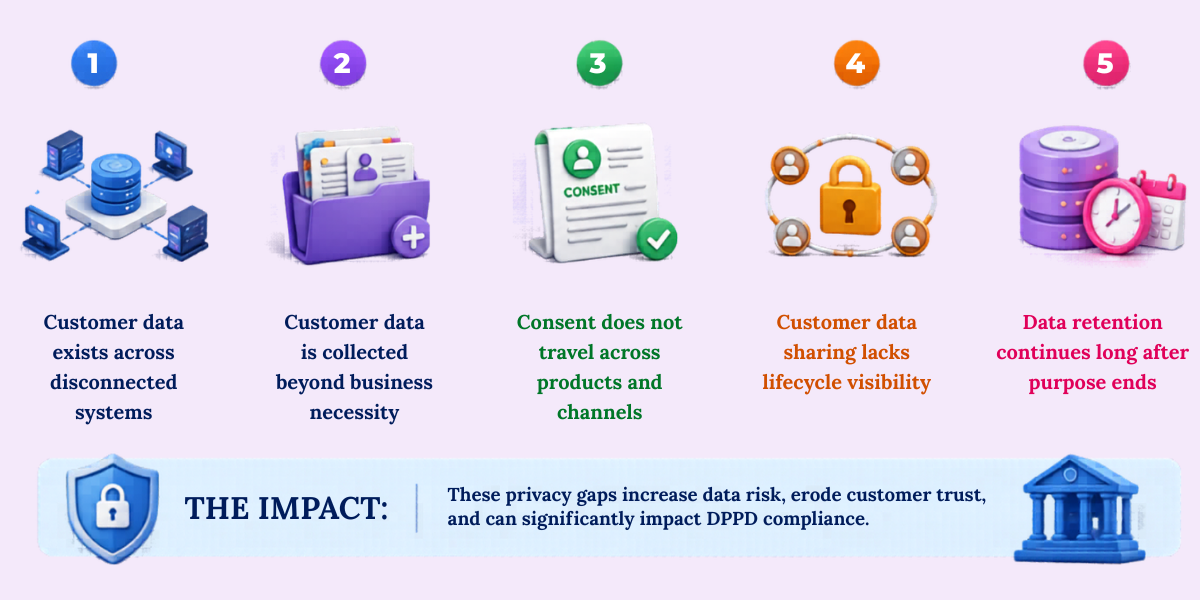
The biggest data privacy issues in BFSI stem from how customer data is collected, stored, shared, and retained across the organization. The most common gaps include fragmented customer data across disconnected systems, excessive data collection, poor consent governance, limited visibility into third-party data sharing, and retaining personal data long after its intended purpose has ended. Together, these issues can increase data risk and impact DPDP compliance efforts.
1. Customer Data Exists Across Disconnected Systems
One of the most common data privacy issues in BFSI is fragmented customer data. When personal information is spread across multiple systems, organizations may struggle to maintain accurate records, respond to customer requests, and demonstrate accountability under privacy regulations.
Customer data rarely lives in a single system.
A bank customer may simultaneously exist within:
- Core banking platforms
- Loan management systems
- CRM tools
- Mobile banking applications
- Internet banking portals
- Call centre systems
- Branch databases
- Third-party servicing platforms
Each system may hold a different version of the same customer.
This creates a data visibility gap.
Consider a customer requesting access to their personal data. If information is scattered across ten different systems, can the organization confidently provide a complete response?
That question becomes even harder during mergers, acquisitions, fintech integrations, or large-scale technology transformations.
Why This Creates Data Risk
- Incomplete customer records can impact decision-making and compliance processes.
- Limited data visibility makes it difficult to locate personal data quickly.
- Inconsistent information across systems can create governance challenges.
- Fragmented data inventories make data lifecycle management significantly harder.
Many organizations appear digitally mature from the outside.
Behind the scenes, they are often managing disconnected data islands.
2. Customer Data Is Collected Beyond Business Necessity
Excessive data collection remains a major data privacy issue in BFSI. Organizations that collect personal information without a clear business purpose increase compliance exposure, storage obligations, and overall data risk.
This issue often begins with a familiar mindset.
"Let's collect it now. We may need it later."
Unfortunately, that approach can create long-term privacy challenges.
Banks, insurers, NBFCs, and fintech companies frequently collect additional information during onboarding, customer verification, marketing campaigns, and product applications. Over time, these practices can result in large volumes of personal data that no longer serve a clear purpose.
The DPDP framework emphasizes purpose limitation and responsible data processing.
In simple terms, organizations should collect data because they need it—not because they might need it someday.
Common Examples in BFSI
- Collecting additional documents during onboarding without a defined business purpose.
- Retaining information submitted during unsuccessful loan applications.
- Gathering customer information that extends beyond product requirements.
- Continuing to use legacy data collection forms that request unnecessary details.
There is an uncomfortable irony here.
Organizations often invest heavily in protecting information that never needed to be collected in the first place.
3. Consent Does Not Travel Across Products and Channels
Consent management becomes significantly more challenging when customer interactions span multiple products, business units, and communication channels. Consent captured in one environment may not automatically apply elsewhere.
Consent is not a checkbox. It is a lifecycle.
Many BFSI organizations operate through multiple customer touchpoints:
- Mobile applications
- Internet banking platforms
- Branch networks
- Call centres
- Insurance partnerships
- Credit card programs
- Investment and wealth management services
The challenge arises when consent remains trapped within one system.
A customer may provide information while opening a savings account. Months later, the same information may be used for loan offers, insurance promotions, investment products, or partner-led marketing initiatives.
Was consent originally obtained for those purposes?
Can the organization demonstrate that it was?
These questions are becoming increasingly important.
Key Consent Management Gaps
- Cross-product usage of customer data without clear purpose alignment.
- Disconnected consent records across systems and business units.
- Inconsistent customer preferences across channels.
- Difficulty managing consent withdrawal requests.
4. Customer Data Sharing Lacks Lifecycle Visibility
Customer data frequently moves beyond the organization that originally collected it. Without lifecycle visibility, financial institutions may struggle to understand where customer information travels, who accesses it, and whether it is still being retained.
Customer data rarely stays in one place.
It moves through ecosystems.
A typical BFSI data flow may involve:
- KYC service providers
- Loan processing partners
- Collection agencies
- Insurance partners
- Analytics vendors
- Cloud service providers
- Outsourced operational teams
Sharing data is not inherently problematic. Losing visibility is.
Consider a lending workflow involving multiple service providers. Customer information may pass through several organizations before a final decision is made.
Can the organization answer:
- Where is the data today?
- Who accessed it?
- Why is it still being retained?
- Has the original purpose expired?
Many organizations cannot answer these questions with complete confidence.
Common Visibility Challenges
- Limited oversight of third-party processing activities.
- Multiple copies of customer data created during workflows.
- Inconsistent vendor retention practices.
- Lack of end-to-end data lineage tracking.
A strong privacy program requires visibility beyond organizational boundaries.
5. Data Retention Continues Long After Purpose Ends
Retaining customer data beyond its intended purpose remains one of the most persistent data privacy issues in BFSI. Excessive retention increases operational complexity, governance costs, and potential compliance exposure.
Data has a habit of staying forever.
Especially in financial services.
Dormant accounts, rejected loan applications, historical KYC records, archived customer communications, and inactive policyholder information often remain stored for years.
Sometimes far longer than necessary.
Large financial institutions operate across dozens of systems, business units, and historical platforms. Implementing consistent retention practices is easier said than done.
However, retaining personal data indefinitely creates unnecessary risk.
Common Retention Challenges
- Dormant customer records remaining active for extended periods.
- Legacy platforms storing outdated information after migration.
- Backup environments containing multiple copies of personal data.
- Unclear ownership of deletion and retention processes.
If an organization cannot clearly explain why customer data is still being stored, it should review whether that data still serves a legitimate business purpose.
How Do BFSI Data Privacy Issues Affect DPDP Compliance?
The five issues discussed above directly impact an organization's ability to demonstrate accountability, transparency, purpose limitation, consent governance, and responsible data lifecycle management under the DPDP framework.
Although each issue appears operational on the surface, they are deeply connected to privacy compliance outcomes.
For example:
- Disconnected systems can affect data discovery and customer request handling.
- Excessive collection can conflict with purpose-based processing principles.
- Weak consent governance can create challenges around lawful data use.
- Limited visibility into data sharing can reduce accountability.
- Excessive retention can increase unnecessary privacy exposure.
Viewed individually, these may appear to be operational inefficiencies.
Viewed collectively, they form a privacy governance challenge.
Conclusion
Many organizations view privacy through a cybersecurity lens.
That is only part of the story.
The more difficult challenge often lies within everyday business operations, customer journeys, product ecosystems, and data management practices that have evolved over years without a unified privacy blueprint.
The strongest privacy programs are not built by reacting to incidents.
They are built by understanding how customer data moves through the organization long before a regulatory inquiry, customer complaint, or compliance review occurs.
In the BFSI sector, trust has always been a competitive advantage.
Increasingly, responsible data management is becoming part of that trust.
Key Takeaways
- Many data privacy issues in BFSI originate from operational practices rather than security incidents.
- Customer data fragmentation remains a major visibility challenge.
- Excessive data collection increases compliance and governance risk.
- Consent management becomes difficult across multiple products and channels.
- Third-party data sharing often lacks lifecycle transparency.
- Customer information is frequently retained beyond business necessity.
- These issues can directly affect DPDP compliance readiness.
Related Blog