
Table of contents
By-Research Team
July 7, 2026 | 8 min read | DPDP
Data Retention Policy: Best Practices & Implementation Guide
Every organization collects data. Few know exactly how long they should keep it. Holding personal data longer than necessary increases compliance risks, storage costs, and the impact of a potential data breach. Deleting it too early, however, can expose organizations to legal, operational, and audit challenges.
Under the Digital Personal Data Protection (DPDP) Act, 2023, organizations are expected to retain personal data only for as long as necessary to fulfil the purpose for which it was collected, making a well-defined retention policy an essential part of privacy governance.
In this guide, you'll learn what a data retention policy is, why it matters, how to create one, and how to align it with DPDP compliance and industry best practices.
What Is a Data Retention Policy?
A data retention policy is a documented framework that defines how long different categories of data should be retained, who is responsible for managing them, and when they should be securely archived or deleted. It helps organizations balance regulatory compliance, operational needs, and data privacy obligations while reducing unnecessary data storage.
Without a structured policy, data tends to accumulate indefinitely. This "keep everything" approach often creates hidden risks-from increased storage costs to greater exposure during cyber incidents and regulatory investigations.
In our observation, organizations often mistake data backup for data retention. They are not the same.
Backups ensure business continuity after system failures, whereas a data retention policy determines whether data should continue to exist at all. Retaining unnecessary personal data simply because it exists in backups can undermine privacy compliance.
Why Is a Data Retention Policy Important?
A data retention policy helps organizations reduce privacy risks, comply with legal obligations, improve operational efficiency, and ensure personal data is not retained longer than necessary. It creates a consistent framework for managing information throughout its lifecycle while supporting business continuity and regulatory compliance.
A structured retention policy delivers several benefits:
1. Strengthens Regulatory Compliance
A data retention policy helps organizations comply with privacy laws by retaining personal data only for legitimate purposes. Under the DPDP Act, 2023, Data Fiduciaries should erase personal data once its purpose is fulfilled unless retention is legally required.
2. Reduces Cybersecurity Risk
Deleting obsolete data minimizes the attack surface and reduces the potential impact of data breaches. Organizations with strong data governance are also better equipped to identify and contain security incidents.
3. Improves Operational Efficiency
Retaining only necessary data improves system performance, reduces storage costs, simplifies audits, and makes information easier to manage.
4. Builds Customer Trust
Securely deleting data when it is no longer needed demonstrates responsible data handling, improves transparency, and strengthens customer confidence.
What Should a Data Retention Policy Include?
A comprehensive data retention policy should define the scope of covered data, retention periods, legal and business justifications, ownership responsibilities, security controls, deletion procedures, review mechanisms, and compliance requirements. Together, these elements create a consistent framework for managing data throughout its lifecycle.
A policy should do more than state, "Keep data for seven years."
It should explain why that period exists, who enforces it, and what happens once the period expires.
1. Purpose - Explain why the policy exists and the compliance and business objectives it supports.
2. Scope - Define the data types, systems, and departments covered by the policy.
3. Data Categories - Classify data into categories such as customer, employee, financial, vendor, and marketing data.
4. Retention Schedule - Specify how long each data category should be retained based on legal and business requirements.
5. Roles and Responsibilities - Assign ownership for implementing, monitoring, and reviewing the policy.
6. Disposal Procedures - Outline how data will be securely deleted, anonymized, or archived after the retention period.
7. Exceptions - Document scenarios, such as legal holds or regulatory investigations, where data must be retained longer than planned.
8. Policy Review - Define how often the policy should be reviewed and updated to remain compliant.
How to Create a Data Retention Policy (Step-by-Step)
Creating a data retention policy involves identifying the data you collect, classifying it, determining applicable legal and business requirements, assigning retention periods, defining governance responsibilities, implementing secure deletion procedures, and regularly reviewing the policy to ensure ongoing compliance and operational effectiveness.
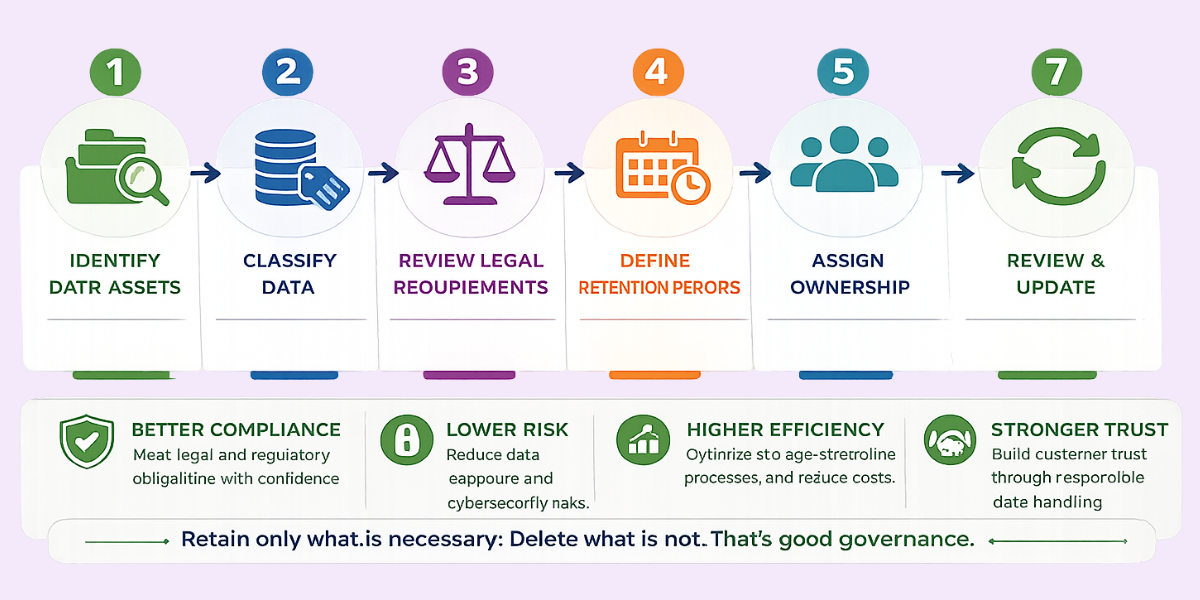
Step 1: Identify All Data Assets
Start by creating a comprehensive inventory of the data your organization collects, processes, stores, and shares.
Include:
- Customer information
- Employee records
- Vendor data
- Financial documents
- Marketing databases
- Website analytics
- CCTV footage
- Email archives
A data inventory provides the visibility needed to apply appropriate retention rules.
Step 2: Classify Data by Purpose and Sensitivity
Once identified, categorize data according to its purpose and sensitivity.
For example:
- Customer onboarding data
- Payroll records
- Recruitment information
- Financial transactions
- Marketing consent records
This makes it easier to assign retention periods and implement security controls.
Step 3: Determine Legal and Business Requirements
Retention periods should never be arbitrary.
Consider:
- Applicable laws
- Regulatory requirements
- Tax obligations
- Employment laws
- Contractual commitments
- Business continuity needs
When multiple requirements apply, document the rationale for the chosen retention period.
Step 4: Define Retention Periods
Assign a documented retention period to every category of data.
The retention period should answer three questions:
- Why is the data being retained?
- How long is it required?
- What happens after the period ends?
Avoid indefinite retention unless supported by a legal obligation.
Step 5: Assign Ownership
Retention is not solely an IT responsibility.
Clearly define who is responsible for:
- Maintaining the retention schedule
- Monitoring compliance
- Approving exceptions
- Conducting reviews
- Authorizing deletion
A shared governance model improves accountability.
Step 6: Implement Automated Retention and Deletion
Manual deletion is difficult to scale and often inconsistent.
Where possible, automate:
- Retention timers
- Deletion workflows
- Archiving rules
- Legal hold exceptions
- Audit logs
Automation reduces human error and strengthens compliance.
Step 7: Review the Policy Regularly
A retention policy is a living document.
Review it:
- Annually
- Following regulatory changes
- After mergers or acquisitions
- When introducing new systems
- Following significant business changes
Regular reviews ensure the policy continues to reflect legal and operational realities.
Data Retention Under the DPDP Act, 2023
The DPDP Act, 2023 does not prescribe fixed retention periods for personal data. Instead, it follows a purpose-based approach, requiring Data Fiduciaries to retain personal data only for as long as necessary to fulfil the purpose for which it was collected, unless retention is mandated by law.
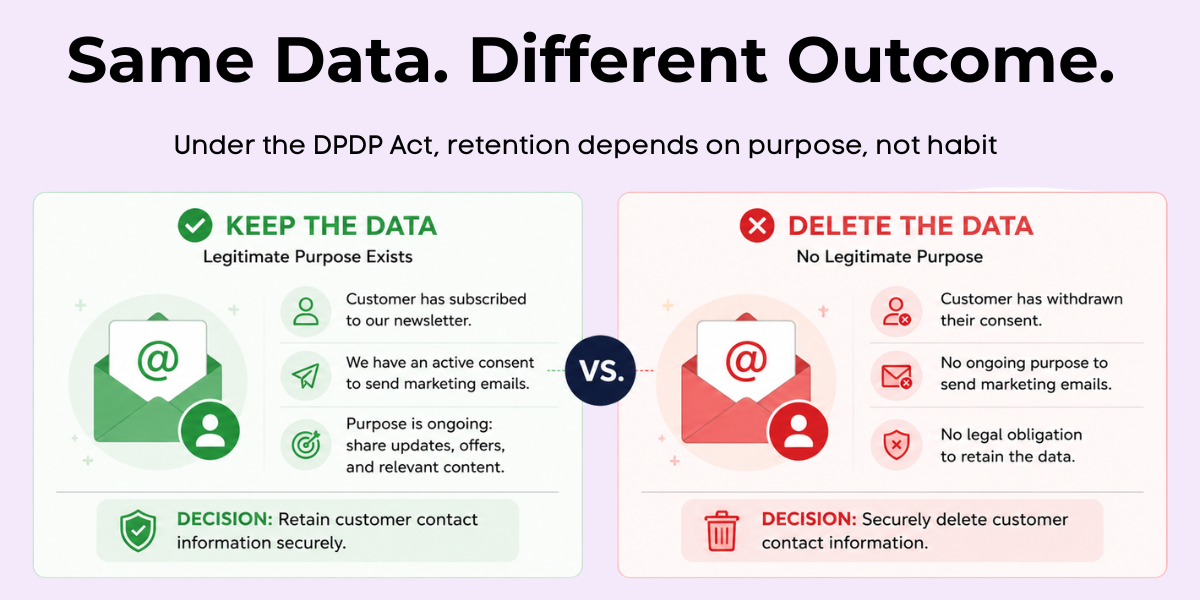
Under Section 8(7), personal data must be erased once the specified purpose has been fulfilled and there is no legal or business requirement to retain it.
In short, organizations should retain data with a documented purpose-not by default.
Best Practices for Data Retention Policy Management
An effective data retention policy should be regularly reviewed, consistently enforced, integrated with governance processes, and supported by automation wherever possible. The goal is not simply to retain data-but to retain the right data for the right amount of time.
Consider these best practices:
1. Build a Centralized Retention Schedule
Maintain a single, organization-wide retention schedule to ensure consistent data retention practices across all departments.
2. Automate Retention Processes
Use automation for data classification, retention timers, deletion workflows, and audit reporting to improve accuracy and reduce manual effort.
3. Review Policies Regularly
Update the retention policy at least annually-or whenever there are significant regulatory or business changes-to keep it relevant and compliant.
4. Train Employees
Conduct regular training on retention responsibilities, secure deletion practices, legal holds, and privacy obligations to ensure consistent policy implementation.
5. Maintain Audit Evidence
Keep records of policy approvals, retention schedules, review history, deletion logs, and exceptions to demonstrate compliance during audits and regulatory reviews.
Conclusion
A data retention policy is no longer optional in today's data-driven environment. As organizations collect increasing volumes of personal information, they must also demonstrate that they know what data they hold, why they hold it, and when it should be securely deleted.
Under the DPDP Act, 2023, responsible data retention is closely tied to accountability. Organizations that adopt a structured retention framework are better positioned to reduce privacy risks, simplify compliance, improve data governance, and build lasting customer trust.
Key Takeaways
- A data retention policy helps organizations decide what data to keep, for how long, and when to delete it.
- It reduces compliance risks, improves security, and builds customer trust.
- A good policy should clearly define data categories, retention periods, responsibilities, and deletion procedures.
- Creating a policy starts with identifying your data and setting retention periods based on legal and business needs.
- Under the DPDP Act, personal data should be kept only for as long as it is needed, unless the law requires otherwise.
- There is no fixed retention period for all data-organizations should define timelines based on applicable requirements.
- Regular reviews, employee training, automation, and audit records help keep the policy effective.
- A well-managed data retention policy strengthens compliance and supports better data governance.
Related Blog