Table of contents
By-Research Team
July 3, 2026 | 7 min read | DPDP
Vendor Risk Management Under the DPDP Act: A Complete Guide
Your organization may have strong privacy policies and cybersecurity controls, but a single third-party vendor can still become your biggest compliance risk. As organizations increasingly rely on cloud providers, payroll processors, HR platforms, payment gateways, and other service providers, managing vendor-related risks has become essential.
This is where vendor risk management under the DPDP Act plays a critical role. Under India's Digital Personal Data Protection Act, 2023, organizations remain responsible for protecting personal data, even when it is handled by vendors on their behalf.
This guide explains what vendor risk management is, why it matters under the DPDP Act, the most common vendor risks organizations face, practical strategies to manage them, and best practices for building a resilient vendor risk management program.
What Is Vendor Risk Management?
Vendor risk management is the process of identifying, assessing, mitigating, monitoring, and governing risks arising from third-party vendors that provide products or services to an organization. Under the DPDP Act, vendor risk management helps organizations reduce privacy, security, operational, and compliance risks associated with vendors processing personal data.
Every organization depends on third parties. Some host cloud infrastructure. Others manage payroll, customer support, HR systems, analytics platforms, marketing campaigns, or payment processing.
Whenever these vendors access, store, process, or transfer personal data, they become an important part of the organization's privacy ecosystem. Although operational responsibility may be shared, governance responsibility remains with the organization.
Why Is Vendor Risk Management Important Under the DPDP Act?
Vendor risk management is important under the DPDP Act because organizations remain responsible for protecting personal data throughout its lifecycle, even when third-party vendors process that data. Effective vendor oversight helps reduce compliance, cybersecurity, operational, and reputational risks while strengthening customer trust.
Modern organizations rarely process personal data alone. Customer information, employee records, payment details, analytics data, and marketing databases often flow through multiple third-party systems.
This interconnected environment creates efficiency—but it also expands the organization's attack surface.
What Are the Most Common Vendor Risks?
Organizations face multiple categories of vendor risk, including data privacy, cybersecurity, operational, compliance, and reputational risks. Understanding these risks enables organizations to prioritize vendor assessments, implement appropriate safeguards, and continuously monitor third-party relationships.
1. Data Privacy Risks
Data privacy risks arise when vendors collect, access, store, process, or share personal data without appropriate governance or security controls.
Examples include:
- Excessive collection of personal data
- Unauthorized processing of personal data
- Improper sharing of personal data with third parties
- Failure to securely delete personal data after use
- Inadequate consent management practices
2. Cybersecurity Risks
Cybersecurity risks occur when vendors lack adequate technical safeguards to protect systems and personal data from cyber threats. A security weakness at the vendor level can quickly become a data privacy incident.
Examples include:
- Weak authentication mechanisms
- Insecure APIs
- Malware and ransomware attacks
- Phishing attacks
- Vulnerable or outdated software
- Misconfigured cloud environments
3. Compliance Risks
Compliance risks arise when vendors fail to meet contractual obligations, regulatory requirements, or recognized industry standards. These gaps can expose organizations to regulatory scrutiny, contractual disputes, and increased operational risk.
Examples include:
- Missing security certifications
- Inadequate compliance documentation
- Delayed or incomplete breach notifications
- Limited support during audits or regulatory reviews
4. Operational Risks
Operational risks affect a vendor's ability to deliver agreed services consistently. Service interruptions or operational failures can disrupt business processes, delay critical operations, and impact customer experience.
Examples include:
- Vendor system outages
- Financial instability
- Staff shortages
- Service degradation
- Disaster recovery failures
5. Reputational Risks
Reputational risks arise when a vendor's actions negatively affect an organization's public image.
Examples include:
- Publicized data breaches involving vendors
- Negative media coverage following a vendor incident
- Loss of customer trust due to poor vendor practices
- Decline in stakeholder confidence after third-party failures
How Can Organizations Manage Vendor Risks Effectively?
Organizations can manage vendor risks effectively by adopting a structured and continuous risk management process that spans the entire vendor relationship—from onboarding to ongoing oversight. A mature vendor risk management program combines governance, due diligence, contractual safeguards, monitoring, and periodic reassessments to reduce privacy, security, and compliance risks.
Many organizations treat vendor risk management as a procurement checklist.
Instead, organizations should build a repeatable framework that enables them to identify risks early, implement appropriate controls, and monitor vendors throughout the relationship.
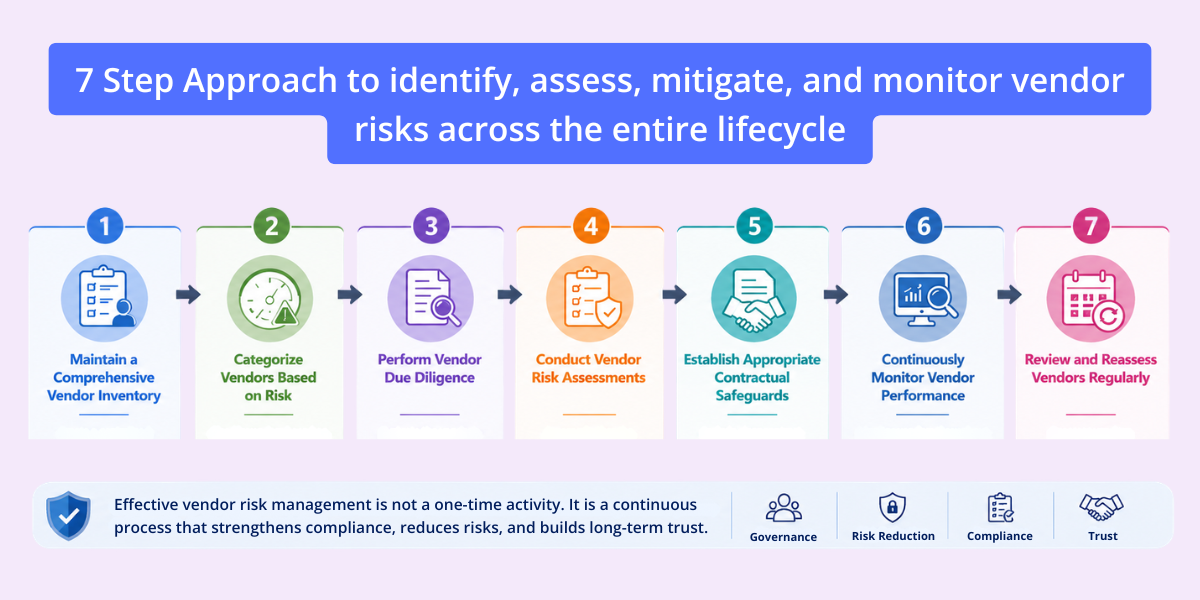
1. Maintain a Comprehensive Vendor Inventory
Start by maintaining a centralized inventory of all third-party vendors that interact with your organization. Your inventory should capture essential details such as the services provided, the personal data processed, vendor ownership, contract timelines, and risk classification. A complete inventory helps organizations gain visibility into their vendor ecosystem and prioritize risks effectively.
2. Categorize Vendors Based on Risk
Not all vendors pose the same level of risk. Classify vendors based on factors such as the sensitivity of personal data they process, the level of system access they have, their business criticality, and whether they engage sub processors or cross-border data transfers. A risk-based approach ensures that high-risk vendors receive greater oversight.
3. Perform Vendor Due Diligence
Before sharing personal data, assess whether a vendor has appropriate privacy, security, and governance controls in place. Reviewing policies, certifications, incident history, and business continuity capabilities helps identify potential risks early and supports informed vendor selection.
4. Conduct Vendor Risk Assessments
Vendor due diligence verifies a vendor's controls, while a vendor risk assessment evaluates whether those controls adequately address your organization's specific risks. Assessments should consider areas such as privacy governance, cybersecurity, access management, encryption, incident response, and regulatory compliance.
5. Establish Appropriate Contractual Safeguards
Vendor contracts should clearly define responsibilities for protecting personal data. Include appropriate provisions covering data processing, confidentiality, security requirements, breach notifications, audit rights, data retention, and secure deletion to establish accountability throughout the vendor relationship.
6. Continuously Monitor Vendor Performance
Vendor risk management does not end after onboarding. Continuously monitor vendors through periodic reviews, performance evaluations, compliance checks, security updates, and incident reporting to identify new or evolving risks throughout the relationship.
7. Review and Reassess Vendors Regularly
Vendor relationships and business risks change over time. Regular reassessments help ensure vendors continue to meet your organization's privacy, security, and compliance expectations, particularly when services, regulations, or risk profiles evolve.
Vendor Risk Management Checklist
Use the following checklist to evaluate whether your organization has established the foundations of an effective vendor risk management program.
✅ Maintain a centralized vendor inventory.
✅ Identify vendors that process personal data.
✅ Categorize vendors based on business and privacy risks.
✅ Conduct vendor due diligence before onboarding.
✅ Perform structured vendor risk assessments.
✅ Verify security and privacy controls.
✅ Execute appropriate contractual safeguards.
✅ Monitor vendors throughout the relationship.
✅ Reassess high-risk vendors periodically.
✅ Maintain evidence for audits and compliance reviews.
Conclusion
Organizations increasingly depend on third-party vendors to deliver critical business functions, but every vendor relationship introduces new privacy, security, and compliance risks. Managing these risks effectively requires more than periodic assessments—it demands a structured governance framework supported by clear processes, ongoing oversight, and documented evidence.
An effective vendor risk management program enables organizations to make informed decisions before engaging vendors, reduce the likelihood of privacy incidents, strengthen regulatory compliance, and build greater trust with customers and stakeholders. By adopting a proactive, risk-based approach, organizations can transform vendor management from a reactive compliance exercise into a strategic capability that supports long-term resilience and responsible data governance.
Key Takeaways
- Vendor risk management helps organizations manage the risks associated with third-party vendors that handle personal data.
- Under the DPDP Act, organizations remain responsible for personal data processed by their vendors.
- Common vendor risks include data privacy, cybersecurity, compliance, operational, and reputational risks.
- Managing vendor risks requires a structured process, from vendor onboarding to continuous monitoring.
- Following best practices and reviewing vendors regularly helps strengthen compliance and reduce risks.
- Using a vendor risk management checklist ensures important steps are not missed.
- A proactive vendor risk management program improves compliance, protects personal data, and builds customer trust.
Related Blog