
Table of contents
By-Research Team
March 6, 2026 | 12 min read | DPDP
How to Create a ROPA: Record of Processing Activity for DPDP Compliance
Most organizations believe they “manage” personal data.
They don’t. They manage scattered spreadsheets, vendor contracts, and consent logs - without a unified compliance fortress.
Under the DPDP Act and global frameworks like GDPR, that fragmentation becomes regulatory exposure. The structural solution is clear: ROPA (Record of Processing Activity) - the documented blueprint that proves how and why you process data.
This guide explains what ROPA is, whether it is required under DPDP, how it differs from data inventory and data mapping, how to build one properly, and the common mistakes that weaken regulatory defence.
What is ROPA (Record of Processing Activity)?
ROPA (Record of Processing Activity) is a structured register documenting how an organization processes personal data, including processing purpose, categories of data subjects, types of personal and sensitive data, recipients, retention timelines, and security safeguards. It serves as evidence of accountability under GDPR Article 30 and as core DPDP compliance documentation.
In regulatory language, it is mandatory documentation under Records of Processing Activities under GDPR Article 30.
[Source: GDPR Article 30].
In operational language, it is your processing blueprint.
The DPDP Act does not explicitly use the word “ROPA.”
But it imposes Data Fiduciary obligations that cannot be demonstrated without structured records.
Different labels. Same structural expectation.
Is ROPA Mandatory or Required Under the DPDP Act, 2023?
ROPA is not explicitly named in the DPDP Act, 2023. However, to comply with Data Fiduciary obligations - including processing purpose limitation, security safeguards, retention control, and breach response - maintaining structured Records of Processing Activities becomes operationally necessary. In practice, ROPA functions as required compliance infrastructure under DPDP.
The DPDP Act requires organizations to:
-
Process personal data for specified lawful purposes
-
Implement reasonable security safeguards
-
Erase data when no longer necessary
-
Notify breaches within prescribed timelines
How do you prove you comply?
Through documentation.
ROPA under GDPR vs DPDP Act
Under GDPR, ROPA is expressly mandated under Article 30 for controllers and processors meeting certain thresholds or processing sensitive data. Under the DPDP Act, while not explicitly mandated, equivalent documentation is necessary to demonstrate compliance with accountability principles and security safeguards.
| Aspect | GDPR (Article 30 – Records of Processing Activities) | DPDP Act, 2023 (India) |
|---|---|---|
| Legal Status of ROPA | Explicitly mandated under Article 30 for controllers and processors meeting thresholds or engaging in non-occasional/high-risk processing. | Not explicitly named in the Act or DPDP Rules. However, documentation is implicitly required to demonstrate Data Fiduciary obligations. |
| Who Must Maintain It | Controllers and processors with 250+ employees, or any entity processing sensitive data or high-risk data regardless of size. | Any Data Fiduciary processing personal data at scale, sensitive data, or children’s data will require structured documentation to demonstrate accountability. |
| Purpose Documentation | Mandatory documentation of specific processing purposes. | Processing must be for specified lawful purposes under consent or legitimate use. Documentation necessary to prove purpose limitation. |
| Categories of Data | Must record categories of personal data and categories of data subjects. Special categories (Article 9) require stricter controls. | Must identify personal data and sensitive data where applicable. Risk-based safeguards expected though classification structure differs from GDPR. |
| Recipients & Sharing | Mandatory listing of recipients, including processors and third parties. | Must be able to demonstrate lawful sharing and purpose limitation. Vendor disclosures required in practice for defensibility. |
| International Transfers | Must document third-country transfers and applicable safeguards (e.g., SCCs). | Cross-border transfers permitted subject to government restrictions. Documentation necessary to demonstrate compliance if transfers occur. |
| Retention Periods | Mandatory inclusion of retention timelines or criteria used to determine them. | Retention limitation required. Data must be erased when purpose is fulfilled. A retention register becomes operationally necessary. |
| Security Measures | Must include a general description of technical and organizational security measures (Article 32 reference). | Data Fiduciaries must implement “reasonable security safeguards.” Documentation required to demonstrate compliance during investigations. |
| Regulatory Inspection | Supervisory authorities can request ROPA at any time. Failure to maintain it has resulted in enforcement findings. | While not explicitly referenced, inability to demonstrate documented compliance can weaken defence during DPDP investigations or breach proceedings. |
| Philosophy of Accountability | Documentation-first compliance. Accountability must be demonstrable on paper. | Principle-based accountability. Documentation becomes the practical mechanism to prove compliance. |
What Is the Difference Between ROPA, Data Inventory, And Data Mapping?
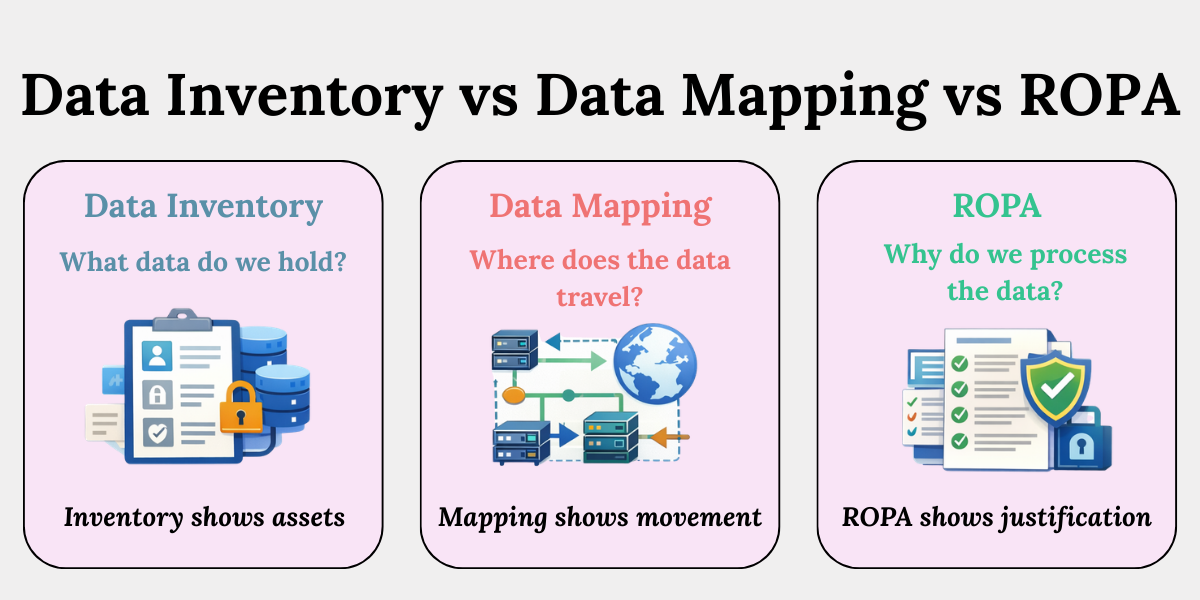
ROPA documents the legal and operational justification for processing activities. A data inventory catalogues what personal data exists and where it is stored. Data mapping traces how data flows across systems and vendors. Each forms a distinct layer within DPDP compliance documentation and should not be treated as interchangeable.
Confusion here is common. And expensive.
1. Data Inventory - The Asset Register
A data inventory records:
-
What personal data and sensitive data exist
-
Where they are stored
-
System owners
-
Retention timelines
It answers: What do we hold?
Without it, you cannot identify exposure.
2. Data Mapping - The Flow Architecture
A data mapping exercise documents:
- How data moves between systems
- Inter-department transfers
- Vendor sharing
- Cross-border transfers
It answers: Where does it travel?
Cross-border transfers under GDPR and DPDP may trigger additional safeguards. Without mapping, you cannot assess risk.
3. ROPA - The Accountability Blueprint
A Record of Processing Activity captures:
1. Processing purpose limitation
Defines the exact, specific reason why personal data is collected and used. This ensures data is not repurposed beyond its original lawful intent under the DPDP Act and GDPR.
2. Lawful basis
Documents whether processing is based on consent, legitimate use (under DPDP), or other lawful grounds such as contract or legal obligation (under GDPR). Without this, processing lacks legal foundation.
3. Categories of data subjects
Identifies whose data is being processed - employees, customers, vendors, children, or users. Risk exposure differs depending on the category.
4. Recipients
Specifies internal departments, third-party processors, and external vendors who receive the data. Transparency in sharing reduces regulatory vulnerability.
5. Data retention and safeguards register
Records how long data is retained, what triggers deletion, and what archival controls exist. Retention without limits violates purpose limitation principles.
6. Security controls
Documents technical and organizational safeguards such as encryption, access controls, and monitoring mechanisms. Security must be demonstrable - not assumed.
It answers: Why are we allowed to process this, and under what safeguards?
- Inventory shows assets.
- Mapping shows movement.
- ROPA shows justification.
- Remove one layer, and the compliance structure weakens.
How to Create ROPA Under DPDP?
To create ROPA under DPDP, organizations must document each processing activity, define its purpose, identify personal and sensitive data categories, assign lawful basis, establish retention timelines, record safeguards, and align entries with DPDP compliance documentation principles. The process should integrate outputs from data inventory and data mapping.
Build deliberately.
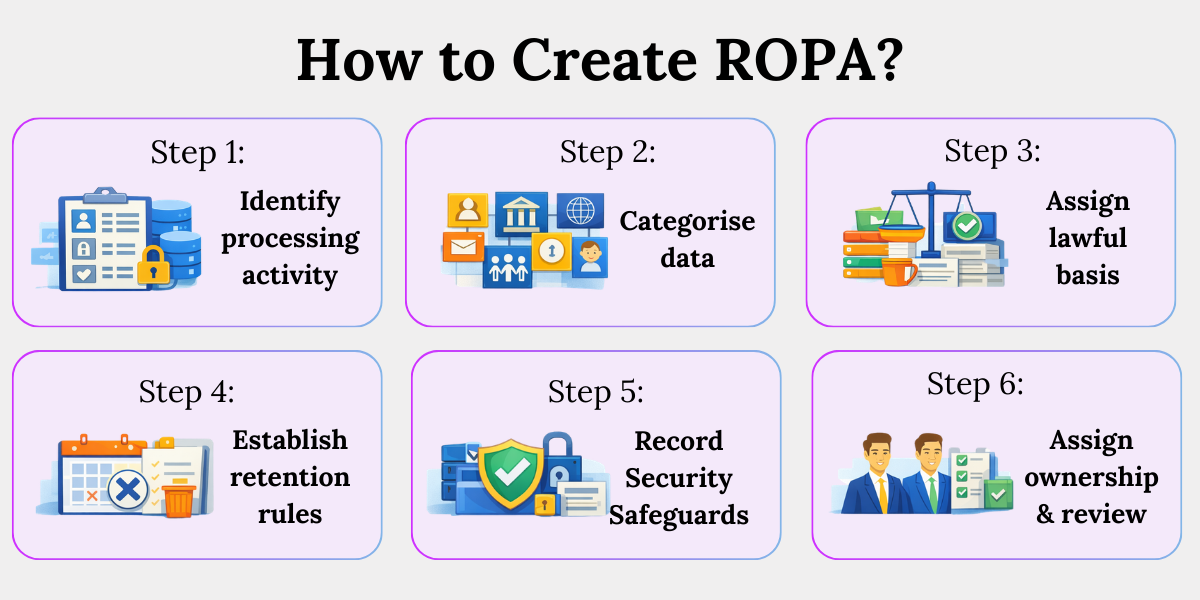
Step 1: Identify Processing Activities
Begin by listing every distinct processing function within the organization - employee payroll, customer onboarding, marketing analytics, grievance handling, vendor due diligence, IT monitoring, and more.
Each activity must have a clearly defined, specific purpose aligned with processing purpose limitation principles under the DPDP Act and Article 5(1)(b) GDPR.
Avoid vague labels like “business operations.” Regulators expect precision.
If you cannot explain why, you process data, you cannot justify that you process data.
Step 2: Categorize Personal and Sensitive Data
For each processing activity, document the exact categories of personal data and sensitive data involved - identifiers, financial information, location data, biometric markers, health records, or children’s data.
Under GDPR Article 9, special categories of data (health, biometric, racial origin, etc.) trigger stricter compliance thresholds. While the DPDP Act structures risk differently, higher sensitivity still increases regulatory scrutiny and safeguard expectations.
Risk is data-dependent.
The more sensitive the data, the stronger the shield required.
Step 3: Assign Lawful Basis
Every processing activity must have a documented lawful foundation.
Under the DPDP Act, processing must rely on consent or legitimate use.
Under GDPR Article 6, lawful bases include consent, contract, legal obligation, vital interests, public task, and legitimate interests.
This must be recorded explicitly within the ROPA. Assumptions do not qualify as lawful basis documentation.
If challenged during investigation, the organization must demonstrate not only what it processes - but under which legal authority it does so.
Document the lawful basis clearly for each processing activity.
Step 4: Establish Retention Rules
Create a structured Data Retention and Safeguards Register linked directly to each processing activity. Document the specific retention period, objective deletion triggers (e.g., contract termination, regulatory expiry), archival controls, and disposal methods.
Under the DPDP Act, personal data must be erased once the purpose is fulfilled unless retention is required by law. GDPR Article 5(1)(e) similarly mandates storage limitation.
Indefinite retention signals governance failure. Retention discipline demonstrates accountability.
Indefinite retention is not caution. It is unmanaged risk.
Step 5: Record Security Safeguards
For each activity, document the implemented safeguards - encryption standards, access control frameworks, role-based access restrictions, logging and monitoring systems, and incident response protocols.
Under GDPR Article 32, controllers must implement appropriate technical and organizational measures. The DPDP Act similarly mandates “reasonable security safeguards.”
Security must be demonstrable, not implied.
In enforcement scenarios, undocumented safeguards are treated as non-existent.
Security without documentation is invisible to regulators.
Step 6: Assign Ownership and Review Cycle
Each ROPA entry must clearly identify the responsible department owner, escalation authority, and review frequency. Governance oversight ensures the register evolves alongside operational changes.
New vendors. New products. New data flows. If ROPA is not reviewed periodically - at least annually or upon material change - it becomes outdated and unreliable.
Compliance is not a one-time draft. It is a living compliance blueprint.
A ROPA without review becomes obsolete within months.
Common ROPA Mistakes Organizations Make
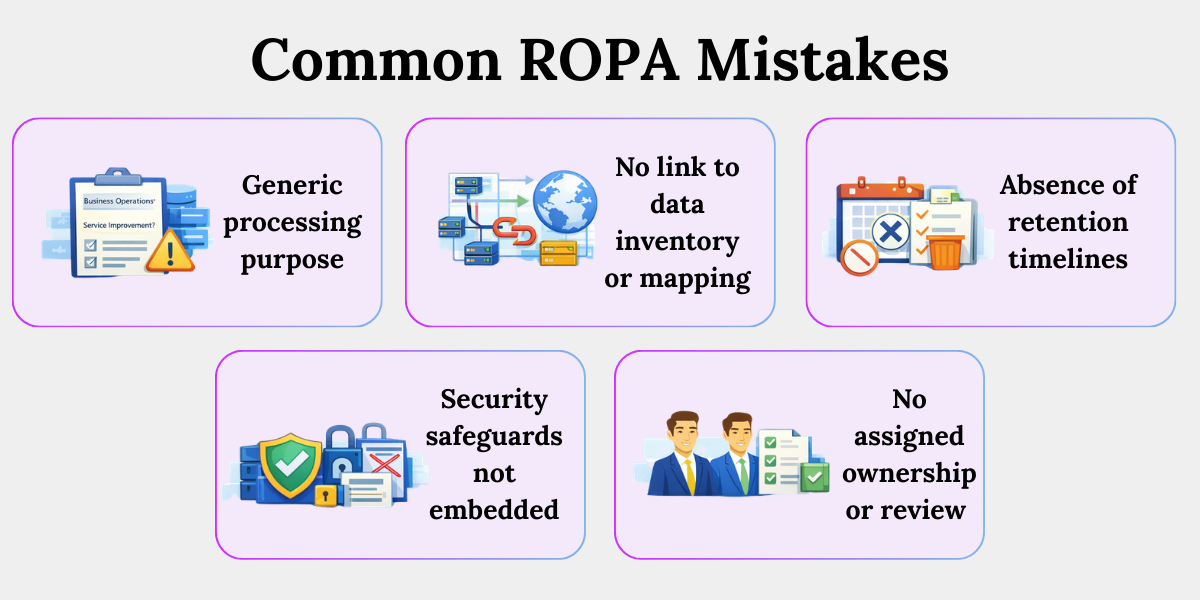
Most ROPA failures arise from vague descriptions, lack of integration with data mapping, absence of retention documentation, and failure to assign ownership. In enforcement scenarios, incomplete or outdated Records of Processing Activities significantly weaken regulatory defence.
-
Generic Processing Purposes
Using vague descriptions like “business operations” or “service improvement” does not satisfy processing purpose limitation under the DPDP Act or GDPR.
Regulators expect clearly defined, narrow, and documented purposes tied to specific operational activities.
If the purpose is not precise, any downstream use of personal data may appear unlawful.
-
No Linkage to Data Inventory or Data Mapping
ROPA must align with actual system architecture. If your data mapping shows cross-border vendor transfers but your ROPA omits recipient documentation, the inconsistency becomes a red flag during audits.
Regulators cross-check documentation layers. When inventory, mapping, and ROPA do not reconcile, it signals governance gaps rather than clerical error.
-
Absence of Defined Retention Timelines
Many organizations meticulously document data collection but neglect deletion controls. Under the DPDP Act, personal data must be erased once the purpose is fulfilled unless legally required otherwise.
GDPR Article 5(1)(e) reinforces storage limitation principles.
Without documented retention periods and objective deletion triggers, organizations cannot demonstrate compliance with erasure obligations. Retention discipline is a measurable accountability marker.
-
Security Safeguards Not Embedded in ROPA
Technical safeguards often exist within IT security manuals but are not reflected in the Record of Processing Activity. Under GDPR Article 32 and DPDP’s reasonable security safeguards requirement, documentation is part of compliance.
During investigations, regulators assess what is documented - not what is verbally asserted. Undocumented safeguards weaken the compliance shield.
-
No Assigned Ownership or Review Mechanism
ROPA is frequently, drafted once and left static. However, processing activities evolve - new vendors onboard, systems migrate to cloud infrastructure, analytics tools expand data capture.
Without designated ownership and periodic review cycles, ROPA becomes outdated. A historical record cannot defend current processing practices.
Compliance is dynamic. Documentation must be too.
Why ROPA Matters for Data Fiduciary Obligations
ROPA operationalizes Data Fiduciary obligations under the DPDP Act by translating legal principles into documented, reviewable processes. It connects purpose limitation, retention control, and security safeguards into a measurable accountability framework.
The DPDP Act is built on accountability.
Accountability requires evidence.
Evidence requires structured records.
Without documented Records of Processing Activities:
-
Purpose limitation cannot be demonstrated.
-
Sensitive data exposure cannot be assessed.
-
Breach response readiness cannot be evaluated.
Compliance without documentation is belief.
Compliance with ROPA is architecture.
Conclusion
Regulators do not ask whether you intended to comply.
They ask whether you can prove it.
ROPA - the Record of Processing Activity - is not bureaucratic paperwork. It is the structural backbone of DPDP compliance documentation and the operational shield protecting Data Fiduciaries.
Build the blueprint before scrutiny arrives.
Because once enforcement begins, documentation created in hindsight rarely survives inspection.
Key Takeaways
-
ROPA (Record of Processing Activity) is the documented blueprint that proves how and why your organization processes personal data.
-
Under the DPDP Act, ROPA is not explicitly named but becomes operationally necessary to demonstrate Data Fiduciary obligations.
-
Under GDPR Article 30, maintaining ROPA is explicitly mandatory for qualifying controllers and processors.
-
ROPA, data inventory, and data mapping serve different functions and must work together as layered compliance architecture.
-
A defensible ROPA must clearly document purpose limitation, lawful basis, data categories, recipients, retention rules, and security safeguards.
-
Retention timelines and documented safeguards are critical to meeting DPDP erasure and security requirements.
-
Common ROPA failures include vague purposes, missing retention controls, disconnected data mapping, and lack of ownership.
-
Without structured processing records, compliance cannot be proven - and defensibility weakens under regulatory scrutiny.
Related Blog