
Table of contents
By-Research Team
July 21, 2026 | 9 min read | DPDP
How to Implement Data Minimisation Under the DPDP Act
Every organisation collects personal data. But does it really need all the information it asks for?
From online registration forms requesting a date of birth to mobile apps asking for contact lists and location access, businesses often collect personal data simply because they can—not because they should.
That is precisely where data minimisation becomes important. Think of it as building a fortress: every additional piece of personal data is another door you must secure.
This guide explains what data minimisation means under the DPDP Act, how the law supports it, and why collecting less personal data is often the smartest compliance strategy.
What Is Data Minimisation?
Data minimisation is the principle of collecting, using, and retaining only the personal data necessary to fulfil a specific and lawful purpose. According to this principle, organisations should avoid collecting information that is excessive, unrelated, or unnecessary for the purpose communicated to the Data Principal.
At its core, data minimisation is about necessity rather than possibility. Just because technology allows an organisation to collect more data does not mean it should.
The benefits of data minimisation extend beyond regulatory compliance.
Collecting less data helps organisations:
- Reduce privacy risks by limiting the volume of personal information exposed during a breach.
- Strengthen cybersecurity because fewer records require protection.
- Lower storage and management costs by retaining only relevant information.
- Improve customer trust by demonstrating responsible data handling practices.
- Simplify compliance with the DPDP Act and other global privacy regulations.
In our observation, organisations often view data minimisation as a compliance restriction. In reality, it is a business efficiency principle. When teams stop collecting information "just in case," they spend less time managing redundant data and more time using meaningful information to deliver better services.
What Does the DPDP Act Say About Data Minimisation?
While the DPDP Act does not contain a standalone provision titled "Data Minimisation," the principle is embedded throughout the legislation. Together, its requirements on lawful purpose, informed consent, purpose limitation, and data erasure ensure that organisations collect only the personal data necessary for a defined purpose and do not retain it indefinitely.
Instead of prescribing a single "data minimisation rule," the Act creates a compliance framework where unnecessary collection becomes difficult to justify. Organisations must be able to explain why personal data is collected, how it will be used, and when it will be erased once the purpose has been fulfilled.
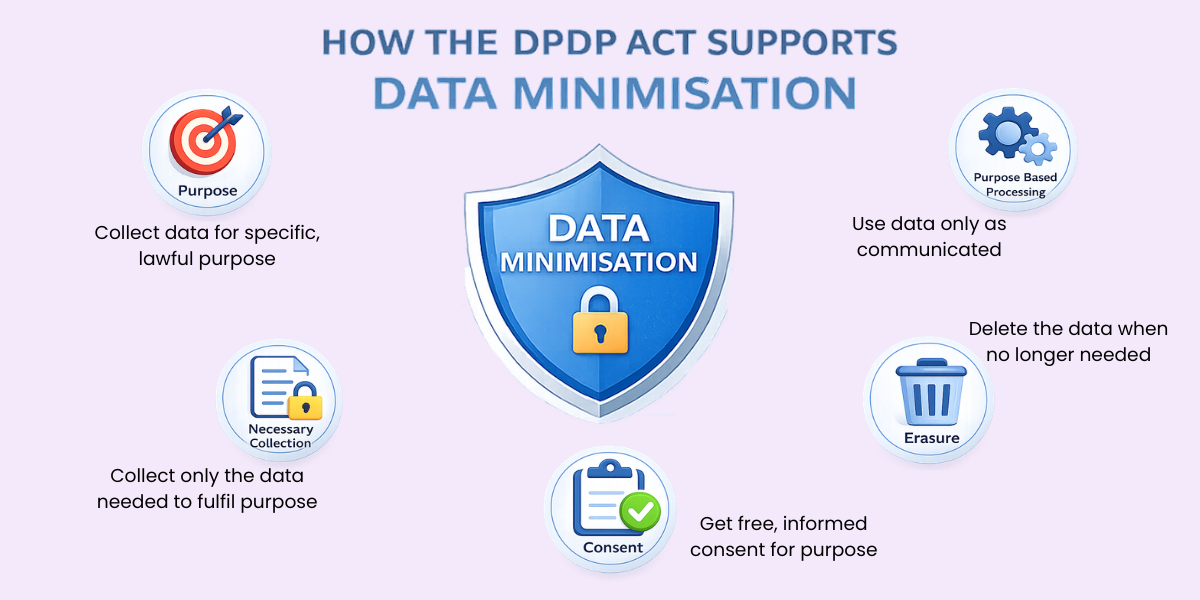
1. Purpose Limitation Requires Collection for a Specific Purpose
The foundation of data minimisation begins with purpose.
The DPDP Act requires personal data to be processed only for a lawful purpose for which the individual has provided consent or where processing is otherwise permitted under the Act. If an organisation cannot clearly explain why a particular data field is needed, collecting it becomes difficult to justify.
2. Consent Must Be Specific and Informed
Collecting unnecessary data often leads to another compliance issue—invalid consent.
The DPDP Act requires consent to be free, specific, informed, unconditional, and unambiguous. Organisations should therefore inform individuals about the categories of personal data being collected and the purpose behind each collection activity.
3. Data Must Not Be Retained Longer Than Necessary
Data minimisation is not limited to collection—it extends throughout the data lifecycle.
Once the purpose for processing personal data has been fulfilled, organisations are expected to erase personal data unless its retention is required under another applicable law. Continuing to store unnecessary information increases compliance obligations and expands the potential impact of a security incident.
4. Why These Provisions Collectively Create a Data Minimisation Principle
Although the phrase "data minimisation" is absent from the Act, the policy logic is clear.
An organisation cannot:
- collect personal data without a defined purpose,
- obtain blanket consent for unrelated processing,
- retain personal data indefinitely, or
- process information beyond what was communicated to the individual.
Together, these obligations encourage organisations to adopt a simple compliance mindset:
Collect only what you need. Use it only for the stated purpose. Delete it when it is no longer required.
Real-World Examples of Data Minimisation Across Industries
Data minimisation is not about collecting the least amount of data possible—it is about collecting the right amount of data for the right purpose. Across industries, organisations should evaluate whether every piece of personal data requested is genuinely necessary to deliver a product, service, or comply with a legal obligation.
Let's see how this principle works in practice.
E-commerce
Scenario: An online shopping website asks for your date of birth and annual income before allowing you to place an order.
What went wrong? These details are not required to process or deliver the order.
Healthcare
Scenario: A hospital asks every patient for their employment details during a routine health check-up.
What went wrong? Employment information is usually unrelated to basic medical treatment.
Banking & Financial Services
Scenario: A bank asks customers about their family members' occupations while opening a standard savings account.
What went wrong? This information is generally unnecessary for account opening or KYC compliance.
Educational Institutions
Scenario: A school admission form requires parents to provide links to their social media profiles.
What went wrong? Social media information has no clear connection to the admission process.
Human Resources
Scenario: A job application form asks candidates for their marital status and blood group before the first interview.
What went wrong? These details are typically unnecessary during the initial hiring stage.
How to Apply Data Minimisation in Your Business?
Implementing data minimisation begins with understanding what personal data your organisation currently collects. Audit your forms, databases, applications, and business processes to identify unnecessary collection. Then apply the principle across every stage of the data lifecycle—from collection to deletion—to reduce privacy risks and strengthen DPDP compliance.
Many organisations assume they practise data minimisation simply because they have a privacy policy.
In reality, data minimisation is an operational discipline. It requires regular reviews of what data is collected, where it is stored, who can access it, why it is processed, and when it should be deleted.
Step 1: Audit Your Existing Data Collection
Start by identifying every point where personal data enters your organisation.
Review:
- Customer registration forms
- Employee onboarding forms
- Vendor onboarding documents
- Mobile applications
- Websites and contact forms
- CRM systems
- HRMS and ERP platforms
- Marketing tools
- Third-party integrations
For each data field, ask:
- Why do we collect it?
- Who uses it?
- Is it mandatory?
- Is it still required?
- Is there a legal obligation to collect it?
If nobody can clearly answer these questions, the data probably does not belong there.
Step 2: Remove Unnecessary Collection
Once the audit is complete, categorise every data field.
- Essential – Required to deliver the service or comply with legal obligations.
- Optional – Useful but not essential.
- Unnecessary – No clear business or legal purpose.
Prioritise removing unnecessary fields before redesigning forms or business processes.
Remember: every unnecessary field increases compliance obligations, storage costs, and breach exposure.
Step 3: Apply Data Minimisation Across the Data Lifecycle
Data minimisation should guide every stage of personal data processing—not just collection.
| Lifecycle Stage | Practical Action |
|---|---|
| Collect | Request only the information necessary for the stated purpose. Avoid "just in case" fields. |
| Store | Eliminate duplicate records and archive only where legally required. |
| Use | Restrict personal data to authorised teams with a legitimate need to access it. |
| Share | Share only the minimum information required with processors, vendors, or partners. |
| Retain | Define retention periods based on legal and business requirements rather than convenience. |
| Delete | Securely erase personal data once the purpose has been fulfilled and retention is no longer required. |
Applying the principle throughout the lifecycle ensures that unnecessary personal data does not quietly accumulate over time.
Step 4: Make Data Minimisation an Ongoing Practice
Data minimisation is not a one-time project.
New products, marketing campaigns, HR processes, and software updates frequently introduce additional data collection.
Build regular reviews into your privacy governance programme by:
- Reviewing data collection forms periodically.
- Validating that each field still serves a legitimate purpose.
- Removing redundant information during system upgrades.
- Training employees on responsible data collection practices.
- Reviewing third-party vendors to ensure they also follow data minimisation principles.
Conclusion
Data minimisation is more than a privacy principle—it is a smarter way to manage personal data.
Rather than asking, "What information can we collect?", organisations should ask, "What information do we actually need?" That simple shift in thinking reduces compliance risk, strengthens cybersecurity, and builds greater trust with customers.
As privacy expectations continue to evolve, organisations that embrace data minimisation won't just be better prepared for compliance—they'll build more efficient processes, reduce unnecessary risk, and demonstrate a genuine commitment to responsible data governance.
Key Takeaways
- Data minimisation means collecting only the personal data needed for a specific purpose.
- The DPDP Act supports data minimisation through purpose limitation, consent, and data erasure requirements.
- Collecting unnecessary personal data increases compliance, security, and privacy risks.
- Review your forms, systems, and processes to identify and remove unnecessary data collection.
- Apply data minimisation throughout the data lifecycle—from collection to secure deletion.
- Conduct regular audits and train employees to maintain effective data minimisation practices.
- Collecting less data strengthens DPDP compliance, improves security, and builds customer trust.
Related Blog