Table of contents
By-Research Team
July 24, 2026 | 12 min read | Privacy
What Is a Privacy Impact Assessment? A Complete Guide for Organizations
Launching a new digital product is exciting. Discovering privacy risks after it goes live is not.
Whether you're rolling out a customer portal, integrating an AI-powered chatbot, or onboarding a new HR platform, every initiative that processes personal data introduces potential privacy risks. Left unidentified, these risks can lead to regulatory issues, customer distrust, costly redesigns, and operational disruptions.
This is where a Privacy Impact Assessment (PIA) becomes essential. Think of it as a blueprint before construction begins. Architects don't wait until a building is complete to check whether its foundation is strong. Similarly, organizations shouldn't wait until a product or process is live to evaluate its privacy implications.
In this guide, you'll learn what a Privacy Impact Assessment is, why it matters, when to conduct one, what information you need before starting, the key components of a PIA, and how to carry out the assessment effectively.
What Is a Privacy Impact Assessment (PIA)?
A Privacy Impact Assessment (PIA) is a structured process used to identify, evaluate, and mitigate privacy risks associated with projects, systems, products, or business processes that involve the collection, use, storage, or sharing of personal data. Its primary goal is to embed privacy considerations early, enabling organizations to reduce risks while maintaining compliance and stakeholder trust.
At its core, a Privacy Impact Assessment helps organizations answer one fundamental question:
"How could this project impact an individual's privacy, and what can we do to reduce those risks before implementation?"
PIA enables organizations to anticipate privacy challenges before they become expensive operational or legal issues.
A Privacy Impact Assessment is also closely aligned with the principle of Privacy by Design, which encourages organizations to build privacy protections into systems and processes from the outset rather than adding them later. This proactive approach is recognized globally as a privacy best practice and is reflected in guidance from regulators such as the UK's Information Commissioner's Office (ICO), the Office of the Australian Information Commissioner (OAIC), and France's CNIL.
Why Is a Privacy Impact Assessment Important?
Privacy risks rarely emerge overnight. They usually develop through small design decisions that seem harmless in isolation but create significant exposure when combined.
A Privacy Impact Assessment helps organizations identify privacy risks before they become incidents, enabling informed decision-making, stronger governance, and improved compliance. Beyond reducing regulatory exposure, PIAs build customer trust, support Privacy by Design, and minimize the cost of correcting privacy issues after deployment.
Consider a business introducing facial recognition for employee attendance. The technology may improve efficiency, but questions quickly arise:
- Is biometric data necessary?
- How long should it be retained?
- Who can access it?
- What happens if the data is compromised?
Without a structured assessment, these questions may remain unanswered until after implementation—when fixing them becomes far more complex and expensive.
Key benefits of conducting a Privacy Impact Assessment
- Identify privacy risks early – A PIA helps identify privacy risks during the planning stage, when changes are easier and less expensive to implement. Fixing issues before deployment reduces future remediation efforts.
- Strengthen compliance readiness – Conducting a PIA demonstrates accountability and responsible data governance. It also helps organizations prepare for privacy obligations under applicable regulations.
- Support Privacy by Design – A PIA encourages teams to embed privacy into products and processes from the start. This leads to better decisions around data collection, access controls, and transparency.
- Build customer and stakeholder trust – Demonstrating a proactive approach to privacy strengthens customer confidence and stakeholder trust. Cisco's 2024 Data Privacy Benchmark Study found that mature privacy programs deliver business value beyond regulatory compliance.
- Reduce long-term operational costs – Identifying privacy issues early helps avoid costly redesigns, legal reviews, and remediation after launch. Preventive assessments are typically faster and more cost-effective than reactive fixes.
Don't wait until privacy risks become compliance challenges.
Learn how our Privacy Assessment Services help organizations proactively assess processing activities and reduce privacy risks.
Explore Privacy Assessment Services ↗
When Should You Conduct a Privacy Impact Assessment?
A Privacy Impact Assessment should be conducted before introducing new projects, technologies, or processing activities that could significantly affect individuals' privacy. Performing a PIA early allows organizations to identify risks during planning, when changes are easier, faster, and less expensive to implement.
One of the biggest misconceptions about PIAs is that they are compliance documents completed after a project is finished.
In practice, Privacy Impact Assessment delivers the greatest value before major decisions become difficult to reverse.
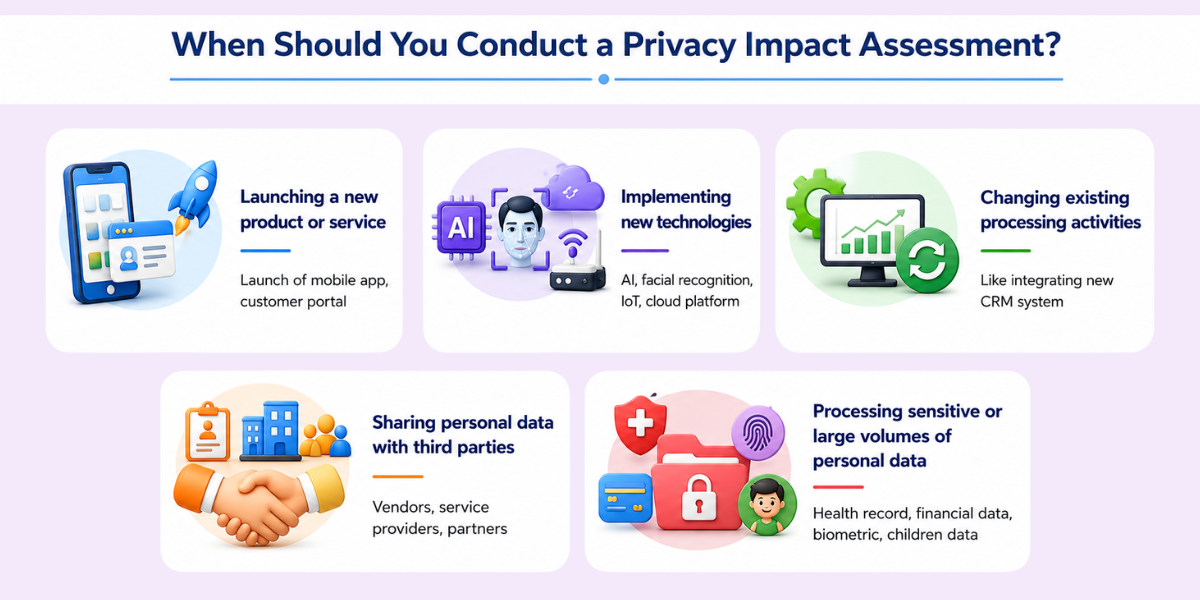
Common situations where a Privacy Impact Assessment should be performed
- Launching a new product or service – If your product or service collects personal data, conduct a PIA before launch. For example, a mobile app, customer portal, or online registration platform should be assessed before going live.
- Implementing new technologies – Technologies like AI, facial recognition, IoT devices, or cloud platforms can introduce new privacy risks. A PIA helps ensure appropriate safeguards are in place before deployment.
- Changing existing processing activities – Conduct a PIA when you expand how personal data is used or introduce new processing activities. Examples include collecting additional customer information or integrating a new CRM system.
- Sharing personal data with third parties – Assess privacy risks before sharing personal data with vendors, partners, or service providers. This helps verify that appropriate contractual and security safeguards are in place.
- Processing sensitive or large volumes of personal data – Projects involving health records, financial information, biometric data, children's data, or large-scale monitoring require a more detailed privacy assessment due to their higher potential impact.
What Information Do You Need Before Starting a Privacy Impact Assessment?
A Privacy Impact Assessment is only as effective as the information it is built on. Before starting a PIA, organizations should understand what personal data is being processed, why it is collected, how it flows through the organization, who has access to it, and what safeguards already exist.
Think of a PIA like building a house. You can't review the structural integrity without first having the blueprint. Similarly, you can't accurately assess privacy risks without understanding the processing activity.
Information You Need Before Starting a Privacy Impact Assessment
- Define the purpose of processing – Clearly identify why personal data is being collected and how it supports a business objective. For example, collecting an email address for order updates may be necessary, while collecting a date of birth may not.
- Identify the personal data involved – List the types of personal data the project will process, such as names, contact details, financial information, or health records. Consider:
- Types of personal data collected
- Whether sensitive or children's data is involved
- Whether existing datasets will be combined
- Map the data flow – Understand how personal data moves throughout its lifecycle to identify potential privacy risks. Document:
- Where data is collected
- Where it is stored
- Who can access it
- Whether it is shared internally or externally
- When it is retained or deleted
- Identify stakeholders and third parties – Involve all relevant teams to ensure the assessment covers every stage of data processing. This may include:
- Business and product teams
- IT and Information Security
- Legal and Compliance
- Third-party vendors or processors
- Review existing privacy and security controls – Assess the safeguards already in place before identifying additional risks. Examples include:
- Encryption
- Role-based access controls
- Multi-factor authentication
- Data retention policies
- Audit logs and incident response procedures
Investing time in preparation makes the assessment significantly more meaningful. A well-prepared PIA focuses on genuine risks instead of spending valuable time collecting basic project information.
What Are the Key Components of a Privacy Impact Assessment?
A Privacy Impact Assessment documents how personal data is processed, identifies potential privacy risks, evaluates existing safeguards, and recommends measures to reduce those risks. While formats vary across organizations, most PIAs include several core components that support informed decision-making and accountability.
It tells the complete story of a processing activity—from why it exists to how privacy risks will be managed throughout its lifecycle.
A typical Privacy Impact Assessment includes the following components
1. Project overview – Provide a concise description of the project, product, system, or process being assessed. This should explain what the initiative does, its objectives, and why personal data is required.
2. Description of processing activities - Document how personal data will be collected, used, stored, shared, retained, and deleted. This section establishes the scope of the assessment and provides the context needed to evaluate privacy implications.
3. Data inventory and data flows – Identify:
- Categories of personal data
- Data subjects involved
- Sources of data
- Internal systems
- Third-party recipients
- Cross-border transfers (if applicable)
Visual data flow diagrams can simplify complex processing activities and make risks easier to identify.
4. Privacy risk assessment – This forms the heart of the PIA. Each identified privacy risk should be analysed by considering:
- The likelihood of the risk occurring
- The potential impact on individuals
- Existing controls
- Residual risk after mitigation
Organizations should evaluate how those risks could realistically affect individuals.
5. Mitigation measures – Every identified risk should have a corresponding mitigation strategy. Examples include:
- Limiting unnecessary data collection
- Improving privacy notices
- Implementing stronger access controls
- Encrypting sensitive information
- Reducing retention periods
- Strengthening vendor oversight
The objective isn't to eliminate all risks—it's to reduce them to an acceptable level.
6. Recommendations and approvals – A completed PIA should clearly state:
- Recommended actions
- Responsible owners
- Implementation timelines
- Final approval decisions
- Any remaining residual risks accepted by management
This transforms the assessment into an actionable governance document rather than a static report.
How Do You Conduct a Privacy Impact Assessment? (Step-by-Step)
Conducting a Privacy Impact Assessment involves understanding the processing activity, identifying privacy risks, evaluating existing safeguards, implementing mitigation measures, and documenting decisions. Following a structured process helps organizations consistently assess projects and integrate privacy into business operations from the outset.
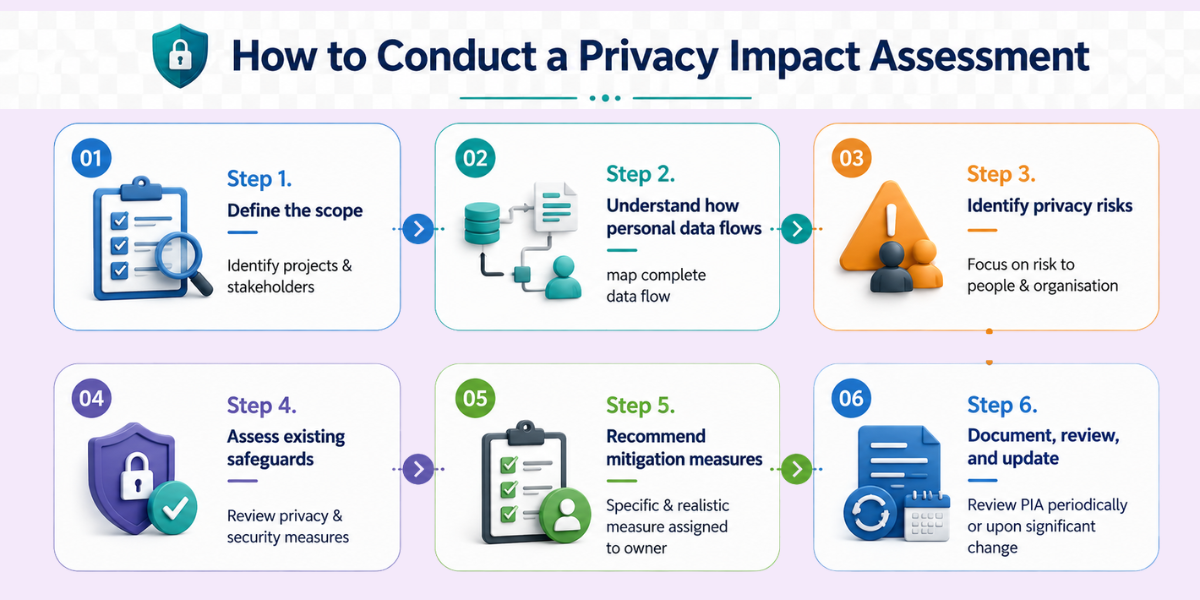
There's no universal template that fits every organization. However, most effective PIAs follow a similar roadmap.
Step 1. Define the scope
Clearly describe the project being assessed. Identify:
- Business objectives
- Processing activities
- Systems involved
- Stakeholders
- Personal data being processed
A well-defined scope keeps the assessment focused and prevents important processing activities from being overlooked.
Step 2. Understand how personal data flows
Map the complete lifecycle of personal data.
Track how information is collected, used, shared, stored, retained, and deleted.
Without understanding data flows, identifying privacy risks becomes largely guesswork.
Step 3. Identify privacy risks
Evaluate how the processing activity could affect individuals. Ask practical questions such as:
- Could excessive personal data be collected?
- Is personal data being used beyond its original purpose?
- Could unauthorized access occur?
- Are third-party processors introducing additional risks?
- Would individuals reasonably expect this processing?
Focus on risks to people—not just risks to the organization.
Step 4. Assess existing safeguards
Review the privacy and security measures already in place. Examples include:
- Access controls
- Encryption
- Authentication
- Employee training
- Vendor due diligence
- Data retention controls
- Monitoring and audit logs
Understanding existing safeguards prevents duplicate recommendations and highlights genuine gaps.
Step 5. Recommend mitigation measures
Where risks remain, identify practical improvements. These might include:
- Collecting less personal data
- Updating privacy notices
- Restricting internal access
- Introducing stronger encryption
- Revising retention schedules
- Enhancing governance processes
Every recommendation should be specific, realistic, and assigned to an owner.
Step 6. Document, review, and update
A Privacy Impact Assessment should not end once the report is approved.
Projects evolve. New technologies are introduced. Processing purposes expand. Vendors change.
Review the PIA periodically or whenever significant changes occur to ensure it continues to reflect the project's actual privacy risks.
Conclusion
Privacy risks are easier to prevent than to fix. A Privacy Impact Assessment (PIA) helps organizations identify privacy risks early, implement appropriate safeguards, and embed privacy into projects from the planning stage rather than treating it as a last-minute compliance exercise.
As organizations adopt AI, cloud technologies, and other data-driven solutions, integrating PIAs into project planning has become a key part of effective privacy governance. By assessing privacy early, organizations can strengthen compliance, build stakeholder trust, and reduce costly risks before they impact the business.
Key Takeaways
- A PIA helps identify and reduce privacy risks before projects go live.
- Conducting a PIA early strengthens compliance, trust, and Privacy by Design.
- Perform a PIA before launching new products, adopting new technologies, or changing data processing activities.
- Gather key inputs first, including data flows, processing purposes, stakeholders, and existing controls.
- A complete PIA should document processing activities, risks, safeguards, and mitigation measures.
- Follow a structured process to identify risks, implement controls, and document decisions.
- Review and update your PIA whenever projects or processing activities change.
Related Blog