Table of contents
By-Research Team
October 27, 2026 | 11 min read | Data Privacy
Data Privacy Challenges in Insurance: Key Risks and Solutions
Insurance companies depend on personal data to assess risk, determine premiums, process claims, detect fraud, and deliver personalised services. But every additional data source, digital touchpoint, and external service provider creates another responsibility: ensuring that personal information is collected, used, shared, and protected appropriately.
The biggest data privacy challenges in insurance arise when organisations cannot maintain clear visibility, control, and accountability across the entire data lifecycle. A privacy notice alone will not solve that problem. Insurers need a practical framework that connects regulatory requirements with everyday business operations.
What Makes Data Privacy Challenging in the Insurance Industry?
Data privacy in the insurance industry is challenging because insurers process personal information across multiple stages, from customer acquisition and underwriting to policy servicing, claims, renewals, and fraud investigations. Information may pass between internal departments, intermediaries, healthcare providers, and technology partners, making consistent governance difficult without clear ownership and controls.
Consider a health insurance claim. The insurer may need information from the policyholder, a hospital, a third-party administrator (TPA), and its claims platform to assess the claim. Each transfer creates a need to understand what information is shared, why it is needed, who can access it, and how long it must be retained.
Several characteristics make insurance particularly complex:
- Long data lifecycles: Information may be collected during onboarding and used again for renewals, claims, disputes, or legally required recordkeeping.
- Multiple data sources: Customer forms, medical documents, financial records, call recordings, digital applications, and connected devices may all contribute to a policy decision.
- Extensive third-party relationships: Brokers, agents, TPAs, hospitals, cloud providers, and analytics vendors may participate in different parts of the insurance process.
- High-impact decisions: Personal information can influence underwriting, eligibility assessments, claims decisions, and pricing.
- Competing operational requirements: Insurers must balance privacy obligations with legitimate business needs, fraud prevention, customer service, and applicable record-retention requirements.
The key issue is fragmented control.
If privacy responsibilities are distributed across disconnected systems and teams, even well-intentioned policies can fail in practice.
What Are the Major Data Privacy Challenges in Insurance?
The major data privacy challenges in insurance include excessive data collection, unclear consent, limited data visibility, third-party exposure, retention and deletion difficulties, security incidents, and privacy risks associated with automated decision-making. Addressing them requires a combination of data governance, technical safeguards, documented processes, and ongoing oversight.
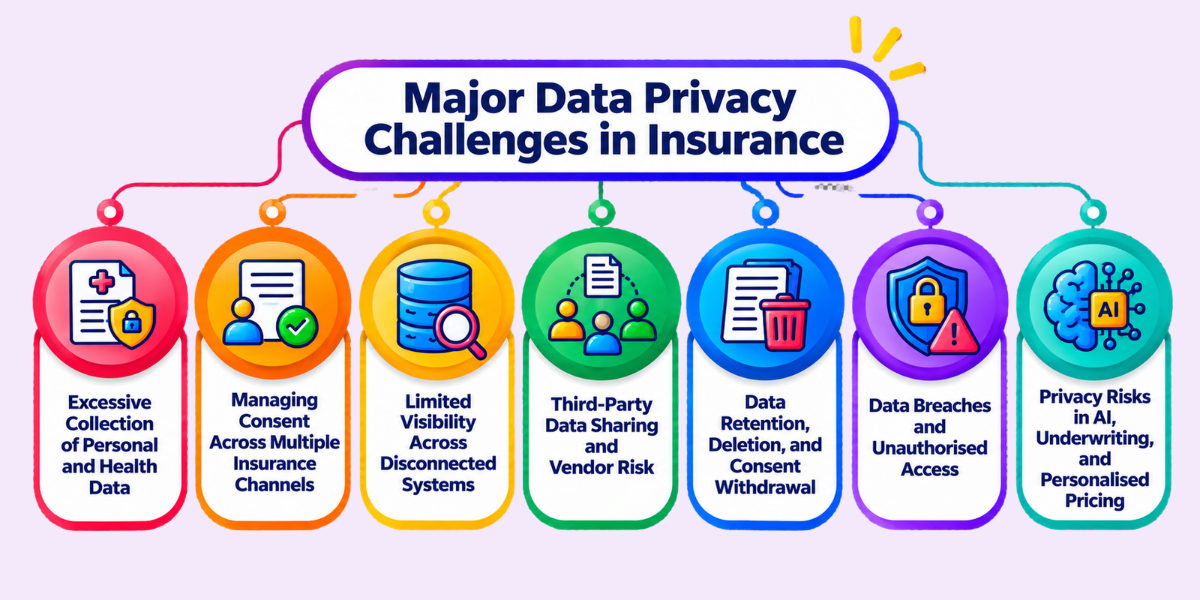
- Excessive Collection of Personal and Health Data
Collect only the information needed for a defined purpose. Insurance companies may require personal, financial, health, or other information to evaluate applications and administer policies. The challenge is ensuring that each collection is justified by the relevant purpose rather than driven by convenience or the possibility of future use.
Excessive collection creates three problems:
- Greater exposure: More information creates more data that must be secured.
- More complex governance: Additional data fields require clear purposes, access rules, and retention decisions.
- Reduced customer confidence: Customers may question why information is being requested if the reason is not explained.
- Managing Consent Across Multiple Insurance Channels
Consent must be connected to the actual processing activity. Insurers may interact with customers through websites, mobile applications, agents, brokers, call centres, and physical branches. Maintaining consistent notices, permissions, and withdrawal mechanisms across these channels becomes difficult when each channel operates independently.
Imagine a customer who purchases a policy through an agent and later manages it through a mobile application. If the insurer cannot reconcile the information captured at onboarding with the records held by its digital platform, it may struggle to demonstrate what the customer was told and which permissions were recorded.
The problem becomes more complicated when information is reused for purposes such as promotional communication, analytics, or optional service enhancements.
- Limited Visibility Across Disconnected Systems
Insurers cannot govern data they cannot locate or understand. Personal information may sit in policy administration platforms, customer relationship management systems, claims applications, document repositories, spreadsheets, email systems, and third-party environments. Without a consolidated view, identifying where information resides and how it moves becomes a major operational challenge.
For example, a claims team may store supporting documents in a central application while copies remain in email attachments or shared folders. A policy change in the main system does not necessarily update those additional copies.
This creates a visibility gap. The organisation may have a privacy policy and access controls, yet still struggle to answer basic questions about the location, purpose, ownership, and retention of personal data.
- Third-Party Data Sharing and Vendor Risk
Outsourcing a service does not eliminate the need to govern the information involved. Insurers depend on intermediaries, TPAs, healthcare providers, cloud platforms, technology vendors, and other partners to support their operations. Each relationship introduces questions about access, security, permitted use, onward sharing, and accountability.
Consider a TPA processing health insurance claims. The insurer needs to understand which information the TPA receives, which systems it uses, which subcontractors may be involved, and how records are protected throughout the arrangement.
A contract that simply says a vendor must maintain confidentiality may not adequately address the operational controls required for the relationship.
- Data Retention, Deletion, and Consent Withdrawal
Keeping data indefinitely is not a substitute for having a retention policy. Insurance records may need to be preserved for policy administration, claims, litigation, fraud investigations, or regulatory requirements. However, organisations must distinguish between records that still serve a legitimate purpose and copies that remain only because nobody has assigned responsibility for removing them.
Suppose a customer closes a policy.
Some information may still be required under applicable legal or regulatory requirements, while other information may no longer be necessary for the original purpose.
A blanket rule to delete everything immediately could conflict with legitimate obligations; a blanket rule to retain everything forever creates a different risk.
- Data Breaches and Unauthorised Access
Security controls must protect information throughout its lifecycle. Insurance databases may contain identity details, contact information, financial records, health information, and claim documentation. Unauthorised access, phishing, compromised credentials, misconfigured storage, or insecure integrations can expose this information and disrupt operations.
A breach does not always begin with a sophisticated attack. A document shared with the wrong recipient or a former employee retaining unnecessary system access can also create a serious privacy incident.
- Privacy Risks in AI, Underwriting, and Personalised Pricing
Automated decisions can create privacy and fairness concerns when organisations cannot explain or govern how personal information is used. Insurers increasingly have opportunities to use analytics, automation, and connected data sources to support risk assessment, fraud detection, customer service, and product personalisation. These uses require careful consideration of data provenance, purpose, accuracy, access, and potential adverse effects.
For example, an insurer might use telematics data to understand driving behaviour or analytics to identify patterns in claims.
The privacy question is not simply whether the technology can generate a useful prediction. It is whether the information was obtained and used appropriately, whether the processing is transparent where required, and whether the outcome can be reviewed under the applicable framework.
AI systems can also reproduce errors or biases present in their input data. A model trained on inaccurate or poorly governed information may produce unreliable results even when its technical performance appears strong.
How Can Insurance Companies Address Data Privacy Challenges?
Insurance companies can address data privacy challenges by establishing a central governance framework that connects data inventory, lawful processing, consent, security, vendor oversight, retention, and incident response. The practical objective is to make privacy controls operational, assign accountability, and maintain evidence that decisions and actions follow documented processes.
- Create a Data Inventory and Map Data Flows
Start by identifying the personal information your organisation collects, uses, shares, stores, and deletes. Map the systems and business processes involved, including relevant external service providers.
Prioritise high-risk processing, such as health claims, identity verification, underwriting, and large-scale customer databases. Use the findings to identify unnecessary data collection, excessive access, and undocumented transfers.
- Establish a Central Privacy Governance Framework
Define responsibilities across legal, compliance, information security, IT, claims, underwriting, HR, and customer service. Each processing activity should have an accountable owner and a clear route for addressing issues.
Maintain an organised record of processing activities, privacy assessments, policies, approvals, and remediation actions. Where a formal Data Protection Impact Assessment is appropriate or required under the applicable framework, use it to evaluate risks before introducing or materially changing high-risk processing.
- Operationalise Consent and Individual Rights
Connect consent records to the systems that use the relevant personal data. Establish procedures for correcting records, processing applicable rights requests, and managing consent withdrawal.
Test these processes from end to end. If a team cannot locate the relevant records or identify the system owner, the process is not ready simply because a policy describes it.
- Strengthen Security and Access Management
Implement controls proportionate to the sensitivity and risk of the information. These may include multifactor authentication, least-privilege access, encryption, secure integrations, logging, vulnerability management, and periodic access reviews.
Do not rely exclusively on perimeter security. Review the identities, permissions, applications, and third parties that can access personal information.
- Implement Vendor Risk Management
Create a complete register of vendors that process or access personal data. Assess their security posture, contractual commitments, access permissions, incident processes, and relevant subcontracting arrangements.
Review material relationships periodically and whenever the scope of processing changes. Include exit procedures that address data return, deletion where appropriate, access revocation, and continuing obligations.
- Build Retention and Deletion Controls
Translate retention policies into system-level requirements. Define which records must be retained, the reason for retention, the applicable period, and the approved deletion or archival process.
Include copies held in secondary systems and by external processors where relevant. Document legal holds and other valid exceptions so that retention decisions are explainable and auditable.
- Train Employees Through Realistic Scenarios
Train employees according to their responsibilities rather than relying only on generic awareness modules. Claims teams, agents, underwriters, customer service representatives, and IT administrators face different privacy risks.
Use practical scenarios such as sending a claim document to the wrong recipient, accessing a customer record without a business need, or sharing personal information with an unapproved vendor. Test whether employees know how to recognise, report, and escalate these situations.
Protect personal data and prepare for applicable DPDP requirements with Privacy Global's DPDP Act Compliance Services.
A Practical Data Privacy Readiness Checklist for Insurers
Use this checklist to assess whether your privacy programme has the foundations required to manage insurance data responsibly.
| Area | Key Question | Evidence to Look For |
|---|---|---|
| Data inventory | Can we identify where personal data is held and why it is processed? | Data inventory and data-flow maps |
| Lawful processing | Is each processing activity linked to an appropriate legal basis and purpose? | Processing records and legal assessments |
| Consent | Can we retrieve relevant consent records and manage withdrawal where applicable? | Consent logs and tested workflows |
| Security | Are access, encryption, monitoring, and incident controls implemented appropriately? | Security reviews and control-testing records |
| Vendor management | Do we know which vendors access personal data and what controls apply? | Vendor register, assessments, and contracts |
| Retention | Are retention periods documented and implemented in relevant systems? | Retention schedules and deletion evidence |
| Individual rights | Can requests be routed to the teams and systems that hold the relevant data? | Procedures, case records, and response logs |
| Incident response | Can we assess, escalate, and respond to a personal data breach? | Response plans, escalation matrices, and test results |
| AI and analytics | Are data inputs, purposes, access, and material risks documented? | Use-case inventory and risk assessments |
| Regulatory readiness | Are obligations mapped to their applicable commencement dates? | Regulatory tracker and implementation roadmap |
Do not treat the checklist as a pass-or-fail certification. It is a starting point for identifying gaps, assigning owners, and setting priorities.
Conclusion
Insurance companies face complex data privacy challenges because personal information moves across multiple systems, teams, and external partners throughout the policy lifecycle. Addressing these risks requires more than written policies; it demands clear data visibility, accountable ownership, effective security controls, and consistent oversight.
A structured data privacy programme helps insurers protect customer information, manage third-party risks, and strengthen operational accountability. By regularly reviewing privacy practices, addressing control gaps, and preparing for evolving regulatory requirements, insurers can build a more resilient privacy framework while maintaining customer trust.
Key Takeaways
- Insurance data privacy is challenging due to multiple data sources, systems, and third-party relationships.
- Excessive data collection increases privacy risks and complicates data governance.
- Consistent consent management is essential across customer touchpoints.
- Data mapping improves visibility into where personal information is stored and shared.
- Vendor oversight helps protect data shared with external service providers.
- Clear retention and deletion policies prevent unnecessary data storage.
- Strong security controls help prevent data breaches and unauthorised access.
- AI-driven insurance decisions require responsible data use and risk assessment.
- A structured privacy framework strengthens accountability, security, and customer trust.
- Regular privacy assessments help identify gaps and prioritise improvements.
Related Blog