Table of contents
By-Research Team
August 28, 2026 | 7 min read | Data Privacy
Importance of Privacy Training: Building a Privacy-Aware Workforce
Privacy compliance does not stop with policies, notices, or technology. When employees collect, access, use, share, store, or delete personal data, their decisions can directly affect an organisation’s privacy risk. Organisations therefore need more than documented controls—they need people who understand how those controls work in practice.
That is where privacy training becomes the operational shield between a compliance framework and a preventable mistake.
What Is Privacy Training?
Privacy training is a structured programme that teaches employees how to handle personal data responsibly and apply an organisation’s privacy policies, procedures, and legal obligations in their daily work. Effective training connects privacy principles with practical decisions such as collecting data, managing consent, responding to requests, sharing information, reporting incidents, and retaining or deleting personal data.
Privacy training is not simply a presentation about privacy laws. It is the translation layer between regulation and employee behaviour.
Why Is Privacy Training Important?
The importance of privacy training comes from its ability to turn privacy requirements into consistent employee actions. It helps organisations reduce avoidable data-handling mistakes, improve awareness of privacy responsibilities, support technical and organisational controls, and build a workforce capable of identifying and escalating privacy risks before they become larger compliance problems.
1. Reduce human error
Employees interact with personal data every day. A customer-support executive may access account information, HR may handle employee records, Marketing may use contact databases, and IT may manage systems containing personal data.
A single wrong action can create a privacy incident.
Training should therefore teach employees what to recognise, what to avoid, and when to escalate.
2. Turn privacy policies into everyday behaviour
Policies define what an organisation expects. Training explains how employees are expected to act.
Think of the privacy policy as the architectural blueprint. Training teaches employees how to actually build according to it.
3. Strengthen regulatory readiness
Privacy regulations create obligations that employees may encounter during routine business activities.
Employees do not need to become privacy lawyers. They do need to recognise when a privacy requirement affects their work.
4. Improve incident detection and reporting
An employee is often closest to the first warning sign.
They may notice:
- Personal data sent to the wrong recipient
- An unexpected request for customer information
- A lost device containing personal data
- Unauthorised access
- Data shared with an unapproved third party
- A suspicious request to export customer records
Training should make the escalation path obvious.
5. Build a privacy-aware culture
A privacy programme becomes stronger when responsibility is distributed across the organisation.
That does not mean every employee needs the same level of expertise. It means every employee should understand the privacy risks associated with their role.
Role-Based Privacy Training
Role-based privacy training tailors learning to the personal data an employee handles, the decisions they make, the systems they access, and the privacy risks associated with their responsibilities. Instead of giving every employee the same generic module, organisations can focus training on the situations each role is most likely to encounter. This makes privacy awareness more relevant and actionable.
One-size-fits-all training looks efficient on paper.
In practice, it can leave important gaps.
How privacy training can differ by role
| Role | Key privacy training areas |
|---|---|
| HR | Employee data, recruitment records, access controls, retention and internal sharing |
| Marketing | Consent, communications, customer data, campaign databases and opt-outs |
| Sales | Customer information, lawful data collection, sharing and CRM practices |
| Customer Support | Identity verification, Data Principal requests, disclosure and escalation |
| IT & Security | Access management, security safeguards, breach detection and incident response |
| Product & Engineering | Privacy by design, data minimisation, data flows and privacy risk assessments |
| Procurement | Data Processor relationships, contracts and third-party data handling |
| Leadership | Accountability, privacy risk, governance and compliance oversight |
| Privacy/Legal Teams | Governance, assessments, rights management, regulatory monitoring and escalation |
Train according to risk, not just job title
Start with a simple question: What privacy decision can this employee make that could create risk?
That question produces better training than simply assigning a department-wide course.
The objective is to make each employee competent at the privacy decisions they actually make.
What Should Privacy Training Include?
Effective privacy training should cover the personal-data handling practices employees need for their roles, including privacy principles, organisational policies, consent, data sharing, retention, Data Principal rights, incident reporting, security responsibilities, and escalation procedures. The content should then be adapted to the employee’s role, systems, data access, and risk exposure.
A strong data privacy awareness training programme should answer one practical question: “What should I do differently after this training?”
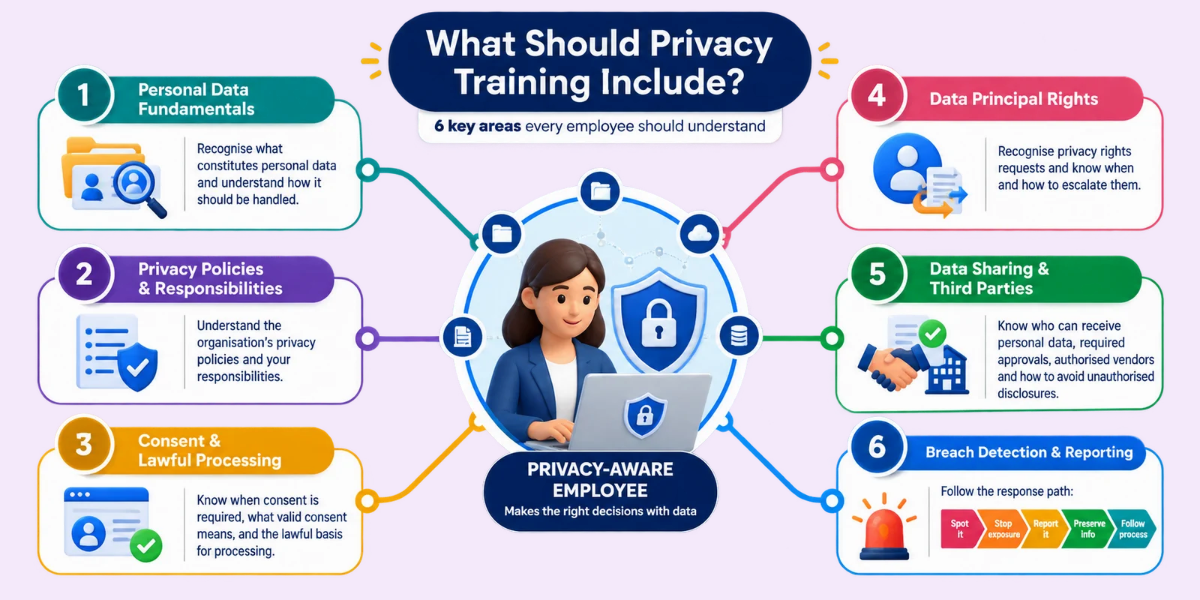
At minimum, employees should understand:
1. Personal data fundamentals
Explain what constitutes personal data and why context matters.
Employees should be able to recognise personal data in the systems and documents they actually use.
2. Privacy policies and responsibilities
Employees should understand the organisation's internal privacy policies and how those policies affect daily work.
Do not bury the guidance in 40 pages of legal language.
Show employees the actual workflow: Collect → Access → Use → Share → Retain → Delete
3. Consent and lawful processing
Training should explain when consent is relevant, what valid consent means, and what employees should do when they are unsure about the basis for processing.
4. Data Principal rights
Employees who interact with customers or users should understand that privacy rights can create operational requests.
An employee does not necessarily need to process the request themselves.
They do need to recognise the request and route it correctly.
5. Data sharing and third parties
Employees should know:
- Who can receive personal data
- What approvals are required
- Which vendors are authorised
- What information can be shared
- When escalation is required
- How to avoid unauthorised disclosures
6. Breach detection and reporting
Training should give employees a clear response path.
Spot it → Stop further exposure → Report it → Preserve relevant information → Follow the incident process.
The employee should not be left wondering whether an incident is “serious enough” to report. That decision belongs in the escalation framework.
Conclusion
The importance of privacy training becomes clear when privacy compliance moves from the policy document to the employee making a decision.
A well-designed privacy programme gives employees the roadmap, judgement and escalation path they need to handle personal data correctly. It strengthens the wider compliance architecture while helping organisations turn regulatory expectations into repeatable business practices.
Key Takeaways
- Privacy training helps employees understand how to handle personal data responsibly.
- Privacy training is important because it reduces human error and strengthens privacy compliance.
- Role-based training focuses on the privacy risks and responsibilities specific to each employee’s role.
- Effective training should cover personal data, policies, consent, Data Principal rights, data sharing, and breach reporting.
- Employees should know how to identify privacy risks and when to escalate them.
- Training should be practical, helping employees apply privacy requirements to their everyday work.
- Continuous awareness helps turn privacy policies into consistent employee behaviour.
- A well-trained workforce strengthens the organisation’s overall privacy compliance framework.
Related Blog