Table of contents
By-Research Team
June 19, 2026 | 8 min read | DPDP
Data Protection Officer Responsibilities Under the DPDP Act
Organizations today collect personal data through websites, mobile apps, HR systems, customer support platforms, marketing tools, and third-party vendors. The challenge is not collecting data. The challenge is ensuring that every stage of the data lifecycle complies with the Digital Personal Data Protection (DPDP) Act, 2023.
This is where data protection officer responsibilities become critical.
A Data Protection Officer (DPO) acts as the organization's privacy governance lead. Think of the DPO as the architect of the compliance fortress.
This guide explains the DPO role, the key DPO responsibilities, and how a data protection officer supports compliance under India's evolving privacy framework.
Who Is a Data Protection Officer Under the DPDP Act?
A Data Protection Officer (DPO) is an individual appointed by a Significant Data Fiduciary to oversee privacy governance, represent the organization under the DPDP Act, and serve as a key contact point for data principals and regulatory authorities. Under the law, the DPO must be based in India and report to the organization's governing body.
In simple terms, the DPO helps answer a critical question:
"Are we processing personal data in a way that aligns with our legal obligations?"
Think of the DPO as the control tower of an organization's privacy program. The DPO may not fly every plane, but they help ensure the entire system operates safely and according to the rules.
When Is a Data Protection Officer Required?
Under the DPDP Act, a Data Protection Officer is mandatory for organizations designated as Significant Data Fiduciaries by the Central Government. Not every organization is required to appoint a DPO. The requirement applies to entities that process personal data at a scale or risk level that justifies enhanced oversight.
The Government may classify an organization as a Significant Data Fiduciary based on factors such as:
- Volume of personal data processed
- Sensitivity of personal data processed
- Risk to the rights of data principals
- Potential impact on national interests
- Risk to public order or electoral democracy
Once designated as an SDF, the organization must appoint a DPO who:
- Represents the Significant Data Fiduciary under the Act
- Is based in India
- Reports to the Board of Directors or equivalent governing body
- Acts as a point of contact for grievance redressal mechanisms
A common misconception is that every company must appoint a DPO. The DPDP Act takes a risk-based approach. However, many organizations voluntarily establish DPO-like privacy leadership functions because privacy governance often becomes a business necessity long before it becomes a legal obligation.
What Are the Responsibilities of a Data Protection Officer?
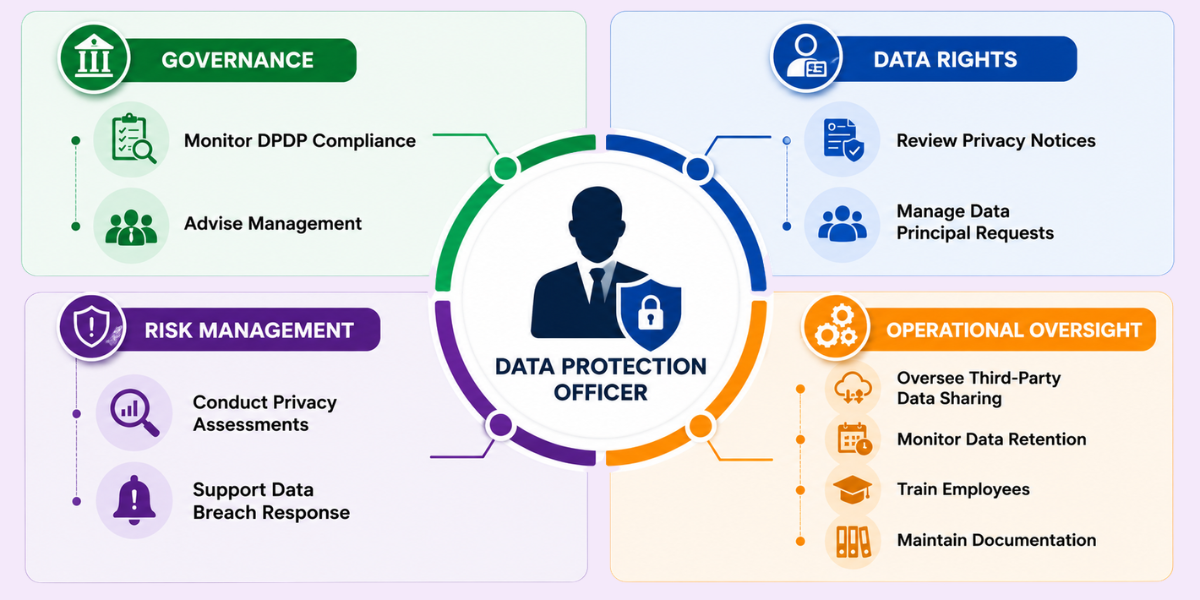
The responsibilities of a Data Protection Officer revolve around monitoring compliance, supporting privacy governance, advising leadership, and helping the organization meet its obligations under the DPDP Act. While the Act defines certain statutory requirements, the practical role of a DPO extends across multiple operational processes.
-
Monitoring DPDP Compliance
A DPO continuously monitors whether the organization's data processing activities align with the requirements of the DPDP Act. This includes reviewing internal controls, identifying compliance gaps, and tracking changes in regulatory obligations.
-
Reviewing Privacy Notices and Consent Mechanisms
The DPO reviews privacy notices, consent requests, and communication mechanisms to ensure they are transparent, understandable, and aligned with legal requirements. Poorly designed notices often create compliance risk long before an investigation begins.
-
Managing Data Principal Requests
The DPDP Act grants individuals certain rights regarding their personal data.
The DPO helps establish processes for handling requests related to access, correction, updating, erasure, and grievance redressal. Effective request management demonstrates accountability and helps build trust with data principals.
-
Supporting Data Breach Response
The DPO supports breach response planning, incident assessment, escalation procedures, communication workflows, and coordination between legal, security, and business teams.
-
Conducting Privacy Assessments
The DPO helps evaluate new projects, technologies, products, and data processing activities to identify privacy risks before they become operational problems.
This proactive approach helps organizations avoid building compliance issues directly into their business processes.
-
Overseeing Third-Party Data Sharing
Customer information may move through cloud providers, payroll vendors, CRM platforms, analytics tools, marketing agencies, and outsourcing partners.
The DPO helps assess whether third-party relationships include appropriate privacy controls, contractual safeguards, and accountability mechanisms.
-
Monitoring Data Retention Practices
The DPO helps monitor retention schedules, deletion processes, archival practices, and data lifecycle controls to ensure information is not stored indefinitely without justification.
-
Training Employees on Privacy Obligations
The DPO helps design awareness programs and privacy training initiatives so employees understand their responsibilities when handling personal data.
-
Maintaining Privacy Documentation
The DPO helps maintain privacy documentation, governance records, internal procedures, audit evidence, and compliance artifacts that support accountability efforts. Documentation acts as the blueprint of the privacy program.
-
Advising Management on Compliance Risks
Leadership teams need visibility into privacy risk. The DPO advises senior management on emerging regulatory obligations, operational weaknesses, governance concerns, and compliance priorities.
How Does a DPO Support DPDP Compliance?
A Data Protection Officer supports DPDP compliance by translating legal obligations into operational controls. The DPO helps ensure that privacy requirements are embedded into everyday business processes rather than treated as standalone legal exercises.
One of the easiest ways to understand the DPO role is to map responsibilities to compliance outcomes.
| DPDP Compliance Area | How the DPO Supports Compliance |
|---|---|
| Privacy Notices | Reviews notices and disclosures |
| Consent Management | Evaluates consent mechanisms |
| Data Principal Rights | Oversees request handling processes |
| Breach Response | Supports incident management workflows |
| Vendor Governance | Reviews third-party data practices |
| Retention Compliance | Monitors retention and deletion controls |
| Privacy Governance | Advises management and monitors compliance |
This is where many organizations struggle.
They focus on individual compliance tasks rather than building an integrated governance framework. The DPO helps connect these moving parts into a single compliance architecture.
What Is a DPO Not Responsible For?
A Data Protection Officer advises, monitors, and supports compliance efforts, but the DPO is not personally responsible for ensuring that every privacy obligation is fulfilled. Ultimate accountability remains with the organization and its leadership.
This distinction is important.
Many organizations mistakenly assume that appointing a DPO automatically transfers privacy accountability. It does not.
A DPO Is Responsible For
- Monitoring compliance
- Advising management
- Supporting governance activities
- Identifying compliance risks
- Coordinating privacy initiatives
A DPO Is Not Responsible For
- Personally, guaranteeing compliance
- Owning every business process
- Replacing management accountability
- Acting as the sole privacy decision-maker
- Independently implementing every control
Think of the DPO as the architect rather than the construction crew.
The architect designs the blueprint, identifies structural weaknesses, and recommends improvements. The organization must still build and maintain the structure.
Can a DPO Be Outsourced?
Yes. Organizations can outsource the Data Protection Officer function through an external DPO or DPO-as-a-Service model, provided the arrangement satisfies applicable legal and operational requirements.
Many organizations struggle to recruit experienced privacy professionals with expertise across compliance, governance, technology, and risk management.
This is where outsourced DPO models become attractive.
Internal DPO
Best suited for:
- Large organizations
- Mature privacy programs
- Complex internal governance structures
Benefits:
- Deep organizational knowledge
- Continuous internal engagement
- Direct operational involvement
External DPO
Best suited for:
- Growing organizations
- Resource-constrained teams
- Organizations building privacy programs for the first time
Benefits:
- Specialized expertise
- Independent perspective
- Faster implementation
- Lower operational overhead
The right model depends on the organization's risk profile, data processing activities, governance maturity, and regulatory obligations.
Conclusion
The role of a Data Protection Officer under the DPDP Act goes far beyond compliance administration. A DPO helps build the governance framework that allows organizations to process personal data responsibly, transparently, and lawfully.
As privacy obligations continue to evolve, organizations need more than policies and checklists. They need a practical compliance blueprint.
That is the true value of a DPO.
The strongest privacy programs are not built around reacting to regulatory pressure. They are built around governance, accountability, and trust. A well-positioned Data Protection Officer helps turn those principles into everyday business practice.
Key Takeaways
- A Data Protection Officer (DPO) helps organizations oversee privacy governance and supports compliance with the DPDP Act.
- Under the DPDP Act, appointing a DPO is mandatory for organizations designated as Significant Data Fiduciaries (SDFs).
- Core DPO responsibilities include monitoring compliance, managing data principal requests, reviewing consent practices, overseeing data sharing, supporting breach response, and advising leadership on privacy risks.
- A DPO helps translate DPDP requirements into practical controls and processes that can be embedded across the organization.
- While a DPO monitors and advises on privacy compliance, ultimate accountability for compliance remains with the organization and its leadership.
- Organizations can choose an internal or outsourced DPO model based on their data processing activities, privacy maturity, and compliance needs.
Related Blog