Table of contents
By-Research Team
June 23, 2026 | 8 min read | DPDP
Role of Data Protection Officer in DPDP Compliance
Every privacy law creates obligations. Very few organizations clearly define ownership.
That is the challenge many businesses face with the Digital Personal Data Protection (DPDP) Act, 2023. Leaders understand they must protect personal data, manage grievances, respond to breaches, and demonstrate accountability. But who owns these responsibilities in practice?
The answer is the Data Protection Officer (DPO).
This practical guide explains the DPO role in DPDP compliance, who needs a DPO, why the role matters, and how boards should evaluate its effectiveness.
Who is a Data Protection Officer?
A Data Protection Officer (DPO) under the DPDP Act is a designated individual responsible for overseeing data protection compliance, acting as a contact point for Data Principals and regulators, and ensuring that privacy obligations are translated into operational controls. For Significant Data Fiduciaries (SDFs), appointing a DPO is a statutory requirement.
Many organizations mistakenly view the DPO as a privacy administrator. That is too narrow.
The data protection officer role is fundamentally a governance role. The DPO acts as the bridge between legal obligations, business operations, technology teams, and leadership. Their responsibility is not merely to identify compliance gaps but to ensure those gaps are addressed.
In practical terms, the DPO becomes the organization's privacy control tower. Every significant compliance decision eventually flows through this function.
Is Hiring a DPO Mandatory?
A DPO is mandatory when an organization is classified as a Significant Data Fiduciary (SDF) under the DPDP Act. The government may designate an organization as an SDF based on factors such as the volume and sensitivity of personal data processed, risks to individuals, and the potential impact on national interests.
Importantly, the DPDP Act requires that the DPO:
- Be based in India
- Represent the Significant Data Fiduciary under the Act
- Serve as a key point of contact for compliance matters
This requirement reflects an important regulatory principle.
Accountability must have a name attached to it.
A privacy framework without ownership is like a fortress without a gatekeeper. The walls may exist, but no one is monitoring who enters or leaves.
Who Needs to Appoint a Data Protection Officer?
-
Large Digital Platforms
Platforms handling millions of customer interactions generate complex privacy obligations that require dedicated oversight.
-
Financial Services Firms
Banks, fintech companies, insurers, and lending platforms process large volumes of sensitive financial information.
-
Healthcare Organizations
Hospitals, health-tech providers, and diagnostics companies manage highly sensitive personal data.
-
SaaS and Technology Companies
Technology companies often process customer data across multiple jurisdictions and systems, creating heightened governance risks.
-
Data-Driven Enterprises
Organizations relying heavily on analytics, profiling, AI, or automated decision-making should establish strong privacy oversight.
In our observation, many organizations wait for regulatory classification before investing in privacy leadership.
That is similar to waiting for a fire inspection before installing smoke detectors.
Why is a DPO Needed?
A DPO is needed because compliance is not a one-time project. It is an ongoing governance function that requires continuous monitoring, decision-making, and accountability.
The DPDP Act requires organizations to manage consent, address grievances, implement safeguards, and respond to privacy incidents. These obligations span legal, operational, and technical functions. Without clear ownership, gaps emerge quickly.
-
Privacy Governance
The DPO integrates privacy requirements into policies, processes, and decision-making, ensuring compliance becomes a business function, not an afterthought.
-
Risk Management
The DPO proactively identifies privacy risks, assesses potential impacts, and implements controls to prevent regulatory violations and data misuse.
-
Grievance Oversight
The DPO oversees grievance redressal processes, ensuring Data Principal complaints are addressed promptly, transparently, and in accordance with DPDP requirements.
-
Breach Preparedness
The DPO establishes incident response mechanisms, monitors vulnerabilities, and coordinates escalation procedures to minimize breach-related compliance risks.
The strongest organizations do not view privacy as a compliance expense.
They view it as a trust asset.
Customer trust is increasingly becoming a competitive differentiator. Organizations that demonstrate accountability often gain advantages in procurement, partnerships, and customer acquisition.
Role of a DPO for DPDP Compliance
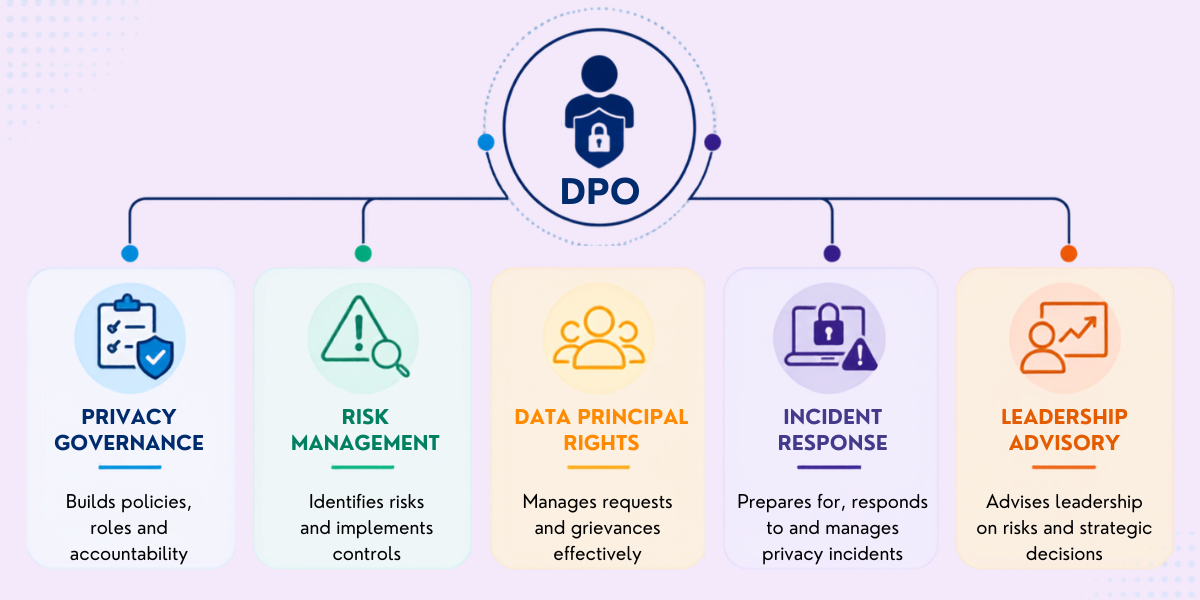
The DPO role in DPDP compliance is to convert statutory obligations into operational reality. The DPO monitors compliance, advises leadership, oversees privacy governance, coordinates incident response, manages stakeholder engagement, and ensures that privacy controls remain effective as the organization evolves.
This is where the role moves beyond theory.
A high-performing DPO acts as the architect of the organization's privacy framework.
-
Build a Privacy Governance Framework
The DPO establishes the organization's privacy governance framework by defining roles, responsibilities, reporting structures, and accountability mechanisms for handling personal data. They work closely with legal, IT, HR, and business teams to ensure privacy requirements are integrated into everyday processes rather than managed in isolation.
This helps create clear ownership of compliance obligations, reduces confusion across departments, and ensures the organization can consistently demonstrate compliance with the DPDP Act.
-
Monitor Compliance
The DPO continuously monitors the organization's compliance with the DPDP Act, internal policies, and data protection procedures through periodic reviews, assessments, and audits. They identify compliance gaps, track remediation efforts, and evaluate whether existing controls remain effective as business operations evolve.
This ongoing oversight helps prevent small compliance issues from developing into regulatory violations, financial penalties, or reputational risks.
-
Manage Data Principal Rights
The DPO oversees processes for handling Data Principal requests, including access, correction, updating, erasure of personal data, consent withdrawal, and grievance redressal. They ensure requests are processed accurately, consistently, and within applicable timelines while maintaining appropriate records.
Effective management of these rights not only supports compliance with DPDP requirements but also strengthens customer trust by demonstrating transparency and accountability.
-
Support Incident Response
The DPO plays a key role in preparing for and responding to personal data breaches by establishing incident response procedures, coordinating investigations, assessing potential impacts, and supporting notification and reporting requirements. They work with security, legal, and business teams to ensure incidents are managed efficiently and documented properly.
This enables organizations to respond quickly to privacy incidents, minimize potential harm, and meet their regulatory obligations.
-
Advise Leadership
The DPO provides ongoing guidance to senior management on privacy risks, compliance obligations, emerging regulatory developments, and the privacy implications of business initiatives. They help leadership assess risks, prioritize remediation efforts, and make informed decisions regarding data processing activities.
This ensures that privacy considerations are incorporated into strategic planning and that compliance risks are addressed before they affect business operations or stakeholder trust.
How Should a Board Evaluate a DPO?
Boards should evaluate a DPO based on governance outcomes, risk reduction, and compliance maturity—not on the number of policies created or meetings attended.
This is where many organizations get it wrong.
A 100-page policy does not prove compliance.
Effective controls do.
Board-Level DPO Evaluation Metrics
1. Compliance Health
Measure:
- Open compliance gaps
- Audit findings
- Remediation progress
These indicators reveal whether the privacy architecture is strengthening or weakening.
2. Incident Readiness
Evaluate:
- Response procedures
- Escalation effectiveness
- Breach preparedness exercises
A fortress is only as strong as its response plan.
3. Grievance Management
Review:
- Resolution timelines
- Escalation patterns
- Recurring complaint themes
Customer complaints often reveal compliance weaknesses before audits do.
4. Training Effectiveness
Assess:
- Employee participation rates
- Awareness levels
- Behavioural improvements
Privacy culture cannot be outsourced. It must be built.
5. Leadership Visibility
A DPO should have direct access to decision-makers.
If critical privacy issues struggle to reach leadership, the reporting structure itself may require review.
Conclusion
The DPO role in DPDP compliance is far more than a regulatory requirement.
It is the foundation of privacy governance.
As organizations process larger volumes of personal data, privacy risks become business risks. The DPO translates legal obligations into operational controls, convert risks into action plans, and help leadership build sustainable trust.
The most effective organizations will not appoint a DPO because the law requires it.
They will appoint a DPO because they recognize that privacy, like cybersecurity, is no longer a supporting function. It is a core component of business resilience, digital trust, and long-term growth.
Key Takeaways
- A DPO is responsible for overseeing data protection compliance and ensuring privacy obligations are effectively implemented across the organization.
- Organizations designated as Significant Data Fiduciaries (SDFs) must appoint a DPO under the DPDP Act.
- Businesses handling large volumes of personal data can benefit from appointing a DPO even when it is not legally required.
- The DPO plays a critical role in privacy governance, risk management, grievance handling, and breach preparedness.
- An effective DPO translates regulatory requirements into operational processes and business practices.
- Boards should evaluate a DPO based on compliance outcomes, risk reduction, and governance maturity
Related Blog