Table of contents
By-Research Team
June 16, 2026 | 8 min read | DPDP
Who Is a Data Protection Officer (DPO)?
Data has become the fuel of modern business. Banks use it to assess credit risk. Insurers use it to process claims. Fintechs use it to power digital experiences. The challenge is that as organizations collect more personal data, the risks multiply just as quickly.
So, who is a data protection officer, and why has the role become increasingly important in modern organizations?
Think of the DPO as part architect and part navigator. The architect designs the privacy blueprint. The navigator helps the organization stay on course as regulations, technologies, and customer expectations evolve.
Data Protection Officer Under DPDP Act
As businesses increasingly rely on customer, employee, financial, and digital data, privacy governance has become a critical business function rather than a purely legal exercise. The DPDP Act reflects this shift by placing greater emphasis on organizational accountability and responsible data management.
A Data Protection Officer (DPO) plays an important role in helping organizations establish accountability for how personal data is collected, used, shared, and protected. Under India's Digital Personal Data Protection (DPDP) Act, 2023, certain organizations designated as Significant Data Fiduciaries may be required to appoint a Data Protection Officer to oversee privacy-related matters and serve as a point of contact for Data Principals.
In practice, the role helps organizations align privacy considerations with day-to-day decision-making.
Why Organizations Need a Data Protection Officer
Organizations need a Data Protection Officer because modern business models depend on personal data. A DPO helps create structure, accountability, and oversight around how that data is collected, used, shared, retained, and governed across the enterprise.
Consider a large bank.
Customer onboarding data may pass through:
- Branch systems
- Mobile applications
- Credit assessment platforms
- Fraud detection tools
- Third-party service providers
Each touchpoint introduces privacy considerations.
Now multiply that across millions of customers.
Suddenly, privacy is no longer a legal issue. It becomes an operational challenge.
Why Is Data Protection Officer Important?
-
Digital Transformation Has Expanded Data Flows
Organizations are collecting more personal data than ever before.
Cloud platforms, AI tools, customer analytics, and digital onboarding processes create complex data ecosystems that require oversight.
-
Privacy Expectations Have Increased
Customers increasingly expect transparency regarding how their information is handled.
Trust is no longer built solely through products and services. It is also built through responsible data practices.
-
Regulations Continue to Expand
The GDPR has influenced privacy laws worldwide. Countries across Europe, Asia, Latin America, and other regions have introduced or strengthened privacy frameworks.
-
Privacy Has Become a Governance Issue
Boards and executive teams are increasingly discussing data governance, AI governance, and privacy accountability as part of enterprise risk management.
Organizational Position of a Data Protection Officer
A Data Protection Officer typically operates as an independent privacy function that interacts with leadership, legal teams, compliance functions, risk teams, security teams, and business units. Under GDPR principles, the DPO must be involved in data protection matters and report at the highest organizational levels.
One of the most misunderstood aspects of the DPO role is organizational placement.
Many assume the DPO sits solely within legal or compliance teams.
Reality is more nuanced.
A DPO often serves as a cross-functional advisor across multiple business functions.
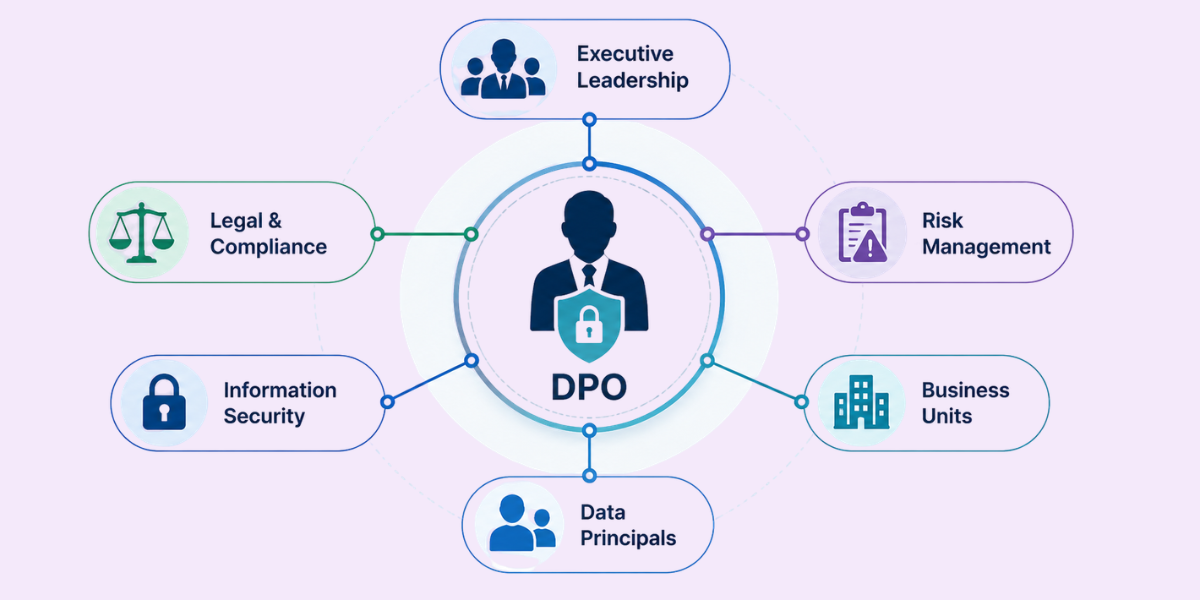
Who Does a Data Protection Officer Work With?
-
Executive Leadership
Senior leaders need visibility into privacy risks that could affect business operations, customer trust, and organizational reputation. A DPO helps leadership understand how privacy considerations align with strategic decision-making.
-
Legal Teams
Privacy requirements often intersect with legal obligations and compliance frameworks. A DPO works with these teams to support consistent privacy governance across the organization.
-
Risk Management Teams
Privacy risks are increasingly considered part of broader enterprise risk management programs. A DPO helps organizations identify and assess risks associated with personal data processing.
-
Information Security Teams
Privacy and security are closely connected but serve different purposes. A DPO collaborates with security teams to promote the protection and responsible handling of personal data.
-
Business Units
Products and services frequently rely on personal data to deliver customer value. A DPO provides privacy guidance to help business teams make informed data-related decisions.
-
Customer Experience and Grievance Functions
Organizations must be prepared to address privacy-related concerns raised by individuals. A DPO supports teams responsible for handling customer requests and grievances involving personal data.
Think of the DPO as a control tower within the organization's privacy governance framework.
The DPO may not own every process involving personal data, but they help ensure that decisions across departments remain aligned, coordinated, and accountable.
What Are the Characteristics of an Effective DPO?
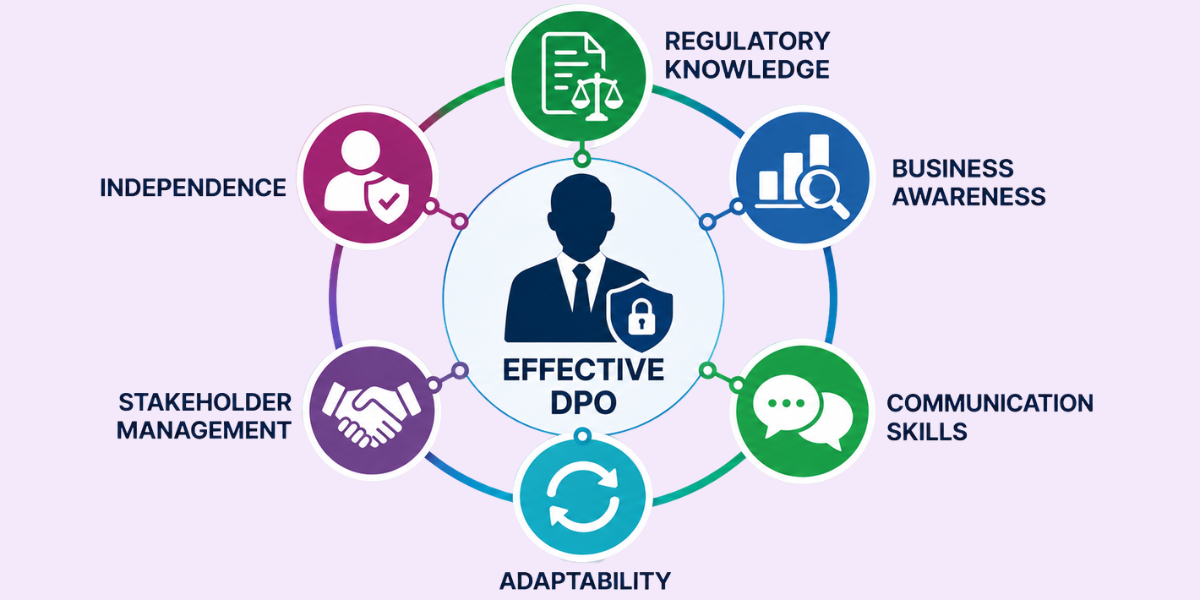
An effective Data Protection Officer combines regulatory knowledge, business understanding, communication skills, independence, and governance awareness. The role requires balancing legal expectations with operational realities across the organization.
Technical knowledge alone is not enough.
Many privacy challenges are ultimately people challenges.
-
Regulatory Expertise
A DPO should have a strong understanding of privacy laws and evolving regulatory requirements, including the DPDP Act. This knowledge helps organizations make informed decisions about the collection, use, and protection of personal data.
-
Independence
The DPDP Act places significant emphasis on accountability and responsible data governance. A DPO should be able to provide objective privacy guidance without undue influence from business or operational pressures.
-
Business Awareness
Privacy decisions often affect customer experience, product development, and business operations. An effective DPO understands how the organization functions and balances privacy considerations with business objectives.
-
Communication Skills
Privacy requirements can be complex and difficult for non-specialists to interpret. A DPO should be able to explain privacy risks, obligations, and expectations in clear and practical language.
-
Stakeholder Management
Privacy governance requires collaboration across legal, compliance, technology, security, and business teams. A DPO must be able to build alignment among stakeholders to support consistent and responsible data handling practices.
-
Adaptability
Privacy regulations, technologies, and business practices continue to evolve rapidly. An effective DPO stays informed about emerging developments and helps the organization adapt to changing privacy expectations.
A common industry joke is that privacy professionals spend less time reading regulations than they do convincing people to follow them.
There is more truth in that observation than many organizations realize.
Which Industries Need a Data Protection Officer?
Data Protection Officers play an especially important role in industries that process significant volumes of personal data, sensitive information, or large-scale customer records.
Not all industries face the same privacy challenges.
Some sectors operate within highly data-intensive environments where privacy oversight becomes particularly important.
-
Financial Services
Banks, fintech companies, NBFCs, and insurance providers process large volumes of personal and financial information. Strong privacy governance helps these organizations manage data responsibly and maintain customer trust.
-
Healthcare and Life Sciences
Healthcare organizations routinely handle sensitive personal and health-related information. Effective privacy oversight helps ensure this data is managed responsibly throughout its lifecycle.
-
Technology and Digital Platforms
Technology companies and digital platforms often rely on large-scale personal data processing to deliver products and services. Privacy governance helps support transparency, accountability, and responsible data use.
-
Telecommunications
Telecom providers process significant volumes of subscriber and communication-related data. Strong privacy practices are essential for managing this information responsibly.
-
Education and EdTech
Educational institutions and EdTech platforms collect personal information relating to students, parents, and staff. Privacy governance helps ensure this data is handled appropriately and securely.
-
Retail and Consumer Businesses
Retailers and consumer-facing businesses often process customer profiles, purchase histories, and behavioural data. Effective privacy oversight supports responsible data management and customer confidence.
In each of these industries, the volume and sensitivity of personal data increase the need for structured privacy governance. This makes the DPO role increasingly important in supporting accountability and responsible data management.
Conclusion
The question is no longer simply "Who is a DPO?"
The more important question is:
What role does privacy leadership play in a data-driven organization?
As organizations collect, analyse, and share increasing volumes of personal data, the need for structured privacy governance continues to grow. A Data Protection Officer serves as a critical part of that governance architecture—helping organizations build accountability, navigate complexity, and maintain trust in an environment where data has become one of the most valuable assets they manage.
For modern enterprises, the DPO is not merely a compliance requirement. The role is an important pillar in the broader blueprint of responsible data governance.
Key Takeaways
- A Data Protection Officer (DPO) helps organizations establish accountability for how personal data is collected, used, shared, and protected.
- As organizations process increasing volumes of personal data, the DPO role has become an important part of privacy governance.
- The DPDP Act reinforces the need for structured oversight and responsible data management practices.
- A DPO works across leadership, legal, risk, security, and business teams to support privacy-related decision-making.
- Effective DPOs combine regulatory knowledge, business awareness, communication skills, and independence.
- Industries that process large volumes of personal or sensitive data often require stronger privacy governance.
- The DPO role helps organizations build trust, accountability, and confidence in how personal data is managed.
- Modern organizations increasingly view the DPO as a key contributor to responsible data governance and long-term business resilience.
Related Blog