
Table of contents
By-Research Team
June 26, 2026 | 9 min read | DPDP
Third-Party and Vendor Risk in BFSI: How Financial Institutions Can Manage Vendor Risks
Banks, insurers, NBFCs, and other financial institutions increasingly rely on third parties to deliver digital services, process transactions, perform KYC checks, manage customer interactions, and store data.
The challenge? Customer data often travels farther than organizations realize.
A single customer onboarding journey may involve a KYC provider, a credit bureau, a cloud platform, a CRM system, and a payment processor. While these partnerships improve efficiency, they also create new operational, security, compliance, and privacy risks.
This is why third-party risk in BFSI has become a board-level concern. Regulators, customers, and stakeholders increasingly expect them to maintain visibility and accountability across their entire vendor ecosystem.
This guide provides a practical blueprint for understanding, assessing, and managing third-party and vendor risks in BFSI organizations.
What Is Third-Party and Vendor Risk in BFSI?
Third-party and vendor risk in BFSI refers to the operational, security, privacy, compliance, financial, and reputational risks that arise when external organizations gain access to systems, processes, or customer data. These risks emerge whenever banks, insurers, or financial institutions depend on outside entities to support business operations.
At first glance, third-party risk and vendor risk may appear identical. In practice, vendor risk is often considered a subset of third-party risk.
A third party can include:
- Vendors and suppliers
- Cloud service providers
- FinTech partners
- KYC and verification agencies
- Credit bureaus
- Collection agencies
- Outsourced customer support providers
- Software and SaaS providers
Who Are the Common Third Parties and Vendors in BFSI?
Customer data in BFSI is routinely shared with a wide range of third parties and vendors, including KYC providers, payment processors, cloud service providers, credit bureaus, collection agencies, CRM platforms, and FinTech partners. Many organizations underestimate the number of entities involved in a single customer journey.
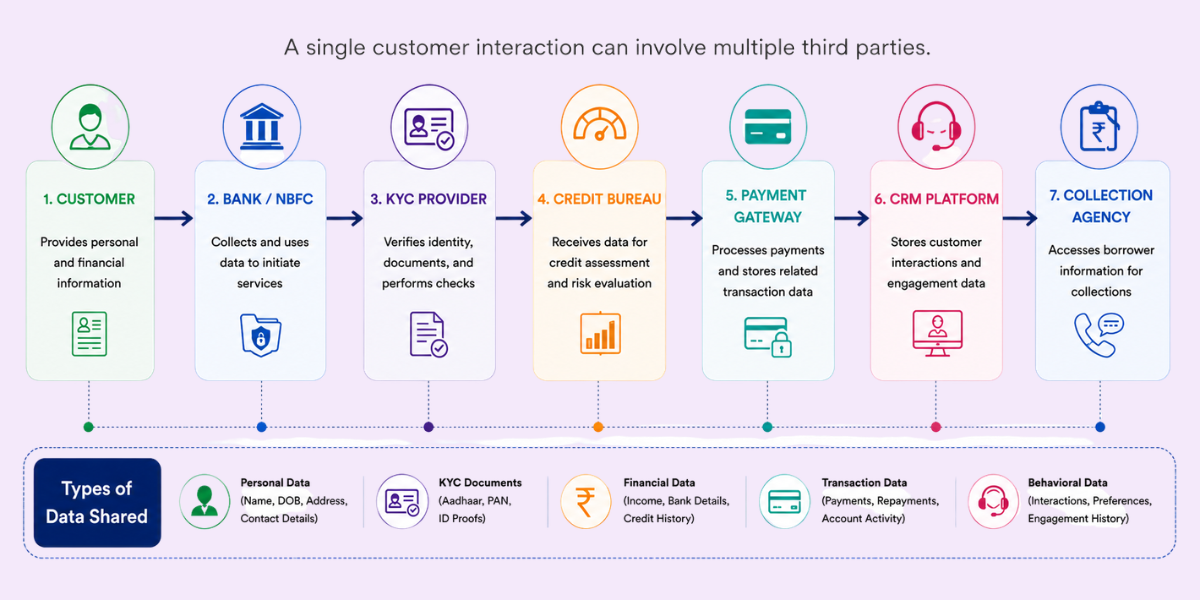
Consider a simple loan application.
Customer information may flow through:
-
KYC and Identity Verification Providers
These providers verify identity documents, perform background checks, and support onboarding processes.
Examples include:
- Digital KYC vendors
- Identity verification platforms
- AML screening providers
-
Payment Service Providers
Payment processors often handle transaction data, payment credentials, and customer information.
-
Credit Bureaus
Financial institutions routinely exchange customer information with credit reporting agencies for underwriting and risk assessment purposes.
-
Cloud Service Providers
Cloud platforms store and process vast volumes of customer and operational data.
-
Collection Agencies
Collection partners may receive borrower information, contact details, and repayment histories.
-
CRM and Customer Support Platforms
Customer service interactions, complaints, and engagement records are often stored within external systems.
What Are the Most Common Third-Party and Vendor Risks in BFSI?
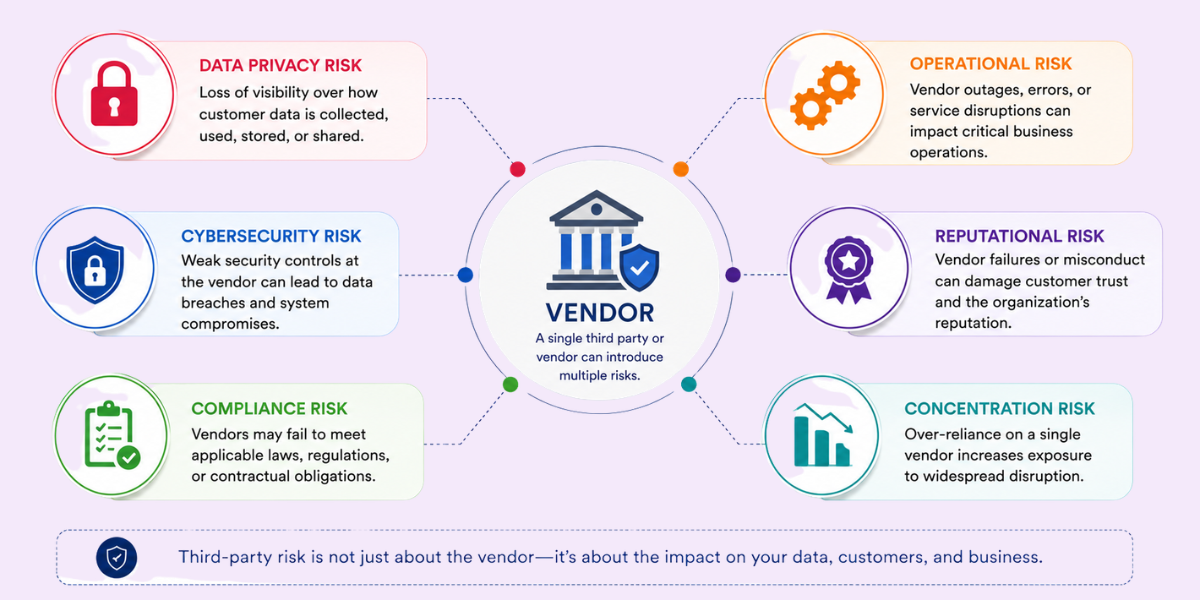
The most common third-party and vendor risks in BFSI include data privacy risks, cybersecurity risks, compliance failures, operational disruptions, reputational damage, and concentration risks. These risks can directly affect customer trust, regulatory compliance, and business continuity.
-
Data Privacy Risk
Third parties often require access to customer data to deliver services. The risk arises when organizations lose visibility over how that data is used, stored, or deleted after it is shared.
Vendors may retain data longer than necessary or process it beyond its intended purpose, creating privacy and compliance concerns.
-
Cybersecurity Risk
A vendor's weak security controls can become an attacker's easiest entry point. If a third party experiences a security incident, sensitive customer information and critical systems may also be exposed.
-
Compliance Risk
Vendors may fail to meet applicable privacy, security, or regulatory requirements. Even when the issue originates with the vendor, financial institutions often remain accountable because they are responsible for the customer data being processed.
-
Operational Risk
Many BFSI services depend on third parties. A disruption at a payment processor, KYC provider, cloud platform, or collection agency can delay transactions, customer onboarding, loan processing, and other critical operations.
-
Reputational Risk
Customers rarely separate a vendor's failure from the organization's failure. If a third party mishandles data or experiences a breach, customer trust and brand reputation can suffer, even when the incident occurs outside the organization.
If a Vendor Causes a Data Breach, Who Is Responsible?
A vendor may cause the breach, but accountability often remains with the financial institution that collected and controls the customer data. Organizations cannot transfer responsibility simply by outsourcing data processing activities to third parties.
This is where many organizations make a dangerous assumption.
They believe: "The vendor manages the system, so the vendor is responsible."
Regulators view the situation differently.
Financial institutions remain responsible for:
- Selecting appropriate vendors
- Conducting due diligence
- Monitoring vendor performance
- Managing contractual obligations
- Protecting customer data
Outsourcing a function does not outsource accountability.
How Should BFSI Organizations Assess Third-Party and Vendor Risks?
BFSI organizations should assess third-party and vendor risks through structured due diligence, risk classification, security assessments, privacy reviews, contractual evaluations, and ongoing monitoring. Effective assessments focus on both business criticality and customer data exposure.
A practical assessment framework should answer three questions:
-
What Data Will the Vendor Access?
Start by identifying exactly what information the vendor will handle. The type and sensitivity of data being shared will directly influence the level of risk involved.
- Personal data
- Financial data
- Sensitive information
- Transaction records
The more sensitive the data, the greater the need for strong security, privacy, and compliance controls.
-
How Critical Is the Vendor?
Organizations should assess how important the vendor is to business operations and customer-facing services. Classify vendors based on:
- Business dependency: Determine how reliant the organization is on the vendor's services.
- Service criticality: Evaluate whether the vendor supports core functions such as payments, KYC, lending, or claims processing.
- Customer impact: Consider how customers would be affected if the vendor experienced a disruption.
- Operational importance: Assess whether the vendor's failure could interrupt critical business processes or regulatory obligations.
-
What Controls Are in Place?
Before sharing customer data, organizations should review the safeguards the vendor has implemented to manage risk effectively.
- Security controls: Like encryption, access controls, and network security.
- Privacy practices: Policies governing how personal data is collected, used, stored, and deleted.
- Incident response capabilities: The vendor's ability to detect, investigate, and respond to security or privacy incidents.
- Compliance certifications: Certifications that demonstrate compliance with industry standards and regulatory requirements.
- Audit reports: Independent reviews that assess the effectiveness of the vendor's controls.
Assess risk before onboarding, not after an incident.
How Can BFSI Organizations Manage Third-Party Risk?
Third-party risk management should span the entire vendor lifecycle—from onboarding and monitoring to reassessment and offboarding. Risk management is not a one-time event; it is a continuous governance process. BFSI organizations need continuous oversight to ensure vendors remain secure, compliant, and aligned with business requirements throughout the relationship.
-
Maintain Visibility Over Shared Customer Data
Once customer data is shared with a vendor, organizations should continue tracking what data is being accessed, why it is being used, and whether it is being retained beyond its intended purpose. Regular reviews help identify visibility gaps before they become compliance issues.
-
Monitor Vendor Performance and Compliance
Vendor performance should be reviewed on an ongoing basis. Organizations should track service levels, compliance obligations, incident history, and changes in the vendor's operating environment to ensure risks remain within acceptable limits.
-
Review Vendor Access Regularly
Access permissions should not remain static. Periodic reviews help ensure that vendors only retain access to the systems and data necessary for their role. Unused accounts and excessive privileges should be removed promptly.
-
Respond Quickly to Vendor Incidents
Organizations should establish clear processes for handling vendor-related incidents, including security breaches, service disruptions, and compliance failures. Fast escalation and coordinated response can significantly reduce operational and reputational damage.
-
Reassess Vendor Risks Periodically
Vendor risks evolve over time. Changes in business operations, technology, regulations, or the vendor's ownership structure may introduce new risks that were not present during the initial assessment.
-
Ensure Secure Vendor Offboarding
When a vendor relationship ends, organizations should verify that access has been revoked, customer data has been returned or deleted, and contractual obligations have been fulfilled. Effective offboarding prevents former vendors from becoming future risks.
Conclusion
Third-party relationships are now fundamental to how BFSI organizations operate. Digital onboarding, cloud infrastructure, payment processing, customer engagement, and FinTech partnerships all depend on external providers.
But every external relationship expands the organization's risk perimeter.
The most mature BFSI organizations understand a simple reality: third-party risk management is not just about managing vendors—it is about maintaining visibility, accountability, and control over customer data throughout its entire lifecycle.
In an increasingly interconnected financial ecosystem, better data oversight is no longer a competitive advantage. It is a business necessity.
Key Takeaways
- Third-party and vendor risk arises when external organizations handle customer data or support critical BFSI operations.
- Banks and financial institutions share customer data with vendors such as KYC providers, payment gateways, cloud providers, and collection agencies.
- Poor vendor oversight can lead to privacy, security, compliance, operational, and reputational risks.
- Organizations often lose visibility over how customer data is used, stored, and deleted after it is shared with a vendor.
- A vendor may cause a breach, but the financial institution is often held accountable for the customer data involved.
- Vendor assessments should focus on the data being shared, the importance of the vendor, and the safeguards they have in place.
- Managing third-party risk requires ongoing monitoring throughout the entire vendor relationship.
Related Blog