Table of contents
By-Research Team
May 26, 2026 | 8 min read | DPDP
Difference Between Data Fiduciary and Significant Data Fiduciary (SDF)
In today’s digital economy, personal data powers modern businesses. But not every company handling data creates the same level of risk. A small payroll platform and a nationwide social media giant may both process personal data, yet the damage caused by a compliance failure in each case is vastly different. That is exactly why the DPDP Act creates two separate compliance layers — Data Fiduciaries and Significant Data Fiduciaries (SDFs).
For businesses, understanding this distinction is not just a legal exercise. It can be the difference between basic compliance and enterprise-level regulatory accountability.
What is a Data Fiduciary?
A Data Fiduciary under the DPDP Act is any person, company, government body, or organization that determines the purpose and means of processing personal data. In simple terms, if an entity decides why personal data is collected and how it will be used, it acts as a Data Fiduciary.
Under Section 2(i) of the DPDP Act, a Data Fiduciary may include:
- Ecommerce platforms
- Banks and fintech companies
- SaaS businesses
- Hospitals and health tech providers
- HRMS platforms
- Educational institutions
- Government portals
A company becomes a Data Fiduciary the moment it decides:
- What personal data will be collected
- Why the data is needed
- How the data will be processed
- Who can access the data
- How long the data will be retained
This means even relatively small businesses can fall within the scope of the DPDP Act if they process personal data for business operations.
What is a Significant Data Fiduciary (SDF)?
A Significant Data Fiduciary (SDF) is a category of Data Fiduciary identified by the Central Government based on the scale, sensitivity, and risk associated with personal data processing activities. SDFs are subject to stricter compliance obligations because their processing activities can create larger risks for individuals, public systems, and national interests.
In simple terms, every Significant Data Fiduciary is a Data Fiduciary, but not every Data Fiduciary becomes an SDF.
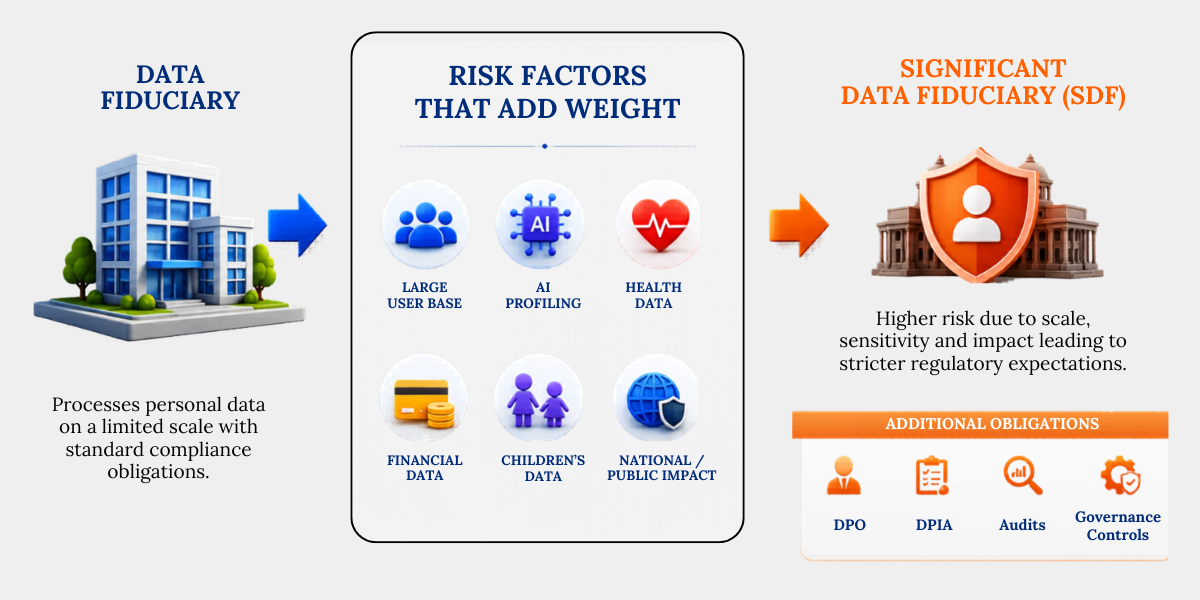
Under Section 10 of the DPDP Act, the government may classify a Data Fiduciary as “Significant” after evaluating several critical risk factors.
1. Volume of Personal Data Processed
Organizations processing personal data at a very large scale are more likely to be classified as Significant Data Fiduciaries.
Why? Because a breach affecting millions of users creates far greater risks such as identity theft, financial fraud, and mass profiling. Ecommerce platforms, telecom companies, and social media networks typically process huge volumes of personal data daily.
2. Sensitivity of Personal Data
The government also considers how sensitive the processed data is.
Data such as financial information, health records, biometric data, behavioural data, and children’s data creates higher risks if leaked or misused. For example, a hospital data breach is far more serious than a standard app-data leak.
3. Risk to Rights of Data Principals
The DPDP Act aims to protect the rights and privacy of individuals whose data is being processed.
If a company’s activities can significantly impact privacy, reputation, or financial security, regulators may classify it as high-risk. AI profiling systems and behavioural tracking platforms often fall into this category.
4. Impact on Sovereignty and Integrity of India
Some data-processing activities may affect national security or strategic interests.
Platforms handling large-scale citizen data, communication systems, or critical infrastructure information may create risks beyond individual privacy breaches. This is why sovereignty considerations play a role in SDF classification.
5. Risk to Electoral Democracy
The DPDP Act also evaluates whether data-processing activities could influence democratic processes.
Political profiling, voter targeting, and misinformation campaigns using personal data may impact electoral fairness, leading to stricter scrutiny for such platforms.
6. Public Order Implications
If misuse or leakage of personal data could disrupt public order, the organization may face stricter regulatory evaluation.
Examples include misinformation campaigns, communal targeting, and manipulation using personal profiling. Regulators may assess whether such processing activities could contribute to social instability.
Difference Between Data Fiduciary and SDF
Not all data-processing businesses carry the same compliance weight. Some operate with standard obligations, while others function under a much heavier regulatory spotlight.
| Criteria | Data Fiduciary | Significant Data Fiduciary (SDF) |
|---|---|---|
| Definition | A Data Fiduciary is any organization or individual that determines the purpose and means of processing personal data. | A Significant Data Fiduciary is a specially classified Data Fiduciary identified by the Central Government based on the scale and risk of data processing activities. |
| Status Under the DPDP Act | A Data Fiduciary falls under the general compliance framework of the DPDP Act. | An SDF falls under an enhanced regulatory framework with stricter compliance obligations. |
| Government Notification Requirement | A business automatically becomes a Data Fiduciary once it starts deciding how personal data is processed. | A company becomes an SDF only after being specifically notified by the Central Government. |
| Basis of Classification | Classification is based on whether the entity processes personal data and determines processing purposes. | Classification depends on factors such as data volume, sensitivity, public risk, and national impact. |
| Scale of Personal Data Processing | A Data Fiduciary may process personal data on a small, medium, or limited scale. | An SDF usually processes personal data at a very large or high-impact scale. |
| Sensitivity of Personal Data | A standard Data Fiduciary may process ordinary business-related personal data. | An SDF often processes highly sensitive, behavioural, financial, biometric, or health-related data. |
| Risk to Individuals | The risk to Data Principals may be limited or moderate depending on the processing activity. | The processing activities of an SDF can create significant risks to privacy, security, and individual rights. |
| National and Public Impact | Most Data Fiduciaries have limited impact on public systems or national interests. | SDFs may affect public order, electoral processes, or the sovereignty and integrity of India. |
| Requirement to Appoint a Data Protection Officer (DPO) | A Data Fiduciary is generally not required to appoint a Data Protection Officer under the DPDP Act. | An SDF is required to appoint a Data Protection Officer based in India. |
| Requirement to Conduct a Data Protection Impact Assessment | A standard Data Fiduciary is generally not required to conduct mandatory DPIAs. | An SDF must conduct Data Protection Impact Assessments to evaluate processing risks. |
| Audit Obligations | Regular compliance audits may not be mandatory for all Data Fiduciaries. | SDFs are required to undergo periodic independent compliance audits. |
| Governance Expectations | A Data Fiduciary is expected to maintain standard privacy and compliance controls. | An SDF is expected to maintain advanced governance, accountability, and risk-management frameworks. |
| Regulatory Scrutiny | Regulatory oversight is comparatively lower for standard Data Fiduciaries. | SDFs are subject to significantly higher levels of regulatory monitoring and scrutiny. |
| Compliance Costs | Compliance obligations are generally less complex and less expensive. | Compliance programs for SDFs are more resource-intensive due to audits, DPIAs, and governance obligations. |
| Examples | Small SaaS businesses, payroll vendors, local ecommerce stores, and educational institutes may qualify as Data Fiduciaries. | Large fintech companies, telecom providers, social media platforms, and major health tech ecosystems may qualify as SDFs. |
A simple way to understand the distinction is this: a Data Fiduciary manages personal data processing, while a Significant Data Fiduciary manages large-scale data risk infrastructure.
That difference changes everything from governance costs to board-level accountability.
Additional Compliance Obligations for SDFs
Significant Data Fiduciaries are required to follow stricter compliance obligations under the DPDP Act because their processing activities create higher risks for individuals and public systems. These obligations are designed to strengthen governance, accountability, and risk management.
1. Appoint a Data Protection Officer (DPO)
SDFs must appoint a Data Protection Officer based in India.
The DPO acts as the primary compliance contact for regulators and Data Principals. The role includes handling grievances, monitoring compliance, and overseeing data protection practices within the organization.
2. Conduct Data Protection Impact Assessments (DPIAs)
SDFs are required to conduct Data Protection Impact Assessments before carrying out high-risk processing activities. A DPIA helps identify privacy risks, security gaps, profiling risks & potential harm to individuals.
3. Undergo Periodic Compliance Audits
SDFs must conduct regular audits through independent auditors.
These audits evaluate whether the organization’s privacy controls, security practices, consent systems, and governance mechanisms comply with the DPDP Act.
4. Implement Stronger Governance Frameworks
SDFs are expected to maintain more advanced governance systems compared to ordinary Data Fiduciaries.
This may include:
- Internal compliance policies
- Incident response plans
- Vendor-risk management systems
- Access-control mechanisms
- Accountability structures
Conclusion
The DPDP Act does not treat all data-processing organizations the same — and neither should businesses treat their compliance strategy. While a Data Fiduciary operates under standard data protection obligations, a Significant Data Fiduciary functions under a far stricter regulatory framework built for high-risk and large-scale data ecosystems.
Businesses that strengthen their privacy and compliance systems today will be far better prepared for tomorrow — because under the DPDP Act, poor data governance can quickly become a serious business risk.
Key Takeaways
- A Data Fiduciary is any organization that decides how and why personal data is processed.
- A Significant Data Fiduciary (SDF) is a high-risk category of Data Fiduciary identified by the Central Government.
- Factors such as data volume, sensitivity, public impact, and national risk determine SDF classification.
- SDFs face stricter obligations such as appointing a Data Protection Officer and conducting DPIAs.
- Large platforms handling sensitive or high-volume personal data are more likely to attract SDF-level scrutiny.
- Understanding the difference between a Data Fiduciary and an SDF is essential for building the right compliance and governance strategy under the DPDP Act.
Related Blog