Table of contents
By-Research Team
May 29, 2026 | 8 min read | DPDP
RTI vs DPDP: Does India’s Data Protection Law Weaken the Right to Information?
Transparency built democratic accountability in India. Privacy is now reshaping digital governance.
That is where the conflict around RTI and DPDP begins. The RTI Act was designed to open government systems to public scrutiny, while the DPDP Act was created to protect personal data in an increasingly digital economy.
The challenge is no longer theoretical. Public authorities, journalists, and citizens are now asking:
Where does transparency end and personal privacy begin?
India is effectively trying to build two constitutional shields at the same time: one for democratic accountability and another for citizen privacy. The difficulty is that both shields now overlap.
What is the Right to Information (RTI) Act?
The Right to Information (RTI) Act, 2005 gives citizens the legal right to access information held by public authorities to promote transparency and accountability in governance.
The RTI Act transformed governance in India by allowing citizens to inspect how decisions are made and how public money is used. Think of RTI as a public audit flashlight. It allows citizens to examine government records, expose irregularities, and question administrative decisions that were once hidden behind bureaucratic walls.
The law requires public authorities to respond to information requests within prescribed timelines and has played a major role in exposing corruption, welfare leakages, and administrative failures across sectors.
What is the Digital Personal Data Protection (DPDP) Act?
The DPDP Act is India’s first dedicated data protection law. Its objective is to regulate how personal data is collected, stored, processed, and shared across public and private systems.
Imagine government and corporate databases as digital vaults. The DPDP Act strengthens the locks protecting the personal information stored inside those vaults. The controversy begins when those stronger locks potentially restrict legitimate public scrutiny.
RTI vs DPDP: What Is the Difference Between Transparency and Privacy?
The RTI Act promotes transparency by allowing access to government-held information, while the DPDP Act protects personal data from unauthorized disclosure. RTI prioritizes accountability. DPDP prioritizes privacy.
The regulatory challenge is balancing both rights without allowing one framework to completely weaken the other.
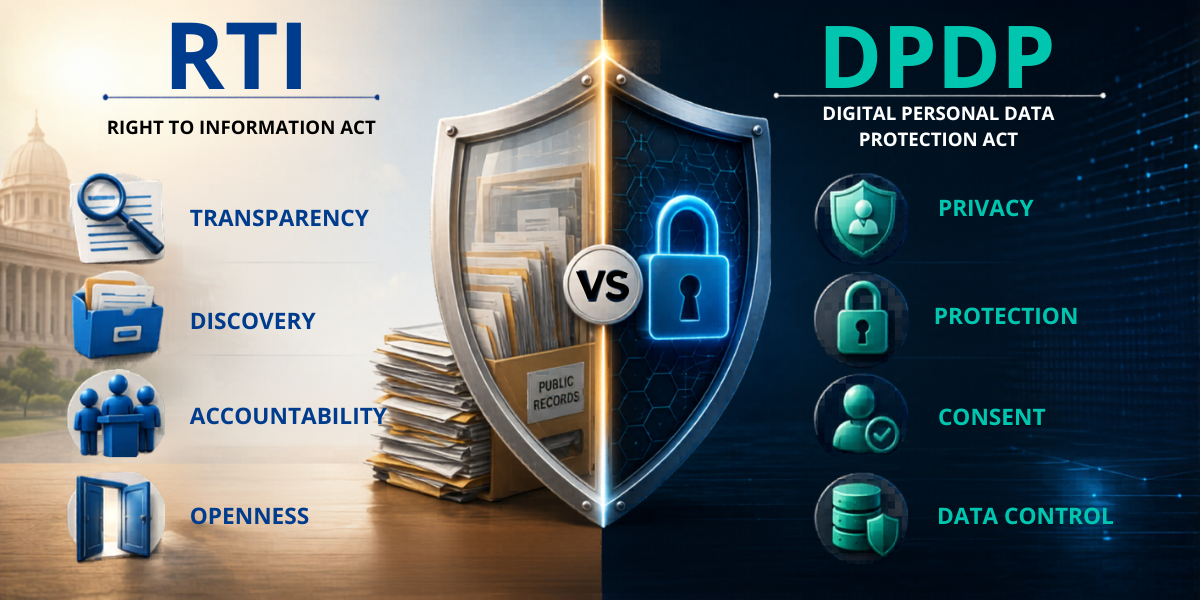
At its core, this is not just a legal debate. It is a governance architecture problem.
RTI asks: “What should citizens know about the government?”
DPDP asks: “What personal information should remain protected?”
Both are legitimate constitutional concerns. But operational conflicts emerge when information requested under RTI contains personal data.
RTI is fundamentally disclosure-oriented, while DPDP is fundamentally protection-oriented. One framework push institution toward openness. The other pushes them toward controlled processing and restricted disclosure.
Does the DPDP Act Weaken the RTI Act?
Critics argue that amendments introduced through the DPDP Act may weaken the RTI framework by expanding the scope for denying access to personal information. Supporters argue the amendments are necessary to protect privacy rights in the digital age.
This is the heart of the controversy.
The DPDP Act amended Section 8(1)(j) of the RTI Act. Earlier, personal information could still be disclosed if a larger public interest justified disclosure. The revised wording has triggered concern because transparency advocates believe it may broaden denial powers available to public authorities.
Why does this matter in practice?
Because some of India’s most important RTI disclosures historically involved personal data linked to public officials, beneficiaries, appointments, and conflict-of-interest investigations. Without that balancing mechanism, critics fear authorities may increasingly deny RTI requests using privacy as a defensive shield.
A compliance framework without accountability can become performative. That is the real fear behind the RTI and DPDP debate. Privacy should operate as a constitutional safeguard—not as an invisibility cloak for governance failures.
At the same time, unrestricted disclosure of personal data can also create genuine risks involving identity theft, profiling, harassment, and surveillance misuse. This is why courts globally struggle with transparency-versus-privacy conflicts.
There is no perfect binary answer. Only calibrated balancing.
Can Information Now Be Denied Under RTI Due to the DPDP Act?
Yes, certain RTI requests involving personal information may now face greater scrutiny or denial after the DPDP-related amendments. However, denial is not automatic, and public authorities must still justify exemptions within the legal framework.
This is where confusion has exploded across public discourse.
Many people now believe: “RTI is finished.”
That interpretation is exaggerated.
The RTI Act still exists. Public authorities are still obligated to disclose information unless valid exemptions apply.
However, the operational threshold for disclosure involving personal data may become more restrictive in practice.
The real-world risk is over-correction. Public authorities may begin using privacy objections defensively to avoid disclosure even in cases involving legitimate public accountability.
In our observation, the future conflict will not be: “RTI versus privacy.”
It will be: “How much privacy is proportionate in a democratic system that depends on transparency?”
How Section 8(1)(j) Changed After the DPDP Act
Section 8(1)(j) of the RTI Act previously allowed disclosure of personal information when larger public interest justified it. Amendments linked to the DPDP Act altered this balancing language, creating concerns about broader exemption powers for public authorities.
This amendment is the legal epicentre of the RTI and DPDP debate.
Before the amendment, Section 8(1)(j) effectively created a balancing test:
- Is the information personal?
- Would disclosure invade privacy?
- Does larger public interest justify disclosure?
That final safeguard mattered enormously. It acted like a constitutional pressure valve and prevented privacy from becoming absolute.
The revised framework has raised concerns because transparency advocates believe the “public interest override” protection has weakened.
Critics argue this could reduce disclosure accountability in sensitive governance matters.
Impact of RTI and DPDP Changes on Citizens, Journalists, and Accountability
1. Increased Difficulty in Accessing Public Information
Journalists and citizens may now face greater resistance when seeking records containing personal information. Public authorities could increasingly invoke privacy exemptions while rejecting RTI requests involving recruitment irregularities, welfare schemes, disciplinary actions, or public appointments.
A transparency system becomes weaker when disclosure starts depending more on institutional comfort than public interest.
2. Greater Privacy Protection for Individuals
The DPDP Act strengthens safeguards around personal data processing and disclosure. This may reduce risks involving identity theft, profiling, unauthorized sharing, and misuse of sensitive information.
In practical terms, stronger privacy laws act like digital guardrails that prevent personal information from becoming an unrestricted public commodity.
3. Operational Challenges for Journalists and Investigators
Investigative journalism often depends on accessing records linked to public officials, contractors, or governance decisions. More restrictive disclosure practices may increase procedural barriers for accountability reporting.
In our observation, this could gradually shift the balance between transparency and institutional secrecy if exemptions are interpreted too broadly.
4. Increased Legal Ambiguity for Public Authorities
Government departments and Public Information Officers (PIOs) now face the challenge of balancing privacy obligations with transparency duties.
When two legal frameworks overlap, defensive interpretation often increases. Many authorities may choose denial over disclosure simply to reduce compliance risk.
5. Long-Term Impact on Democratic Accountability
RTI has historically functioned as a public accountability mechanism that exposed corruption, inefficiency, and misuse of power. If access thresholds become significantly stricter, democratic oversight may weaken over time.
At the same time, ignoring privacy protections entirely would create a governance framework vulnerable to surveillance and misuse. The real challenge is preserving both accountability and dignity together.
Conclusion: RTI and DPDP Must Coexist, Not Compete
The debate around RTI vs DPDP is ultimately a debate about democratic design in the digital age. India is trying to protect two essential constitutional values simultaneously:
- the citizen’s right to know
- the citizen’s right to privacy
Neither objective is illegitimate.
India does not need a transparency fortress with no privacy safeguards. Nor does it need a privacy shield so strong that accountability disappears behind it.
The future of governance will depend on calibrated balance—not absolutist interpretation.
Key Takeaways
- The RTI Act promotes transparency by allowing citizens to access government information.
- The DPDP Act protects personal data and strengthens privacy rights in India.
- The RTI vs DPDP debate is about balancing transparency with privacy.
- Changes to Section 8(1)(j) have raised concerns about easier denial of RTI requests involving personal data.
- The DPDP Act does not end RTI, but it may make disclosure of certain information more restrictive.
- India’s challenge is creating a system where privacy and accountability can coexist together.
Related Blog