Table of contents
By-Research Team
July 14, 2026 | 8 min read | DPDP
Third-Party Data Sharing Under the DPDP Act: Workflow & Data Processing Agreement
Every business shares personal data with third parties. Whether it's a payroll provider, cloud service, CRM platform, payment gateway, or marketing agency, third-party data sharing is a routine part of business operations. But under India's Digital Personal Data Protection (DPDP) Act, 2023, sharing personal data doesn't mean transferring responsibility.
The Data Fiduciary remains accountable for ensuring that personal data is processed lawfully, securely, and only for the intended purpose—even when another organization processes it. This is where a well-defined third-party data sharing workflow and a robust Data Processing Agreement (DPA) become essential.
This guide explains what third party data sharing means, how it is regulated under the DPDP Act, the steps organizations should follow before sharing personal data, and the contractual safeguards every business should have in place.
What Is Third-Party Data Sharing?
Third-party data sharing is the practice of providing personal data to an external organization so it can perform a specific business function or service. Under the DPDP Act, organizations must ensure such sharing is lawful, purpose-driven, and supported by appropriate safeguards.
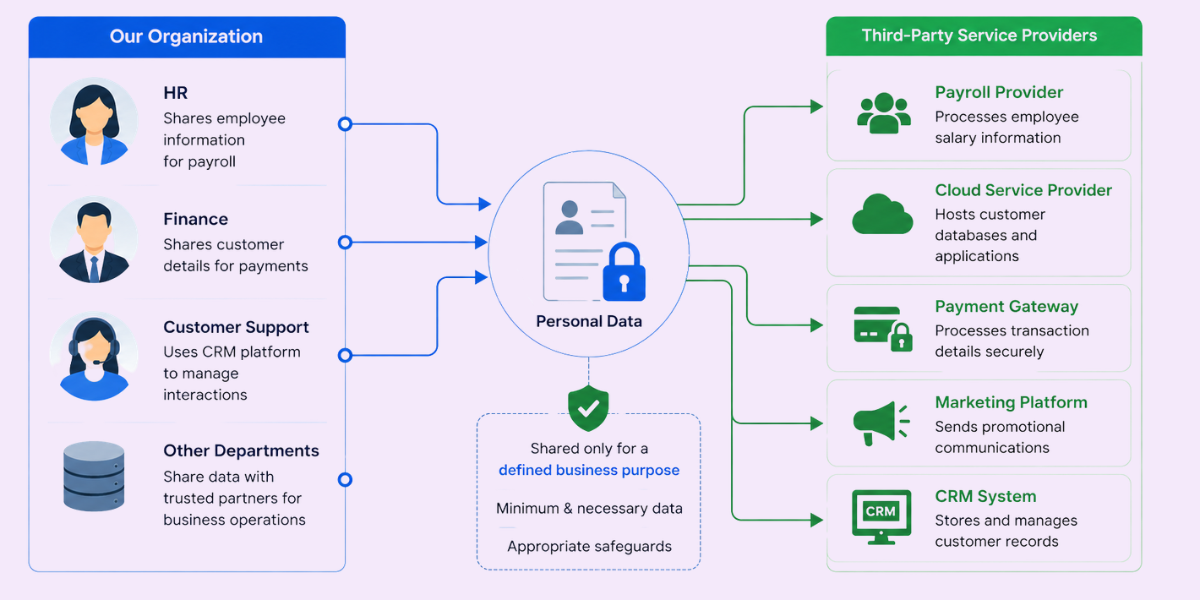
Think about your organization's daily operations. HR shares employee information with a payroll provider. Finance shares customer details with a payment gateway. Customer support teams use CRM platforms to manage interactions. These are all examples of third party data sharing.
Common examples include:
- Payroll providers processing employee salary information.
- Cloud service providers hosting customer databases.
- Payment gateways processing transaction details.
- Marketing platforms sending promotional communications.
- CRM systems storing customer records.
The important distinction is that personal data should only be shared for a defined business purpose. Collecting or sharing more information than necessary increases compliance risk and weakens your organization's privacy posture.
How Does the DPDP Act Regulate Third-Party Data Sharing?
The DPDP Act allows organizations to share personal data with third parties when the processing aligns with the applicable legal requirements and the organization continues to meet its obligations under the Act. Sharing data does not transfer accountability from the Data Fiduciary to the third party.
A common misconception is that once data is shared with a vendor, responsibility shifts to that vendor. It doesn't.
Under the DPDP Act, the Data Fiduciary remains responsible for protecting personal data and ensuring that any processing carried out by a third party complies with applicable legal obligations.
Before sharing personal data, organizations should ask:
- Is there a clear purpose? Every data-sharing activity should support a legitimate business function.
- Is only the necessary data being shared? Avoid excessive or unrelated data transfers.
- Are appropriate contractual safeguards in place? Third parties should process data only according to agreed instructions.
- Can the organization demonstrate accountability? Maintaining records and governance processes strengthens compliance.
Imagine hiring a courier to deliver an important package. Although someone else transports it, you're still responsible for choosing a reliable service and ensuring it reaches the right destination. Third-party data sharing works in much the same way.
What Is a Data Processing Agreement (DPA) and Why Does It Matter?
A Data Processing Agreement (DPA) is a legally binding contract that defines how a third-party processes personal data on behalf of an organization. It establishes responsibilities, security expectations, and processing instructions while helping demonstrate accountability.
Many businesses already have service agreements with vendors.
However, a service agreement explains what service is being delivered.
A Data Processing Agreement explains how personal data must be handled while delivering that service.
Without a clearly defined DPA, organizations may struggle to demonstrate that personal data is processed according to agreed instructions and appropriate safeguards.
A well-drafted DPA helps organizations:
- Clearly define processing responsibilities.
- Protect confidential information.
- Reduce misunderstandings between parties.
- Support regulatory compliance.
- Strengthen customer trust.
In our observation, organizations often invest heavily in cybersecurity but overlook contractual controls. That's a bit like building a fortress with reinforced walls while leaving the front gate unlocked.
Essential Clauses of Data Processing Agreement
An effective Data Processing Agreement should clearly define the scope of processing, security responsibilities, confidentiality obligations, and procedures for handling personal data throughout its lifecycle.
Every DPA should include clauses that answer one simple question:
"How will this personal data be protected?"
1. Purpose and Scope
Clearly define why personal data is being processed, what activities are permitted, and the duration of processing. This ensures the processor uses the data only for the agreed business purpose and avoids unauthorized use.
2. Processing Instructions
Specify that the processor may handle personal data only according to the documented instructions provided by the organization. This helps maintain control over how the data is collected, used, stored, and shared.
3. Confidentiality Obligations
Require everyone involved in processing personal data to maintain strict confidentiality throughout the engagement. This reduces the risk of unauthorized disclosure and reinforces accountability for handling sensitive information.
4. Security Measures
Outline the technical and organizational safeguards expected, such as encryption, access controls, multi-factor authentication, and incident response procedures. These measures help protect personal data from unauthorized access, loss, or misuse.
5. Personal Data Breach Notification
Define how and when the processor must notify the organization if a personal data breach occurs. Timely reporting enables faster investigation, regulatory compliance, and effective response to minimize potential impact.
6. Sub-Processors
Specify whether the processor can engage sub-processors and the conditions for doing so. Clearly defining these requirements improves transparency and ensures accountability throughout the data processing chain.
7. Data Retention and Deletion
State how long personal data may be retained and the process for securely returning or deleting it once processing is complete. This helps prevent unnecessary storage and supports data lifecycle management.
8. Audit and Compliance
Include provisions that allow the organization to verify compliance with agreed contractual and security obligations. Regular audits and documented evidence help demonstrate accountability and strengthen trust between both parties.
Want to implement compliant third-party data sharing practices?
Explore our DPDP Compliance Services to build secure and compliant data-sharing practices.
Third-Party Data Sharing Workflow
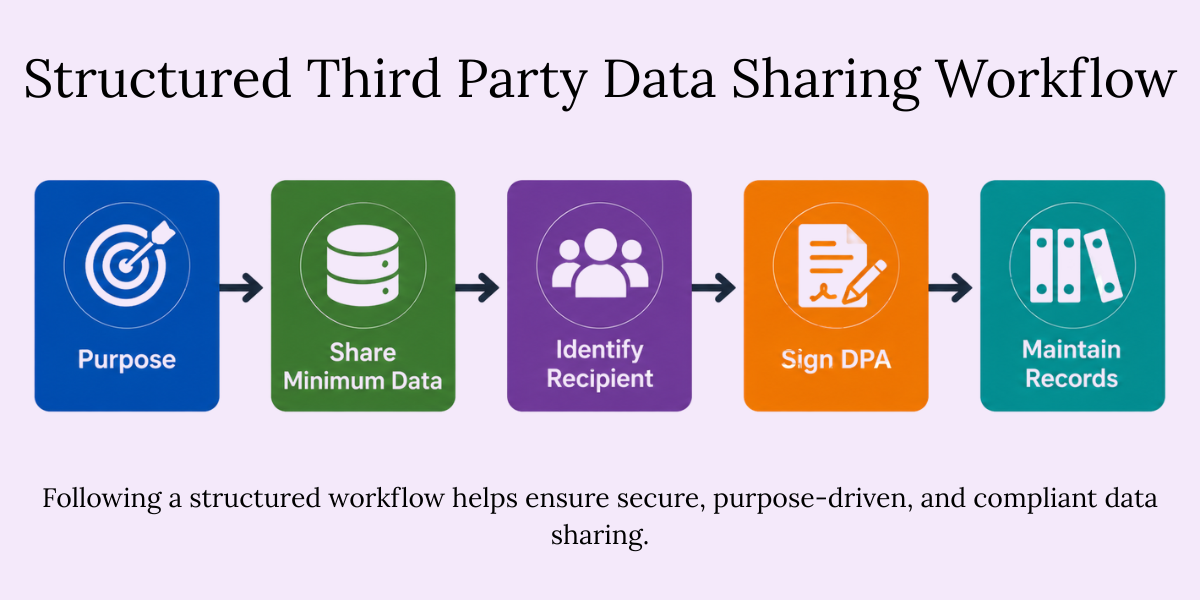
A structured workflow helps organizations reduce compliance risks by ensuring that personal data is shared only, when necessary, for a defined purpose, and under appropriate contractual safeguards. Consistency is often the strongest defense against avoidable privacy incidents.
Instead of treating every data-sharing request differently, build a repeatable process.
Step 1: Define the Business Purpose
Start by asking one simple question: Why is this data being shared?
Every instance of data sharing should have a clear and legitimate business purpose. If the reason for sharing isn't well-defined or the objective is unclear, the data probably shouldn't be shared.
Step 2: Share Only the Required Data
Avoid the "share everything just in case" mindset.
For example, a payroll provider requires employee salary details—not complete HR records, medical information, or performance evaluations.
Applying data minimization reduces both operational and compliance risks.
Step 3: Identify the Receiving Party
Understand who will receive the information and what role they play in processing it.
Knowing whether the recipient is processing data on your behalf helps determine the contractual safeguards that should be implemented.
Step 4: Execute a Data Processing Agreement
Before personal data is shared, establish a written Data Processing Agreement (DPA) that defines:
- Purpose of processing
- Security expectations
- Confidentiality obligations
- Data handling instructions
- Breach notification requirements
Think of the DPA as the blueprint that defines how the third party may enter, use, protect, and eventually return or delete your data.
Step 5: Maintain Records
Document what data was shared, with whom, for what purpose, and under which agreement.
Good documentation doesn't just support compliance—it makes responding to audits, customer requests, and internal reviews significantly easier.
Practical Blueprint
Purpose Defined → Share Minimum Data → Identify Recipient → Sign DPA → Maintain Records
Conclusion
Third-party relationships are essential for modern businesses, but they also introduce privacy and compliance responsibilities that cannot be ignored. The DPDP Act encourages organizations to adopt a governance-first approach where every instance of data sharing is backed by purpose, accountability, and clearly defined contractual obligations.
Rather than treating compliance as a one-time legal exercise, build it into your everyday operations. A documented workflow, supported by a comprehensive Data Processing Agreement, creates a stronger foundation for responsible data handling and long-term trust.
If your organization is reviewing vendor contracts, implementing DPDP compliance measures, or strengthening third-party data sharing practices, Privacy Global can help you build practical, business-focused privacy frameworks that align with the DPDP Act.
Key Takeaways
- Third-party data sharing is permitted under the DPDP Act, but accountability remains with the Data Fiduciary.
- Always define a clear business purpose before sharing any personal data.
- Share only the minimum personal data required to achieve the intended purpose.
- Use a Data Processing Agreement (DPA) to clearly define roles, responsibilities, and security obligations.
- Include essential clauses like confidentiality, security, breach notification, and data deletion in every DPA.
- Follow a structured data-sharing workflow to ensure consistent and compliant practices.
- Maintain accurate records of all third-party data-sharing activities to demonstrate compliance.
- Strong contractual safeguards help reduce privacy risks and build trust with customers and stakeholders.
Related Blog