Table of contents
By-Research Team
September 11, 2026 | 10 min read | DPDP
What is DPO-as-a-Service? A Complete Guide for Businesses
Data protection rarely becomes difficult because an organisation has never heard of privacy. It becomes difficult when privacy responsibilities have no clear owner; regulatory requirements keep evolving, and the internal team is expected to manage everything on top of its existing roles.
That is where DPO as a service can provide a practical solution. Instead of building a full-time internal function, an organisation can engage external data protection expertise to provide ongoing guidance, oversight, and support.
But there is an important distinction: DPO-as-a-service is a service model, not a blanket transfer of accountability. The organisation remains responsible for its decisions and compliance obligations. The external DPO provides the expertise and governance support needed to manage those responsibilities effectively.
For businesses operating in India, the distinction matters even more. Under the Digital Personal Data Protection Act, 2023 (DPDP Act), the statutory definition of a Data Protection Officer refers to an individual appointed by a Significant Data Fiduciary (SDF). The Act requires an SDF's DPO to represent the SDF, be based in India, report to the Board or equivalent governing body, and serve as a contact point for grievance redressal.
The practical question, therefore, is not simply “Do we need a DPO?”
It is: What level of privacy expertise does our organisation need, and how should that expertise be structured?
What is DPO-as-a-Service?
DPO as a service is an outsourced model in which an organisation engages an external privacy professional or specialist provider to perform Data Protection Officer functions and provide ongoing data protection support. Depending on the applicable law and engagement, this can include compliance advice, monitoring, DPIA support, regulatory liaison, rights-request support, and privacy governance.
In simple terms, think of it as adding a privacy specialist to your organisational architecture without necessarily building the entire function internally.
The term DPO as a service is commonly used commercially to describe outsourced or external DPO arrangements. Under the GDPR, organisations can appoint an external DPO through a service contract, either with an individual or an organisation, provided the applicable independence and conflict-of-interest requirements are satisfied.
The DPO's role is not to become the organisation's decision maker for personal data. The DPO advises and monitors; the organisation remains responsible for the processing decisions that it makes.
That distinction is the foundation of a sound DPOaaS model.
Who Needs a Data Protection Officer-as-a-Service?
DPO as a service is particularly relevant to organisations that need dedicated privacy expertise but do not want, or are not yet equipped, to build the entire capability internally. It can also support organisations that already have privacy teams but need additional specialist capacity, independent oversight, or coverage for complex regulatory and operational requirements.
Start with the legal question. Then consider the operational one.
Under India's DPDP Act, the statutory DPO requirement applies to Significant Data Fiduciaries. The Act states that an SDF must appoint a DPO who represents the SDF, is based in India, reports to the Board or similar governing body, and acts as a contact point for grievance redressal.
That does not mean every organisation in India is automatically required to appoint a statutory DPO under the DPDP Act.
However, organisations that are not SDFs still have data protection responsibilities under the Act and may choose to establish dedicated privacy oversight as a governance best practice.
The EDPB similarly notes that organisations can voluntarily appoint a DPO even where the GDPR does not mandate one.
Organisations That May Consider DPOaaS:
-
SMEs without a dedicated privacy team
Smaller organisations may not have enough ongoing work to justify a full-time specialist. DPOaaS can provide access to expertise without requiring the organisation to build an entire privacy function from scratch.
-
Organisations scaling rapidly
Growth changes privacy risk. New customers, employees, vendors, products, applications, and processing activities create more data flows to govern. An external DPO function can provide additional capacity while the organisation's privacy program matures.
-
Organisations operating across jurisdictions
Different privacy laws can impose different requirements around DPO appointments, rights, governance, breach management, and regulatory engagement. External specialists with cross-jurisdictional expertise can help coordinate these requirements.
-
Organisations handling complex or high-risk processing
Large-scale monitoring, sensitive data processing, extensive profiling, or other high-risk activities can require stronger privacy governance. Under GDPR, for example, certain large-scale monitoring and large-scale sensitive data processing activities trigger mandatory DPO requirements.
-
Organisations with an existing privacy function
DPOaaS does not have to replace an internal team. It can act as an additional privacy shield, providing specialist advice, independent oversight, regulatory support, or additional resources during periods of increased workload.
The practical test is simple: if privacy responsibilities are growing faster than your internal capability, DPOaaS may be worth evaluating.
What Does DPO-as-a-Service Include?
A DPO as a service engagement typically combines privacy advisory, compliance monitoring, governance support, rights management, risk assessment, and regulatory assistance. The exact scope depends on the applicable regulations, organisation's risk profile, and service agreement, but the objective is consistent: establish an ongoing mechanism for identifying, managing, and monitoring data protection obligations.
A DPO should not appear only when there is a regulatory crisis. That is the privacy equivalent of installing a fire alarm after the building catches fire.
The EDPB identifies core DPO activities including advising the organisation and employees, monitoring compliance, advising on DPIAs, cooperating with the supervisory authority, and acting as a contact point for individuals. It also recommends involving the DPO early in matters involvipersonal data protection.
Core DPOaaS Responsibilities:
- Privacy Governance: Build and maintain a structured privacy governance framework covering policies, responsibilities, procedures, controls, and reporting.
- Compliance Monitoring: Monitor the implementation of privacy requirements, identify compliance gaps, track remediation actions, and maintain ongoing compliance visibility.
- Data Protection Impact Assessments: Support DPIAs where required or appropriate to identify and assess privacy risks associated with processing activities.
- Records and Data Mapping Support: Support records of processing, data inventories, and data-flow mapping to establish what data is processed, why, where, and by whom.
- Data Principal or Data Subject Rights: Support processes for handling applicable privacy rights requests, including requests relating to access and information about personal data and its processing.
- Data Breach and Incident Support: Assess and coordinate the privacy implications of personal-data incidents and support appropriate breach-response processes.
- Vendor and Third-Party Privacy Risk: Assess privacy risks associated with third-party vendors and data processors to strengthen controls across the wider data ecosystem.
- Training and Awareness: Conduct privacy training and awareness initiatives to help employees understand and fulfil their data protection responsibilities.
- Regulatory Liaison: Act as a contact point with relevant supervisory authorities or regulators where required or permitted under applicable privacy laws.
How Does DPO-as-a-Service Work?
DPO-as-a-service generally works through a structured lifecycle: assess the organisation's current privacy position, define responsibilities, establish a roadmap, provide ongoing advisory and monitoring, and report progress to relevant stakeholders. The engagement should be tailored to the organisation's regulatory obligations, risk profiles, processing activities, and privacy maturity.
Think of the process as the building a privacy roadmap before driving the compliance journey.
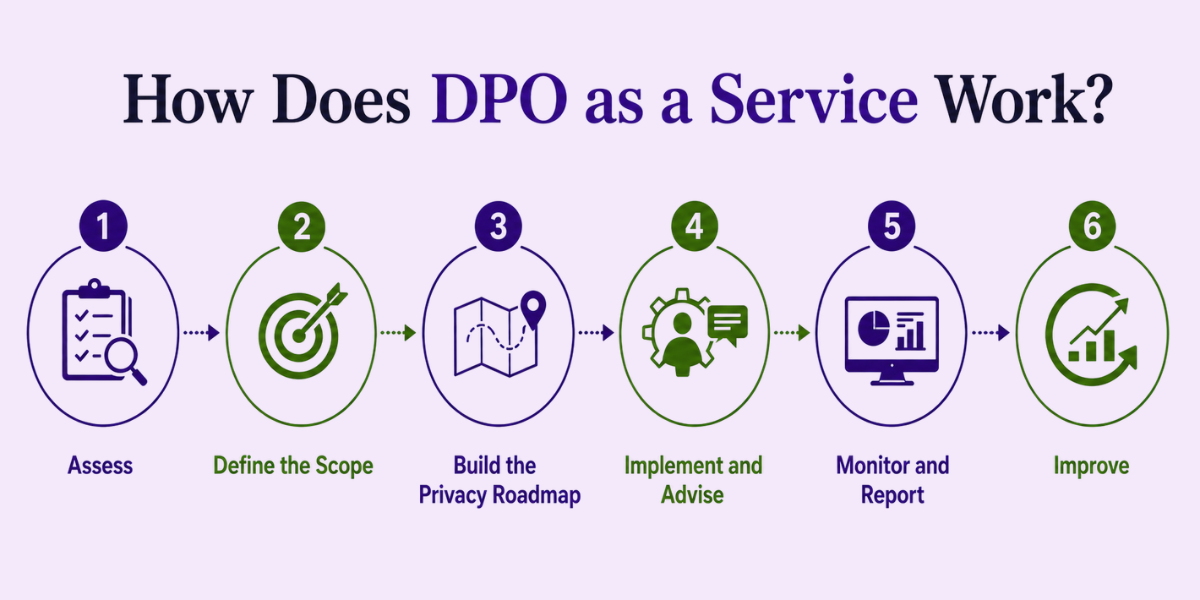 A practical DPOaaS engagement can be structured into the following stages:
- Assess:
Review existing privacy policies, data flows, processing activities, risk assessments, vendor controls, and incident procedures to identify gaps and priority areas. - Define the Scope:
Establish the DPO’s responsibilities, internal ownership, escalation process, reporting requirements, and key stakeholder interactions to ensure clear accountability. - Build the Privacy Roadmap:
Prioritize compliance actions based on regulatory requirements, risk, business impact, effort, and dependencies. - Implement and Advise:
Provide ongoing support across DPIAs, policies, data mapping, rights requests, vendor assessments, incidents, training, and new initiatives. - Monitor and Report:
Track compliance risks, remediation, incidents, assessments, training, and other agreed metrics through regular reporting and reviews. - Improve:
Continuously update the privacy program as regulations, technologies, business processes, and data practices evolve.
Benefits of DPO as a Service
The primary benefits of DPO as a service are access to specialist expertise, flexible resourcing, stronger privacy governance, ongoing compliance support, and the ability to scale privacy capabilities as business requirements change. For organisations without sufficient internal resources, DPOaaS can provide a structured privacy function without requiring the organisation to build every capability internally.
But cost savings are only one part of the equation. The real value is governance capacity.
Key Benefits of DPOaaS:
- Access to Specialist Expertise: Get dedicated data protection expertise for complex processing activities, DPIAs, incidents, rights requests, and evolving regulatory requirements.
- Flexible and Scalable Support: Scale privacy support based on business needs, such as new product launches, acquisitions, regulatory changes, or market expansion.
- Reduced Internal Resource Burden: Access an established privacy function without the full recruitment, training, and management requirements of building an in-house team.
- Stronger Privacy Governance: Establish clear responsibilities, monitoring, documentation, escalation, and reporting instead of treating privacy as an occasional legal task.
- Independent Oversight: An appropriately structured external DPO arrangement can provide an additional layer of independent privacy oversight.
- Continuous Regulatory Readiness: Stay prepared as privacy regulations, business processes, and compliance requirements evolve.
- Better Decision-Making: Integrate privacy considerations into decisions about products, vendors, technologies, and data use before problems become expensive to fix.
Need dedicated data protection expertise without building an in-house team?
Explore our DPO Services↗ and find the right support for your organization.
Conclusion
DPO as a service gives organisations a practical way to strengthen their privacy architecture without assuming that every organisation needs to build the same internal structure.
The right approach starts with the regulatory requirement, but it should not end there. Assess your obligations. Define ownership. Build the privacy roadmap. Establish ongoing monitoring. Keep the DPO function connected to business decisions.
For organisations evaluating data protection officer as a service, the key question is therefore not simply whether outsourcing is possible.
It is whether the chosen model provides the expertise, independence, governance, and continuity needed to manage privacy risk effectively.
Key Takeaways
- DPOaaS provides specialist privacy expertise without requiring a complete in-house function.
- DPO requirements depend on applicable laws; under India’s DPDP Act, statutory DPO requirements apply to Significant Data Fiduciaries.
- DPOaaS can cover governance, DPIAs, rights requests, incident support, vendor risk, training, and compliance monitoring.
- A structured DPOaaS model follows a roadmap: Assess → Define → Plan → Implement → Monitor → Improve.
- The organisation remains accountable for its data protection decisions, while the DPO provides advice and oversight.
- DPOaaS strengthens privacy governance, flexibility, and regulatory readiness.
Related Blog