
Table of contents
By-Research Team
August 21, 2026 | 8 min read | Data Governance
Record of Processing Activities (ROPA) Best Practices
A privacy programme can have policies, consent mechanisms, vendor contracts, and security controls—and still have one fundamental problem: you may not know exactly what personal data your organisation is processing, why, where, or through whom.
That is where a Record of Processing Activities (ROPA) becomes useful. Think of it as the blueprint of your personal data processing landscape. It brings processing activities into one structured view, so privacy teams can identify gaps, assign ownership, and connect compliance requirements to actual business operations.
For organisations preparing for India’s Digital Personal Data Protection (DPDP)** framework, this distinction matters. The DPDP Act, 2023, does not use the term “ROPA” in the same prescriptive way that Article 30 of the GDPR does. However, maintaining a structured record can provide practical evidence of how an organisation understands and governs its processing activities.
What Is ROPA?
A Record of Processing Activities (ROPA) is a structured record of an organization's personal data processing activities. It typically captures what data is processed, why it is processed, whose data is involved, who receives it, how long it is retained, and what safeguards apply. Under GDPR, Article 30 expressly prescribes ROPA requirements; under DPDP, organisations can use ROPA as a practical governance mechanism for documenting processing.
In simple terms, ROPA tells the story of how personal data moves through your organisation.
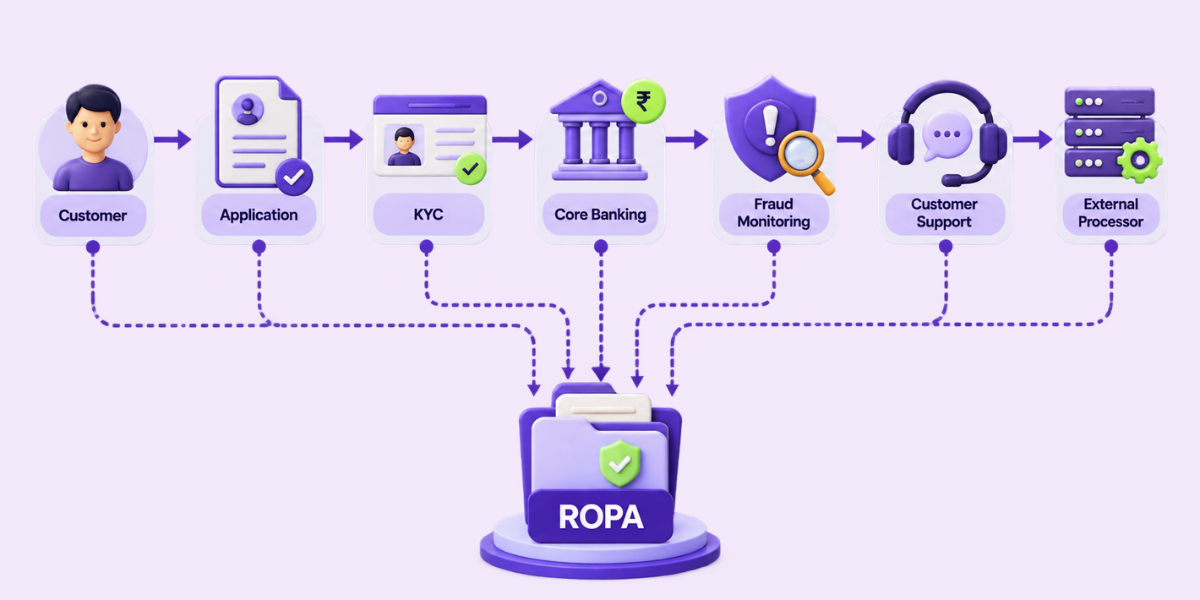
Consider a bank onboarding a new customer. Personal data may flow across application channels, KYC systems, core banking, fraud monitoring, customer support, and external processors.
ROPA brings these activities into one structured record instead of leaving information scattered across teams and systems.
ROPA Is More Than a Spreadsheet
A spreadsheet can be the format, but it is not the governance framework. A useful ROPA connects processing activities with purposes, data, systems, processors, retention, and controls.
Practical blueprint:
- Processing activity — What is being done with the data?
- Purpose — Why is it being processed?
- Data — Whose data and what categories?
- Ecosystem — Which teams, systems, and processors are involved?
- Controls — What retention and security measures apply?
The goal is simple: turn scattered data knowledge into a structured processing record.
Is ROPA Mandatory Under DPDP?
The DPDP Act, 2023 does not expressly mandate a standalone ROPA equivalent to GDPR Article 30. However, maintaining a ROPA can help Data Fiduciaries demonstrate accountability by documenting processing activities, purposes, data flows, processors, retention, and safeguards.
Unlike GDPR, which explicitly requires records of processing in certain circumstances, the DPDP framework focuses on broader obligations such as security safeguards and breach notification. A structured ROPA can therefore serve as a practical governance tool to connect these obligations with actual data processing.
Processing Activity → Data → System → Processor → Access → Retention → Security Controls
This gives organisations a clear view of their processing landscape—and makes privacy governance easier to demonstrate.
Why ROPA Matters for DPDP Compliance
ROPA matters because it turns an organization's understanding of personal data processing into a structured governance record. It can connect processing purposes, data categories, systems, processors, retention, security safeguards, and ownership, making privacy risks easier to identify and compliance activities easier to coordinate. Under DPDP, this practical visibility can strengthen how organisations manage their Data Fiduciary responsibilities.
A ROPA should not sit in the privacy team’s folder gathering digital dust.
It should function as a privacy control map.
- Strengthens Data Visibility by giving organisations a clear view of what personal data is processed, why it is processed, and which teams are involved.
- Supports Data Mapping by connecting data inventory, data flows, processing activities, and purposes in one structured record.
- Improves Processor Oversight by helping track which Data Processors handle personal data, what data they receive, and why.
- Supports Security Governance by helping identify where safeguards such as encryption, access controls, monitoring, backups, and breach-response measures apply.
- Creates Better Audit Readiness by providing a structured record of processing activities, making compliance reviews and audits easier to manage.
What Should a ROPA Include?
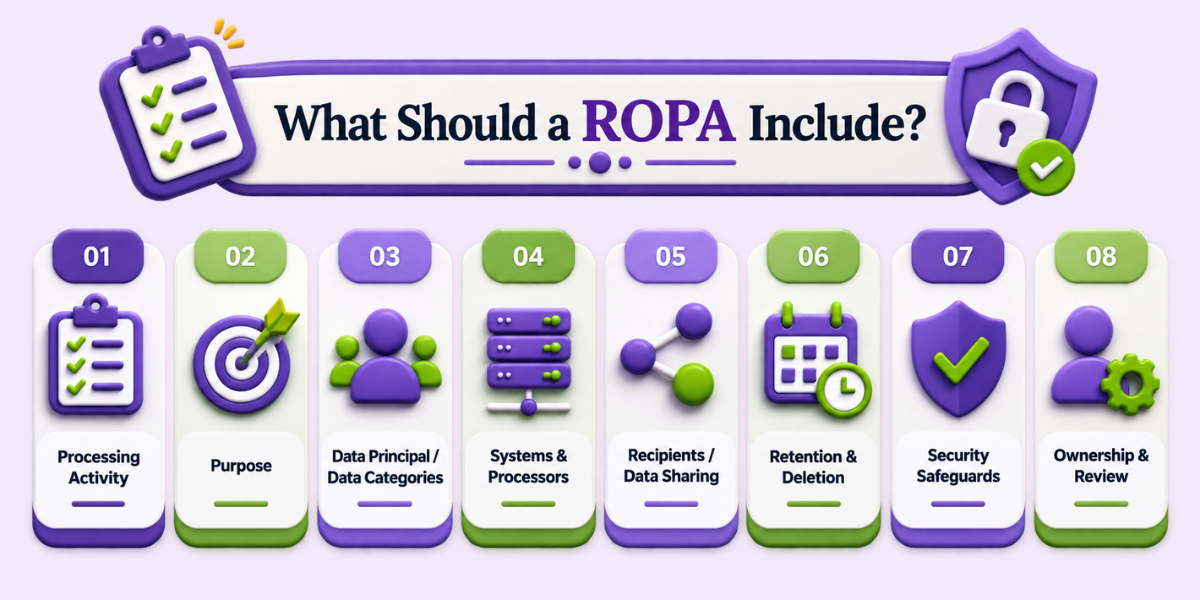
A DPDP-aligned ROPA should provide a clear, current view of each relevant processing activity, including its purpose, categories of Data Principals and personal data, systems and processors involved, recipients, retention, applicable safeguards, ownership, and review status. The exact fields should be adapted to the organization's processing environment and applicable legal obligations rather than copied from a GDPR template.
There is no value in creating a beautiful 40-column spreadsheet that nobody understands.
Build the ROPA around the questions your privacy programme needs
- Processing Activity and Purpose — What personal data is processed and why?
- Data Principal and Personal Data Categories — Whose data is processed and what types of personal data are involved?
- Systems and Data Processors — Which systems and Data Processors handle the personal data?
- Recipients and Data Sharing — Who receives or has access to the personal data?
- Retention and Deletion — How long is the data retained and when should it be deleted?
- Security Safeguards — What security measures protect the personal data?
- Ownership and Review Information — Who owns the processing activity and when the ROPA entry was last reviewed or updated?
Looking to strengthen your ROPA under the DPDP Act and build a more structured privacy programme? Check out our
DPDP Compliance solutions.ROPA Best Practices for a Stronger Privacy Programme
Knowing the fields is only half the job. The real value comes from how the ROPA is built, governed, and maintained.
1. Build ROPA From Data Mapping
Do not start with an empty spreadsheet and ask every department to “fill it in.”
Start with data discovery and mapping. Identify systems, data sources, processing purposes, recipients, processors, and flows first. The ICO similarly recommends using information, audits, or data-mapping exercises to feed processing documentation.
2. Assign Clear Ownership
Make someone responsible for each processing record.
The business knows why the data is used. IT knows where it sits. Procurement knows which vendor is involved. Privacy knows which governance requirements apply.
ROPA works when those perspectives meet in one controlled record.
3. Keep It Event-Driven
Do not wait for an annual privacy review to discover that the business launched three products, onboarded seven vendors, and changed two systems.
Review the ROPA when:
- A new product or service launches
- A new processing purpose is introduced
- A new Data Processor is onboarded
- A system change
- Data categories change
- Retention requirements change
- Data-sharing arrangements change
- A significant security or privacy event occurs
A ROPA should reflect current processing, not last year's processing.
4. Connect ROPA With Other Privacy Controls
A mature privacy programme should not operate as a collection of disconnected documents.
Connect the ROPA with:
Data Inventory → Data Mapping → Privacy Notices → Consent Records → Processor Contracts → Retention → DPIAs/Risk Assessments → Breach Records → Audit Evidence
This creates architecture rather than a document library.
5. Make ROPA Searchable and Maintainable
Use an electronic format that allows authorised teams to add, amend, review, and track records efficiently.
The ICO recommends electronic records because processing documentation needs to be maintained and updated as processing changes.
For a small organisation, a controlled spreadsheet may be sufficient as a starting point. For complex organisations with hundreds of processing activities, multiple business units, and large processor ecosystems, dedicated privacy-management tooling can provide stronger workflow and change-management capabilities.
Conclusion
Privacy compliance becomes difficult when information about personal data processing is scattered across teams, systems, and vendors. ROPA brings these pieces together into one structured view of how personal data is processed.
For organisations preparing for DPDP compliance, ROPA can strengthen privacy governance by connecting processing activities with purposes, data flows, processors, controls, and ownership.
Build the record. Connect it to your data map. Assign ownership. Keep it current. That is what turns ROPA from a compliance document into a practical privacy-governance tool.
Key Takeaways
- ROPA provides a structured view of personal data processing, helping organisations understand what data is processed, why, where, and by whom.
- ROPA is not expressly mandated as a standalone document under the DPDP Act, but it can serve as a practical tool for demonstrating accountability and strengthening privacy governance.
- A strong ROPA should capture key processing details, including purposes, data categories, processors, recipients, retention, security safeguards, ownership, and review information.
- Build ROPA from data mapping, rather than creating it as an isolated spreadsheet or compliance document.
- Keep ROPA current and event-driven by updating it when processing activities, systems, vendors, data categories, or retention requirements change.
- Connect ROPA with other privacy controls such as data inventory, data mapping, privacy notices, consent records, processor contracts, DPIAs, retention, and breach management.
- Treat ROPA as a living privacy-governance tool, not a one-time compliance exercise.
Related Blog