Table of contents
By-Research Team
August 4, 2026 | 7 min read | DPDP
Purpose Limitation Under the DPDP Act Explained
Organizations often collect personal data for one reason but gradually begin using it for entirely different purposes. Customer information collected for account creation starts appearing in marketing campaigns. Employee records find their way into analytics projects. Vendor data gets reused without proper evaluation. Most organizations don't intend to misuse data—it simply happens as business needs evolve.
That's exactly why Purpose Limitation under the DPDP Act is one of the most important privacy principles. In simple terms, if you collect data to solve one problem, you shouldn't quietly reuse it to solve another.
This guide explains Purpose Limitation, why it matters, how Purpose Limitation under DPDP works, when it applies, and the common mistakes organizations should avoid to strengthen privacy compliance.
What Is Purpose Limitation?
Purpose Limitation is the principle that personal data should be collected for a specific, lawful purpose and should not be used for unrelated purposes without a valid legal basis or appropriate consent. It ensures organizations process only the data necessary to achieve the purpose originally communicated to individuals.
This principle ensures that organizations remain transparent about why they collect personal data and prevent "purpose creep"—where data collected for one activity gradually gets reused for others without the individual's knowledge.
For example, a hospital collects a patient's contact details to schedule appointments. Using those same details later to promote unrelated wellness products would represent a different processing purpose and should be evaluated carefully before proceeding.
By defining the purpose before collecting personal data, organizations create a strong foundation for lawful processing, better governance, and increased customer trust.
Why Is Purpose Limitation Important?
Purpose Limitation helps organizations reduce privacy risks, improve transparency, and demonstrate accountability. By restricting personal data to clearly defined purposes, businesses can prevent unnecessary processing, reduce compliance risks, and strengthen trust with customers, employees, and regulators.
Without purpose limitation, personal data often spreads across departments, systems, and vendors with little oversight. What begins as a legitimate business process can gradually become excessive data sharing, unnecessary retention, or unauthorized reuse.
Purpose limitation also complements other privacy principles such as data minimisation, storage limitation, and purpose specification. When organizations clearly define why personal data is collected, it becomes much easier to determine what data should be collected, who should access it, and how long it should be retained.
More importantly, this principle encourages organizations to ask an important business question:
"Are we using this data because we need to—or simply because we already, have it?"
That simple shift in thinking often prevents future compliance issues.
Purpose Limitation Under the DPDP Act
Purpose Limitation under the DPDP Act requires Data Fiduciaries to process personal data only for the specific purpose for which it was collected or another lawful purpose permitted under the Act. Organizations must clearly communicate the purpose to the Data Principal before processing begins.
The Digital Personal Data Protection Act, 2023 builds its consent framework around the concept of a specified purpose. Before requesting consent, a Data Fiduciary must provide a clear notice explaining what personal data will be processed and why it is being collected.
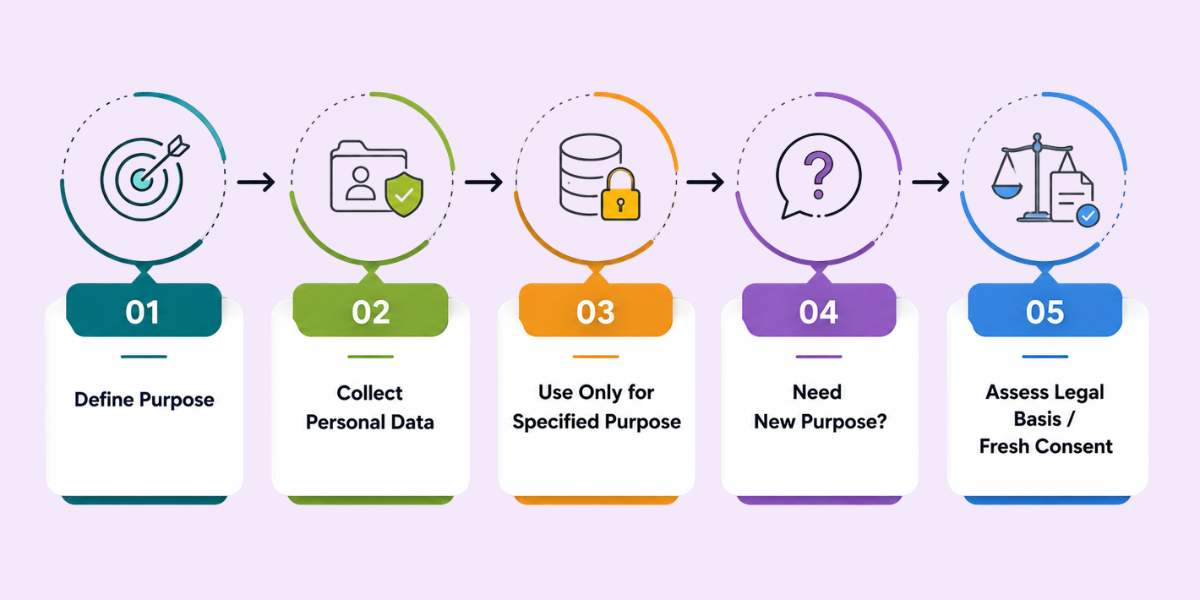
In practice, this means organizations should define the purpose before collecting personal data—not after. If the business later wishes to use the same data for a substantially different purpose, it should evaluate whether the new processing is legally permissible or whether fresh consent is required.
For example:
- A bank collects identity documents for KYC verification.
- An HR team collects employee details for payroll processing.
- An e-commerce platform collects delivery addresses to fulfill customer orders.
Each activity has a clearly defined purpose. Reusing that information for unrelated business objectives without appropriate justification may create privacy and compliance risks.
Purpose limitation is therefore not simply about limiting data collection—it is about ensuring every processing activity remains connected to its original business purpose.
When Does Purpose Limitation Apply?
Purpose Limitation applies whenever an organization collects, uses, shares, or continues processing personal data. Any new processing activity that differs from the original purpose should be evaluated before implementation to ensure it remains compliant with privacy obligations.
Organizations should pay particular attention in situations such as:
-
Before launching a new product or service
New services often require additional personal data or introduce new processing activities. Define the business purpose before collecting any information.
-
Before using data for marketing
Customer information collected for transactions should not automatically be reused for promotional campaigns without considering the original purpose and applicable legal requirements.
-
Before sharing data with vendors
Whenever personal data is transferred to third-party processors, confirm that the sharing supports the original processing purpose and is governed by appropriate contractual safeguards.
-
When introducing AI or analytics
Artificial intelligence and analytics platforms frequently reuse existing datasets. Organizations should verify that this new processing aligns with the purpose originally communicated to individuals.
-
When expanding business operations
Entering new markets, launching new services, or restructuring internal processes can change how personal data is used. Review whether the original purpose still applies before continuing processing.
Purpose limitation should become part of everyday business decisions—not just a legal review during compliance audits.
Need guidance on DPDP compliance?
Visit our DPDP Compliance ↗ page to learn how we help organizations assess privacy risks, implement compliant data processing practices, and strengthen privacy governance.
Common Mistakes to Avoid
Organizations often violate purpose limitation not because they ignore privacy laws, but because business processes evolve faster than governance. Identifying these mistakes early helps prevent unnecessary privacy risks and strengthens long-term compliance.
-
Collecting data "just in case"
If there is no defined business purpose today, there probably isn't a reason to collect the data. Future possibilities are rarely sufficient justification.
-
Writing vague privacy notices
Statements like "for business purposes" or "to improve our services" provide little clarity. Clearly specify why personal data is being collected.
-
Reusing personal data without evaluation
Just because another department finds existing data useful doesn't automatically mean it can be reused. Every new purpose should be assessed independently.
-
Ignoring third-party processing
Purpose limitation extends beyond your organization. Vendors should process personal data only for the agreed business purpose.
-
Keeping personal data after the purpose ends
If the purpose has been fulfilled, retaining personal data indefinitely increases privacy risk without delivering additional value.
-
Treating purpose limitation as a one-time exercise
Business operations change constantly. Review processing purposes regularly to ensure they remain accurate, relevant, and aligned with current business activities.
Conclusion
Purpose Limitation under the DPDP Act is more than a legal requirement—it's a practical governance principle that helps organizations process personal data responsibly. By clearly defining the purpose before collecting data and ensuring every processing activity aligns with that purpose, organizations can reduce privacy risks, strengthen accountability, and build greater trust with individuals.
As businesses adopt new technologies, engage more vendors, and process increasing volumes of personal data, purpose limitation becomes even more important. Building this principle into everyday decision-making enables organizations to move beyond reactive compliance and create a stronger, more sustainable privacy program.
Key Takeaways
- Purpose Limitation under the DPDP Act requires organizations to collect and process personal data only for a specific, clearly defined purpose.
- Clearly defining the purpose before collecting personal data helps improve transparency, accountability, and overall privacy compliance.
- Reusing personal data for a different purpose without appropriate legal basis or fresh consent can create privacy and compliance risks.
- Apply purpose limitation whenever personal data is collected, shared, reused, or processed through new technologies, vendors, or business processes.
- Regularly review processing activities to ensure personal data continues to be used only for its intended purpose.
- Embedding purpose limitation into everyday business decisions helps reduce privacy risks, strengthen governance, and build long-term trust with individuals.
Related Blog