Table of contents
By-Research Team
September 18, 2026 | 11 min read | DPDP
Internal vs External DPO: Which Is Right for Your Organisation?
Choosing between an internal and external DPO is not simply a question of whether to hire an employee or outsource a function. It is a governance decision that affects independence, regulatory expertise, business continuity, cost, and how quickly your organisation can respond to privacy risks.
For Indian organisations, the decision also needs to be viewed through the Digital Personal Data Protection (DPDP) Act, 2023 and the DPDP Rules, 2025. The Rules were notified in November 2025, with different provisions coming into force on different dates.
So, which model creates the stronger privacy fortress?
The answer depends on your organisation's regulatory obligations, privacy workload, internal expertise, independence requirements, and need for continuity.
Who Is a Data Protection Officer?
A Data Protection Officer (DPO) is a designated individual responsible for representing an organisation in relation to specified data protection obligations and serving as an important point of contact for privacy matters. Under the DPDP Act, the statutory DPO requirement is specifically tied to Significant Data Fiduciaries (SDFs), which must appoint an individual based in India who is responsible to the Board or similar governing body and serves as the grievance redressal contact.
Why Organisations Need a DPO
A DPO provides a dedicated governance layer between privacy requirements and day-to-day business operations. The role can involve coordinating privacy assessments, rights-related processes, regulatory engagement, grievance handling, and privacy governance.
Think of the DPO as part of the organisation's privacy control tower. The DPO does not replace every privacy, legal, security, or compliance function; instead, the role helps ensure those functions operate within an accountable privacy framework.
Does Your Organisation Need a DPO Under the DPDP Act?
Under the DPDP Act, the specific statutory appointment of a DPO applies to a Significant Data Fiduciary (SDF). Section 10 requires an SDF to appoint an individual who is based in India, is responsible to the Board or similar governing body, represents the SDF under the Act, and serves as the point of contact for the grievance redressal mechanism.
What Does the DPDP Act Require From a DPO?
Section 10 sets four core requirements for the SDF's DPO:
- Represent the SDF under the Act.
- Be based in India.
- Be responsible to the Board of Directors or similar governing body.
- Act as the point of contact for the grievance redressal mechanism.
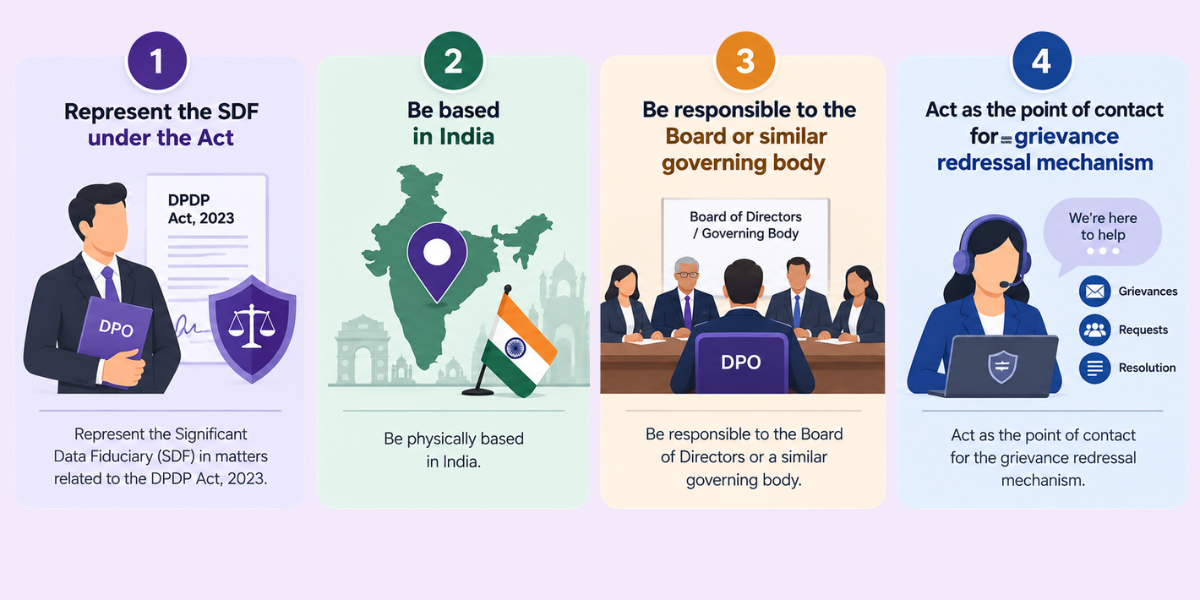
These requirements make the DPO more than a name on an organisation chart. The reporting relationship, location, and grievance function are explicit elements of the statutory role.
Internal vs External DPO: What’s the Difference?
An internal DPO is generally an employee performing the DPO function within the organisation, while an external DPO is appointed through an external professional or service arrangement. The difference extends beyond employment status: organisations should compare expertise, independence, continuity, cost, organisational knowledge, scalability and regulatory coverage before choosing a model.
| Factor | Internal DPO | External DPO |
|---|---|---|
| Employment model | Employee within the organisation | External professional or service provider |
| Organisational knowledge | Deep understanding of internal processes and teams | Requires onboarding and ongoing organisational context |
| Privacy expertise | Depends on the individual's skills and experience | Can provide access to specialist privacy expertise |
| Regulatory exposure | Depends on the individual's experience | May provide broader exposure across regulations and organisations |
| Independence | Must be carefully protected from conflicts | Can provide greater structural independence when appropriately appointed |
| Cost | Salary, benefits, recruitment and training | Service or retainer-based cost |
| Availability | Can depend heavily on one individual | May offer team-based support and backup |
| Scalability | Additional resources may require further hiring | Support can generally be adjusted as workload changes |
| Continuity | Vulnerable to resignation, leave or role changes | Can be stronger where provider has backup resources |
| Speed of appointment | Recruitment and onboarding required | External engagement can generally be faster |
| Business integration | High day-to-day integration | Requires structured communication with internal teams |
| Cross-industry experience | Usually centred on the organisation's environment | May bring experience from multiple sectors |
| Best suited for | Organisations needing dedicated, embedded privacy leadership | Organisations needing flexible, specialist or independent support |
An internal DPO embeds privacy capability inside the business. An external DPO can add specialist expertise and continuity without requiring the organisation to maintain the entire capability internally.
How Much Does an Internal vs External DPO Cost?
The cost of an internal DPO extends beyond salary, while an external DPO's fee depends on scope, service levels and complexity. A meaningful comparison should therefore consider the total cost of ownership, including recruitment, training, technology, backup coverage, specialist support, onboarding, and additional privacy work—not simply employee salary versus external retainer.
What Does an Internal DPO Cost?
An internal DPO may involve:
- Salary and benefits: The direct employment cost of the DPO.
- Recruitment: Hiring specialised privacy talent can take time and resources.
- Training: Privacy regulations evolve, so maintaining expertise requires continuous learning.
- Technology: The DPO may need privacy management, assessment, reporting, or workflow tools.
- Specialist support: Complex legal or technical issues may still require external experts.
- Continuity: A single-person model may require backup resources during leave or departure.
The hidden cost is often the easiest one to overlook. You may hire one DPO and still need a privacy team, legal support, security specialists, and technology around that person.
What Does an External DPO Cost?
An external DPO or DPO-as-a-service (DPOaaS) model generally operates through a service or retainer arrangement.
Potential costs can include:
- Retainer or service fee: The core cost of the DPO service.
- Onboarding: Time required to understand your organisation, systems and processing activities.
- Additional projects: DPIAs, audits, policy work or assessments may fall outside the base scope.
- Incident support: Major privacy incidents may require additional resources.
- Out-of-scope work: Complex or urgent requirements can affect the final cost.
The commercial advantage is flexibility. But flexibility only creates value when the scope and service expectations are clearly defined.
Which DPO Model Is Right for Your Organisation?
There is no universal answer to the internal vs external DPO question. An internal DPO may be stronger when privacy work is deeply embedded in daily operations, while an external DPO can make more sense when specialist expertise, independence, flexibility or continuity are the bigger priorities.
Choose an Internal DPO If...
-
Privacy workload is substantial and continuous.
If your organisation runs frequent privacy assessments, handles significant rights activity, manages complex processing operations and requires daily privacy coordination, an embedded DPO may provide stronger operational integration.
-
Deep business knowledge is critical.
An internal DPO can develop detailed knowledge of business processes, technology architecture, vendors and internal stakeholders. That institutional knowledge can make privacy decisions faster and more context-aware.
-
You can support the role properly.
An internal appointment works best when the organisation can provide the DPO with adequate authority, expertise, time, resources and access to senior decision-makers.
Choose an External DPO If...
-
Specialist expertise is difficult to maintain internally.
An outsourced DPO can give organisations access to professionals who work across privacy regulations, industries and risk scenarios without requiring every capability to be built in-house.
-
Independence is a priority.
An external arrangement can help create separation from operational teams, although independence still depends on how the DPO role is structured and managed.
-
Your workload fluctuates.
If privacy work intensifies during audits, new product launches, regulatory changes or major processing projects, a flexible external model can scale more easily than a fixed full-time role.
-
Continuity matters.
A provider with multiple specialists can reduce dependence on one individual, particularly where backup coverage is included.
Consider a Hybrid DPO Model If...
A hybrid model combines internal privacy capability with external DPO expertise.
The internal team can manage day-to-day privacy operations and business coordination, while the external DPO provides independent oversight, specialist guidance and escalation support.
This can be useful for organisations that have started building a privacy programme but are not ready to maintain every specialist capability internally.
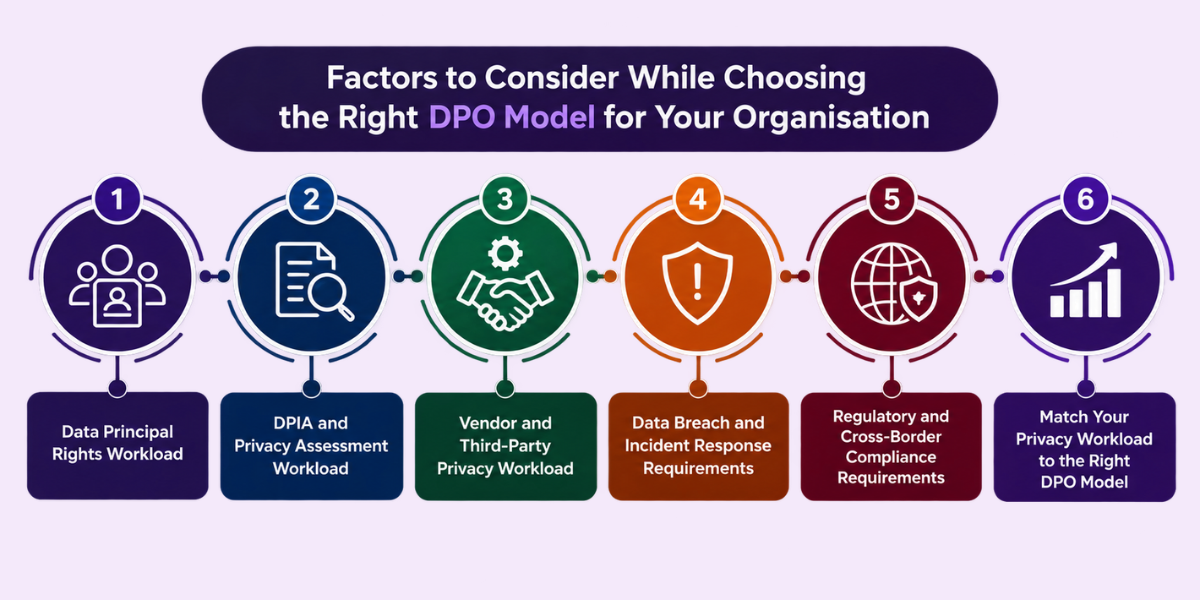
Factors to Consider While Choosing the Right DPO Model for Your Organisations
Company size is a weak proxy for DPO workload. A smaller organisation processing sensitive or complex data across multiple systems may require more privacy oversight than a larger organisation with a simpler processing environment. Measure the work before choosing the organisational model.
-
Assess Your Data Principal Rights Workload
Look at the volume and complexity of rights-related requests your organisation may need to handle.
The DPDP framework provides Data Principals with rights and requires Data Fiduciaries to establish mechanisms for exercising those rights and addressing grievances. The Rules also provide operational requirements around rights requests and grievance mechanisms.
More rights activity means more operational pressure on your privacy function.
-
Assess Your DPIA and Privacy Assessment Workload
Consider how frequently your organisation launches new products, introduces new processing activities, adopts AI systems, integrates vendors or changes data-use purposes.
For SDFs, the DPDP framework includes additional obligations around Data Protection Impact Assessments and audits. The notified Rules provide for a recurring DPIA and audit cycle for SDFs once the relevant provisions take effect.
If assessments are occasional, external support may be efficient. If they are continuous, embedded internal capability may become more valuable.
-
Assess Your Vendor and Third-Party Privacy Workload
Map the number of vendors, processors, platforms, APIs and other third parties that touch personal data.
The more complex the ecosystem, the more effort is required to understand processing relationships, contractual controls, security expectations and data flows.
Your vendor landscape is part of your DPO workload—even when the DPO never touches the underlying systems.
-
Assess Your Data Breach and Incident Response Requirements
Evaluate the volume of incidents, escalation requirements, regulatory obligations and internal stakeholders involved in responding to them. The DPDP Rules include detailed requirements around security safeguards and breach notifications, making incident readiness an important part of the broader privacy operating model.
A team-based external model may offer continuity, while an internal model may provide faster organisational context. The right choice depends on which capability is currently your bottleneck.
-
Assess Your Regulatory and Cross-Border Compliance Requirements
A company operating only under one regulatory framework has a different privacy workload from one managing DPDP alongside GDPR, sector-specific requirements and other international laws.
Count regulations, jurisdictions and business units—not just employees.
Multiple regulatory frameworks can increase the value of broader specialist expertise, particularly when internal teams lack the capacity to track regulatory changes.
-
Match Your Privacy Workload to the Right DPO Model
Use this simple decision logic:
- High workload + high complexity + strong internal capability: Internal or hybrid model.
- Variable workload + limited internal expertise: External DPO or DPOaaS.
- High complexity + need for independence: External or hybrid model.
- Growing privacy programme + existing privacy team: Hybrid model.
- Continuous enterprise-wide privacy operations: Dedicated internal capability may be justified.
The objective is not to pick the cheapest model.
Build the model that can actually carry the privacy workload.
Conclusion
The strongest DPO model is the one that can withstand real operational pressure.
If your organisation has a large, continuous privacy workload and can support a dedicated function, an internal DPO may provide the depth and integration you need. If specialist expertise, flexibility, independence or continuity are the bigger gaps, an external DPO, outsourced DPO or DPO-as-a-service model may provide a more practical route.
The blueprint is simple: start with your regulatory obligations, measure your privacy workload, identify your capability gaps, and then choose the DPO model that closes those gaps.
Do not appoint a DPO merely to put a name beside a compliance requirement.
Build a privacy function that can actually defend the organisation.
Key Takeaways
- A DPO provides privacy governance, risk oversight, rights support, regulatory coordination, and accountability within an organisation.
- Significant Data Fiduciaries must appoint a DPO who is based in India, reports to the Board or similar governing body, represents the SDF, and handles grievance redressal.
- An internal DPO offers deeper business knowledge, while an external DPO can provide specialist expertise, flexibility, independence, and continuity.
- Compare the total cost of the DPO model, including recruitment, training, technology, specialist support, service fees, and continuity—not just salary versus retainer.
- Choose based on your organisation’s privacy workload, expertise, independence needs, operational integration, and continuity requirements.
- Assess Data Principal rights, DPIAs, vendors, data breaches, regulatory requirements, and cross-border activities before selecting a DPO model.
- A hybrid approach can combine internal privacy operations with external DPO expertise, providing both business knowledge and specialist oversight.
- Build the DPO model that can handle your actual privacy workload, close capability gaps, and provide the level of governance your organisation requires.
Related Blog