Table of contents
By-Research Team
August 11, 2026 | 11 min read | Data Governance
Data Classification: What It Is and Why It Matters
Organizations generate and process more data today than ever before. Customer records, financial transactions, employee information, intellectual property, and operational documents flow across on-premises systems, cloud platforms, and third-party applications every day. Without data classification, protecting this information becomes a guessing game rather than a strategic process.
Simply put, you cannot protect what you don't understand. That is why data classification is important for organizations. It helps organizations identify what information they hold, determine its level of sensitivity, and apply appropriate security controls throughout the data lifecycle.
In this guide, you'll learn what data classification is, why it matters, the different types and classification levels, the methods organizations use, and practical examples of how classification works in the real world.
What Is Data Classification?
Data classification is the process of organizing information into predefined categories based on its sensitivity, business value, criticality, or regulatory requirements. By assigning classification labels, organizations can apply appropriate security controls, manage access, support compliance, and reduce the risk of unauthorized disclosure or misuse.
In practice, data classification answers three fundamental questions:
- What data do we have?
- How sensitive is that data?
- What level of protection does it require?
Once these questions are answered, organizations can make informed decisions about encryption, access controls, retention periods, monitoring, backup strategies, and secure disposal.
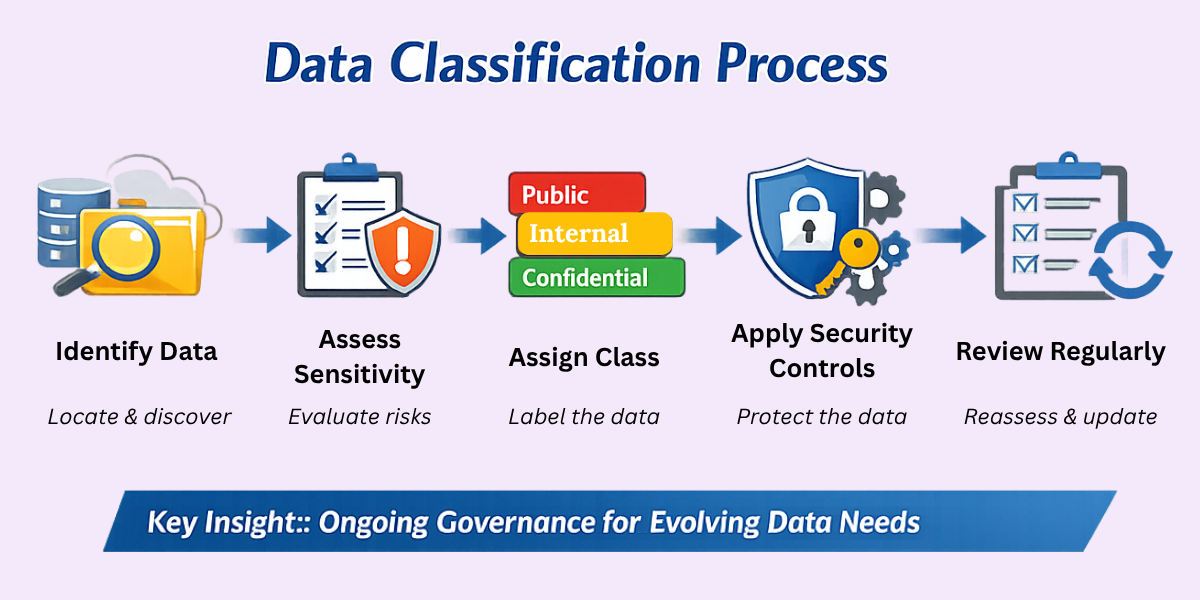
Note: Data classification is not a one-time project. It is an ongoing governance practice that evolves with organizational growth, regulatory changes, and emerging security risks.
Why Data Classification Matters
Data classification helps organizations understand the value and sensitivity of their information so they can apply appropriate security controls, support regulatory compliance, improve operational efficiency, and reduce cyber risks. Without classification, organizations cannot effectively protect, manage, or govern their data.
- Strengthens Data Security
Prioritize protection where it matters most.
Data classification enables organizations to apply security controls based on the sensitivity of information rather than using a one-size-fits-all approach. Highly sensitive data can be protected through encryption, role-based access controls (RBAC), multi-factor authentication (MFA), and continuous monitoring, while less sensitive information can be managed with standard safeguards.
For example, customer payment details and intellectual property require significantly stronger controls than publicly available product brochures.
- Supports Regulatory Compliance
Compliance begins with knowing what data you collect and how sensitive it is.
Privacy and security regulations expect organizations to identify and protect regulated information. Data classification makes this possible by helping organizations distinguish personal data, financial information, health records, and other regulated datasets from ordinary business information.
For example:
- GDPR applies additional safeguards to personal data.
- HIPAA protects electronic protected health information (ePHI).
- India's DPDP Act requires organizations to implement reasonable security safeguards for digital personal data.
- Improves Access Control
Not everyone needs access to every file.
Data classification enables organizations to implement the principle of least privilege, ensuring employees access only the information required for their roles. This minimizes insider risks while reducing the potential impact of compromised user accounts.
For example, payroll information should only be accessible to authorized HR and finance personnel, whereas internal policy documents may be available across the organization.
- Enhances Data Governance
Good governance starts with organized information.
Data governance relies on understanding what information exists, where it resides, who owns it, and how it should be managed. Data classification provides this context by creating a consistent framework for organizing enterprise information.
Once data is classified, organizations can more effectively implement retention schedules, archive inactive records, enforce lifecycle policies, and improve data quality across business functions.
- Reduces Cybersecurity Risks
Attackers don't target random files—they target valuable information.
Cybercriminals actively seek customer databases, financial records, intellectual property, authentication credentials, and confidential business documents. Data classification helps security teams identify these high-value assets and prioritize their protection.
According to IBM's Cost of a Data Breach Report 2026, organizations continue to face significant financial and operational consequences following data breaches, reinforcing the importance of identifying and securing sensitive information before an incident occurs.
- Enables Faster Incident Response
When every second counts, knowing what data is affected makes all the difference.
During a cybersecurity incident, security teams must quickly determine whether sensitive information has been accessed, altered, or exfiltrated. Organizations with well-classified data can immediately assess the severity of an incident, identify affected records, and prioritize containment and recovery efforts.
- Supports Better Business Decision-Making
Data classification is not only a security tool—it is a business enabler.
By understanding the value and sensitivity of organizational information, leaders can make more informed decisions about cloud migration, data sharing, third-party access, storage optimization, and digital transformation initiatives.
What Types of Data Should Organizations Classify?
Organizations should classify any data that has business value, contains personal or sensitive information, supports critical operations, or is subject to legal or regulatory requirements. Identifying the type of data is the first step in determining the level of protection it requires.
Not all information carries the same level of sensitivity or business impact. While some data is intended for public access, other information can cause financial, operational, or reputational harm if exposed. The following are the most common types of data organizations should classify.
-
Personal Data - Information that can directly or indirectly identify an individual.
Examples: Name, email address, phone number, customer ID, Aadhaar number, passport number.
-
Sensitive Personal Data - Information that requires enhanced protection because unauthorized disclosure could significantly affect an individual's privacy or security.
Examples: Health records, biometric data, financial information, and authentication credentials.
-
Financial Data - Information related to an organization's financial operations and transactions.
Examples: Payroll records, invoices, banking information, tax documents, and revenue reports.
-
Intellectual Property (IP) - Proprietary information provides a competitive advantage to the organization.
Examples: Source code, product designs, patents, research documents, trade secrets.
-
Operational and Business Data - Information used to support internal business processes and day-to-day operations.
Examples: Business plans, contracts, project documents, internal policies, and SOPs.
-
Public Information - Information approved for public access and external distribution.
Examples: Company websites, press releases, brochures, annual reports, marketing materials.
What Are the Common Data Classification Levels?
Data classification levels define how information should be handled and protected based on its sensitivity, business value, and potential impact if disclosed. While organizations may use different naming conventions, most classification frameworks follow four standard levels.
Once data has been identified, it is assigned a classification level that determines the security controls required throughout its lifecycle. These levels help organizations apply consistent protection measures, manage access, and reduce the risk of unauthorized disclosure.
| Classification Level | Description | Examples | Typical Protection Measures |
|---|---|---|---|
| Public | Information approved for public disclosure. | Website content, brochures, press releases. | Basic integrity controls and backups. |
| Internal | Information intended for internal business use only. | Internal policies, meeting notes, and project documents. | Employee-only access and standard security controls. |
| Confidential | Sensitive business or personal information that could cause harm if disclosed. | Employee records, customer databases, contracts, and financial reports. | Role-based access control, encryption, logging, and multi-factor authentication. |
| Restricted | The organization's most sensitive information requires the highest level of protection. | Source code, encryption keys, trade secrets, payment card data, and highly sensitive personal information. | Strong encryption, privileged access management, continuous monitoring, Data Loss Prevention (DLP), and strict audit controls. |
The type of data identifies what the information is, while the classification level determines how it should be protected.
What Are the Different Methods of Data Classification?
Organizations classify data using different methods depending on the nature of the information, business requirements, and available technology. The most common methods include content-based, context-based, user-based, metadata-based, and AI-assisted classification. Many organizations use a combination of these approaches to improve accuracy and efficiency.
There is no single method that works for every organization.
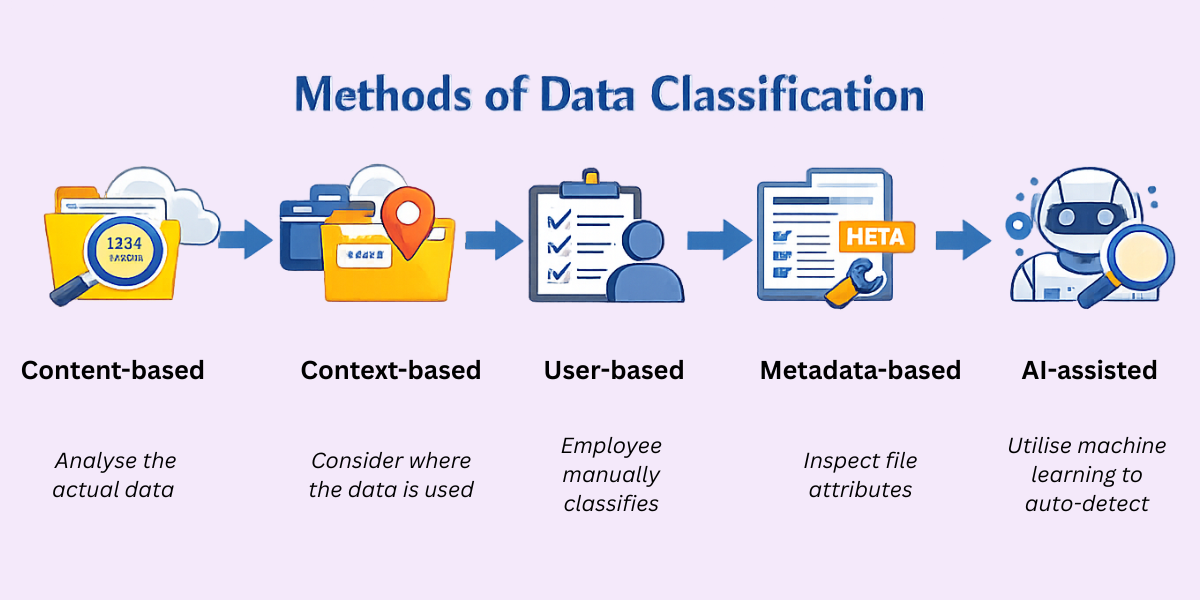
Selecting the right method depends on the volume of data, regulatory obligations, and the level of accuracy required.
- Content-Based Classification
Content-based classification analyzes the actual information stored within a file or record to determine its sensitivity.
This method searches for specific keywords, patterns, or data formats that indicate sensitive information. For example, a document containing Aadhaar numbers, passport details, credit card numbers, or medical records can be automatically identified as confidential.
Content-based classification is widely used because it focuses on the data itself rather than where it is stored or who owns it.
- Context-Based Classification
Context-based classification assigns labels based on information surrounding the data rather than its contents.
Instead of analyzing every document, this method considers attributes such as:
- File location
- Department
- Application
- Data owner
- Source system
- Creation date
For example, all documents stored within the Human Resources payroll system may automatically receive a higher classification because they are likely to contain sensitive employee information.
- User-Based Classification
User-based classification relies on individuals to classify data according to predefined organizational policies.
Employees creating or handling information manually assign labels such as Public, Internal, Confidential, or Restricted based on the sensitivity of the content.
This approach works well for documents requiring business context that automated systems may not fully understand. However, its effectiveness depends on employee awareness, consistent policies, and regular training.
- Metadata-Based Classification
Metadata-based classification uses file attributes instead of document content to determine how information should be classified.
Typical metadata includes:
- File type
- Author
- Department
- Creation date
- Document owner
- Security labels
- Existing sensitivity tags
Because it does not inspect the document itself, metadata-based classification is often faster and is commonly used alongside other classification methods.
- AI-Assisted Data Classification
AI-assisted data classification uses machine learning and artificial intelligence to identify sensitive information, recognize patterns, and recommend or automatically assign classification labels.
Unlike traditional rule-based systems, AI can understand context, detect similar documents, identify unstructured information, and continuously improve classification accuracy as new data is created.
As organizations generate larger volumes of cloud-based and unstructured data, AI-assisted classification is becoming an important capability within modern data security and governance platforms.
Important: Most organizations do not rely on a single classification method. Combining content-based, context-based, user-based, metadata-based, and AI-assisted classification creates a more accurate, scalable, and resilient data classification strategy.
Real-World Examples of Data Classification
By classifying different types of data based on their sensitivity, organizations can implement appropriate security controls, reduce risk, and ensure compliance with internal policies and regulatory requirements.
While classification levels may vary slightly between organizations, the underlying principle remains the same—the greater the potential impact of unauthorized access, the higher the level of protection required.
| Data Type | Typical Classification Level | Reason |
|---|---|---|
| Company website content | Public | Intended for unrestricted public access. |
| Marketing brochures | Public | Shared externally without restrictions. |
| Internal policies and SOPs | Internal | Used by employees but not intended for public disclosure. |
| Project documentation | Internal | Supports business operations and internal collaboration. |
| Employee records | Confidential | Contains personal and employment-related information. |
| Financial reports | Confidential | Sensitive business information that could impact the organization if disclosed. |
| Payroll records | Restricted | Includes salary details, tax information, and bank account numbers. |
| Encryption keys and security credentials | Restricted | Unauthorized access could compromise entire systems. |
Conclusion
Data classification is more than a security exercise—it's a strategic business capability. By understanding what information they hold and assigning appropriate classification levels, organizations can protect sensitive data, streamline governance, and confidently meet evolving regulatory expectations.
Whether you're beginning your data governance journey or strengthening an existing information security program, data classification provides the foundation for protecting your organization's most valuable asset—its data.
Key Takeaways
- Data classification organizes information based on its sensitivity, business value, and regulatory requirements.
- Not all data requires the same level of protection. Classifying information allows organizations to apply security controls where they matter most.
- Common data types include personal data, sensitive personal data, financial data, intellectual property, operational information, and public information.
- Most organizations use four classification levels: Public, Internal, Confidential, and Restricted.
- Data can be classified using content-based, context-based, user-based, metadata-based, and AI-assisted methods.
- An effective data classification program strengthens security, supports compliance, improves governance, and enables better business decision-making.
Related Blog