Table of contents
By-Research Team
August 14, 2026 | 10 min read | Data Governance
Data Inventory vs Data Mapping: What’s the Difference?
Most organisations know they have personal data. Far fewer can answer two different questions with confidence: what personal data do we have, and how does that data move? Those questions sound similar, but they require two different governance practices—data inventory and data mapping.
Confusing the two creates blind spots.
An inventory without mapping can tell you where data sits but not where it travels. A map without a reliable inventory can show flows without giving you a dependable record of the underlying data.
What Is a Data Inventory?
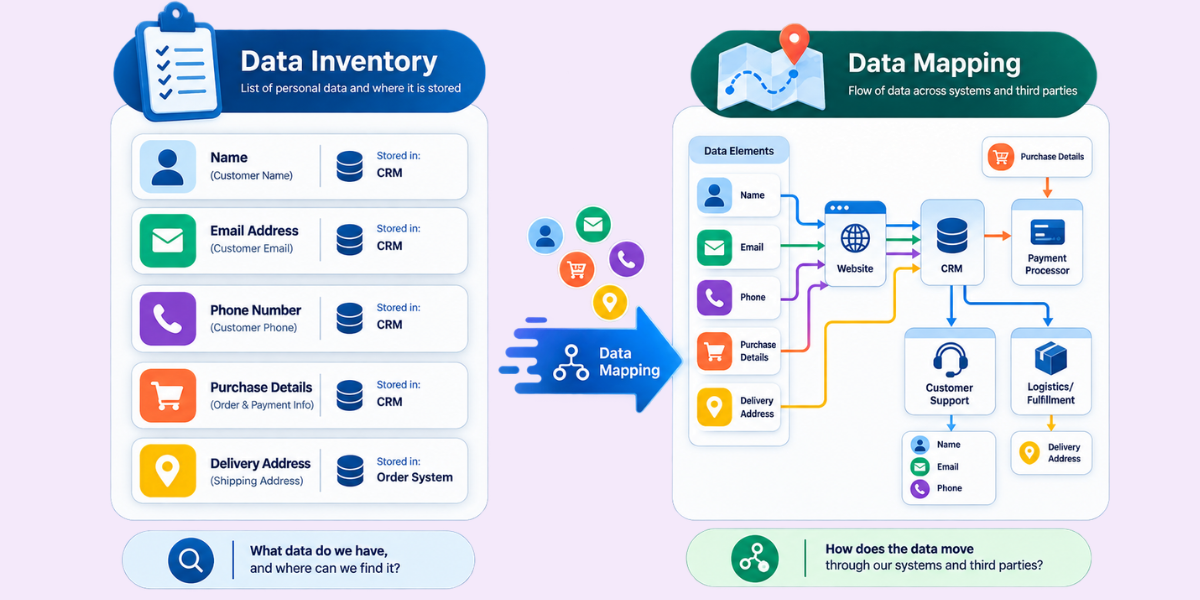
A data inventory is a structured record of the personal data an organisation collects, stores, or processes, along with information about where that data is held and why it is used. It provides a snapshot of the organisation’s data landscape.
Example: A company’s inventory may record that customer names, email addresses, phone numbers, and purchase details are stored in its CRM system for order management and customer support.
It answers: “What personal data do we have, and where can we find it?”
It does not, by itself, tell you whether that customer data is subsequently sent to a payment provider, analytics platform, logistics partner, cloud service or another internal system.
That is where data mapping enters the picture.
What Is Data Mapping?
Data mapping documents how personal data moves between systems, processes, departments, and third parties throughout its lifecycle. It provides visibility into the relationships and flows that connect different parts of an organisation’s data environment.
Example: A data map may show customer information flowing from a website → CRM → payment processor → customer-support platform.
That sequence tells you something an inventory cannot tell you on its own: how personal data travels through the organisation and beyond it.
Data Inventory vs Data Mapping: What’s the Difference?
The difference between data inventory and data mapping is primarily their focus: a data inventory records what personal data exists and where it is maintained, while data mapping explains how that data moves between systems, processes and third parties. They are complementary controls, not competing alternatives.
| Aspect | Data Inventory | Data Mapping |
|---|---|---|
| Core question | What personal data do we have? | How does personal data move? |
| Primary focus | Data assets and attributes | Relationships and data flows |
| Records | Data categories, systems, purposes, owners and locations | Sources, destinations, transfers, processing activities and relationships |
| Output | Structured data register | Data-flow representation or map |
| Example | Customer email exists in CRM | Customer email moves from website → CRM → email platform |
| Main visibility | What exists and where | How data travels and who receives it |
| Privacy value | Establishes the data landscape | Exposes data-flow and third-party relationships |
| Typical use | Data governance, retention, privacy operations | Flow analysis, risk assessment, processor and transfer oversight |
The simplest way to remember it:
Inventory answers “what.”
Mapping answers “how.”
Example: Suppose an organisation collects:
- Name
- Email address
- Mobile number
- Delivery address
The inventory could record that these details are stored in the organisation's CRM and order-management system.
The data map could show: Website → CRM → Order Management → Logistics Provider → Customer Support
Now the compliance team can see something much more important: the data does not stop where the inventory record starts.
This distinction is also why the two practices should not be treated as interchangeable.
If someone asks: “Where is our customer's phone number stored?”
Start with the inventory.
If they ask: “Which systems and vendors receive the customer's phone number?”
You need the map.
Data inventory and data mapping work together.
A mature privacy programme does not choose between them.
It connects them.
Inventory establishes the data landscape → Mapping establishes the relationships → Privacy governance uses both to determine what needs to be controlled.
What Information Should a Data Inventory and Data Map Include?
A privacy data inventory should capture the attributes of the data and its processing context, while a data map should capture the relationships and movement of that data. The two records can be connected, allowing an organisation to move from a static record of personal data to a complete view of its lifecycle.
What information does data inventory include?
A practical inventory should capture information such as:
-
Personal data category
Identify the types of personal data involved, such as contact information, identity information, financial information, employee records or other personal data.
This creates the foundation for determining what protections and governance processes apply.
-
Data subjects
Record whose data is being processed.
For example, an organisation may maintain separate records for customers, employees, job applicants and business contacts.
-
System or storage location
Identify where the data resides.
That could include a CRM, HRMS, cloud database, SaaS application, shared drive or another repository.
-
Processing purpose
Record why the organisation processes the data.
A customer's phone number may support order delivery, while an employee's bank details may support payroll.
-
Data owner
Assign responsibility to the appropriate business function.
A privacy team may govern the framework, but the business function using the data needs operational ownership.
-
Retention information
Record how long the data is retained and what triggers deletion or review.
Retention becomes difficult to control when organisations cannot identify which systems contain the relevant data.
→ Learn more about how to build and maintain a data inventory for effective compliance.
-
Third-party involvement
Record relevant processors, vendors and service providers.
This creates the starting point for understanding third-party exposure.
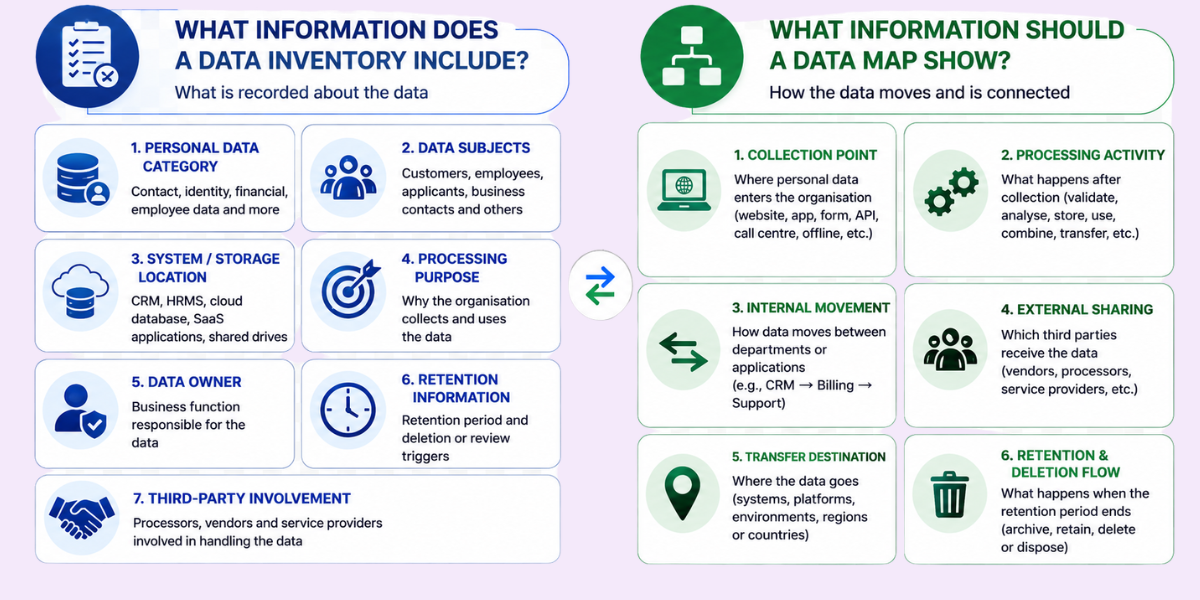
What information should a data mapping show?
A data map should show the relationships between those records.
-
Collection point
Where does the personal data enter the organisation?
Examples include websites, mobile applications, registration forms, APIs and customer-service channels.
-
Processing activity
What happens after collection?
The data may be validated, analysed, combined, stored, used to deliver a service or transferred to another system.
-
Internal movement
Does the data move between departments or applications?
For example: Sales CRM → Billing System → Customer Support
-
External sharing
Which third parties receive the data?
Payment providers, cloud platforms, logistics companies, consultants and analytics providers may all form part of the flow.
-
Transfer destination
Where does the data go?
The map should identify relevant destinations so the organisation can understand its processing architecture and assess applicable requirements.
-
Retention and deletion flow
What happens when the retention period ends?
A mature map should not stop at storage. It should also show the path toward archival, deletion or another authorised disposition.
→ For a deeper explanation, see our guide to data mapping and complete data visibility.
What Happens When Your Data Inventory or Data Map Is Incomplete or Outdated?
An incomplete data inventory creates blind spots about what personal data exists, while an incomplete data map creates blind spots about where that data flows. When either becomes outdated, privacy documentation can stop reflecting operational reality, making rights handling, retention, vendor oversight, breach response and risk assessment harder to execute reliably.
This is where the difference stops being theoretical.
Imagine your privacy documentation says: Customer data → CRM → Payment Provider
But six months ago, the business added an analytics platform that receives the same information.
The documentation is now wrong.
The organisation has not necessarily stopped having a privacy programme. It has stopped having an accurate picture of reality.
What happens when the data inventory is incomplete?
1. Personal data can remain undiscovered
A business unit may collect information through a new application or spreadsheet that never enters the central inventory.
The compliance team thinks the dataset does not exist. The business knows it does. That is a visibility failure.
2. Retention decisions become harder
If you do not know where a dataset exists, you cannot reliably determine where it should be reviewed, archived or deleted.
“Delete it when no longer needed” sounds simple until nobody knows where all the copies are.
3. Ownership becomes unclear
An inventory gap often creates an accountability gap.
If no department is recorded as responsible for a dataset, who validates its purpose, retention or access?
4. Vendor exposure can be missed
A new SaaS tool can become part of the personal-data environment without appearing in privacy documentation.
That creates a gap between procurement reality and privacy governance.
What happens when the data map is incomplete?
1. Hidden data flows remain invisible
The organisation may know that customer data exists in its CRM but fail to recognise that it is also sent to an external analytics provider.
The inventory is not necessarily wrong. The flow picture is incomplete.
2. Downstream systems may be overlooked
A data map that stops at the first destination can hide subsequent processing.
The real flow may be: Website → CRM → Processor A → Processor B
A two-step map may show only the first relationship.
3. Cross-border processing can become harder to identify
Where data moves matters.
A complete map helps organisations understand relevant processing destinations and identify flows that require further legal or governance assessment.
4. Breach response becomes slower
When an incident occurs, teams need to determine what happened and where affected information travelled.
An incomplete map means reconstructing the architecture under pressure.
That is hardly the ideal time to discover that someone connected another SaaS platform three months ago.
What happens when either record becomes outdated?
The most dangerous problem is not always an obviously incorrect record.
It is false confidence.
A document that looks complete but does not reflect current systems can create a misleading sense of control.
This is why data inventory, and data mapping should be treated as living governance records, not annual compliance paperwork.
The existing Privacy Global guidance on data inventory similarly emphasises that an inventory needs to evolve as systems, vendors and products change.
Conclusion
Data privacy compliance does not begin with another policy document.
It begins with visibility.
A data inventory tells you what you have. A data map tells you where it goes.
Build the inventory to establish the blueprint. Build the map to trace the routes. Then connect both to the governance processes that manage retention, Data Principal rights, security, vendors and risk.
Because when the question is “Where is our personal data?”, having an answer is useful.
When the question becomes “Where did it go?”, you need the map.
Key Takeaways
- Data inventory records what personal data an organisation has and where it is stored.
- Data mapping shows how personal data moves between systems, processes, and third parties.
- The key difference is simple: inventory answers “what,” while mapping answers “how.”
- A privacy data inventory and data map should capture different but connected information.
- Using both gives organisations better visibility for DPDP compliance and privacy governance.
- Incomplete or outdated records can hide data, vendors, systems, and data flows.
- Keeping both records updated helps maintain an accurate view of the organisation’s data environment.
Related Blog