Table of contents
By-Research Team
June 30, 2026 | 9 min read | DPDP
How to Avoid Consent Violations in Marketing Under DPDP Act
Marketing teams collect more customer data than ever before. Yet the biggest compliance risk is not collecting data – it is using that data without valid consent.
A customer downloads a brochure. An email campaign follows. The customer unsubscribes. The messages continue. Somewhere between marketing automation, CRM synchronization, and campaign execution, consent and compliance, are both lost.
The solution is a structured framework. Organizations must collect consent correctly, manage it consistently, monitor it continuously, and honor it across every marketing channel.
This guide provides a practical blueprint for avoiding consent violations in marketing and building a compliant consent management program under the DPDP Act.
What Is Consent-Based Marketing Under the DPDP Act?
Consent-based marketing is the practice of collecting, managing, and using personal data for marketing activities only after obtaining valid, informed, specific, and unambiguous consent from individuals. Under the DPDP Act, organizations must provide clear notices, enable consent withdrawal, and process personal data only for the purposes communicated to the Data Principal.
Many organizations assume customer interaction automatically equals marketing permission. It does not.
A customer purchasing an insurance policy has consented to policy administration. That does not automatically authorize the company to send investment offers, loan promotions, or partner advertisements.
The DPDP Act establishes a simple principle: purpose matters.
If the purpose changes, organizations must assess whether fresh consent is required.
According to the DPDP Act, consent should be:
- Free and voluntary
- Specific to a stated purpose
- Informed through a clear notice
- Unambiguous
- Capable of being withdrawn easily
What Marketing Activities Require Consent?
Most promotional activities involving personal data require valid consent. Organizations should assess each marketing channel independently because consent obligations may vary depending on the purpose, communication method, and data processing involved.
Many compliance failures occur because organizations view consent as a single event rather than a collection of permissions across multiple channels.
-
Email Marketing
A customer may sign up to receive updates about a specific product or service, but that does not automatically mean they have agreed to receive promotional emails about unrelated offerings. Organizations should ensure that marketing communications align with the purpose for which consent was originally obtained.
-
WhatsApp Campaigns
Many businesses collect mobile numbers for order confirmations, customer support, or service updates. However, using those numbers later for promotional WhatsApp messages without obtaining appropriate consent can create compliance risks.
-
Behavioural Advertising
Behavioural advertising involves tracking a user's online activities to deliver personalized ads. Because this often relies on monitoring user behaviour across websites or applications, organizations should clearly explain these practices and obtain consent where required.
-
Third-Party Marketing Partnerships
Organizations often work with advertising agencies, lead-generation providers, or marketing platforms to run campaigns. Before sharing customer data with these third parties, businesses should ensure that individuals have been informed about such sharing and that the necessary consent has been obtained.
Common Consent Violations in Marketing
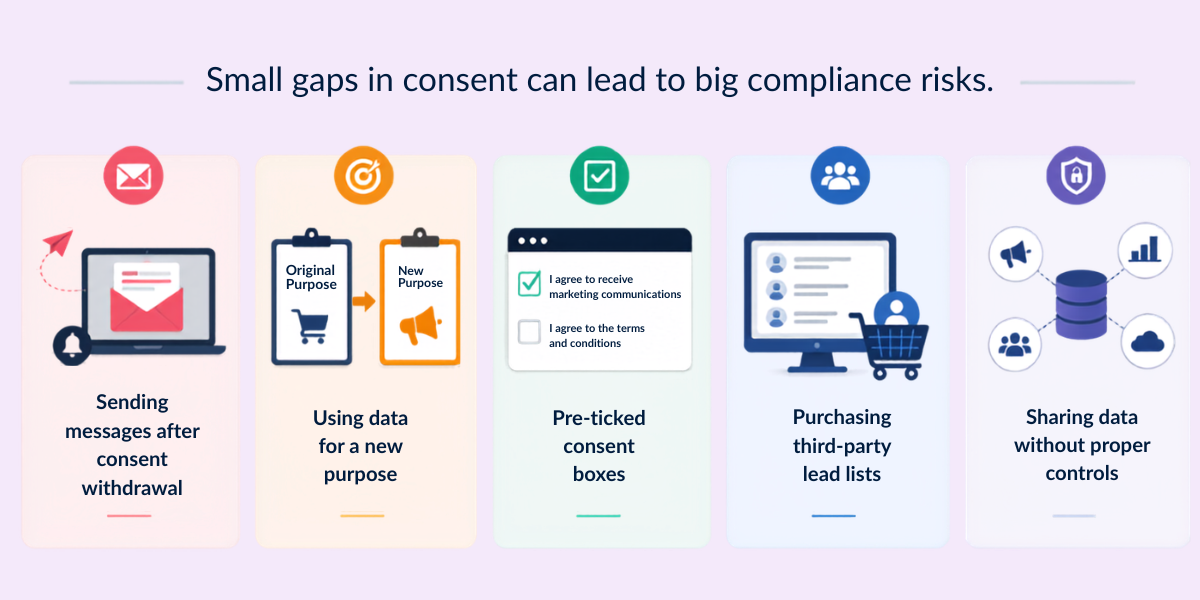
A consent violation in marketing occurs when an organization collects, uses, shares, or retains personal data for marketing purposes without valid consent or beyond the scope of the original consent provided. Many violations result from poor processes rather than malicious intent.
This is where compliance teams should focus their attention.
Based on recent enforcement trends globally, most violations arise from operational failures rather than deliberate misconduct.
-
Sending Marketing Communications After Consent Withdrawal
A common consent violation occurs when a customer unsubscribes from marketing communications but continues to receive promotional messages. This often happens when consent preferences are updated in one system, such as an email marketing platform, but not reflected across other systems.
Key Lesson: Withdrawal mechanisms are only effective when connected systems honor them.
-
Using Data for a New Purpose
Organizations may collect personal data for one specific purpose and later decide to use it for a different marketing activity. For example, a healthcare provider may collect patient information for appointment scheduling and later use the same data to promote wellness products.
The purpose changed. The consent framework did not.
This creates a gap between customer expectations and organizational behaviour.
-
Pre-Ticked Consent Boxes
Some organizations use pre-ticked checkboxes to increase opt-in rates for marketing communications. However, consent choice should reflect an individual's active decision, not their failure to notice a default setting.
-
Purchasing Third-Party Lead Lists
Marketing teams sometimes purchase lead databases from external vendors with the assumption that consent has already been obtained. However, simply being told that "the leads are consented" is not enough.
Organizations should verify:
- How consent was collected
- When consent was collected
- What notice was provided
- Whether third-party sharing was disclosed
- Whether records exist
-
Sharing Data Without Appropriate Controls
Many marketing campaigns involve external agencies, advertising platforms, analytics providers, or other third-party partners. Sharing customer data with these parties without proper disclosures, agreements, or consent can create compliance risks.
The more vendors involved, the larger the compliance attack surface.
What Are the Risks of Consent Violations?
Consent violations expose organizations to regulatory penalties, customer complaints, operational disruptions, reputational damage, and increased scrutiny from regulators. The financial impact often extends far beyond any direct penalty.
Organizations frequently underestimate secondary consequences.
Regulators investigate violations.
Customers lose trust.
Business relationships suffer.
The damage compounds.
-
Regulatory Risk
Failure to comply with consent requirements can result in regulatory scrutiny and potential penalties under privacy laws such as the DPDP Act.
-
Customer Trust Erosion
Customers expect their communication preferences to be respected. Ignoring those preferences can damage trust and brand reputation.
-
Increased Complaint Volumes
Poor consent management can lead to customer complaints, grievance requests, and additional administrative effort.
-
Vendor-Related Exposure
Organizations remain responsible for how third-party vendors handle customer data on their behalf.
How to Avoid Consent Violations in Marketing
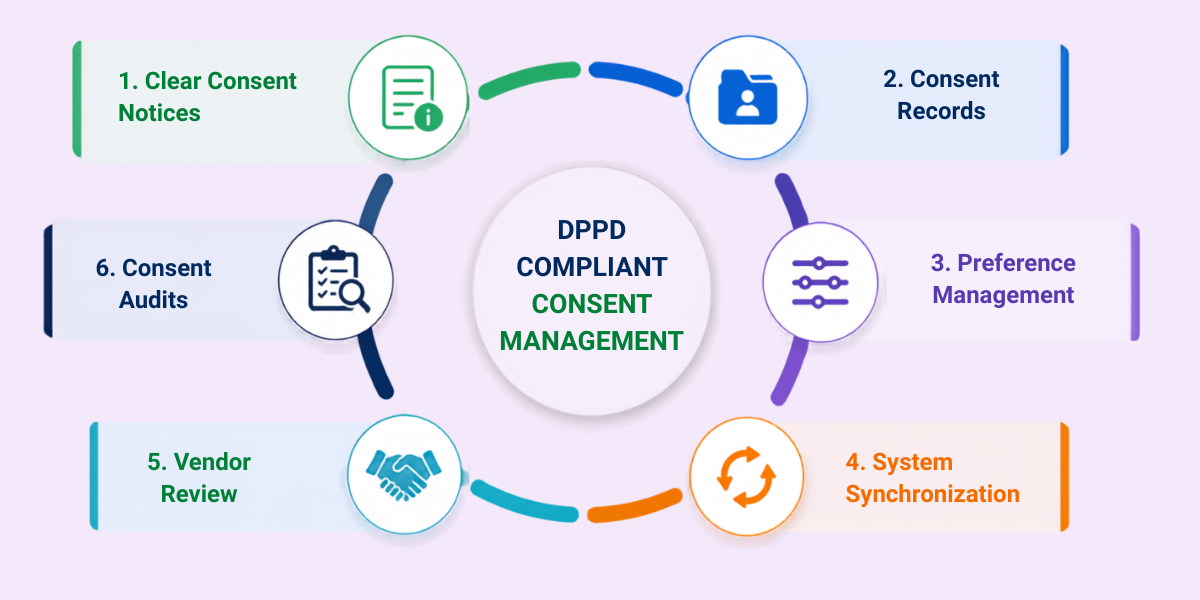
Organizations can avoid consent violations by implementing a structured consent governance framework that covers collection, recording, monitoring, withdrawal management, vendor oversight, and regular compliance audits.
Think of consent management as a fortress.
Every control protects a different entry point.
If one control fails, the entire structure becomes vulnerable.
-
Build Clear Consent Notices
Customers should clearly understand what they are agreeing to before sharing their personal data.
State:
- What data is collected
- Why it is collected
- How it will be used
- Who may access it
- How consent can be withdrawn
Clear notices help customers make informed choices and reduce the risk of misunderstandings later.
-
Maintain Consent Records
Collecting consent is only part of the process. Organizations should maintain evidence demonstrating:
- When consent was obtained
- What notice was presented
- Which purpose was approved
- How consent was captured
Maintaining these records helps support compliance efforts and simplifies audits or investigations.
-
Synchronize Consent Across Systems
Many organizations use multiple tools to manage customer data, including CRM systems, email marketing platforms, customer support applications, and analytics solutions
Organizations should ensure that consent preferences are updated consistently across all connected systems so that customer choices are respected everywhere.
-
Audit Marketing Databases
Marketing databases should not be treated as permanent storage for customer information. Organizations should periodically review the data they hold and verify:
- Why do we have this data?
- What consent supports its use?
- Is the purpose still valid?
- Can we prove compliance?
Regular reviews help maintain data quality and reduce compliance risks.
-
Review Third-Party Marketing Vendors
Many marketing activities involve external agencies, advertising platforms, email service providers, and analytics vendors. Before sharing personal data with these partners, organizations should understand the:
- Data handling practices
- Security controls
- Consent governance processes
- Compliance documentation
Consent Management Best Practices for DPDP Compliance
Effective consent management in marketing requires organizations to treat consent as a lifecycle rather than a one-time event. Every stage-from collection to withdrawal-must be governed, documented, and auditable.
-
Establish a Consent Lifecycle Framework
- Capture consent through clear notices and maintain records of when, how, and for what purpose it was obtained.
- Regularly track changes to customer preferences and ensure consent records remain up to date.
- Make it easy for customers to opt out and ensure their preferences are reflected across all systems.
- Periodically audit consent records and marketing activities to confirm data is being used as intended.
-
Create a Consent Governance Program
- Define who is responsible for collecting, managing, and reviewing consent across the organization.
- Marketing, compliance, legal, and IT teams should work together to maintain consistent consent practices.
- Review new campaigns and data-sharing activities before they are launched.
- Ensure third-party partners follow the same consent and privacy requirements as your organization.
-
Train Marketing Teams
- Help teams recognize when consent is required and how it should be obtained.
- Use personal data only for the purposes communicated to customers.
- Ensure employees know how to process and honor opt-out requests.
- Regular training helps reduce mistakes and strengthens compliance across marketing activities.
Conclusion
Consent-based marketing sits at the intersection of customer trust, regulatory compliance, and operational discipline.
The DPDP Act raises the expectations around transparency, accountability, and purpose-based data processing. Marketing teams must evolve accordingly.
The objective is not simply to avoid consent violations. The objective is to build a consent architecture that can withstand audits, support growth, and maintain customer trust over the long term.
In compliance, good intentions are not enough.
Documented, defensible, and well-governed consent is the real competitive advantage.
Key Takeaways
- Consent-based marketing requires more than collecting consent-it requires managing and honouring it throughout the customer lifecycle.
- Organizations should only use personal data for the specific purposes communicated to individuals.
- Common consent violations often result from poor processes, outdated records, or failure to honor opt-out requests.
- Clear notices, accurate consent records, and regular audits are essential for maintaining compliance.
- A structured consent management program helps organizations reduce risk and stay compliant with the DPDP Act.
Related Blog