
Introduction — What Rule 4 Really Means
The Digital Personal Data Protection (DPDP) Act, 2023 and the DPDP Rules, 2025 have formally introduced one of India’s most important privacy innovations — the Consent Manager.
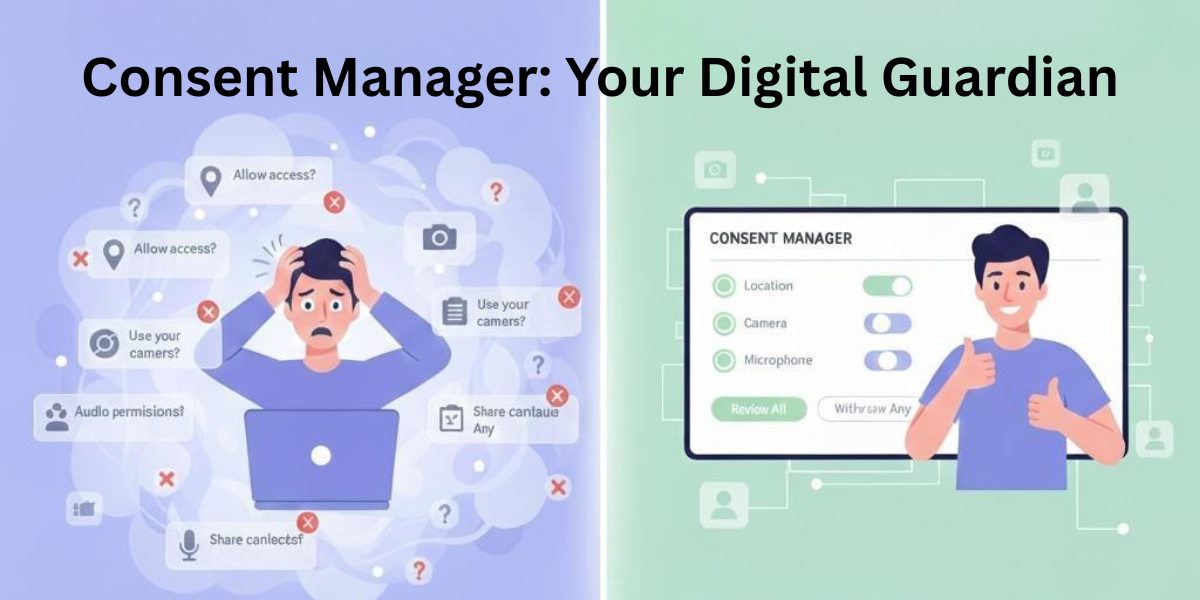
A Consent Manager is basically the bridge between you and the companies that use your data. They help make sure your choices are clearly captured, respected, and easy to manage
Think of a Consent Manager as the “UPI of permissions” — one single place where you can check who you’ve given consent to, update it, withdraw it, or track it across different apps.
No more digging through settings, trying to remember old approvals, or wondering, “Wait… when did I say yes to that?”
Requirements to Become a Consent Manager
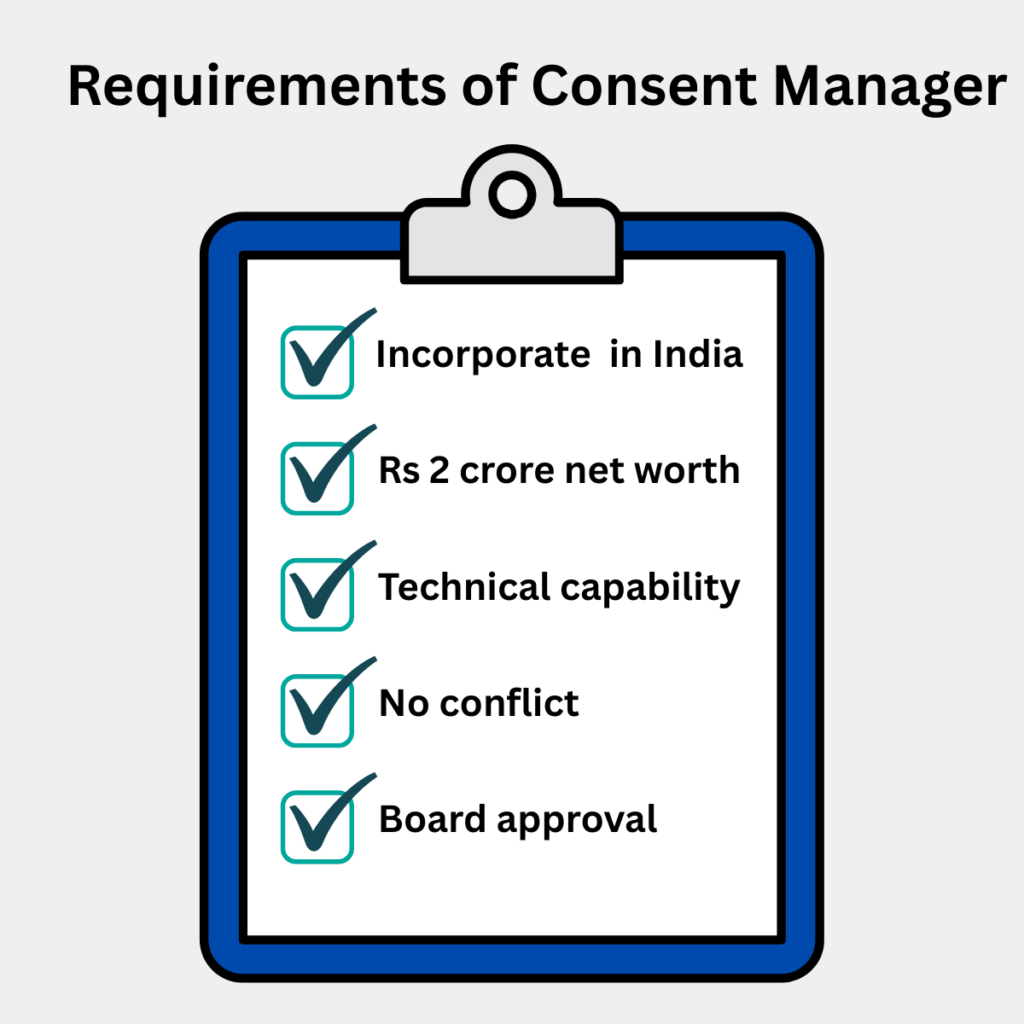
Rule 4 is very clear: not just any company can call itself a Consent Manager.
✔ Must be incorporated in India
The organisation must be legally set up in India. This ensures the DPDP Board knows exactly who’s responsible and can hold them accountable if anything goes wrong.
✔ Minimum net worth of ₹2 crore
This requirement proves the company is financially stable and serious about the role. It also keeps fly-by-night or unreliable players out of such an important position.
✔ Proven technical capability
A Consent Manager isn’t running a simple dashboard — they need to operate a secure, scalable system that can handle huge volumes of consent activity across many companies. This needs real engineering strength, not spreadsheets or basic tools.
✔ Strong organisational credibility
The Board evaluates directors, promoters, and shareholders to ensure clean governance and integrity. This reduces the risk of conflicts of interest and builds trust.
✔ Mandatory scrutiny by the Data Protection Board
Before anyone gets the official “Consent Manager” badge, the Board thoroughly examines their technology, processes, security controls, and governance. If they don’t meet the criteria, the application is declined — with a clear explanation.
In simple words:
Being a Consent Manager is not a business opportunity. It’s a responsibility reserved for the most compliant, reliable, and stable organisations.
Is a Consent Manager Mandatory?
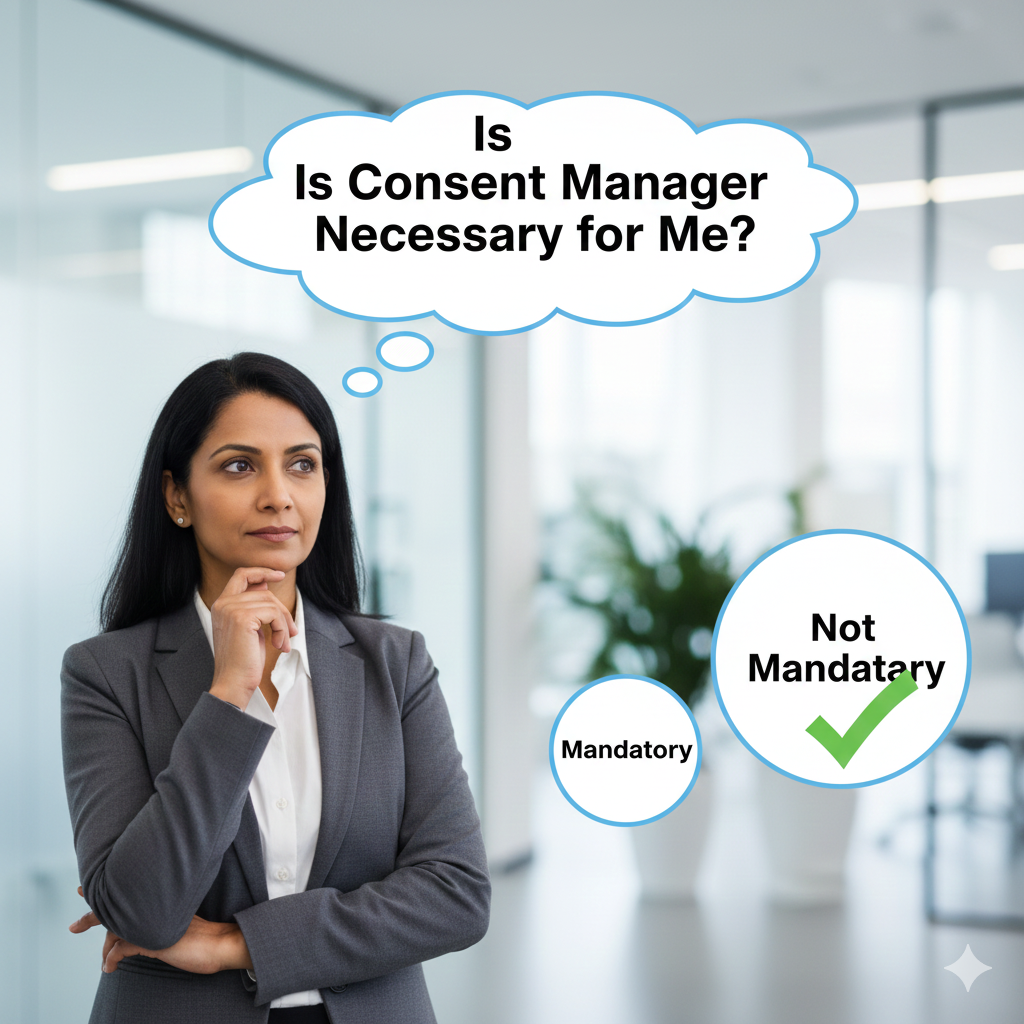
Before we move on to what a consent manager is supposed to do, let’s settle the big question:
No — Consent Managers are not mandatory.
But when does a Consent Manager become hard to avoid?
In industries that deal with a lot of personal or sensitive data, users are far more likely to start relying on Consent Managers. That includes:
- BFSI (banking, lending, insurance)
- Healthcare (diagnostics, telehealth, EMRs)
- E-commerce (ads, recommendations, personalisation)
- Telecom (KYC, offers, marketing)
- Education / EdTech (student data, parental consent)
These sectors handle huge amounts of data every day, which means users will want more control — and Consent Managers make that convenient.
And once users start managing their permissions through a Consent Manager, businesses must respect those signals across every system immediately.
No delays, no “we’ll update it later,” no excuses.
Example:
If a user withdraws consent for marketing via a Consent Manager, your company must immediately:
- Stop all email campaigns
- Stop WhatsApp drips
- Pause personalised ads
- Update CRM and CDP preferences
- Stop data sharing with partners
No delays. No “we didn’t see it.” DPDP doesn’t allow excuses.
Duties of a Consent Manager
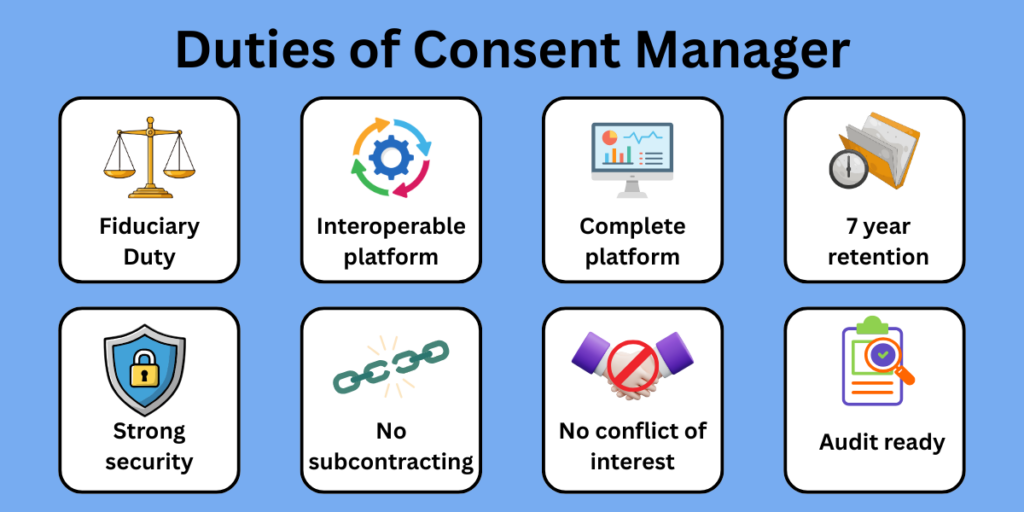
Once approved, a Consent Manager must follow strict duties outlined in Rule 4 and the First Schedule (Part B). These obligations are designed to protect Data Principals and ensure companies interact with a trustworthy intermediary.
1. Fiduciary duty toward the Data Principal
A Consent Manager must always put the Data Principal’s rights and interests above all else. This means staying neutral and never favouring any business or commercial motive.
2. Maintain an accessible, transparent, interoperable platform
The platform must be simple enough for any user to navigate easily, regardless of technical skill. It must also be interoperable, i.e., work smoothly across different organisations so consent signals move without friction.
3. Provide a complete website/app for consent management
Users should get one central place where they can give consent, withdraw it, check their history, download records, or raise a complaint. No more searching through multiple apps to find a toggle.
4. Retain consent records for 7 years
Every consent, withdrawal, and notice must be securely stored for transparency and dispute resolution. These records become crucial during disputes or regulatory checks.
5. Implement strong security safeguards
Consent Managers must deploy advanced security measures to protect personal data and prevent breaches. This includes monitoring, encryption, strict access controls, and fast breach response procedures.
6. No subcontracting of core duties
Core responsibilities must be performed by the Consent Manager itself and cannot be outsourced to another companies. This keeps accountability clear and ensures nothing gets lost in the chain.
7. Avoid conflict of interest
The Consent Manager must operate independently from the companies whose consents they manage. This avoids bias and keeps user rights at the centre.
8. Maintain audit-ready records and respond to Board requests
Consent Managers must keep detailed logs and be always ready to provide information to the Data Protection Board of India. Transparency is non-negotiable.
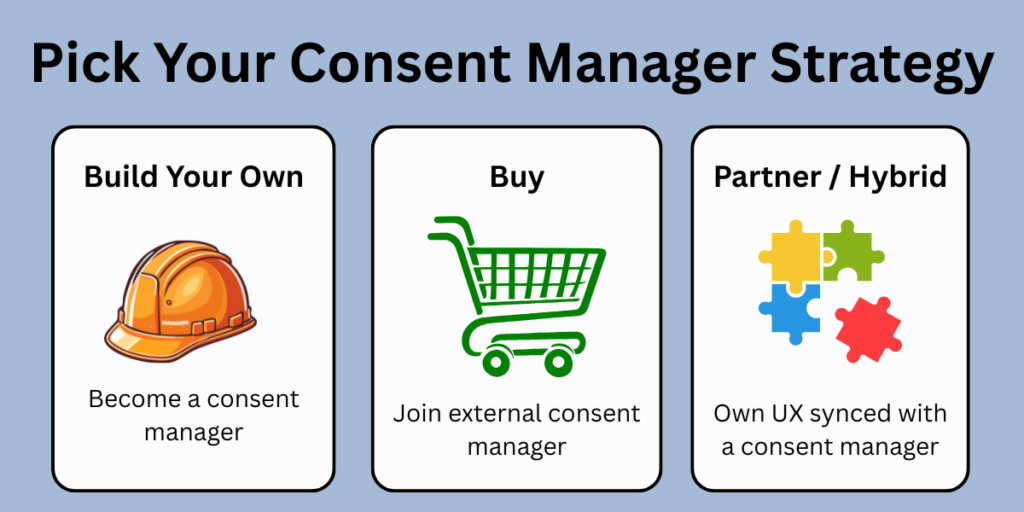
Pick Your Consent Manager Strategy – Build vs Buy vs Partner
Every organisation now must decide how they want to operate in a Consent Manager-enabled ecosystem. And your choice affects your long-term compliance and operational setup.
5.1. Build Your Own (Become a Consent Manager)
Becoming a Consent Manager is possible for a Data Fiduciary — but only under one very important condition: the Consent Manager must operate as a completely independent and neutral entity that serves other businesses, not its own users.
The DPDP framework has strict conflict-of-interest rules. This means a company cannot manage consent for its own services because it can’t truly stay unbiased when its business goals are involved.
In simple terms, you can be a Consent Manager — just not for yourself.
Choose this only if you are:
- A large platform
- A digital ecosystem player
- An industry consortium
- A company with deep pockets + long-term governance capabilities
Because to qualify, you need:
- ₹2 crore minimum net worth
- Strong governance
- Zero conflict of interest
- Enterprise-grade tech
- Full-time compliance operations
Translation: Not for the faint-hearted.
5.2. Buy — Integrate with an External Consent Manager
Most organisations — especially BFSI, healthcare, telecom, and large digital platforms — will find this to be the simplest and fastest approach.
Benefits:
- Compliance-ready infra
- Faster deployment
- Zero burden of registration
- Automatic interoperability
- Less audit pressure
Integrating with an existing Consent Manager lets you become DPDP-ready much faster — and you avoid the heavy costs, strict checks, and complex requirements of becoming one yourself.
5.3. Partner — The Hybrid Model
With this approach, your app collects consent internally while syncing with one or more Consent Managers via APIs.
This is the emerging model:
- Your app collects consent internally.
- Consent Manager APIs sync the “consent of record.”
- Both systems remain updated.
This approach lets businesses keep their own customised user experience while still meeting the strict, audit-ready consent requirements that DPDP demands.
Benefits of Using a Consent Manager
✔ Stronger compliance posture
A Consent Manager keeps a clean, verified record of every consent action. This makes audits smoother and reduces the chances of compliance slips or penalties.
✔ Higher user trust and transparency
When people can see and control how their data is used, they trust the brand more. That trust shows up in better engagement and stronger relationships.
✔ Faster and cleaner audits
Since all consent logs are organised in one place, responding to regulator requests becomes quick and hassle-free. No more scrambling through scattered systems.
✔ Reduced legal and operational risk
Clear consent trails reduce the chances of mishandling data. This means fewer complaints, fewer escalations, and fewer workflow disruptions
✔ Better marketing precision
When marketing teams rely only on valid, DPDP-compliant consents, targeting becomes sharper and safer. Your outreach improves without risking your reputation.
✔ User experience that feels respectful
A simple and honest consent interface makes people feel in control. Users appreciate brands that let them opt in or out without tricks or dark patterns.
Conclusion
Rule 4 introduces a powerful new privacy infrastructure for India – Consent Manager — that makes consent transparent, traceable, and user-controlled.
Key takeaways:
- Consent Managers are regulated intermediaries, not just another software tool.
- Becoming one requires strong finances, solid tech, and clean governance — the bar is high.
- The role comes with heavy responsibilities and long-term accountability.
- They’re not mandatory, but they become extremely valuable in large, data-heavy sectors.
- For most organisations, it’s easier to integrate with or partner with a Consent Manager than to build one.
- Using a Consent Manager brings clear advantages: more trust, stronger compliance, smoother audits, and safer operations.