Table of contents
By-Research Team
August 7, 2026 | 9 min read | Privacy
Privacy Program Framework: A Practical Blueprint
Organizations today collect more personal data than ever before. Yet many still approach privacy as a collection of disconnected policies, annual audits, or last-minute compliance projects. That approach might satisfy a checklist temporarily, but it rarely creates sustainable compliance.
A Privacy Program Framework provides the structure needed to manage data privacy consistently across people, processes, and technology. Think of it as the architectural blueprint of a building. Policies are the walls, processes are the rooms, and governance is the foundation holding everything together. Without that blueprint, even well-intentioned privacy initiatives can become fragmented and difficult to maintain.
Whether your organization is preparing for the Digital Personal Data Protection (DPDP) Act, complying with the General Data Protection Regulation (GDPR), or strengthening overall privacy governance, building a structured privacy program is no longer optional—it is a business necessity.
What Is a Privacy Program Framework?
A Privacy Program Framework is a structured governance model that helps organizations establish, implement, monitor, and continuously improve their privacy program. It defines the policies, responsibilities, processes, and controls required to manage personal data responsibly while meeting regulatory obligations and reducing privacy risks.
At its core, a privacy program framework answers four critical questions:
- What personal data do we collect?
- Why do we collect it?
- Who is responsible for protecting it?
- How do we demonstrate compliance over time?
Rather than treating privacy as a legal exercise, organizations should view it as an ongoing governance function. Based on recent enforcement trends, regulators increasingly expect organizations to demonstrate accountability—not simply produce documentation when requested.
Several globally recognized standards support this approach, including the NIST Privacy Framework, ISO/IEC 27701, and privacy requirements under regulations such as the GDPR and India's DPDP Act. While these frameworks differ in implementation, they share a common objective: helping organizations manage privacy risks through structured governance.
Why Is a Privacy Program Framework Important?
A Privacy Program Framework helps organizations move beyond reactive compliance by establishing repeatable processes for managing privacy risks, meeting regulatory requirements, and building stakeholder trust. It transforms privacy from a one-time project into a continuous business capability.
Privacy regulations continue to evolve across jurisdictions. Organizations operating without a structured framework often struggle with inconsistent processes, unclear ownership, and delayed responses to regulatory obligations.
A well-designed framework strengthens the organization in multiple ways.
-
Improve Regulatory Compliance
Privacy laws increasingly emphasize accountability rather than paperwork alone. A structured framework helps organizations demonstrate how privacy obligations are implemented across business operations instead of relying solely on policies.
-
Reduce Privacy Risks
Prioritize risk before it becomes an incident. By identifying personal data, understanding processing activities, and conducting regular risk assessments, organizations can address vulnerabilities before they escalate into breaches or regulatory investigations.
-
Build Customer and Stakeholder Trust
Customers increasingly expect organizations to explain how their information is collected, used, shared, retained, and protected. A mature privacy program reinforces transparency and demonstrates responsible data stewardship.
-
Create Operational Consistency
Without a common framework, different departments often develop their own privacy practices.
Marketing may collect consent differently than Human Resources. Procurement may assess vendors differently than Information Security. A privacy program framework creates a shared governance model that reduces inconsistencies across the organization.
-
Support Business Growth
New products, acquisitions, digital transformation initiatives, and international expansion introduce additional privacy obligations.
An established privacy program provides the governance needed to scale confidently without rebuilding compliance processes every time the business evolves.
What Are the Key Components of a Privacy Program Framework?
An effective Privacy Program Framework combines governance, operational processes, technical controls, and continuous monitoring. Together, these components create a coordinated system for managing personal data throughout its lifecycle.
Think of the framework as constructing a fortress. Strong walls alone are not enough—you also need architects, guards, maintenance plans, and regular inspections.
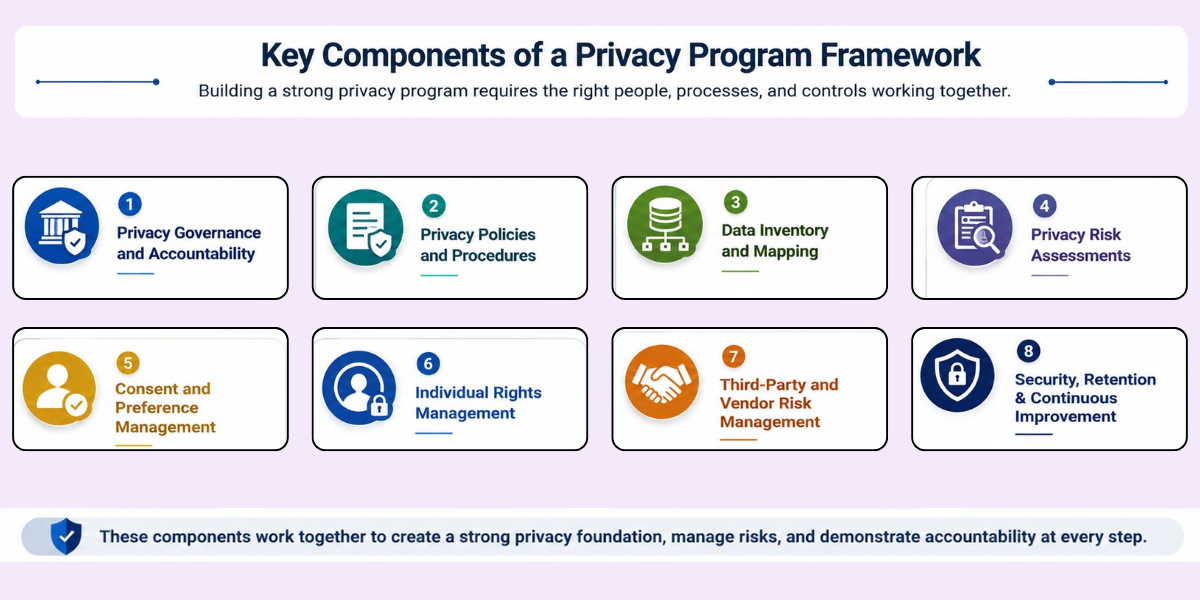
1. Privacy Governance and Accountability
Every privacy program begins with clear ownership.
Define executive sponsorship, assign privacy responsibilities, establish governance committees where appropriate, and clarify decision-making authority. Whether led by a Data Protection Officer (DPO), privacy office, or cross-functional team, accountability should be clearly documented.
2. Privacy Policies and Procedures
Policies establish organizational expectations.
Procedures explain how those expectations are implemented in daily operations. Together, they provide consistent guidance for employees handling personal data across different business functions.
3. Data Inventory and Data Mapping
You cannot protect data you cannot find.
Maintain an accurate inventory of personal data and document how information moves across systems, departments, vendors, and business processes. Data inventories and data maps provide the operational foundation for many other privacy activities.
4. Privacy Risk Assessments
Identify high-risk processing before implementation.
Conduct Privacy Impact Assessments (PIAs) or Data Protection Impact Assessments (DPIAs) where appropriate to evaluate risks, assess mitigation measures, and support informed decision-making.
5. Consent and Preference Management
Where consent serves as the legal basis for processing, organizations should establish mechanisms to obtain, manage, record, and withdraw consent consistently.
Effective consent management also strengthens transparency and customer confidence.
6. Individual Rights Management
Modern privacy laws provide individuals with rights over their personal data.
Organizations should implement documented processes for handling requests such as access, correction, deletion, portability, and consent withdrawal within applicable legal timelines.
7. Third-Party and Vendor Risk Management
Privacy responsibilities do not end at organizational boundaries.
Evaluate vendors, processors, and service providers before sharing personal data. Include contractual privacy obligations and monitor ongoing compliance throughout the relationship.
8. Security and Incident Response
Privacy and cybersecurity operate as complementary disciplines.
Implement administrative, technical, and organizational safeguards while maintaining documented breach response procedures that align with applicable legal requirements.
9. Data Retention and Secure Disposal
Retaining data indefinitely increases unnecessary risk.
Define retention schedules based on legal, regulatory, and business requirements, then securely dispose of information that is no longer needed.
10. Privacy Training and Awareness
Even the strongest policies cannot compensate for uninformed employees.
Deliver regular privacy awareness training tailored to employee responsibilities and reinforce privacy expectations through ongoing communication.
11. Monitoring, Auditing, and Continuous Improvement
A privacy program should evolve alongside the business.
Conduct periodic reviews, monitor compliance activities, evaluate emerging regulatory developments, and update controls as organizational risks change.
A successful privacy program starts with a clear understanding of your current privacy posture.
Explore our Privacy Assessment Services ↗ to identify gaps and build a stronger privacy program.
How to Build a Privacy Program Framework
Building a Privacy Program Framework requires a structured, phased approach. Organizations should begin with governance and regulatory understanding before implementing operational processes, monitoring controls, and continuous improvement activities.
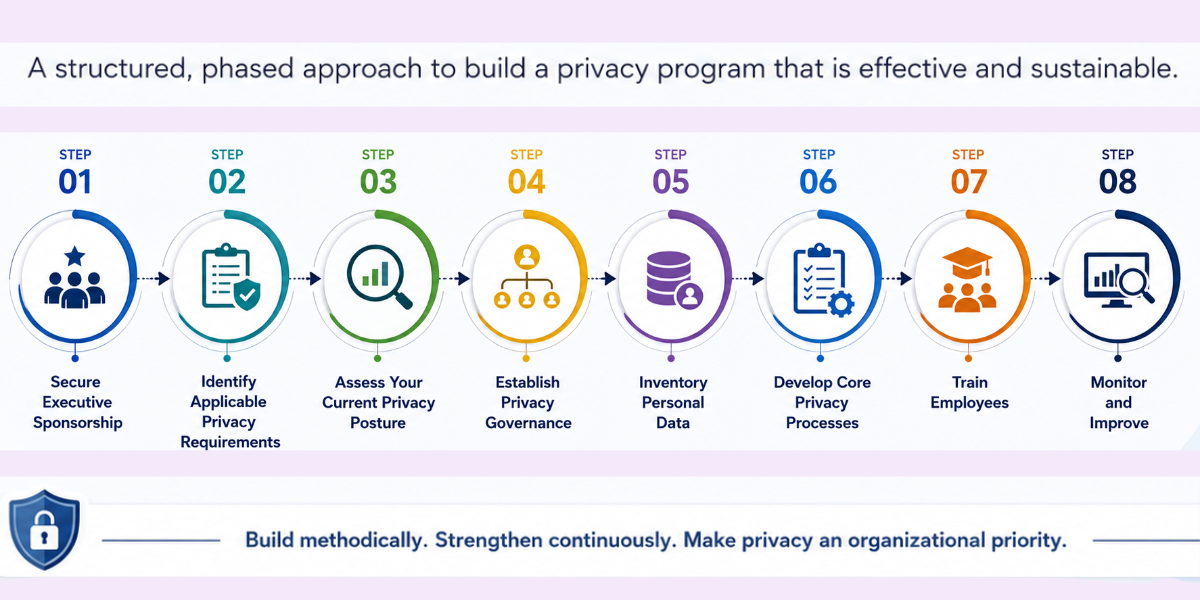
Trying to implement every privacy process simultaneously is like constructing the roof before laying the foundation. Build methodically. Strengthen continuously.
Step 1. Secure Executive Sponsorship
Privacy programs succeed when leadership actively supports them.
Obtain executive commitment, define organizational objectives, and allocate appropriate resources for implementation.
Step 2. Identify Applicable Privacy Requirements
Determine which regulations, contractual obligations, and industry standards apply to your organization.
These may include the DPDP Act, GDPR, ISO/IEC 27701, sector-specific regulations, or customer contractual requirements.
Step 3. Assess Your Current Privacy Posture
Perform a baseline assessment.
Evaluate existing policies, governance structures, technical controls, operational processes, vendor management practices, and employee awareness to identify gaps.
Step 4. Establish Privacy Governance
Define organizational roles, reporting structures, responsibilities, and decision-making processes.
Effective governance ensures privacy becomes an organizational responsibility rather than an isolated legal function.
Step 5. Inventory Personal Data
Document what personal data is collected, where it resides, why it is processed, who accesses it, and how it flows across internal and external systems.
This information supports nearly every other privacy activity.
Step 6. Develop Core Privacy Processes
Implement operational procedures covering:
- Data subject rights
- Consent management
- Privacy notices
- Risk assessments
- Vendor reviews
- Data retention
- Incident response
Standardized processes improve consistency across departments.
Step 7. Train Employees
Privacy programs depend on people as much as technology.
Provide role-based training so employees understand their responsibilities and recognize privacy risks during everyday activities.
Step 8. Monitor and Improve
Privacy compliance is not a destination.
Conduct periodic audits, review privacy metrics, monitor regulatory developments, and continuously refine the program to address evolving risks and business changes.
Conclusion
A strong Privacy Program Framework is more than a compliance initiative—it is the foundation of responsible data governance. It provides the structure needed to manage personal data consistently, demonstrate accountability, and respond confidently to changing regulatory expectations.
Organizations that invest in a structured privacy program are better positioned to reduce risk, strengthen stakeholder trust, and support sustainable business growth. As privacy regulations continue to evolve, the organizations that succeed will not be those with the most documents, but those with the most disciplined governance.
The blueprint matters. Build it thoughtfully, maintain it continuously, and let privacy become a strategic capability rather than a recurring compliance challenge.
Key Takeaways
- A Privacy Program Framework provides a clear structure for managing data privacy across your organization.
- It helps improve compliance, reduce privacy risks, and build trust with customers and stakeholders.
- A strong privacy program includes governance, policies, data management, risk assessments, security, training, and continuous monitoring.
- Building a privacy program starts with leadership support and grows through well-defined processes and regular improvements.
- Privacy is an ongoing business responsibility, not a one-time compliance exercise.
- A well-managed privacy program helps organizations stay compliant, protect personal data, and support long-term business growth.
Related Blog