Table of contents
By-Research Team
December 23, 2025 | 10 min read | DPDP
Rule 11: Processing PwD Data the Right Way
Introduction
The DPDP Act is redefining data privacy in India, raising the bar for every organisation - because protecting personal data has never been more important
Protecting this personal data becomes an even serious matter when the Data Principal is a person with disability (PwD).
Disabilities can affect decision-making capacity. Vulnerability rises when sensitive disability-related information is processed. That is why the DPDP Rules add special safeguards.
Rule 11 requires verifiable consent from a lawful guardian before processing personal data of a PwD who cannot make legally binding decisions.
It defines who counts as a PwD with impaired legal capacity, who may lawfully give consent on their behalf, and what evidence suffices for verification.
Scope - Who Is Covered
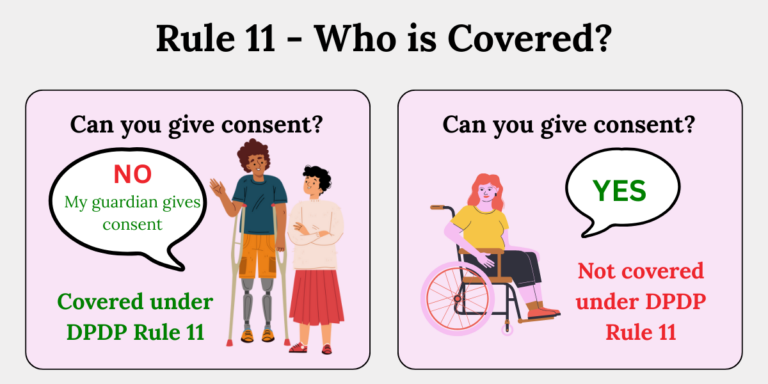
Rule 11 applies when a person with disability:
- Cannot make a legally binding decision, even with support, and
- Has a lawful guardian appointed under an applicable law.
This includes cases such as:
- Severe cognitive or developmental conditions
- Profound intellectual disability
- Situations where a court or authorised body has already determined legal incapacity
Important
PwD who can provide valid consent - independently or with support - do not fall under Rule 11.
The trigger is inability to make a legally binding decision.
Who Can Give Consent
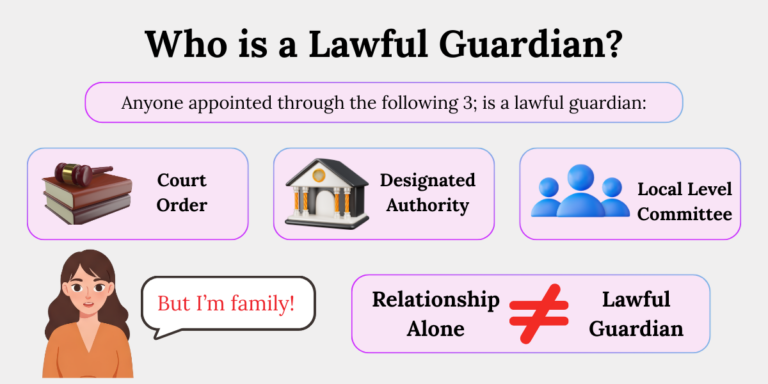
Only one entity is legally valid here: The lawful guardian of the person with disability.
A lawful guardian is someone appointed through:
- A court order, or
- A designated authority, or
- A local-level committee empowered under an applicable guardianship statute.
This is not merely relational consent.
Family members, caregivers, or well-wishers cannot provide consent unless legally appointed.
Essentials of Consent - what makes it valid
Consent under Rule 11 is not a checkbox. It must meet legal essentials and be provided by the lawful guardian only.
- Informed: The guardian must understand the purpose, scope, retention, and any sharing of the PwD’s personal data.
- Specific: Consent must cover clearly itemised processing activities - not vague or omnibus approvals.
- Freely given: The guardian must give consent without coercion.
- Unambiguous & affirmative: The guardian must take a clear action to consent (signed form, recorded statement, authenticated electronic consent).
- Timely & revocable: The guardian may withdraw consent later; the DF must honour revocation subject to lawful constraints.
Compliance Tip
Always capture what the guardian agreed to and why. Never infer consent from relationship or presence.
Verifiable Consent - What It Means Under Rule 11
Verifiable consent under Rule 11 imposes a duty of active verification. The Data Fiduciary must confirm the guardian’s legal authority before any processing.
Acceptable Evidence - Examples
- Court guardianship order - e.g., a court order dated and signed that explicitly appoints X as guardian for Y, listing powers and duration. How to verify: Validate court seal, check order serial/date, contact issuing court if doubt exists.
- Designated-authority certificate - e.g., a disability board certificate that names the guardian and states statutory authority.
How to verify: Confirm certificate number against the issuing body’s records or a published registry. - Local committee appointment document - e.g., a village/municipal social welfare committee decision recorded on headed paper.
How to verify: Request committee minutes or official stamp; cross-check with local authority contact. - Government ID + guardianship registry cross-check - e.g., guardian’s gov ID paired with an entry in a central or state guardianship register.
How to verify: Match name, DOB and guardian reference; ensure ID photo matches the presenting person. - Power of attorney with court validation (only if statute recognises POA for guardianship matters).
How to verify: Check POA scope, notarisation and any required judicial approval. - **Medical capacity assessment + temporary guardian order - ** for emergency/short-term guardianships.
How to verify: Get the certified clinician’s report and the accompanying temporary guardianship order.
Evidence quality and provenance
- Prefer original, dated, signed and sealed documents.
- Require secondary corroboration when documents are atypical (e.g., local committee notes).
- Treat digital records as valid only when issued via an authoritative portal and cryptographically verifiable.
Practical Obligations on Data Fiduciaries
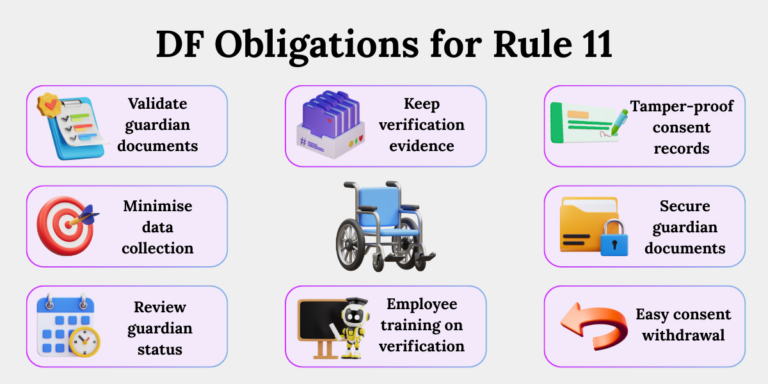
Data Fiduciaries must adopt end-to-end controls. Each obligation below explains what to do and why it matters.
1. Validate Guardian Documents
Require the guardian to share their appointment papers and matching ID, and verify both carefully, because this proves they have the authority to consent and stops anyone from pulling a “trust me bro” impersonation.
2. Keep Verification Evidence
Store the documents, timestamps, and verifier details so you can show regulators solid proof of due diligence later - think of it as keeping your receipts because one day, someone will ask.
3. Use Tamper-Proof Consent Records
Capture consent through a signed file, authenticated audio, or secure digital confirmation so no one can argue later that “I never said that”, because a tamper-proof record ends that debate instantly.
4. Secure Guardian Documents
Encrypt the documents, limit who can access them, and log every action so sensitive information stays protected - leaking guardian paperwork is basically the “final boss” of data mistakes.
5. Allow Easy Consent Withdrawal
Give guardians a simple way to change or withdraw consent and act on it quickly, because consent is not a one-time vow; it’s more like a subscription - they should be able to cancel anytime.
6. Train Staff on Verification
Teach your teams how to identify valid guardianship documents and when to escalate doubts, because untrained staff can approve anything… and we do not want “guess-based compliance.”
7. Review Guardian Status Regularly
Check guardianship details periodically or after legal updates, since appointments can expire or change - and nothing is more awkward than relying on a guardian who stopped being a guardian last year.
8. Minimise PwD Data Collection
Collect only what is necessary for the service, because the less data you store, the less you risk - minimal data, minimal drama.
Think of Rule 11 as a security checkpoint - only verified guardians get a pass.
Legal Risks and Liability Exposure
Non-compliance creates layered legal, financial and reputational risks.
1. Invalid consent = unlawful processing
If the guardian isn’t legally appointed, the entire processing becomes unlawful, forcing the Data Fiduciary to stop immediately, possibly delete the data, and face corrective orders - basically the DPDP equivalent of “start over, but properly this time.”
2. Regulatory action for weak verification
When a Data Fiduciary cannot show proper verification logs, regulators can issue compliance notices, order audits, or impose fines, because “trust me, we checked” is not an acceptable legal argument.
3. Penalties for processing without valid consent
Processing data without proper guardian consent invites monetary penalties and mandated operational fixes, turning a simple oversight into an expensive lesson no CFO wants to repeat.
4. Reputational damage
Any misuse or mishandling of PwD data can erode public trust and attract negative attention, causing customers to walk away faster than you can say “we’re investigating the issue.”
5. Higher liability when disability data causes harm
Because disability-related data is sensitive and misuse can lead to discrimination or emotional harm, the Data Fiduciary may face intense regulatory scrutiny and even civil claims - not the kind of “going viral” anyone wants.
The Critical Threshold
If you rely on a guardian’s consent without verifying legal appointment, you expose your organisation to avoidable enforcement action.
Practical Implementation Challenges
Each challenge below is a real operational friction point. Frame them as checkpoints.
1. Fragmented guardianship pathways
Courts, designated authorities and local committees all issue different guardianship documents in different formats, forcing verification teams to juggle wildly inconsistent proofs and metadata - basically the “assorted snacks” pack of legal paperwork.
2. No central guardianship registry
Because many jurisdictions lack a single authoritative registry, Data Fiduciaries must rely on slow manual checks, which delays onboarding and inflates effort - the compliance equivalent of searching for a file named “final_final_v3.pdf” across ten folders.
3. Over-rigid verification may exclude PwDs
Strict documentation requirements can unintentionally block genuine guardians who use lawful but less formal appointment mechanisms, meaning PwDs may lose access to essential services - a classic case of “rules so tight they end up locking out the right people.”
4. Staff confusion and inconsistent decisions
When frontline teams aren’t properly trained, they may approve weak documents or reject valid ones, creating inconsistent user experiences and legal risk - like letting the wrong person into a club while the VIP waits outside wondering why their name isn’t on the list.
5. Security risks of guardian documents
Guardianship records are highly sensitive and attractive to attackers, so any breach can severely harm the PwD and trigger stricter regulatory action - imagine dropping a box labelled “TOP SECRET” in the middle of a busy street and hoping no one peeks.
6. Changing laws and regional differences
Since guardianship laws vary across states and evolve over time, Data Fiduciaries must constantly update their internal policies or risk accidental non-compliance - because in the legal world, “I didn’t get the update” is not a valid excuse.
Conclusion
While Rule 11 brings real operational challenges - from fragmented documentation to evolving guardianship standards - these hurdles do not reduce its importance. They simply underline why protecting the personal data of PwDs requires care, precision and verified consent at every step.
In the end, getting Rule 11 right isn’t just about staying compliant; it’s about upholding dignity, trust and the responsibility to do the right thing, the right way.
Key Takeaways
- The DPDP Act protects everyone’s data, and PwDs need extra safeguards because they may not always be able to make legal decisions.
- Rule 11 creates a clear system for taking consent from a PwD’s lawful guardian.
- Rule 11 applies only when a PwD cannot make legally binding decisions and has an appointed guardian.
- Only a legally appointed guardian can give consent - not family members or caregivers without formal authority.
- Consent must be clear, specific, informed and revocable, and must stay within the guardian’s legal powers.
- Data Fiduciaries must verify the guardian’s authority using reliable documents or registry checks.
- Organisations must check documents, keep secure records of verification and re-validate guardianship over time.
- Ignoring Rule 11 can result in unlawful processing, penalties, reputational damage and legal claims.
- Proper implementation needs standardised evidence rules, structured checks, trained staff, secure systems and easy processes for guardians.