Table of contents
By-Research Team
July 28, 2026 | 7 min read | Privacy
Privacy Audit: A Practical Compliance Guide
Organizations invest significant time and resources in developing privacy policies, implementing consent mechanisms, and deploying security controls. Yet, many discover compliance gaps only after a regulatory inquiry, customer complaint, or data breach. The issue often isn't the absence of policies—it's the absence of verification.
That's where a privacy audit becomes essential.
Rather than assuming compliance, it provides a structured way to evaluate whether your organization is handling personal data as intended. Whether you're preparing for privacy audit under DPDP requirements or strengthening your overall privacy governance, a well-planned audit helps identify risks before they become regulatory or operational problems.
This privacy audit guide explains what a privacy audit is, why it matters, how to prepare for one, and includes a practical privacy audit checklist you can use to evaluate your organization's privacy practices.
What Is a Privacy Audit?
A privacy audit is a systematic assessment of how an organization collects, uses, stores, shares, secures, and deletes personal data. It verifies whether data handling practices align with applicable privacy laws, internal policies, and documented procedures while identifying compliance gaps.
Think of it as comparing a completed building to its blueprint—not just checking whether the plans exist, but confirming they've been followed.
Unlike a security assessment, a privacy audit evaluates the entire data lifecycle, including governance, consent management, access controls, data retention, third-party data sharing, and incident response to ensure privacy obligations are being effectively met.
Why Conduct a Privacy Audit?
A privacy audit helps organizations identify compliance gaps, validate privacy controls, reduce operational risks, and demonstrate accountability. Rather than reacting to privacy incidents, organizations can proactively assess their data handling practices and strengthen compliance before issues arise.
Privacy obligations continue to evolve. New business processes, cloud applications, vendors, and employee practices can introduce privacy risks over time. Without periodic reviews, these changes often remain unnoticed.
How to Prepare for a Privacy Audit?
Successful privacy audits begin long before the first document is reviewed. Preparation involves defining the audit scope, identifying stakeholders, gathering relevant documentation, and establishing clear objectives. A structured privacy audit framework ensures the assessment is organized, consistent, and focused on meaningful outcomes.
Without preparation, audits quickly become overwhelming. Teams chase documents, responsibilities become unclear, and important risks can easily be overlooked.
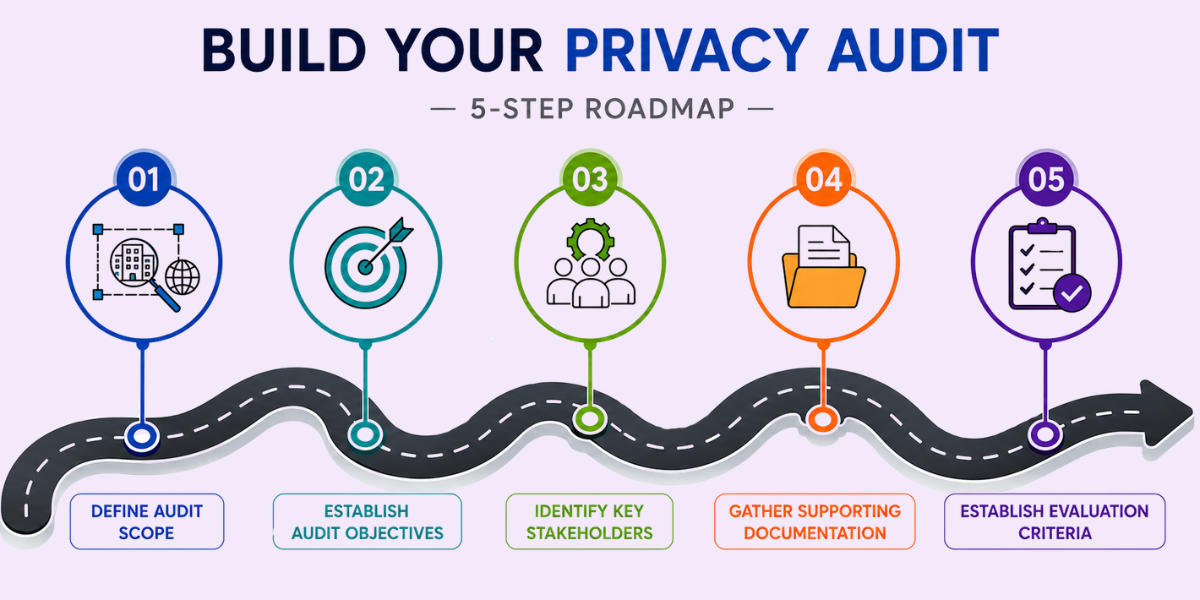
Build your audit using the following roadmap.
1. Define the Audit Scope
Start by determining exactly what the audit will cover, including the business units, applications, systems, categories of personal data, third-party processors, and geographic locations involved. A clearly defined scope keeps the audit focused, prevents unnecessary effort, and ensures critical areas are not overlooked.
2. Establish Audit Objectives
Define what you want the audit to achieve before the assessment begins. Whether the goal is to verify compliance, evaluate privacy controls, assess vendor practices, identify compliance gaps, or improve governance, clear objectives help prioritize activities and measure the audit's success.
3. Identify Key Stakeholders
Privacy responsibilities extend across multiple departments, making cross-functional participation essential. Involve teams such as Legal, Information Security, IT, HR, Marketing, Operations, and Procurement to gain a complete understanding of how personal data is collected, processed, shared, and protected throughout the organization.
4. Gather Supporting Documentation
Collect the documents required to evaluate your organization's privacy practices, such as privacy notices, consent records, data flow diagrams, retention policies, vendor agreements, incident records, and access logs. While documentation provides valuable evidence, it should always be validated against actual operational practices.
5. Establish Evaluation Criteria
Define consistent criteria for assessing audit findings, such as compliant, partially compliant, or non-compliant. Standardized evaluation makes it easier to compare observations, prioritize risks, and develop an effective remediation plan based on the severity of each finding.
Need help evaluating your organization's privacy readiness?
Explore our Privacy Assessment Services ↗ to identify compliance gaps, evaluate your privacy controls, and build a practical roadmap for stronger privacy governance.
Privacy Audit Checklist
A privacy audit checklist provides a structured way to evaluate whether privacy controls, documentation, and operational practices are functioning as intended. It helps organizations conduct audits consistently while ensuring that critical compliance areas are not overlooked.
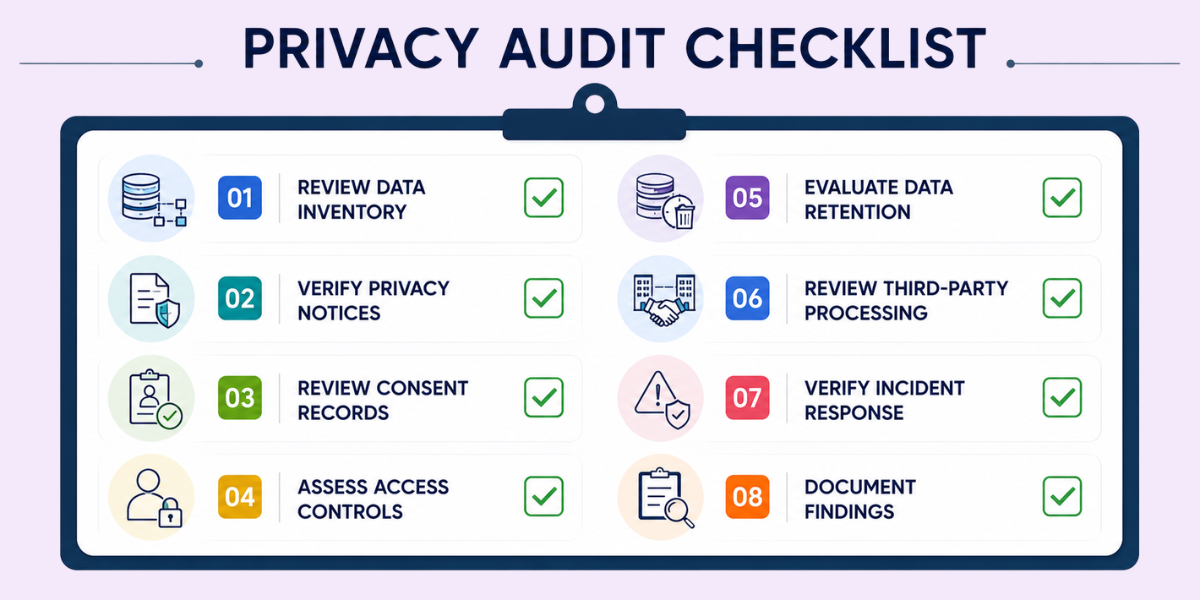
Use the following checklist during your next privacy audit.
1. Review Data Inventory
Confirm that all categories of personal data are identified, documented, and mapped across systems.
2. Verify Privacy Notices
Ensure privacy notices accurately describe how personal data is collected, used, shared, and retained.
3. Review Consent Records
Confirm valid consent records are maintained where applicable and can be demonstrated when required.
4. Assess Access Controls
Verify that employees only have access to personal data necessary for their responsibilities.
5. Evaluate Data Retention
Confirm personal data is retained only for as long as necessary and securely deleted afterward.
6. Review Third-Party Processing
Assess whether vendors handling personal data operate under appropriate contractual agreements and security obligations.
7. Verify Incident Response
Review whether privacy incidents can be detected, investigated, documented, and escalated effectively.
8. Document Findings
Record observations, supporting evidence, identified risks, and recommended corrective actions for every audit finding.
Common Mistakes to Avoid During a Privacy Audit
Privacy audits are most effective when they evaluate actual practices rather than relying solely on documentation. Avoiding common mistakes improves the accuracy of findings and helps organizations identify meaningful opportunities for improvement.
Even well-planned audits can lose effectiveness if they focus only on paperwork.
Avoid these common mistakes.
1. Treating Policies as Proof of Compliance
Policies establish expectations. Audits should verify whether employees and systems consistently follow them.
2. Ignoring Third-Party Processing
Privacy obligations don't end when data leaves your organization. Vendor practices should also be evaluated.
3. Reviewing Documents Without Testing Controls
Validate implementation by reviewing access permissions, deletion processes, consent management, and operational practices.
4. Failing to Prioritize Findings
Not every issue carries the same level of risk. Categorize findings based on business impact and likelihood to support effective remediation.
5. Treating Audits as a One-Time Activity
Privacy risks evolve alongside business operations. Regular audits help organizations maintain ongoing compliance and strengthen governance.
Conclusion
A privacy audit is more than a compliance exercise—it's an opportunity to strengthen your organization's privacy governance. By systematically reviewing data handling practices, validating controls, and addressing identified gaps, organizations can reduce compliance risks and improve operational accountability.
As privacy regulations continue to evolve, periodic audits should become part of every organization's governance strategy rather than a response to regulatory scrutiny. A structured, risk-based approach today can help prevent far more significant compliance challenges tomorrow.
Key Takeaways
- A privacy audit verifies whether your data handling practices align with privacy requirements and internal policies.
- Regular audits help identify compliance gaps before they become regulatory or operational risks.
- A structured audit begins with a clearly defined scope, objectives, stakeholders, and supporting documentation.
- Use a privacy audit checklist to evaluate privacy controls consistently across the organization.
- Validate implementation, not just documentation, to assess actual compliance.
- Review third-party data processing as part of every privacy audit.
- Prioritize audit findings based on risk and implement timely corrective actions.
- Conduct privacy audits periodically to strengthen privacy governance and support continuous compliance.
Related Blog